
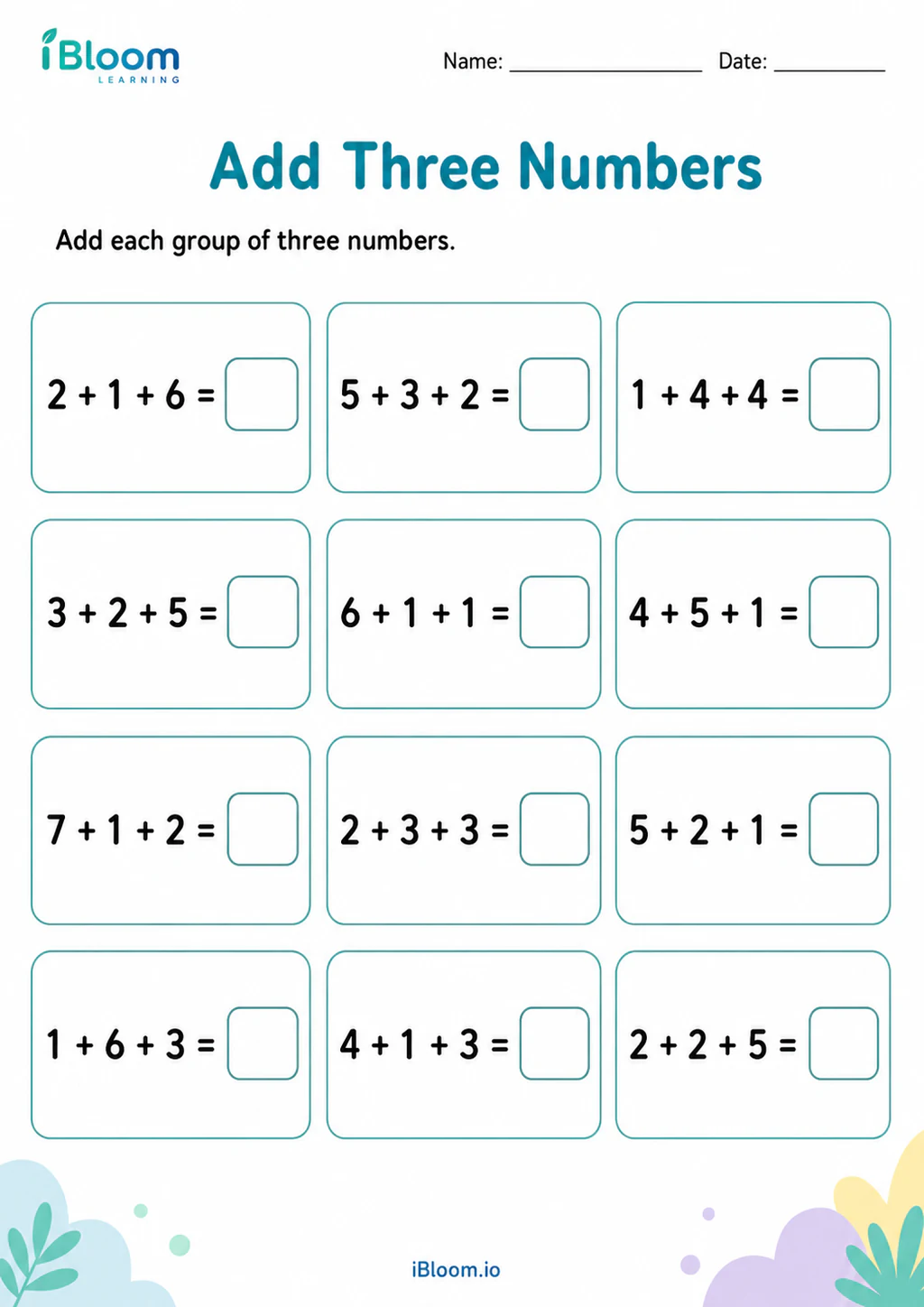
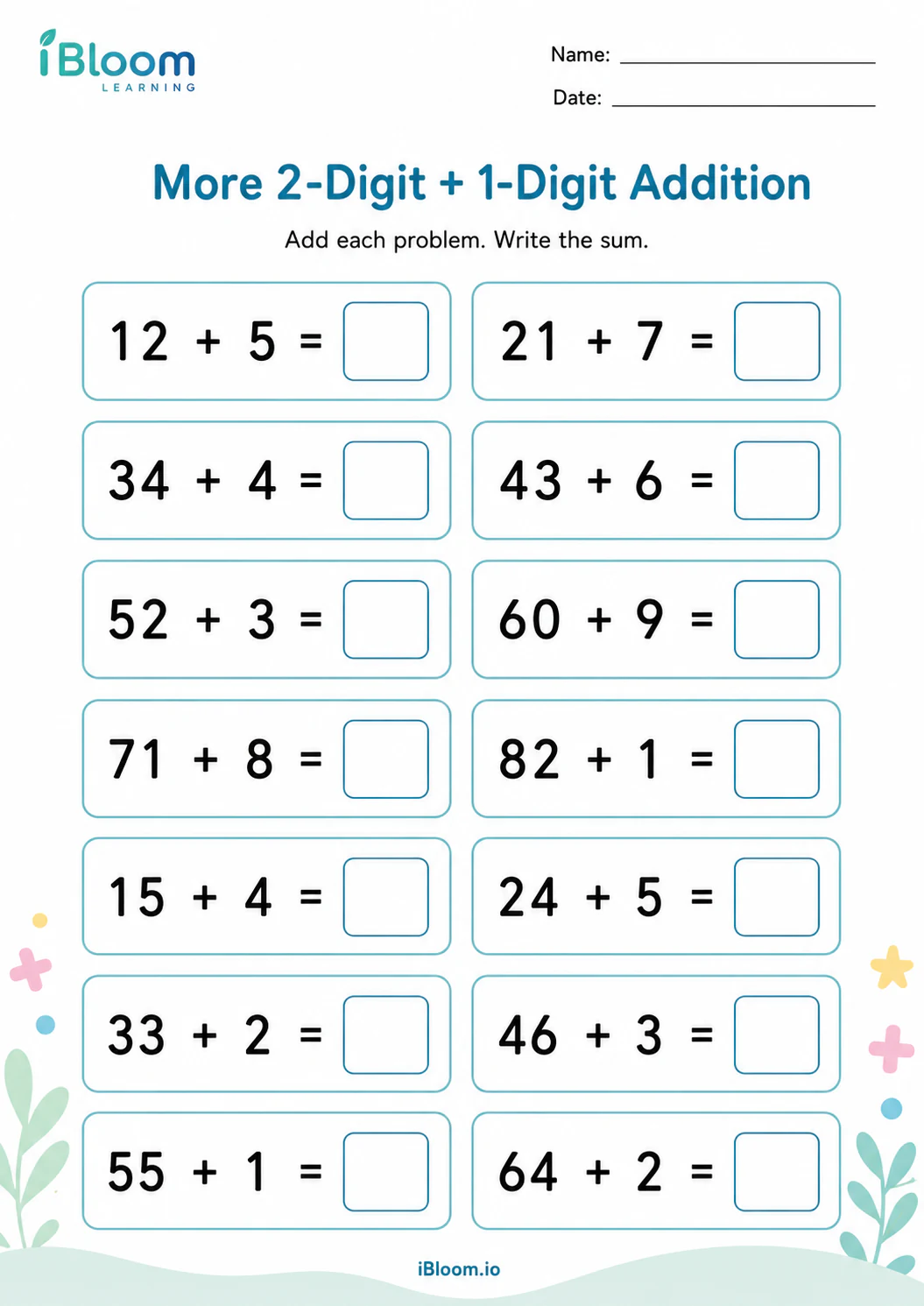
About this worksheet
This Grade 1 printable gives children practice adding three whole numbers with sums no greater than 20. The problems include number sentences and short everyday stories, so learners can represent three amounts with an addition equation and find the total. A separate answer key lists each sum.
How do you add three numbers?
Add two numbers first, then add the third. You can choose the pair that is easiest to combine. In 5 + 1 + 6, add 5 + 1 = 6, then 6 + 6 = 12.
Can making ten help?
Look for two addends that make 10. In 9 + 1 + 4, combine 9 and 1 first, then add 4 to make 14. Part B gives you a chance to spot a useful pair.
- 19 + 1 + 4
- 29 + 1 = 10
- 310 + 4 = 14
How can you check the total?
Add the three numbers in a different order or count on from the sum of a pair. Make sure you included every addend once.
How to use this worksheet
- 1Read all three addends before starting.
- 2Choose two numbers to add first.
- 3Look for a pair that makes ten when it helps.
- 4Add the remaining number to that total.
- 5Check by counting on or changing the order.
Common mistakes and quick fixes
The mistake
Forgetting one addend
The fix
Point to each of the three numbers as you add it.
The mistake
Adding only the first two numbers
The fix
Read the whole number sentence again before writing the answer.
The mistake
Losing count when counting on
The fix
Start from the pair’s sum and say each next number once.
What to practice next
Make more practice
Further reading
Questions parents and teachers ask
How can a first grader add three numbers?
Adding three numbers means combining three amounts to find one total. This worksheet includes number sentences and short stories with three amounts, such as stickers collected at different times. Children can add two amounts first, then add the third, and check each result with the answer key.
Does the printable include an answer key?
Yes. A separate answer key gives the expected answers for checking completed work. For an open-ended response, it offers a sample so an adult can compare the child’s idea without expecting identical wording. Review it after the learner finishes, then discuss any answer that needs another look.
How should I introduce the activity?
Read the short directions together and model one item from the first part. Then let the learner work through the remaining questions at a comfortable pace. Check the key after finishing and talk through one item that felt tricky.
Can a child complete this independently?
A child who knows the skill can try most items independently. An adult can read directions aloud or talk through one example first, then invite the child to explain a choice or check a result. Offer help with directions as needed, and give the learner time to think when useful, too.
How long does this worksheet take?
About 15 minutes. Let the learner pause between parts if needed; careful practice matters more than finishing quickly. A short review afterward can help the child name a strategy that worked. Adults can adjust the pace and reread directions together.