
About this worksheet
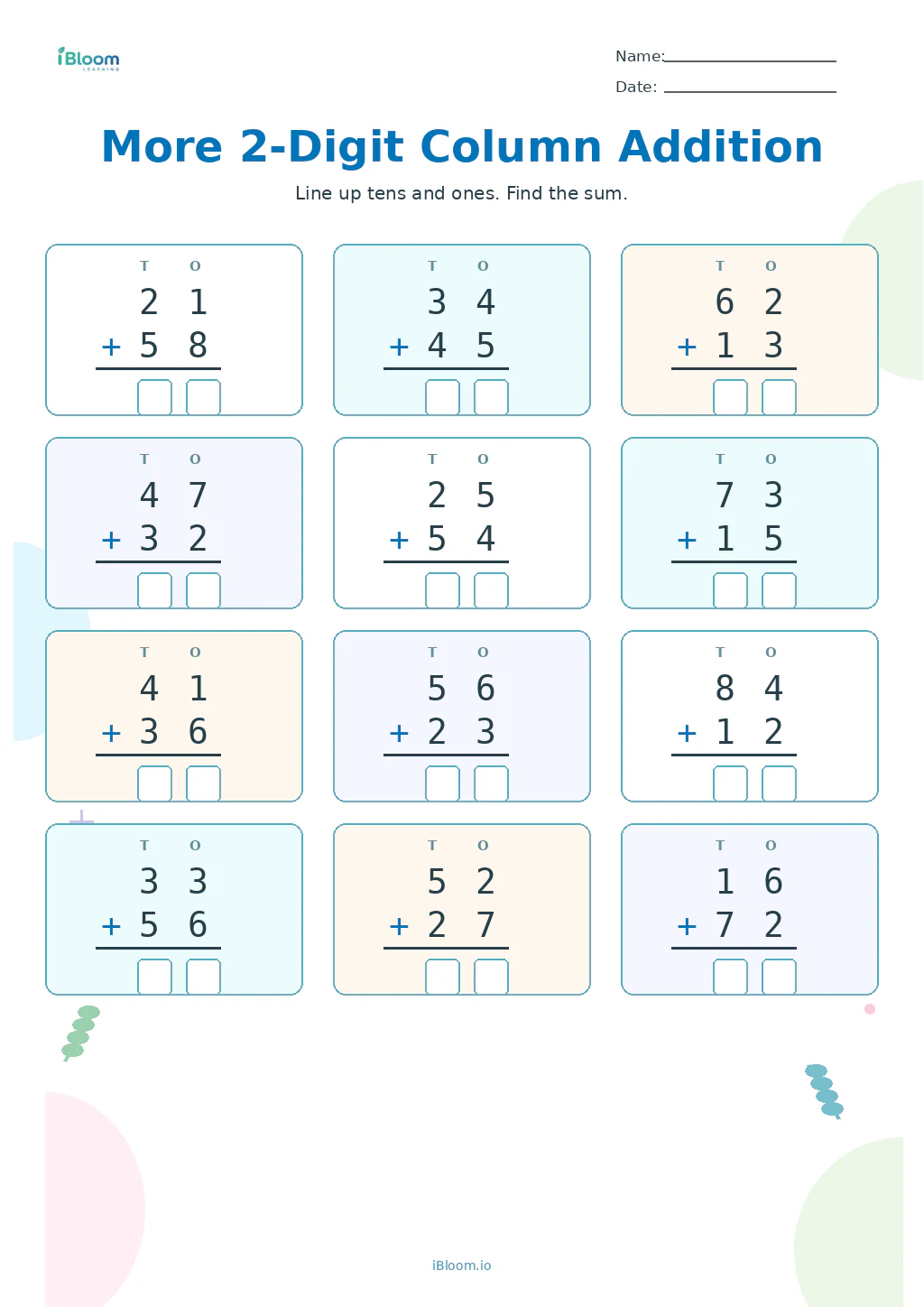
This Grade 1 worksheet gives children 20 two-digit addition problems to solve in columns. Each ones-column total is less than 10, so learners can add the ones and tens separately without making a new ten. The printable set includes a separate answer key and practices the Grade 2 place-value addition standard 2.NBT.B.5.
Aligned to 2.NBT.B.5
Which digits should children add first?
Start with the ones column, then add the tens column. In question 1, 23 + 14 has 3 + 4 = 7 ones and 2 tens + 1 ten = 3 tens, so the sum is 37.
- 1 23
- 2+ 14
- 33 + 4 = 7 ones
- 420 + 10 = 30
- 5Sum: 37
Why keep the digits lined up?
The ones digits belong in one column and the tens digits in the next. If digits drift out of place, a child may combine tens with ones and get a sum that does not match the values.
What is on the practice pages?
The 20 equations use two-digit addends and do not require regrouping. Children can write the sum in the blank, then check a few by adding the tens and ones separately.
How to use this worksheet
- 1Point to the tens and ones in both addends.
- 2Write the numbers with tens above tens and ones above ones.
- 3Add the ones digits and record the ones total.
- 4Add the tens digits and write the full sum.
- 5Check by splitting each number into tens and ones.
Common mistakes and quick fixes
The mistake
Adding digits in different place-value columns
The fix
Line up ones under ones and tens under tens.
The mistake
Adding the tens digits but forgetting their value
The fix
Remember that 2 in the tens place means 20.
The mistake
Writing the ones sum without checking it is less than 10
The fix
Add the ones first and check whether a new ten is needed.
Common Core alignment
This page uses place-value reasoning for two-digit addition.
Add within 100 using place-value and operation strategies.
On this sheet: The two-digit addends are within 100 and each ones-column sum stays below ten.
Show the official wordingHide the official wording
Fluently add and subtract within 100 using strategies based on place value, properties of operations, and/or the relationship between addition and subtraction.
What to practice next
Make more practice
Further reading
Questions parents and teachers ask
What does no regrouping mean?
It means the ones digits add to fewer than 10, so children do not need to trade ten ones for one ten. For example, in 23 + 14, the ones add to 7 and the tens add to 30. Each question on the worksheet follows that pattern.
Which place should children add first?
Start with the ones place, then add the tens. In 23 + 14, add 3 ones and 4 ones to get 7 ones. Then add 2 tens and 1 ten to get 3 tens, making 37. Have the learner point to each place while saying the values aloud before combining them.
Why are the numbers arranged in columns?
Column layout helps children see that ones combine with ones and tens with tens. Encourage your learner to align the digits before adding, then read the sum as a two-digit number. A quick place-value sketch with tens and ones can help make the columns easier to understand.
Does this page include regrouping problems?
No. The problems are written so that the ones digits add to less than ten. That lets children focus on place-value columns and the written addition method without composing a new ten. The ones sums stay below ten, making it possible to focus on lining up place values and recording the total.
Is there an answer key?
Yes. A separate key shows the sum for each of the 20 equations. Children can also check by splitting both addends into tens and ones and adding those parts. Encourage learners to explain how the tens and ones make the total instead of only copying the key.
How long does the worksheet take?
About 15 minutes is a useful estimate for 20 equations. Children may complete one page at a time, explaining how they combined the ones and tens before checking the answer key. A short pause between rows can help keep the columns clear and the sums accurate.