Free printable practice
Number Order Ascend Descend Practice Activities
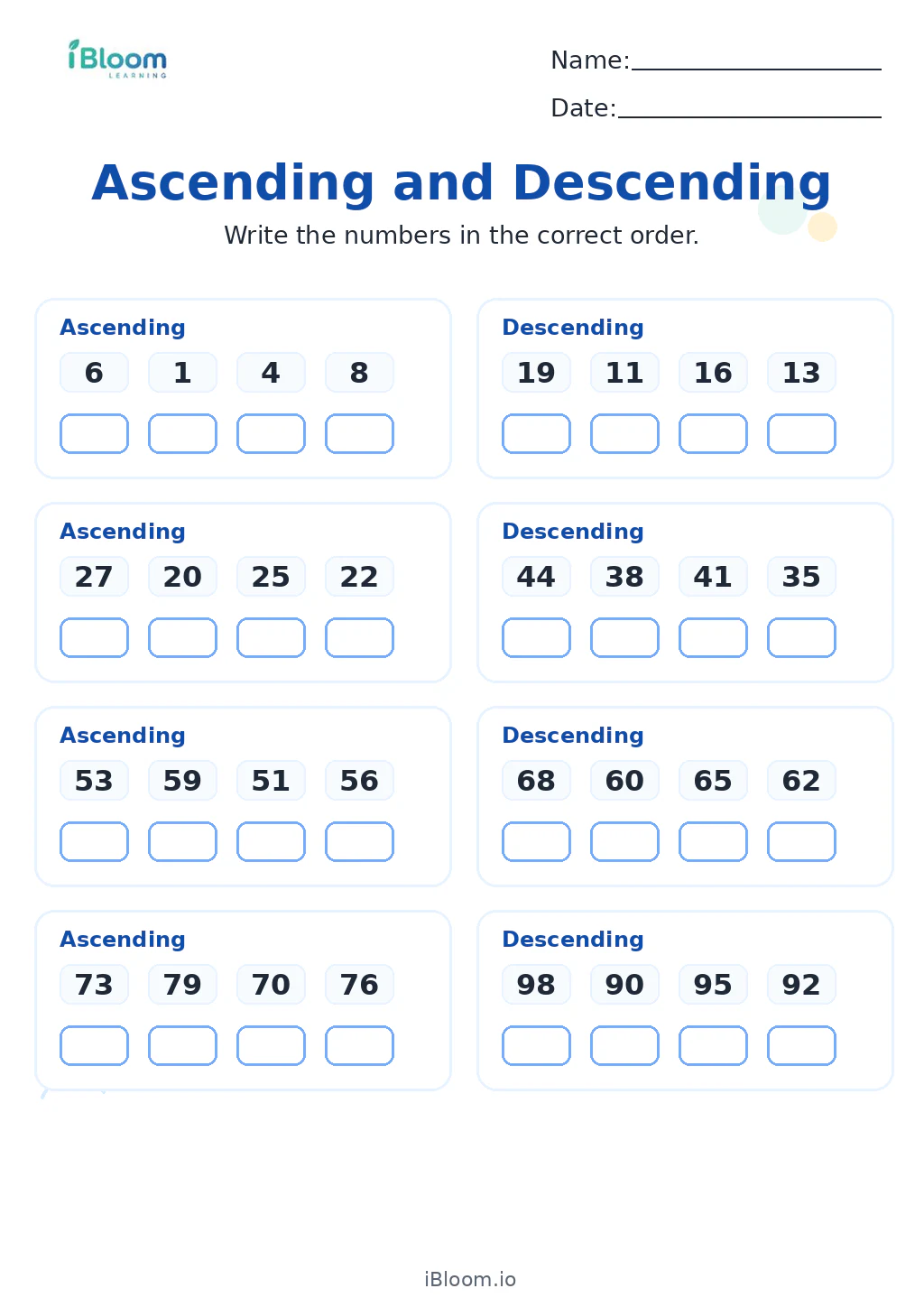
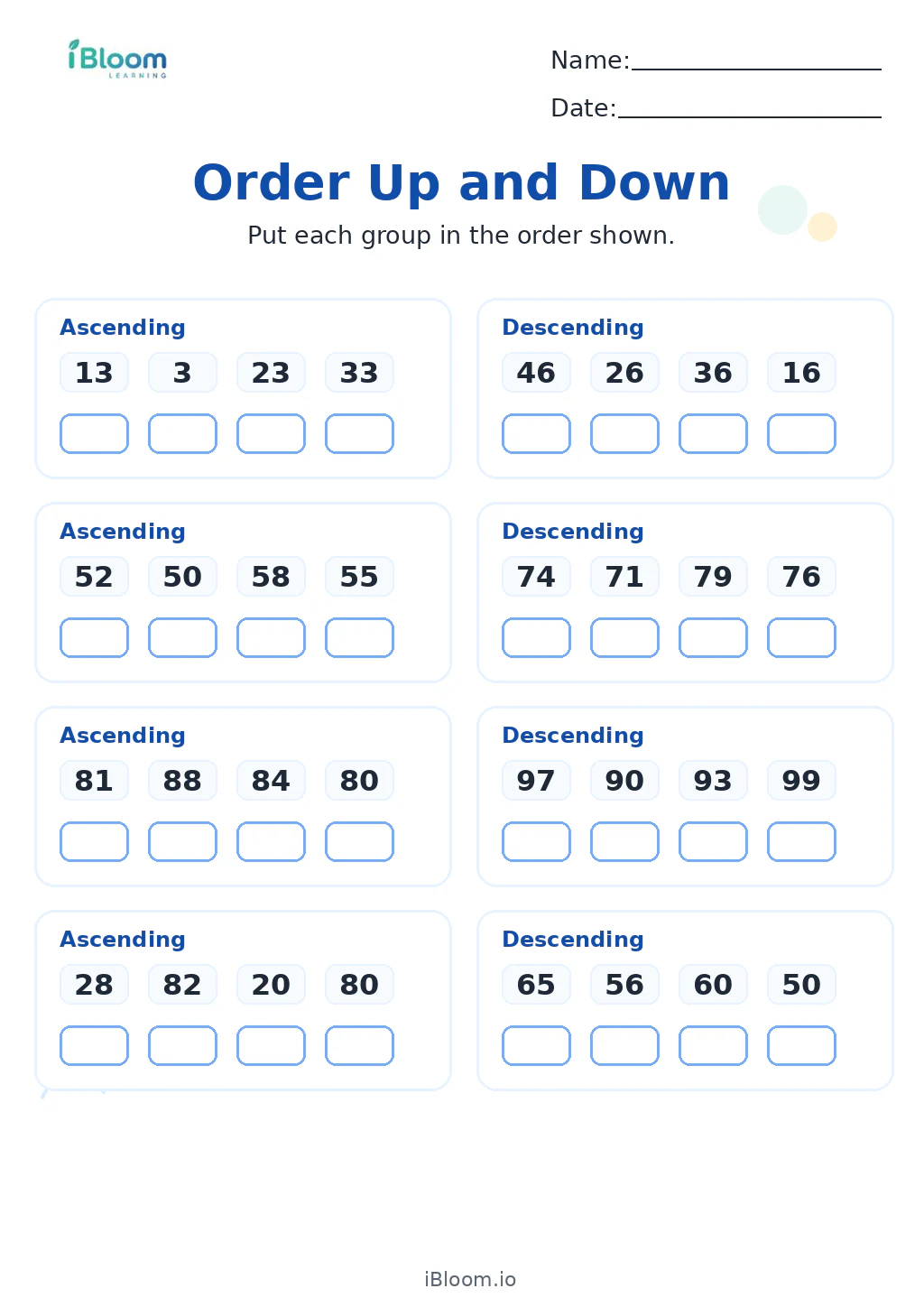
Printable Grade 1 math worksheets for arranging numbers in ascending and descending order using comparison clues and place value.
Free printable worksheet PDFs
Preview every available page, then download the free worksheet PDF for home, homeschool, tutoring, or classroom practice.
Preview the exact activity before downloading it.
Practice that builds confidence
Building the idea of order
These Grade 1 number order worksheets help children practise arranging numbers from least to greatest and greatest to least. Students use comparison language, place value, and careful checking to decide where each number belongs.
The printable activities include ordered lists, mixed number sets, missing-number style tasks, and comparison practice connected to ascending and descending order. They support children who are learning to move beyond simply counting forward and begin reasoning about number size.
Ascending order means numbers go up from the smallest value to the largest value. Descending order means numbers go down from the largest value to the smallest value. In Grade 1, this skill grows from counting sequences into comparing single- and two-digit numbers. Children learn that 27 comes before 34 in ascending order because 2 tens is less than 3 tens, not just because the numbers “look” different.

How the practice progresses
The worksheets begin with manageable sets of numbers and move toward mixed lists where children must compare more than two numbers at once. Some items ask students to rewrite a group of numbers in order; others may include missing spaces or number lines to help them see direction. This supports vocabulary such as least, greatest, before, after, more than, less than, ascending, and descending.
A simple parent routine
At home, ask your child to read every number aloud first. Then have them circle the smallest number for ascending order or the largest number for descending order. Cross off each number as it is placed in the list. After completing a row, ask, “Do the numbers get bigger or smaller?” This quick check helps children notice direction instead of copying numbers randomly.

Classroom uses for teachers
Teachers can use these printables during comparing-numbers lessons, math centers, small-group reteaching, or morning review. They also work well after number line practice because students can connect left-to-right movement with increasing numbers and right-to-left movement with decreasing numbers. For partner work, one child can arrange the numbers while the other explains the order using comparison words.

Common errors to watch for
Some first graders reverse the meanings of ascending and descending, especially when both appear on the same page. Others compare only the ones digit, so they may think 19 is greater than 42 because 9 is greater than 2. Encourage children to compare tens first, then ones. Also watch for skipped numbers when a child rewrites a list without crossing off used numbers.
Free printable PDF download
Use this grade 1 ascending and descending order worksheet page to preview the activity, print it, or download it as a PDF for quick practice. It works well for homework, homeschool lessons, tutoring, morning work, revision, and classroom centers.
Answers and answer key support
After the child completes the worksheet independently, parents and teachers can use the answer support or answer key information to check the work, review mistakes, and choose the next practice step.
Why iBloom worksheets help
These worksheets give repeated, focused practice without adding unrelated skills. Clear number sets, familiar Grade 1 vocabulary, and varied ordering tasks help children build accuracy and confidence. A child-friendly strategy is: “Find the end number first—smallest for up, greatest for down—then place one number at a time.”
Helpful answers
Frequently asked questions
What does ascending order mean for Grade 1 students?
Ascending order means arranging numbers from the smallest to the largest. Children can think of it as numbers going up, like moving forward on a number line.
How is descending order different from counting backward?
Descending order means arranging a given set of numbers from greatest to least. Counting backward follows every number in sequence, while descending order may use a mixed set such as 58, 23, 41, and 10.
What should my child compare first in two-digit numbers?
They should compare the tens digit first. If the tens are the same, then they compare the ones digit to decide which number is greater or smaller.
Why does my child mix up ascending and descending?
The words sound formal and can be confusing at first. Use simple cues: ascending means up from least to greatest, and descending means down from greatest to least.
How can I help my child check an ordered list?
Ask them to read the list from left to right and say whether each next number is bigger or smaller. If the direction changes unexpectedly, they should compare those two numbers again.
Is this grade 1 ascending and descending order worksheet free?
Yes. You can preview it for free and use the printable worksheet for home or classroom practice.
Can I download this grade 1 ascending and descending order worksheet as a PDF?
Yes. Use the worksheet download option to save a printable PDF, or print the worksheet directly from the page.
Does this grade 1 ascending and descending order worksheet include answers or an answer key?
When the activity has fixed answers, iBloom includes answer support so parents and teachers can check the completed worksheet.