
About this worksheet
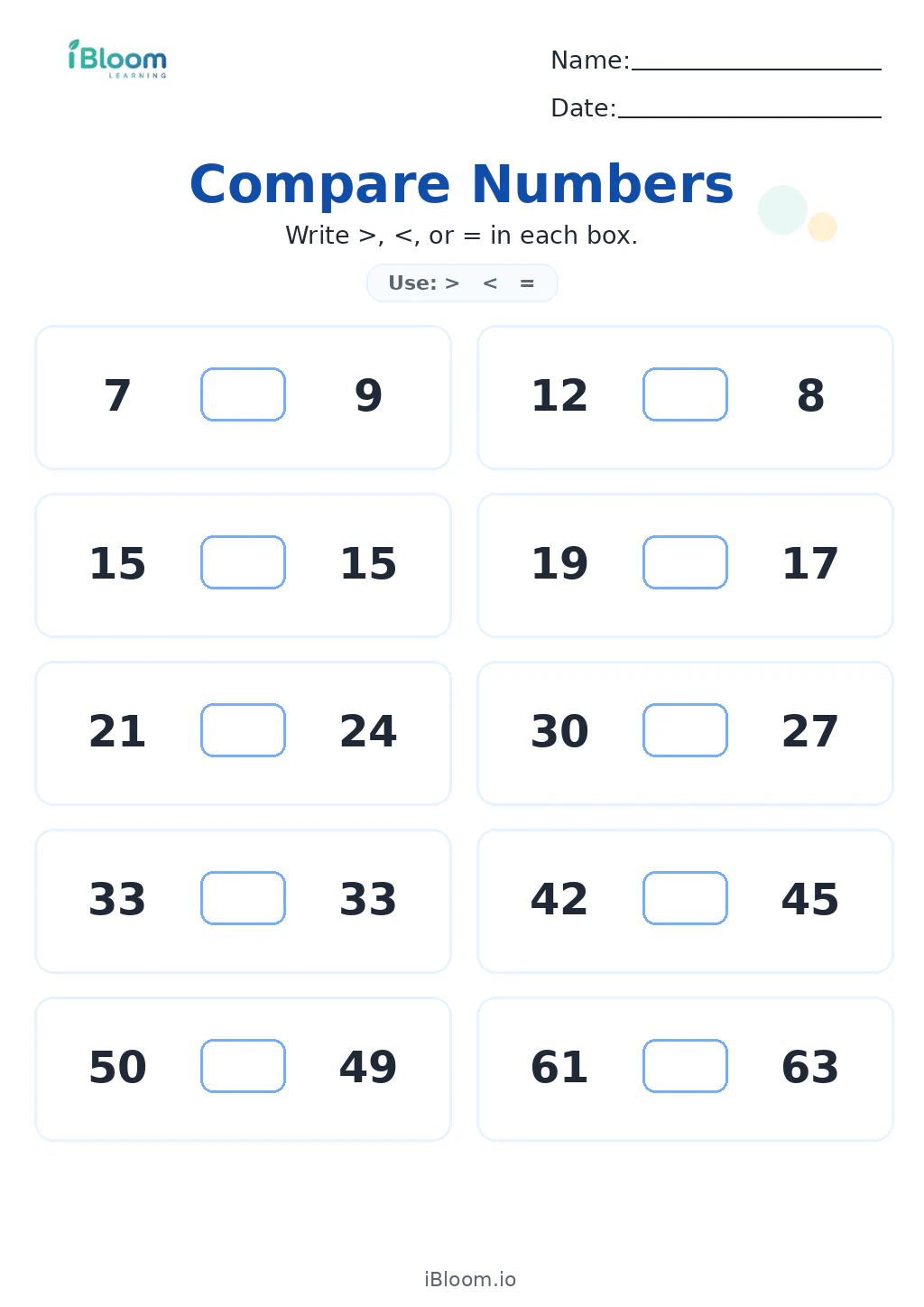
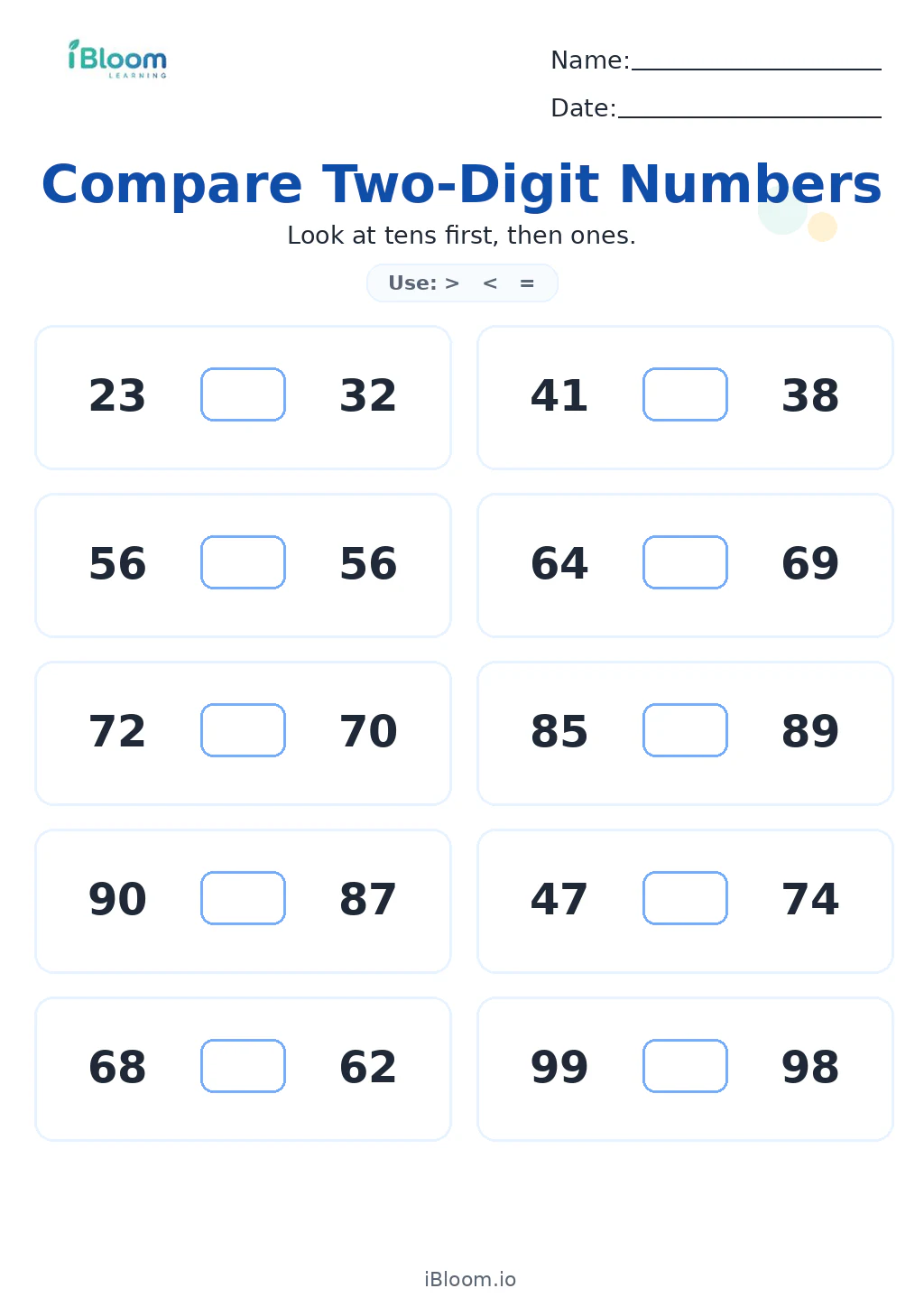
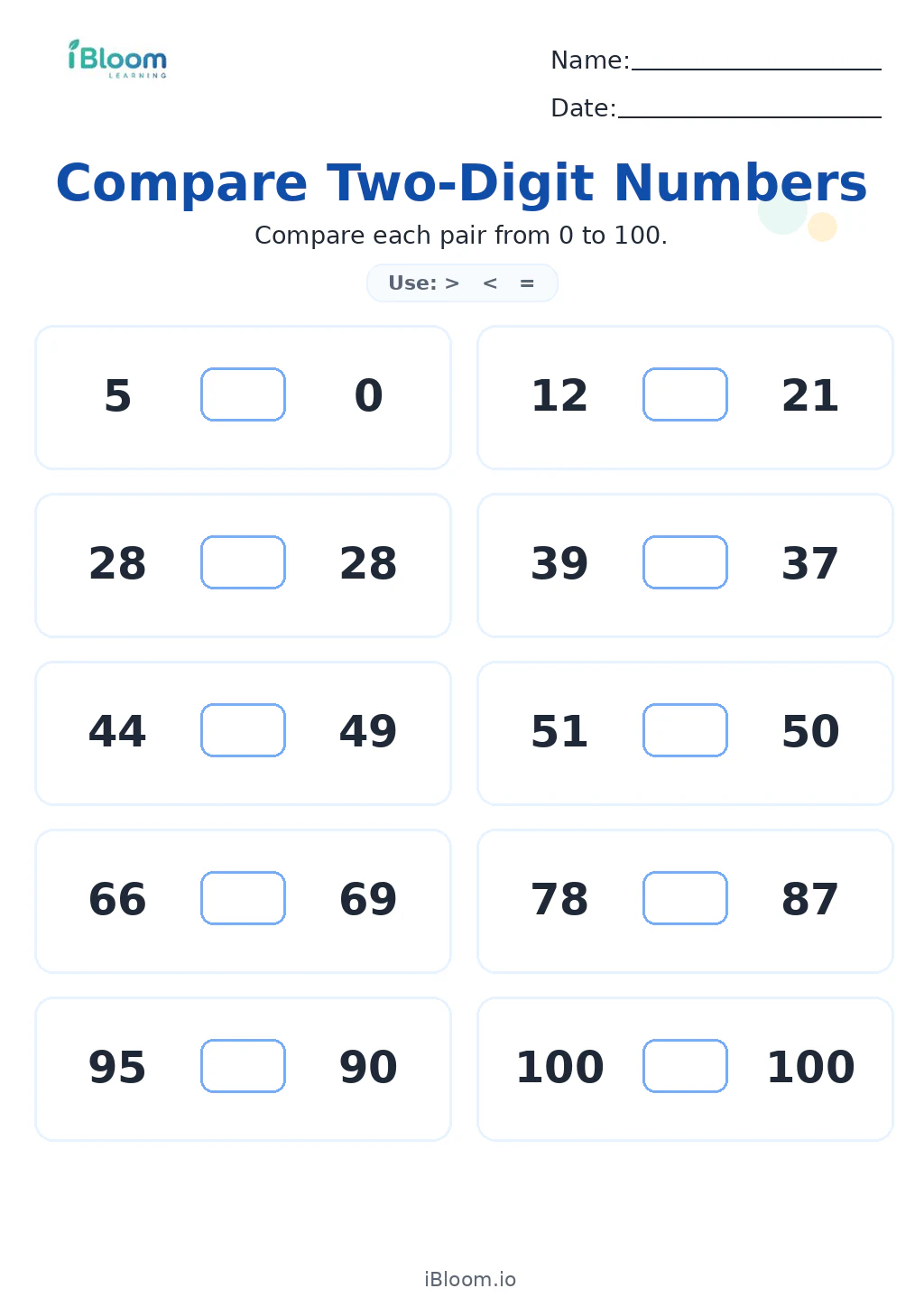
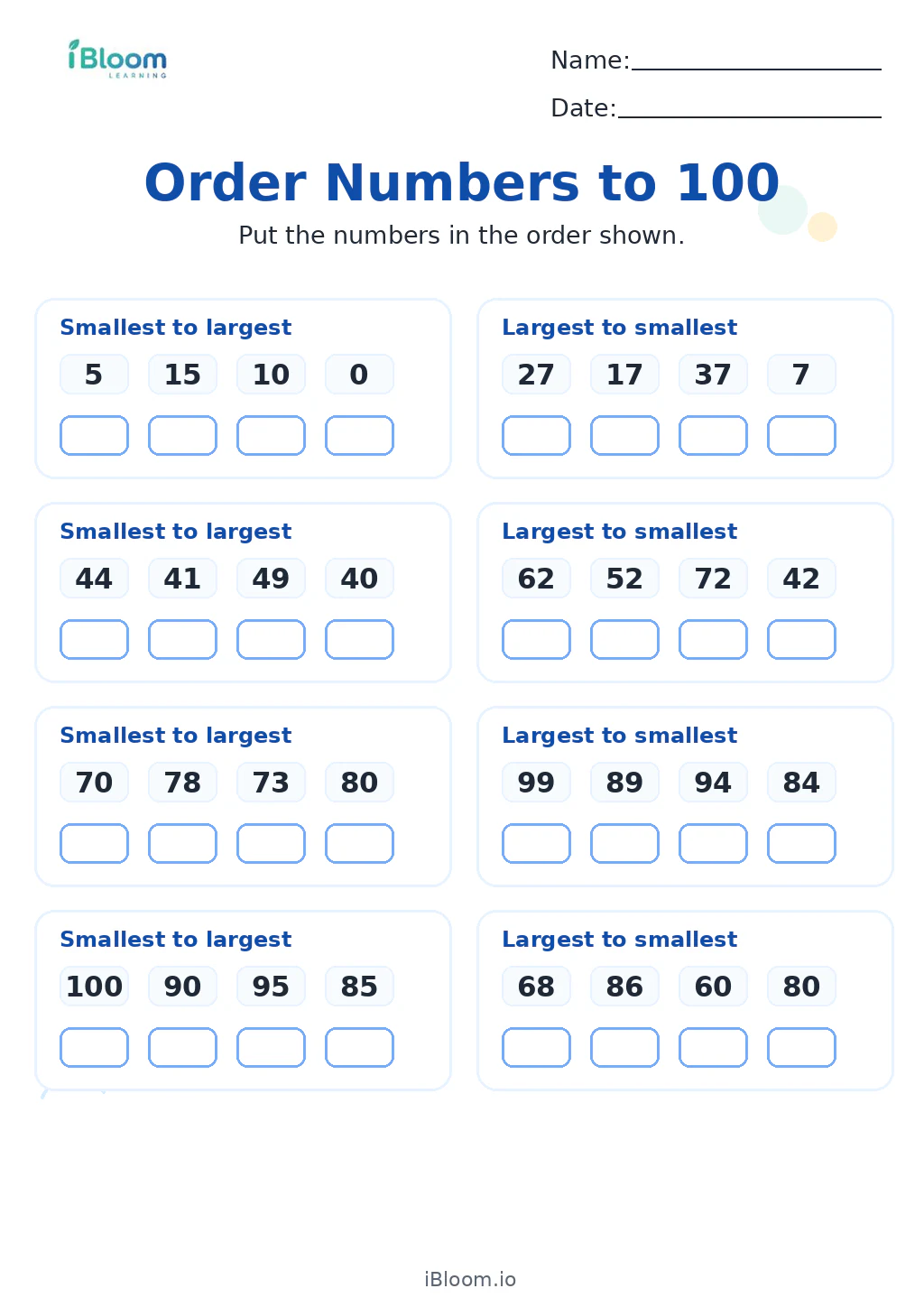
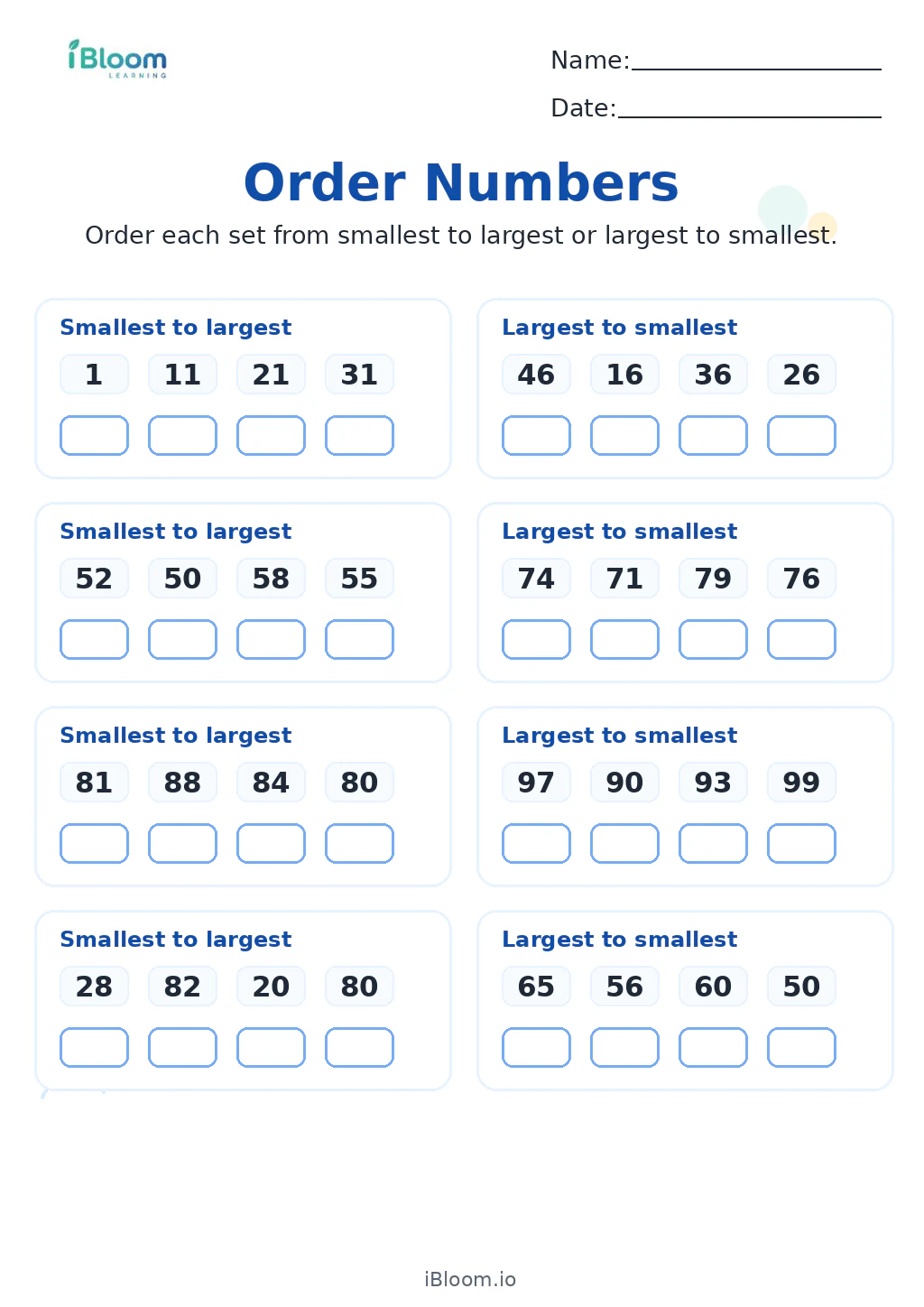
This free Grade 1 worksheet practices ascending and descending order with one- and two-digit numbers. Children arrange eight sets from smallest to largest in Part A and eight sets from largest to smallest in Part B. Part C has four two-digit comparisons using <, >, or =. The 20 questions begin with small numbers, then move to comparing tens and ones. The sheet practices CCSS 1.NBT.B.3 and includes a separate answer key with every ordered set and comparison sign.
Aligned to 1.NBT.B.3
What do ascending and descending mean?
Ascending order moves from the smallest number to the largest. Descending order moves from the largest to the smallest. Have children say the direction before starting each part, then read their completed row from left to right.
Each ordering question contains four numbers. Crossing out a number in the given set after copying it helps a child use each number exactly once.
How do tens and ones decide the order?
Compare tens first. If the tens are equal, compare ones. In question 3, all four numbers have two tens, so the ones digits decide the order. In question 12, compare the tens before the ones: 44 and 41 are greater than 38 and 35.
- 1Given: 22, 29, 24, 21
- 2All have 2 tens. Compare 2, 9, 4, and 1 ones.
- 3The ones go 1, 2, 4, 9.
- 4Ascending order: 21, 22, 24, 29.
How does Part C connect ordering to comparison signs?
The final four questions compare one pair at a time. The open side of < or > faces the greater number. The equals sign means both values are the same. For 47 and 52, four tens is less than five tens, so 47 < 52.
These pair comparisons also provide a way to check an ordered row. In an ascending row, each number should be smaller than the next; in a descending row, each should be greater.
Use the sheet step by step
- 1Read the Part A direction aloud and point to the words smallest and largest.
- 2Order question 1 together: 3, 5, 7, 9, from smallest to largest.
- 3Complete Part A, crossing out each number after copying it.
- 4Read the new Part B direction before starting the descending sets.
- 5Complete Part C, then check each ordered row against the key.
Mistakes to watch for
The mistake
Keeping smallest-to-largest order when Part B begins.
The fix
Pause at the heading and circle largest in the direction; start with the greatest number.
The mistake
Putting 38 before 41 in descending order because 8 is greater than 1.
The fix
Compare tens first: four tens is greater than three tens, so 41 comes before 38.
The mistake
Leaving out a number or writing it twice.
The fix
Match each of the four given numbers to one number in the completed row.
Common Core alignment
Compare two-digit numbers by tens and ones, and record comparisons with <, >, or =.
On this sheet: Children compare tens and ones to order two-digit sets and use all three comparison symbols in Part C.
Show the official wordingHide the official wording
Compare two two-digit numbers based on meanings of the tens and ones digits, recording the results of comparisons with the symbols >, =, and <.
What to practice next
Make more practice
Further reading
Questions parents and teachers ask
How many numbers are in each set?
Each of the sixteen ordering questions has four numbers. Children write all four in the direction named by the part heading. Afterward, they complete four pair comparisons. Have your child check that the answer row includes every original number once before checking whether the order is correct.
Does the sheet start with one-digit numbers?
Yes. The first two ascending sets use one-digit numbers so children can practice the direction with small values. The remaining sets and all four comparisons use two-digit numbers. Compare tens first, then ones when the tens match, and check that each original number appears once in the answer.
What if my child reverses descending order?
Read descending as largest to smallest and find the largest number first. For 18, 12, 15, 10, write 18, then choose the largest number still unused. Continue with 15, 12, and 10. Finally, read the row aloud and check that each number gets smaller.
How do we check the comparison symbols?
Read the complete comparison aloud using less than, greater than, or equal to. For 68 > 61, both numbers have six tens, so eight ones is greater than one one. The open side faces 68. For 35 = 35, both values match exactly, so use the equals sign.
Can we use a number line while working?
Yes. A number line can help your child check which number comes earlier or later. Ask for a tens-and-ones explanation as well, especially for pairs such as 90 and 89. Keep the separate answer key for the final check after your child has tried each set independently.