Free printable practice
Number Charts Practice Activities
Grade 1 number chart worksheets for counting forward and backward, skip counting, number writing, before-and-after numbers, and 1–100 chart fluency.
Explore Number Charts
Free printable worksheet PDFs
Preview every available page, then download the free worksheet PDF for home, homeschool, tutoring, or classroom practice.
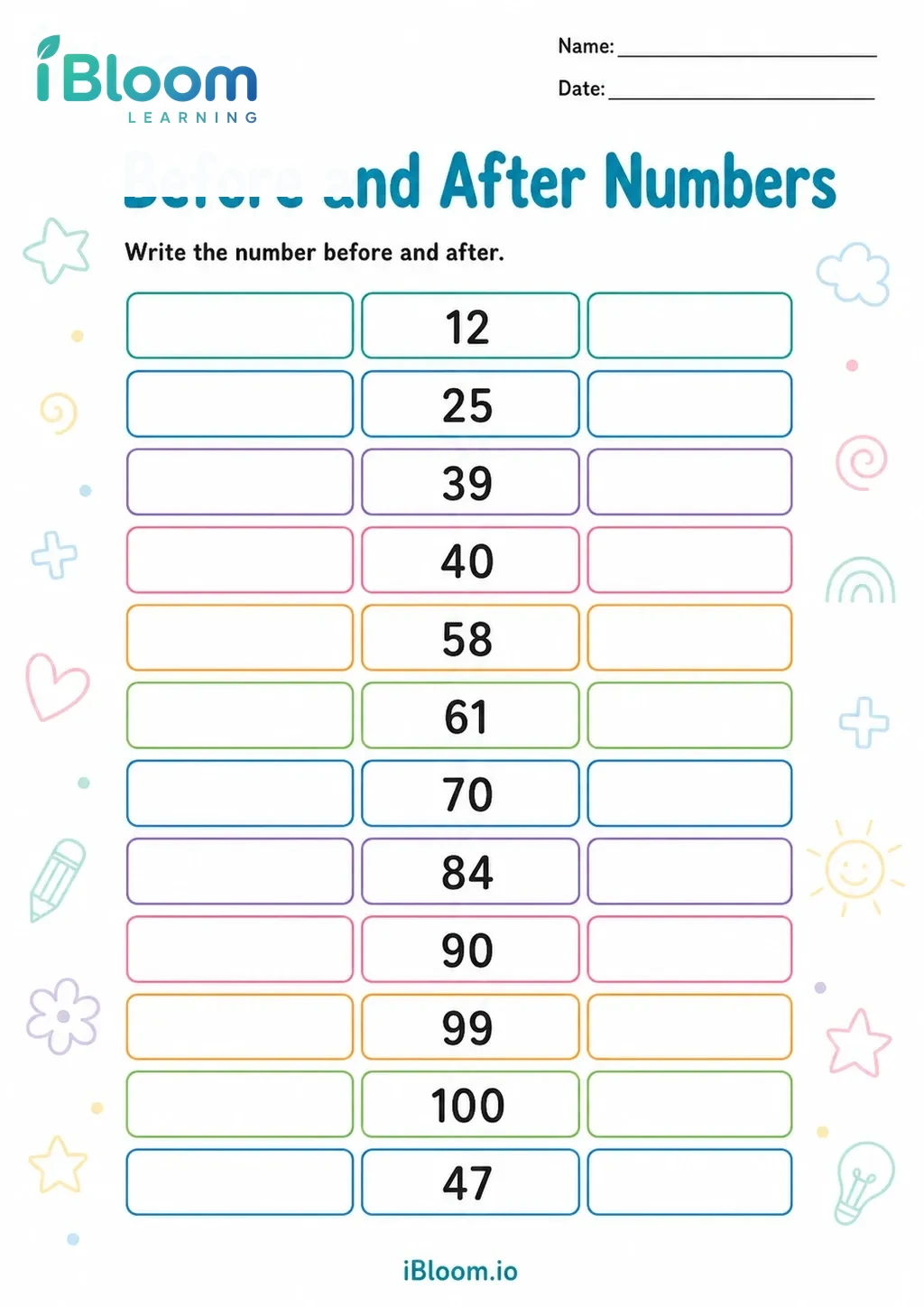
Preview the exact activity before downloading it.
Practice that builds confidence
What children learn from number charts
These Grade 1 number charts worksheets help children build confidence with counting, number order, and patterns on a 1–100 chart. Students practise counting by ones, twos, threes, fours, fives, and tens while connecting spoken numbers, written numerals, and number words.
The printable activities include counting pictures and objects, filling missing numbers, printing numbers from 1–25, 26–50, and 76–100, using full 1–100 charts, counting backward, and answering before-and-after questions. Children also work with sequences, number words from 51–100, and simple count-and-combine tasks.
Number charts make the counting sequence visible. In these Grade 1 worksheets, children see how numbers grow from left to right and row to row, then use that structure to find missing numbers, continue a sequence, and count backward. A full chart from 1–100 supports place value language such as tens, ones, before, after, more, less, next, and between.

Counting patterns and skip counting
The collection moves from counting by ones to skip counting by 2s, 3s, 4s, 5s, and 10s. Children may color or mark patterns on a chart, complete rows of numbers, or write the next numbers in a sequence. Counting by 5s and 10s also prepares students to read groups quickly, while counting by 2s helps with even-number patterns.
Number writing, words, and objects
Some worksheets focus on printing numbers in smaller ranges, such as 1–25, 26–50, and 76–100, so children can practise accurate formation without being overwhelmed. Others ask students to count pictures or objects, combine small groups, or match quantities to numerals. Number word practice from 51–100 strengthens the connection between how a number sounds, how it is written, and where it belongs on the chart.
A simple parent routine
At home, choose one chart task and read the first few numbers together. Ask your child to point while counting, then cover one number and ask what comes before and after. For skip counting, have your child lightly tap each counted number on the chart. End with one quick question such as, “What number is 10 more than 37?” or “Count backward from 24 to 19.”

Classroom uses for teachers
Teachers can use these printables for morning work, math centers, small-group review, or quick checks before moving into addition and subtraction. A teacher might assign counting pictures to students who need one-to-one counting practice, missing-number charts for sequence work, and skip-counting pages for students ready to notice repeated patterns.

Common errors and a child-friendly strategy
Watch for skipped numbers, reversed digits, confusing 13 and 30, losing place when crossing a ten, or saying a number correctly but writing a different numeral. A helpful strategy is “point, say, write, check”: point to the spot on the chart, say the number aloud, write it carefully, then check the numbers before and after. Why iBloom worksheets help: the pages vary the representation, so children practise the same counting ideas through charts, pictures, objects, sequences, number words, and written numerals.
Free printable PDF download
Use this grade 1 number charts worksheet page to preview the activity, print it, or download it as a PDF for quick practice. It works well for homework, homeschool lessons, tutoring, morning work, revision, and classroom centers.
Answers and answer key support
After the child completes the worksheet independently, parents and teachers can use the answer support or answer key information to check the work, review mistakes, and choose the next practice step.
Helpful answers
Frequently asked questions
What number chart skills should a Grade 1 child practise?
A Grade 1 child should practise counting forward and backward, filling missing numbers, identifying before-and-after numbers, reading a 1–100 chart, counting objects, writing numerals, and beginning skip counting by 2s, 5s, and 10s.
How do these worksheets support counting to 100?
They break the 1–100 sequence into manageable tasks, including number printing ranges, full chart work, missing-number sequences, counting questions, and number words from 51–100.
Why is skip counting included with number charts?
Skip counting helps children notice regular patterns on the chart. Marking 2s, 5s, or 10s shows how numbers repeat in predictable ways and prepares students for addition, grouping, and later multiplication ideas.
What should I do if my child loses place on the chart?
Have your child point to each number while saying it aloud. If they get stuck after a ten, guide them to look at the next row and compare the ones digit to the number they just said.
Are picture-counting worksheets useful if my child can already count aloud?
Yes. Counting pictures checks one-to-one correspondence, which means matching each object to one spoken number. This is different from reciting numbers from memory and is important for accurate counting.
Is this grade 1 number charts worksheet free?
Yes. You can preview it for free and use the printable worksheet for home or classroom practice.
Can I download this grade 1 number charts worksheet as a PDF?
Yes. Use the worksheet download option to save a printable PDF, or print the worksheet directly from the page.
Does this grade 1 number charts worksheet include answers or an answer key?
When the activity has fixed answers, iBloom includes answer support so parents and teachers can check the completed worksheet.