Free printable practice
Printing Numbers 76 100 Practice Activities
Grade 1 learners practise neatly printing and sequencing numbers from 76 to 100 using number charts, tracing, and independent writing tasks.
Free printable worksheet PDFs
Preview every available page, then download the free worksheet PDF for home, homeschool, tutoring, or classroom practice.
Preview the exact activity before downloading it.
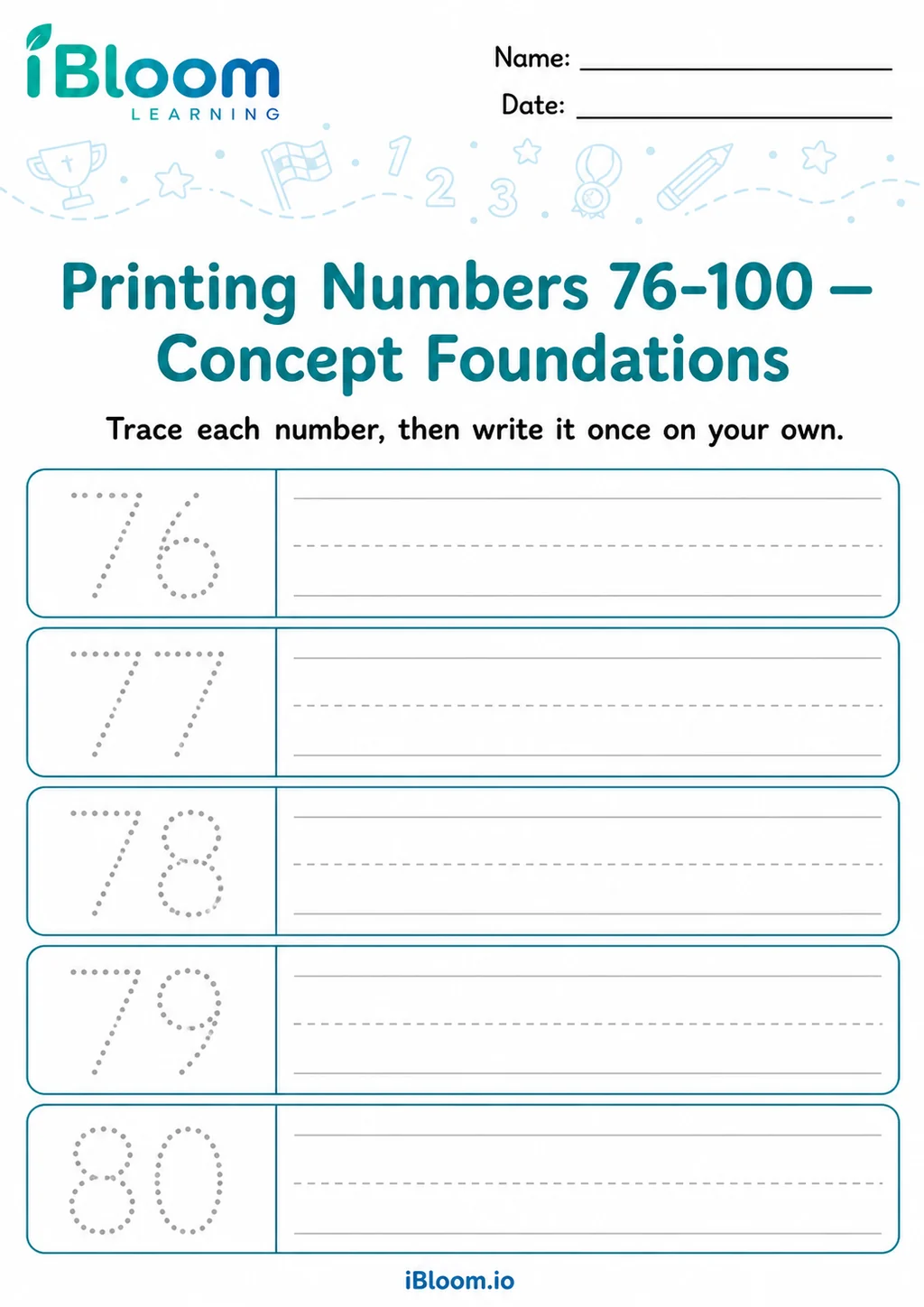 Printing Numbers 76–100 — Concept FoundationsGrade 1 learners practise neatly printing and sequencing numbers from 76 to 100 using number charts, tracing, and independent writing tasks. This Grade 1 foundations worksheet adds concise teaching notes, worked examples, and supported first attempts.Grade 1Free PDF preview
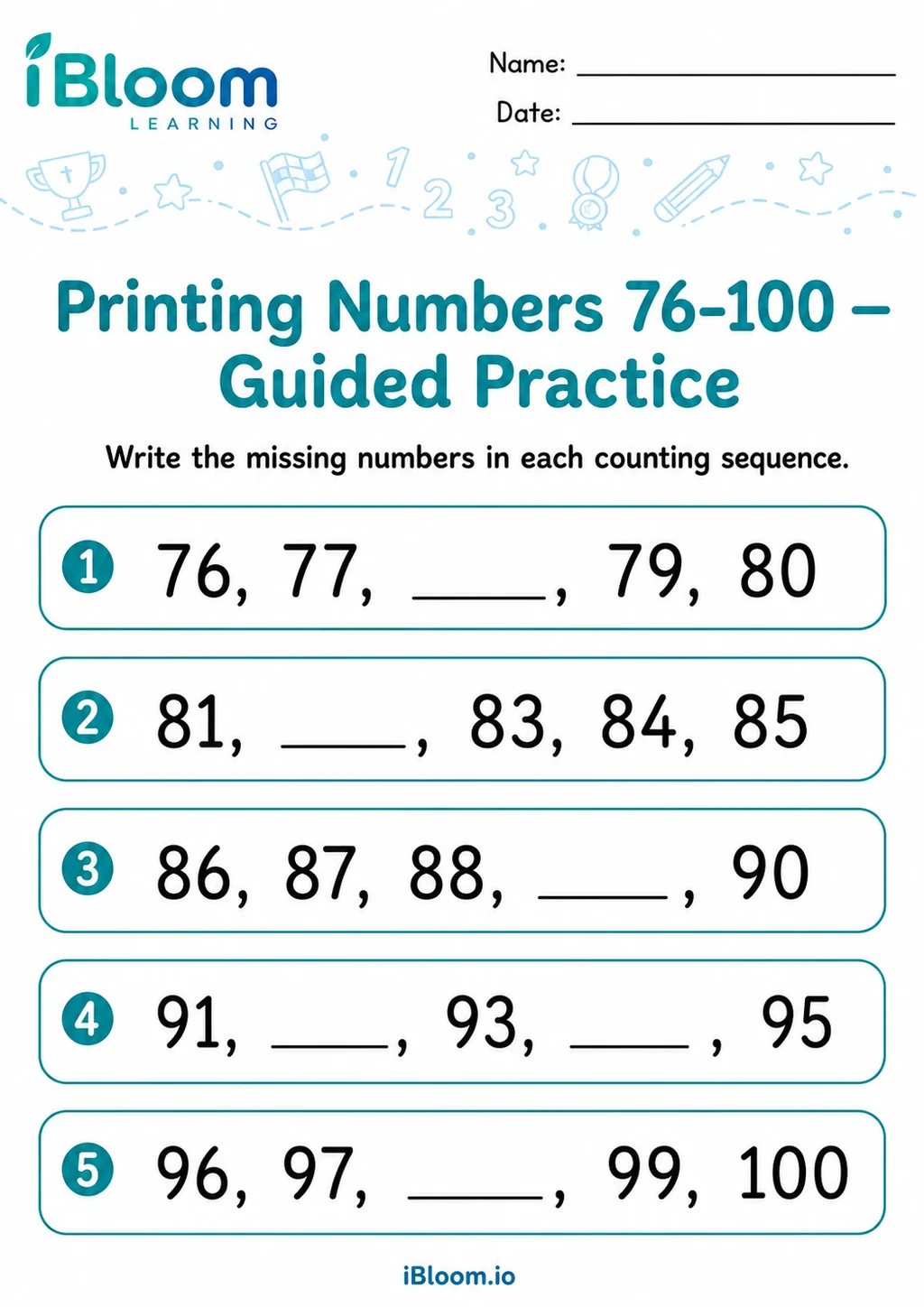 Printing Numbers 76–100 — Guided PracticeGrade 1 learners practise neatly printing and sequencing numbers from 76 to 100 using number charts, tracing, and independent writing tasks. This Grade 1 guided-practice worksheet progresses from prompts and checkpoints to independent questions.Grade 1Free PDF preview
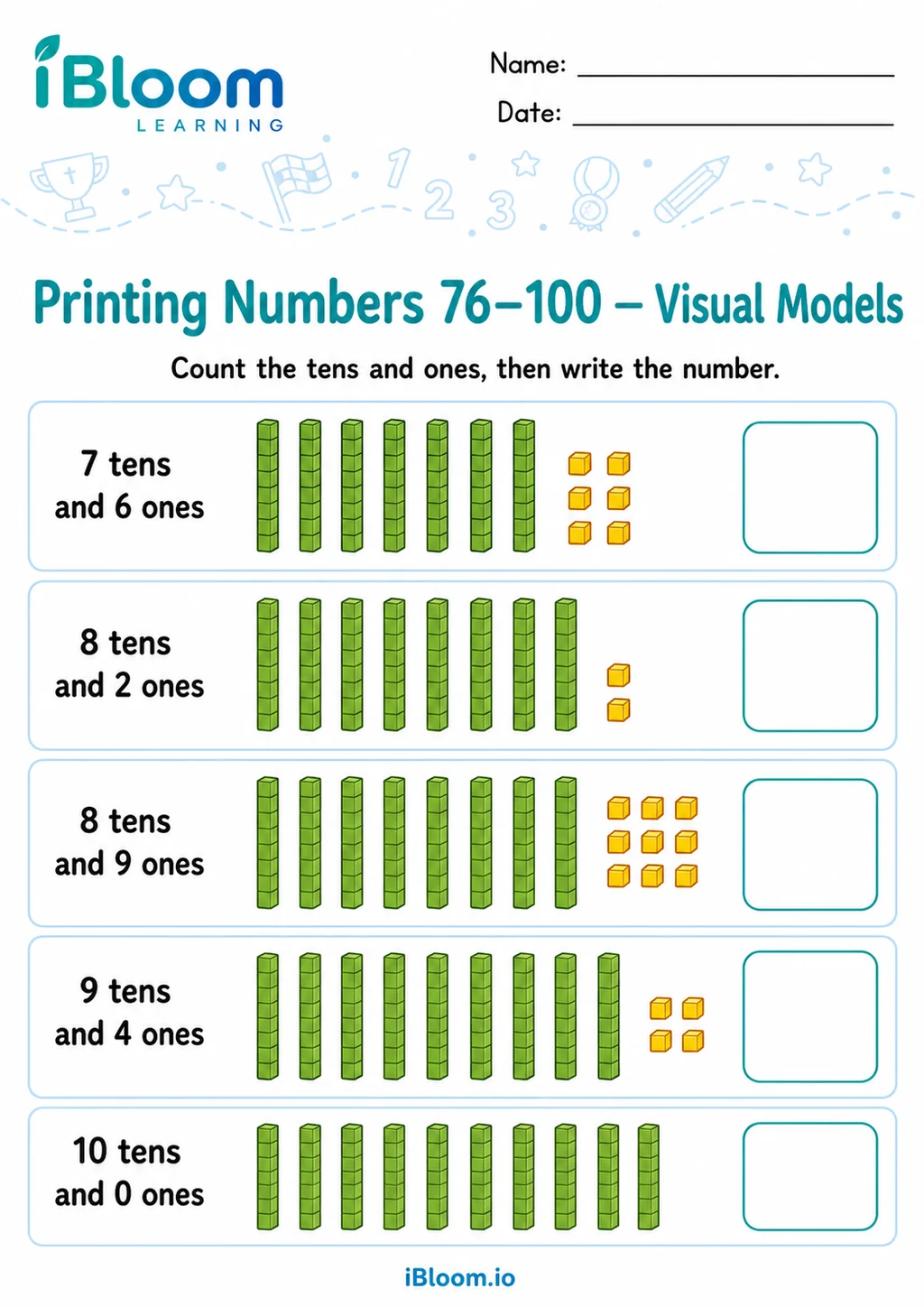 Printing Numbers 76–100 — Visual ModelsGrade 1 learners practise neatly printing and sequencing numbers from 76 to 100 using number charts, tracing, and independent writing tasks. This Grade 1 visual-model worksheet connects suitable diagrams, tables, number lines, or place-value models to mathematical notation.Grade 1Free PDF preview
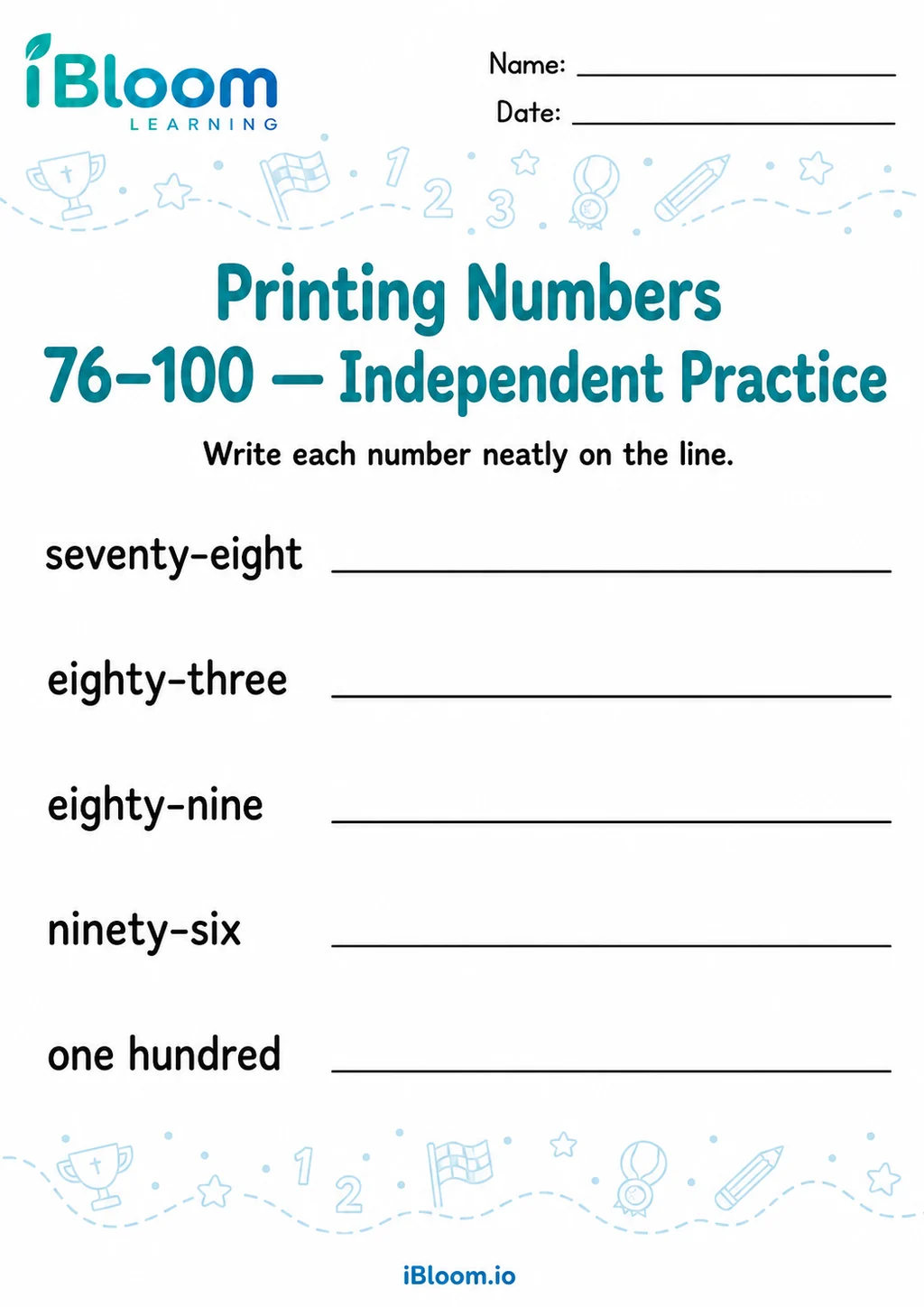 Printing Numbers 76–100 — Independent PracticeGrade 1 learners practise neatly printing and sequencing numbers from 76 to 100 using number charts, tracing, and independent writing tasks. This Grade 1 independent-practice worksheet provides a balanced sequence of accurate, grade-level exercises.Grade 1Free PDF preview
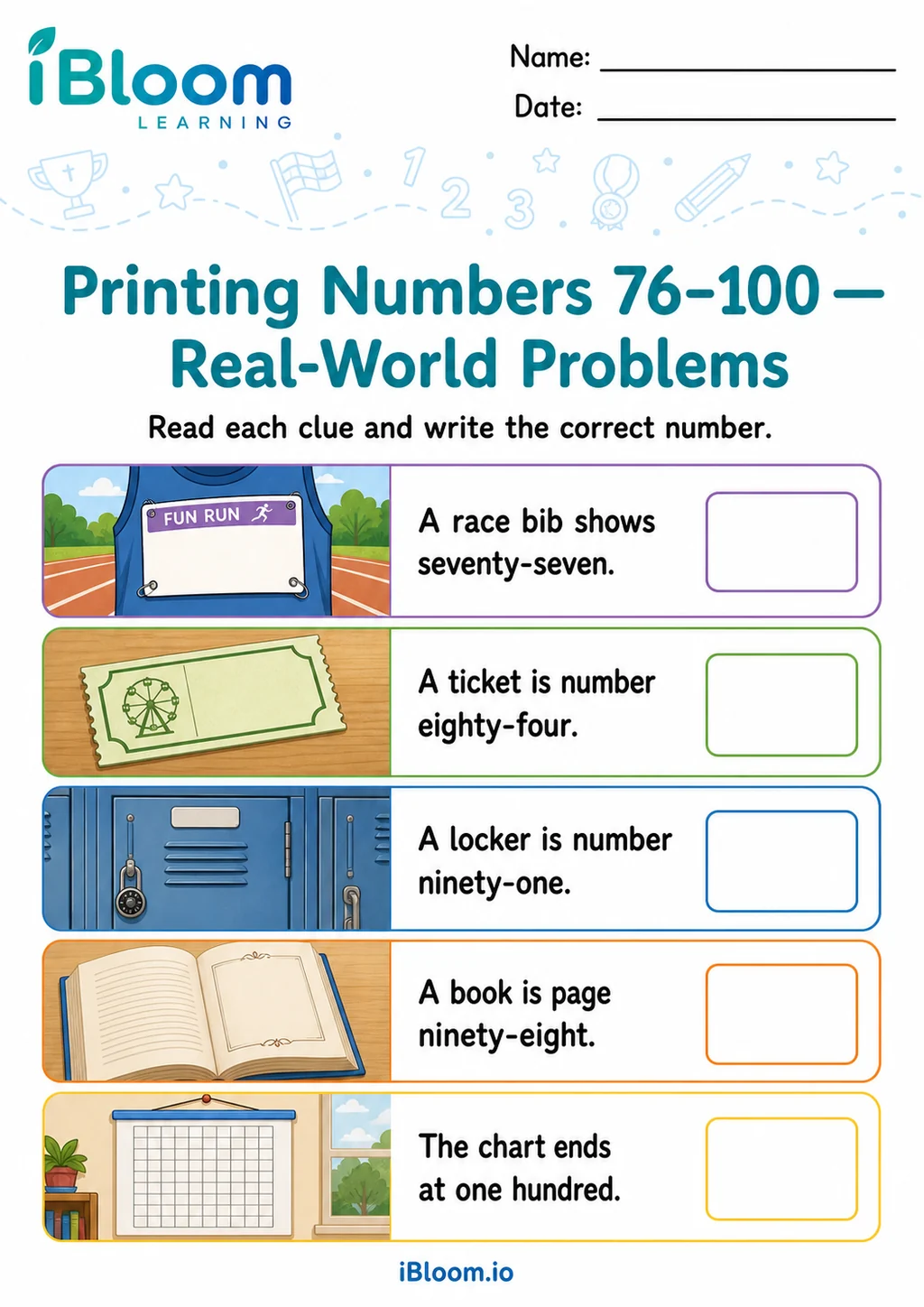 Printing Numbers 76–100 — Real-World ProblemsGrade 1 learners practise neatly printing and sequencing numbers from 76 to 100 using number charts, tracing, and independent writing tasks. This Grade 1 application worksheet uses realistic one-step and multi-step situations with room to model and solve.Grade 1Free PDF preview
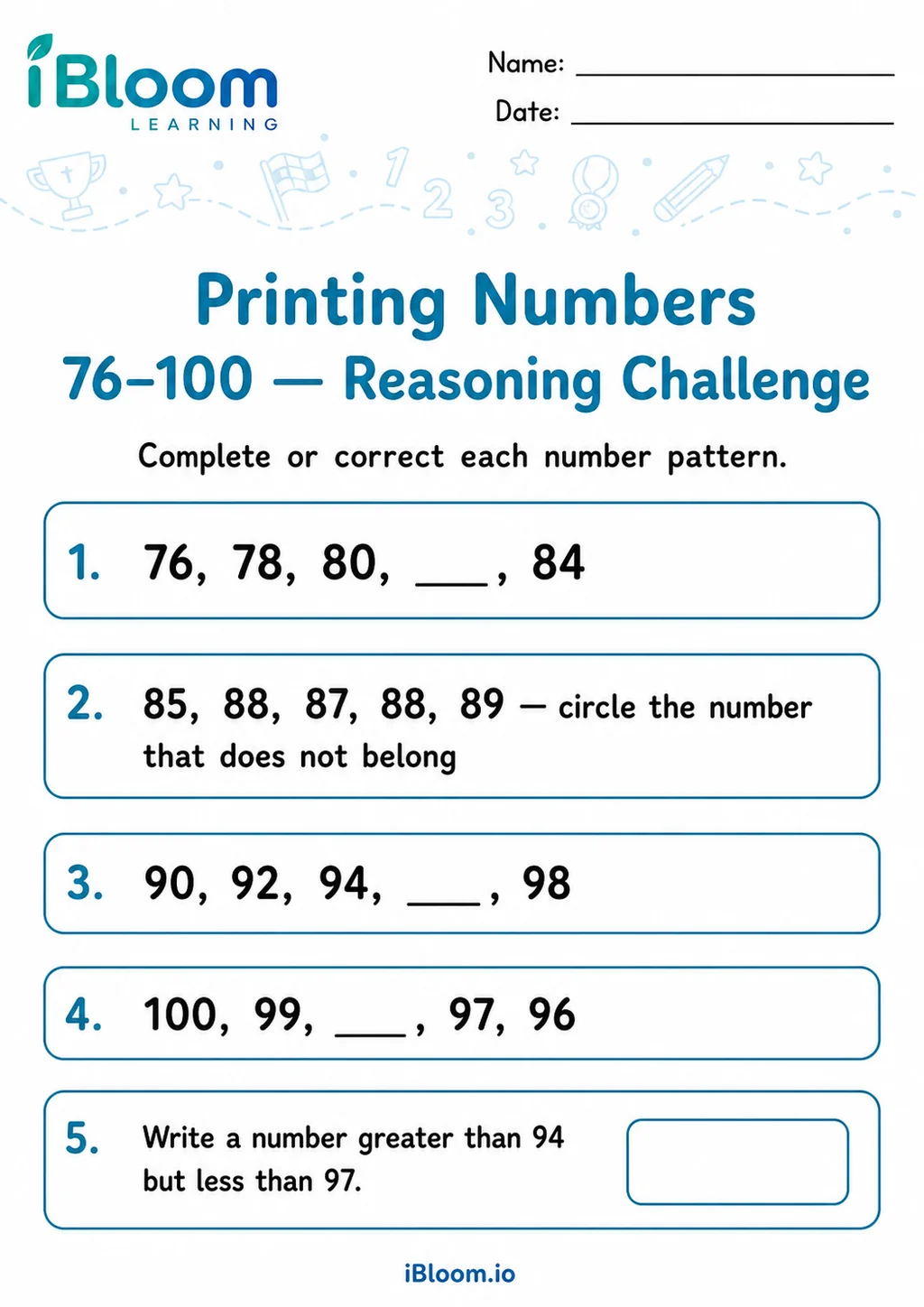 Printing Numbers 76–100 — Reasoning ChallengeGrade 1 learners practise neatly printing and sequencing numbers from 76 to 100 using number charts, tracing, and independent writing tasks. This Grade 1 reasoning worksheet combines error analysis, strategy comparison, missing information, and a gentle extension.Grade 1Free PDF preview
Practice that builds confidence
From counting to confident printing
These Grade 1 math worksheets help children practise printing numbers from 76 to 100 with clear numeral formation, correct order, and growing confidence. Students work with the last part of the 1–100 number chart, where teen patterns are gone and careful attention to tens and ones is needed.
The printable activities include number chart practice, tracing, copying, missing-number work, and independent writing of numerals in the 76–100 range. Children strengthen handwriting control while also reviewing counting forward, number sequence, and place-value language such as tens and ones.
Printing numbers 76 to 100 is more than handwriting practice. Children must remember the sequence after 79, move through the 80s and 90s, and finish with 100. These worksheets connect numeral formation with number chart understanding, so learners see that 86 comes after 85 and before 87, not as an isolated symbol.

Building the number range step by step
Activities can begin with tracing and copying, then move to filling missing numbers and writing short stretches independently. This progression supports children who can count aloud but still need help recording numerals accurately. The range also gives practice with two-digit numbers that share the same ones pattern, such as 76, 86, and 96.
A simple parent routine
At home, ask your child to read a row of numbers aloud before writing. Point to 76, 77, 78, and 79, then ask, “What changes when we get to 80?” After one line of printing, choose two numbers and have your child say the tens and ones: “92 has 9 tens and 2 ones.” Keep the focus on neat, careful writing rather than rushing through the page.

Classroom uses for teachers
Teachers can use these printables during morning work, math centers, number chart review, or small-group support. They are also useful for quick checks when students are learning to write numbers beyond 75. Pairing the page with a hundred chart lets children verify sequence while still practising independent recording.

Common errors to watch for
Some children reverse digits, write 89 after 79, skip 90, or form 100 as 10. Others may say the number correctly but write the digits in the wrong order, such as 68 for 86. Encourage students to touch each digit as they read it and to compare their work with the number chart.
Free printable PDF download
Use this printing numbers 76 to 100 worksheet page to preview the activity, print it, or download it as a PDF for quick practice. It works well for homework, homeschool lessons, tutoring, morning work, revision, and classroom centers.
Answers and answer key support
After the child completes the worksheet independently, parents and teachers can use the answer support or answer key information to check the work, review mistakes, and choose the next practice step.
Child-friendly strategy and why iBloom worksheets help
Teach the reminder: “Say it, find the tens, write the ones.” For 94, a child says ninety-four, writes the 9 for the nineties, then writes 4. iBloom worksheets help by giving repeated, focused practice within one meaningful number range, using enough structure to support accuracy while gradually expecting children to print numbers on their own.
Helpful answers
Frequently asked questions
What should my child know before practising numbers 76 to 100?
It helps if your child can count forward through at least 75 and recognize basic two-digit numbers. A hundred chart can support children who are still learning the sequence.
Why is the range 76 to 100 useful in Grade 1?
This range gives children practice with the upper part of the hundred chart, including the transition from the 70s to 80s, 80s to 90s, and finally to 100.
How can I help if my child reverses digits like 86 and 68?
Ask your child to say the number aloud, identify the tens digit first, and then write the ones digit. Comparing the answer with a hundred chart can also make the error easier to notice.
Should children trace the numbers before writing them independently?
Tracing is helpful for numeral formation, especially at the start. Children should then copy and write numbers independently so they build both handwriting control and number sequence memory.
Can these worksheets be used in math centers?
Yes. They work well for independent centers, small-group review, early finisher practice, or a quick check of number writing from 76 to 100.
Is this printing numbers 76 to 100 worksheet free?
Yes. You can preview it for free and use the printable worksheet for home or classroom practice.
Can I download this printing numbers 76 to 100 worksheet as a PDF?
Yes. Use the worksheet download option to save a printable PDF, or print the worksheet directly from the page.
Does this printing numbers 76 to 100 worksheet include answers or an answer key?
When the activity has fixed answers, iBloom includes answer support so parents and teachers can check the completed worksheet.