Free printable practice
Subtracting From Whole Ten Practice Activities
Grade 1 subtraction worksheets for practising how to take away from a complete ten, using facts, pictures, and number sense.
Free printable worksheet PDFs
Preview every available page, then download the free worksheet PDF for home, homeschool, tutoring, or classroom practice.
Preview the exact activity before downloading it.
Practice that builds confidence
Building the idea of a full ten
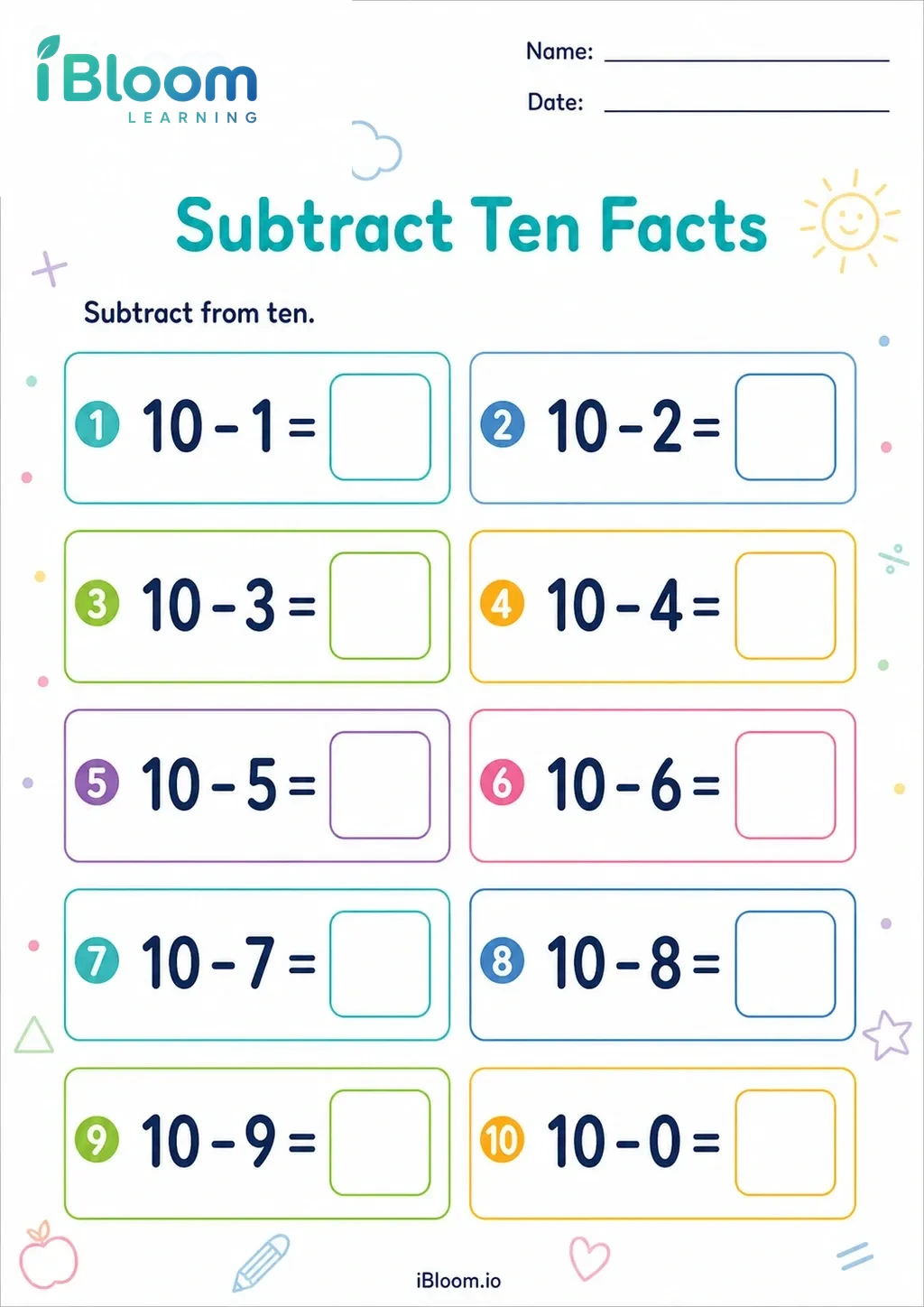
These Grade 1 math worksheets help children practise subtracting from a whole ten, such as solving 10 − 3 or thinking about what is left when a full group of ten is broken apart. Children build fluency while seeing subtraction as taking away, counting back, and finding the missing part of ten.
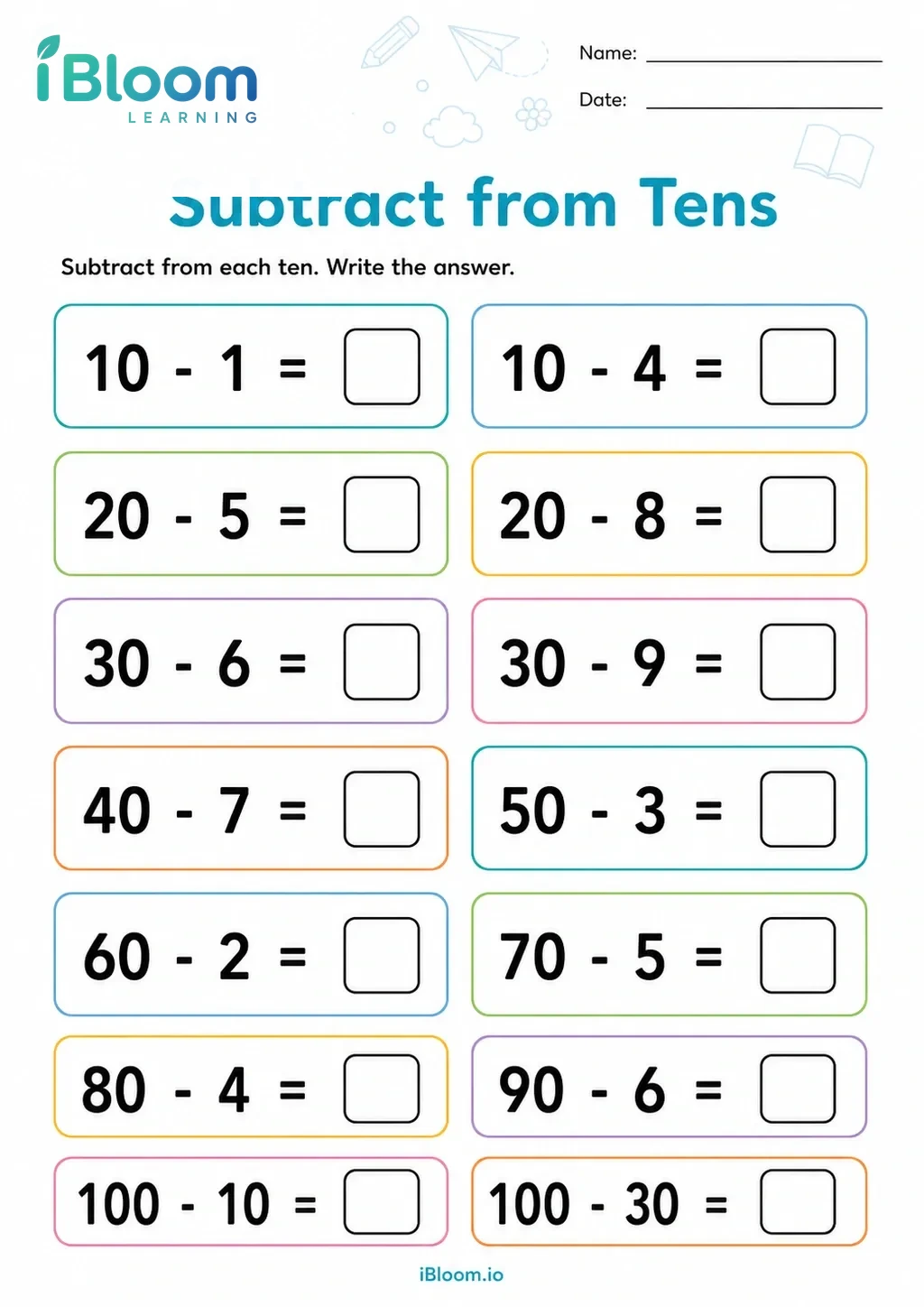
The printable activities include clear subtraction equations, visual supports, and practice that moves from guided examples to independent problems. They are useful for home review, classroom centers, morning work, or extra practice within the subtraction unit.
A whole ten is a complete group, and subtracting from it helps first graders see how numbers fit together. When children solve 10 − 4, they are not just memorizing an answer; they are learning that 10 can be split into 4 and 6. This supports later work with teen numbers, fact families, and mental subtraction.

How the practice progresses
The worksheets begin with simple take-away situations and equations where the starting number is a complete ten. Children may use pictures, fingers, counters, or ten-frame thinking to connect the written problem to a real action. As they gain confidence, they can solve more problems mentally and explain answers using words such as subtract, minus, take away, difference, left, and equal.
Parent routine for home practice
Start with ten small objects, such as buttons, pennies, or blocks. Ask your child to remove some and tell how many are left, then match the action to an equation: “We had 10. We took away 3. That is 10 − 3 = 7.” After a few hands-on examples, have your child complete a short section of the worksheet and read each equation aloud. If an answer is wrong, return to the objects rather than simply giving the correct number.

Classroom uses for teachers
Teachers can use these printables during a Grade 1 subtraction lesson, in math centers, for small-group reteaching, or as independent practice after a ten-frame demonstration. They also work well for quick checks: students who count all each time may need more concrete practice, while students who use known pairs that make ten are ready for more mixed subtraction facts.

Common errors to watch for
Some children reverse the numbers and answer as if the problem were 4 − 10. Others count the number taken away instead of the number left. Watch for counting mistakes when children count back from 10, especially skipping 9 or stopping one count too soon. Encourage them to check by asking, “If I put the taken-away part and the leftover part together, do I get 10?”
Free printable PDF download
Use this grade 1 subtracting from whole ten worksheet page to preview the activity, print it, or download it as a PDF for quick practice. It works well for homework, homeschool lessons, tutoring, morning work, revision, and classroom centers.
Answers and answer key support
After the child completes the worksheet independently, parents and teachers can use the answer support or answer key information to check the work, review mistakes, and choose the next practice step.
Why iBloom worksheets help
The iBloom activities keep the focus narrow: subtracting from a complete ten. This gives children repeated, meaningful practice without mixing in too many new skills at once. A helpful strategy for children is: “Start with 10, take away the part, then name the part left.” Saying the strategy while solving helps turn counting into understanding.
Helpful answers
Frequently asked questions
What does subtracting from a whole ten mean?
It means starting with a complete ten, usually 10, and taking away a number to find how many are left, such as 10 − 6 = 4.
Should my child use fingers or counters for these worksheets?
Yes. In Grade 1, fingers, counters, and ten frames are helpful tools. The goal is to connect the hands-on action of taking away with the written subtraction equation.
How can I help if my child keeps counting the wrong amount?
Have your child build 10 objects first, physically remove the amount being subtracted, and then count only the objects that remain. This makes the difference clear.
Are these worksheets only for memorizing 10 subtraction facts?
No. They support fact fluency, but they also help children understand part-whole relationships, counting back, and how subtraction connects to number pairs that make ten.
When is a child ready for mixed subtraction facts after this?
A child is usually ready when they can solve subtraction from 10 accurately, explain what was taken away and what is left, and check the answer by making 10 again.
Is this grade 1 subtracting from whole ten worksheet free?
Yes. You can preview it for free and use the printable worksheet for home or classroom practice.
Can I download this grade 1 subtracting from whole ten worksheet as a PDF?
Yes. Use the worksheet download option to save a printable PDF, or print the worksheet directly from the page.
Does this grade 1 subtracting from whole ten worksheet include answers or an answer key?
When the activity has fixed answers, iBloom includes answer support so parents and teachers can check the completed worksheet.