





About this worksheet
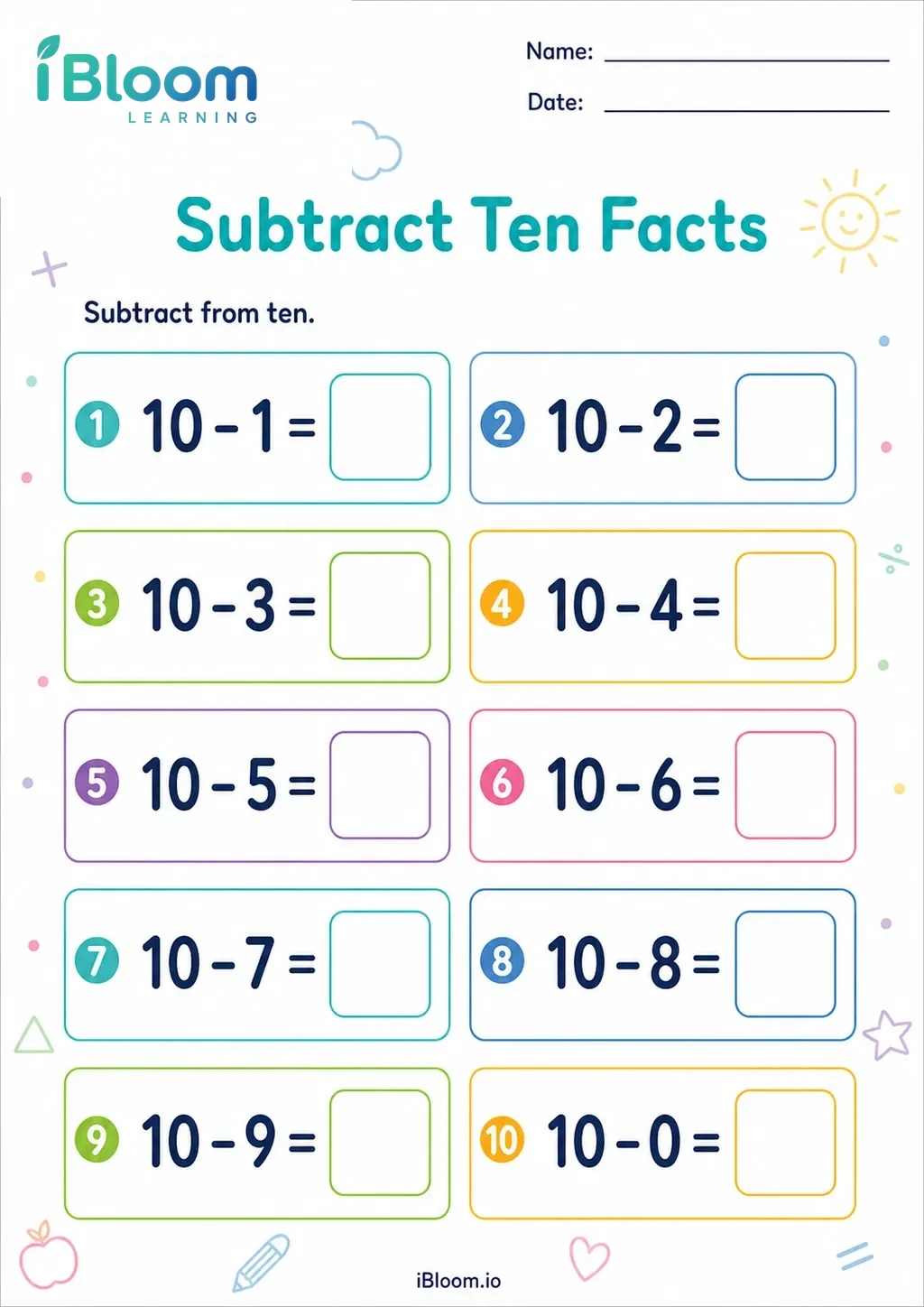
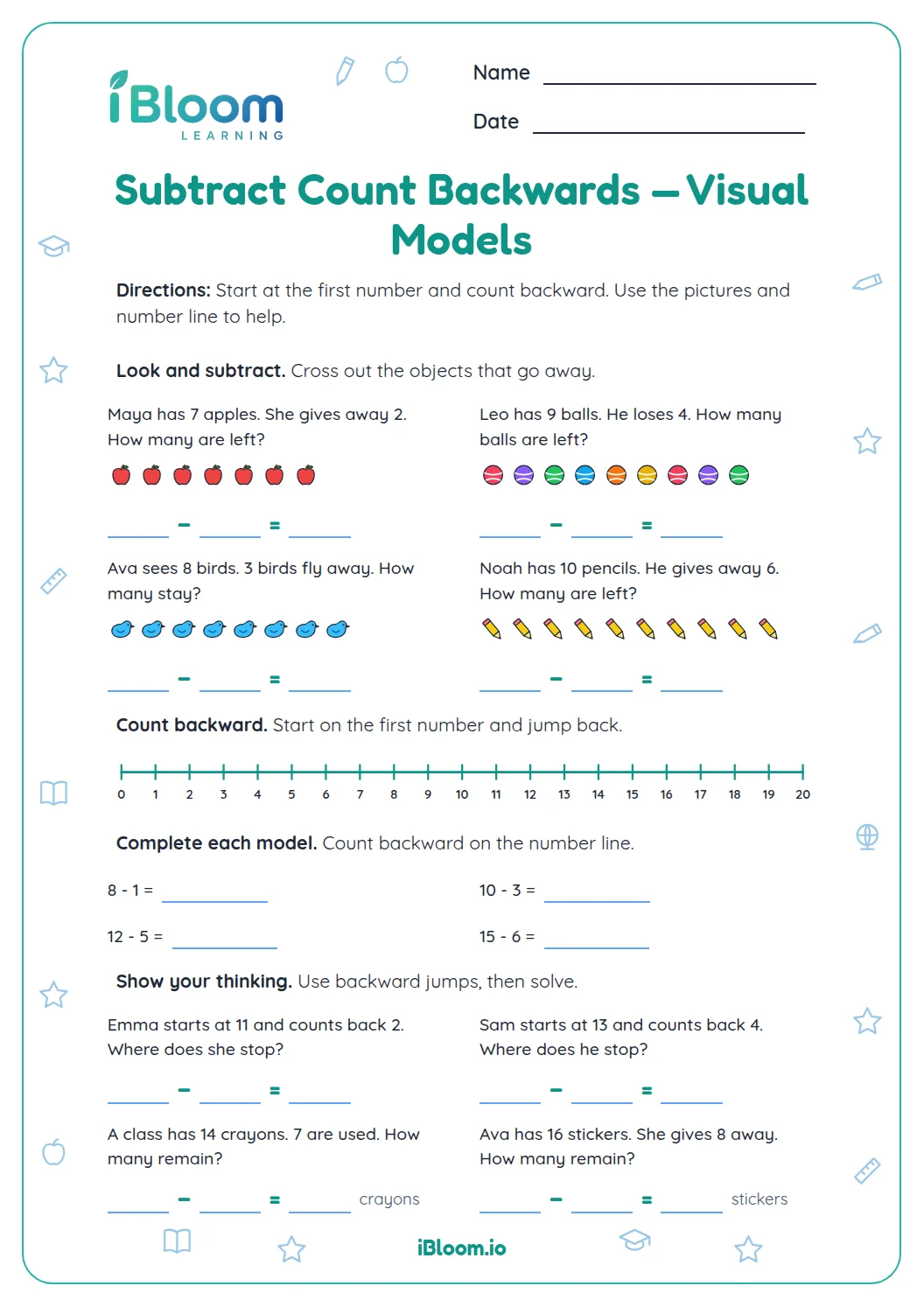
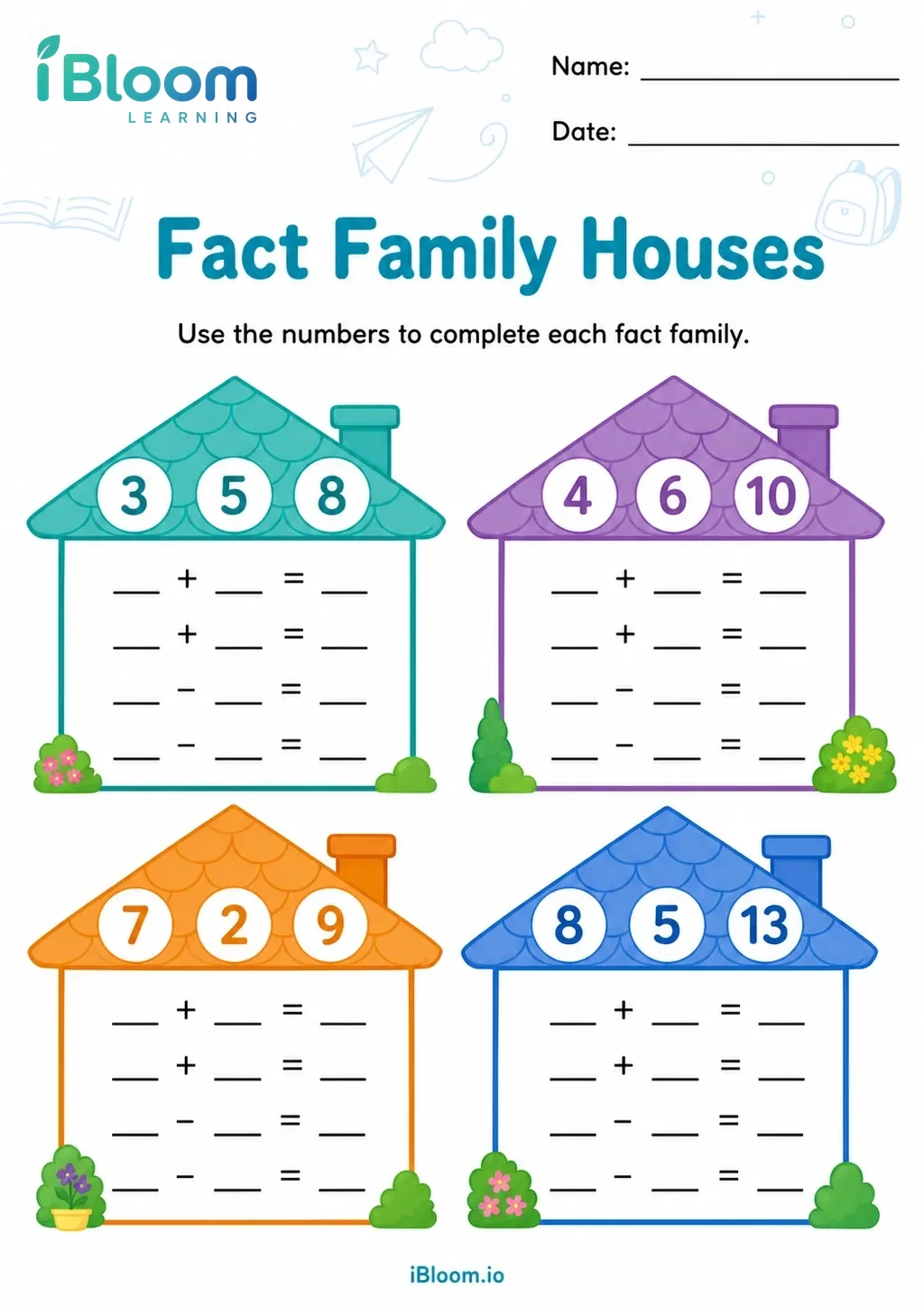
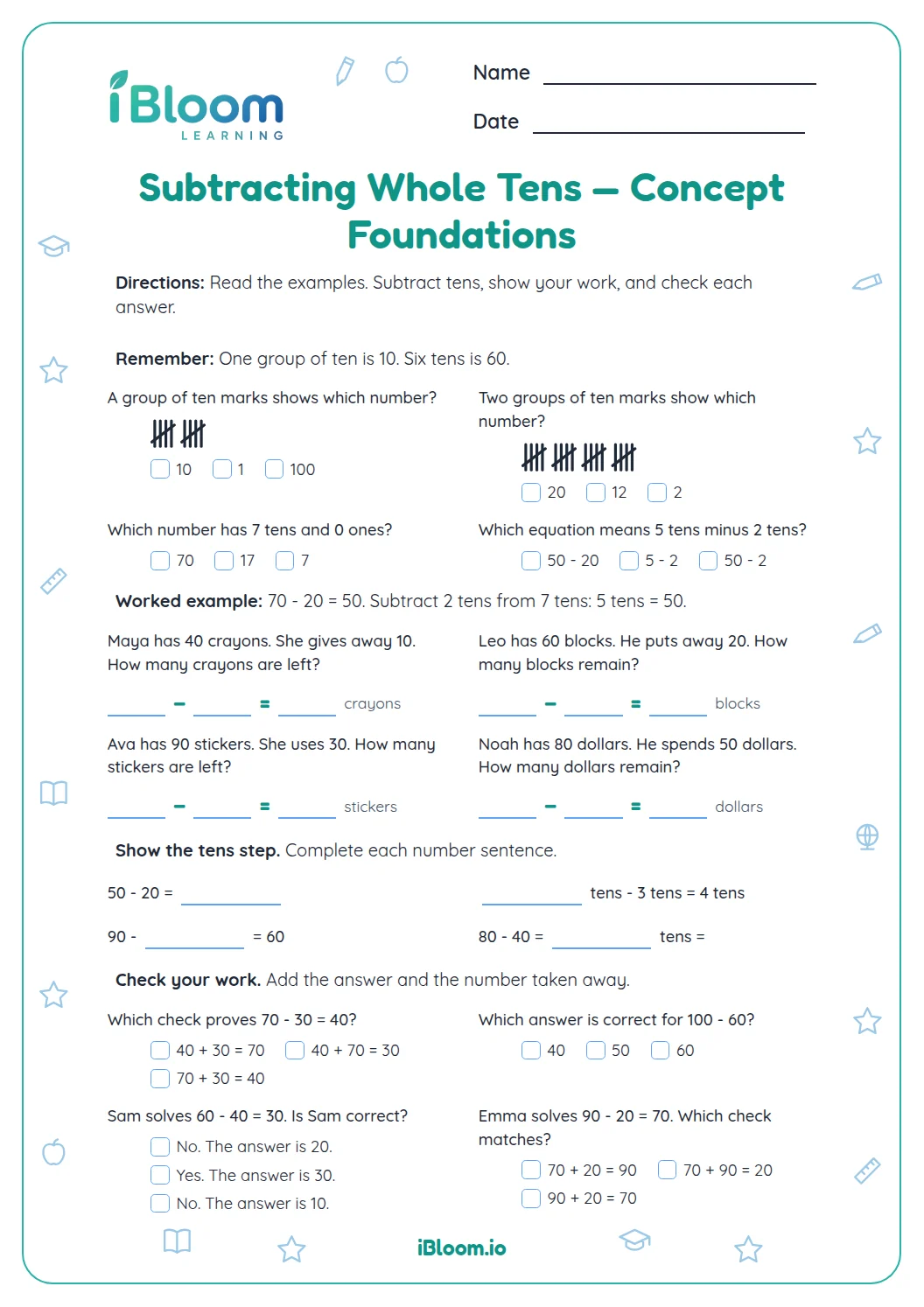
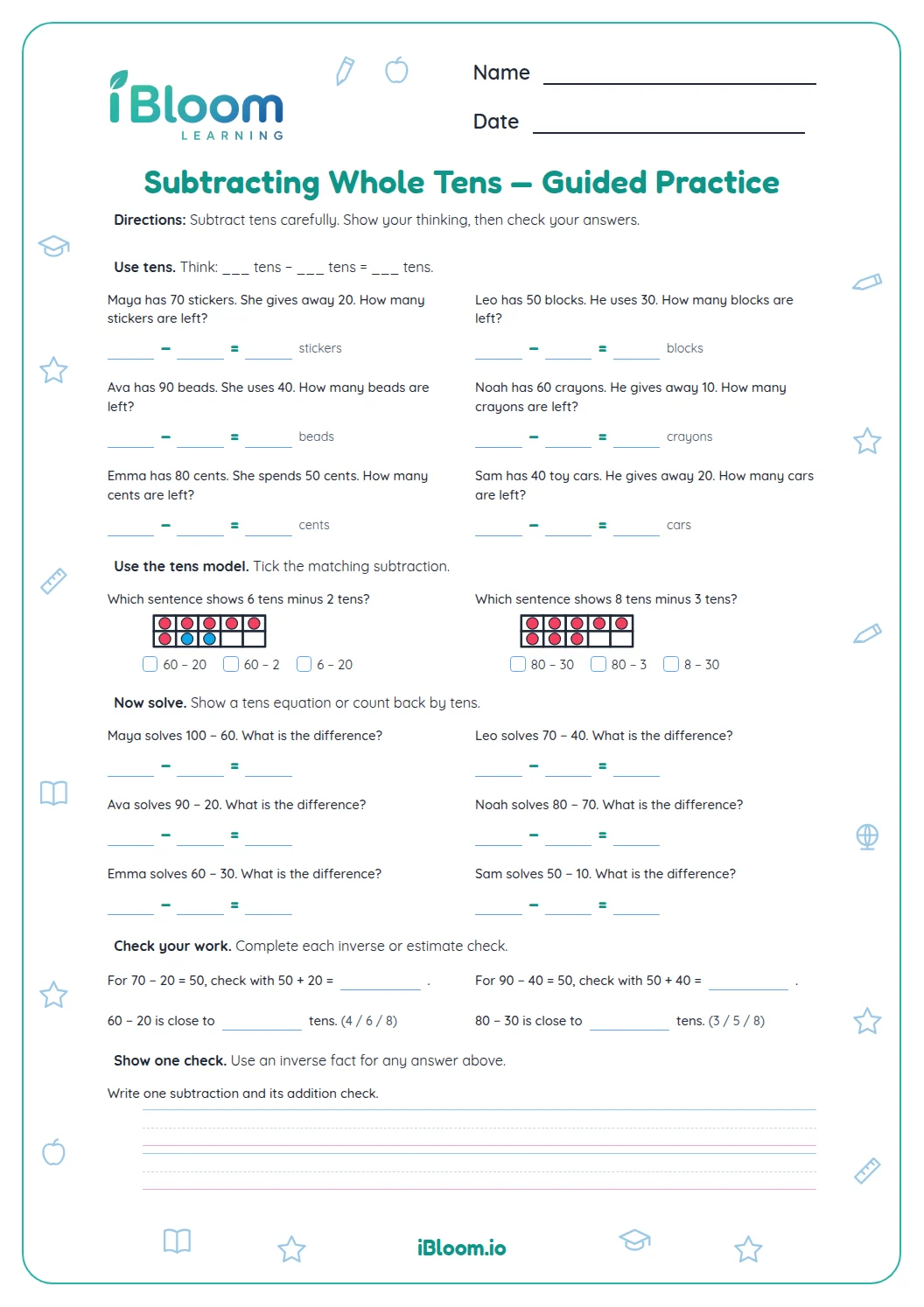
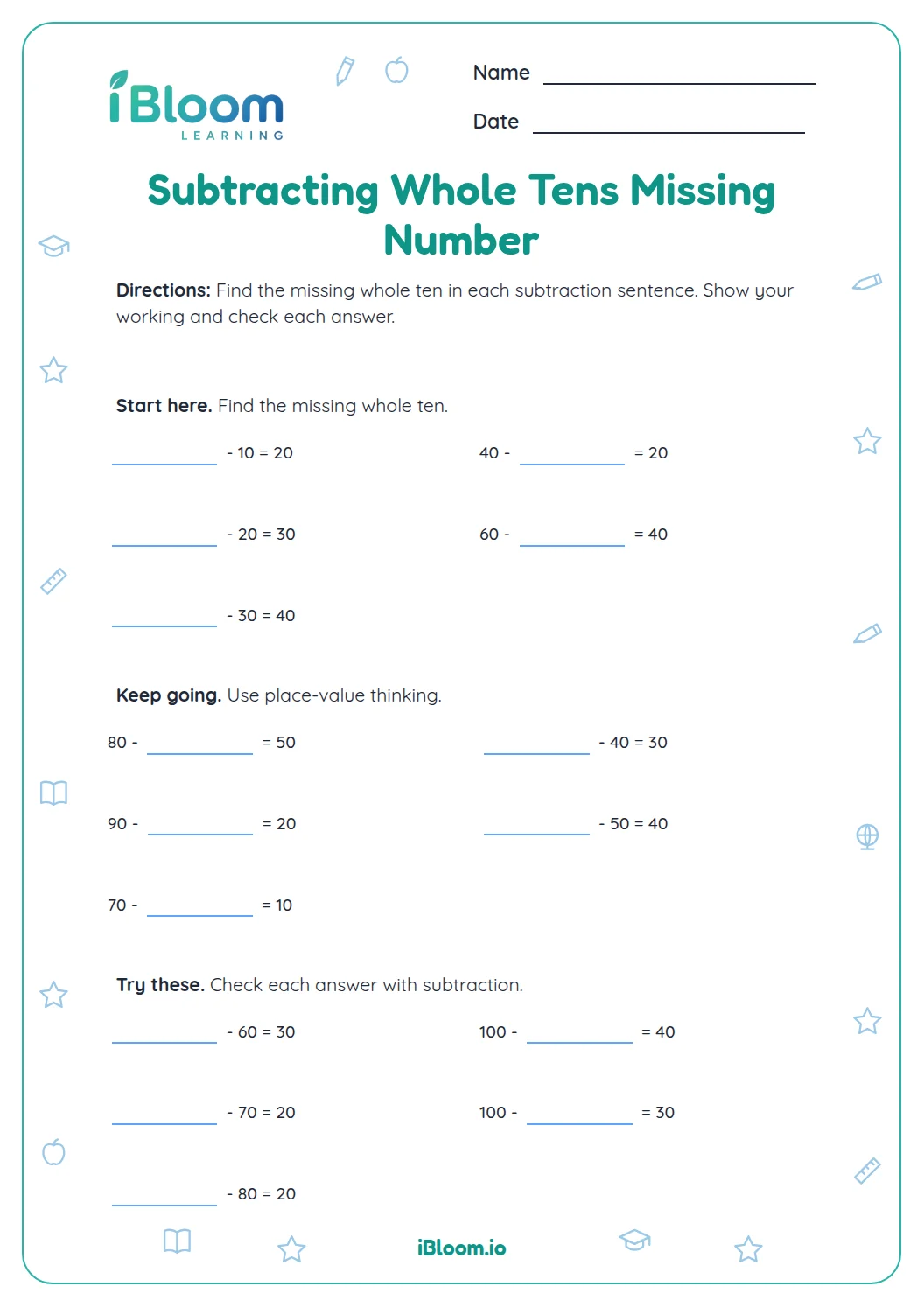
This free Grade 1 worksheet practices subtraction starting with a whole ten. Part A asks children to take single-digit numbers away from 10 and 20. Part B changes the unit: children subtract whole tens from 30, 40, 60 and 90. Part C applies whole-ten subtraction to crayons and stickers with tens-rod models. The 14 questions support Common Core 1.OA.C.6 and 1.NBT.C.6 through counting back, using ten facts and thinking in groups of ten. Children explain their tens strategy aloud and write a number sentence for each story. A separate key shows all answers.
Aligned to 1.OA.C.6 and 1.NBT.C.6
How can a ten fact help with 20 minus a number?
Think of 20 as two groups of ten. For 20 − 6, keep one group of ten while taking 6 away from the other group. The remaining amounts are 10 and 4, which make 14.
Questions 3 and 4 pair 10 − 6 with 20 − 6. Ask the child to explain why the second answer is exactly ten more.
- 120 − 6 = ___
- 220 is 10 + 10.
- 310 − 6 = 4.
- 4Keep the other ten: 10 + 4 = 14.
What changes when both numbers are whole tens?
The counting unit becomes ten. In 60 − 20, think “6 tens minus 2 tens,” then write the remaining 4 tens as 40. Keeping the unit in the spoken explanation helps children avoid writing just 4.
Part B includes 30 − 30 = 0. Taking away every group of ten leaves no groups, just as taking away every counter leaves zero counters.
How do the two stories use groups of ten?
Part C gives 40 crayons with 10 handed out, followed by 60 stickers with 20 used. Children write a subtraction sentence before answering with the number left. Each rod represents ten objects; use the rods to explain the subtraction.
After checking with the key, ask the child to add the amount used back to the amount left. For the stickers, 40 + 20 = 60 checks that the original amount has been restored.
How to use this worksheet
- 1Set out ten counters and practice taking a few away.
- 2Work through 10 − 3, then use it to explain 20 − 3.
- 3Finish Part A and check that each answer is smaller than its starting number.
- 4For Part B, say each number in tens and explain how many tens remain.
- 5Use the rods in Part C to explain the stories, write equations and check by adding back.
Mistakes to check and ways to help
The mistake
Answering 20 − 6 with 4 after using the ten fact.
The fix
Keep the untouched ten beside the 4 remaining ones; 10 + 4 = 14.
The mistake
Answering 60 − 20 with 4.
The fix
Say “4 tens remain,” then write 40.
The mistake
Answering 30 − 30 with 30 because the numbers match.
The fix
Remove all three groups of ten. There are zero groups left.
Common Core alignment
Use ten facts and counting back to subtract within 20.
On this sheet: Part A takes single-digit numbers away from 10 and 20.
Show the official wordingHide the official wording
Add and subtract within 20, demonstrating fluency for addition and subtraction within 10. Use strategies such as counting on; making ten (e.g., 8 + 6 = 8 + 2 + 4 = 10 + 4 = 14); decomposing a number leading to a ten (e.g., 13 - 4 = 13 - 3 - 1 = 10 - 1 = 9); using the relationship between addition and subtraction (e.g., knowing that 8 + 4 = 12, one knows 12 - 8 = 4); and creating equivalent but easier or known sums (e.g., adding 6 + 7 by creating the known equivalent 6 + 6 + 1 = 12 + 1 = 13).
Subtract groups of ten by thinking about how many tens remain.
On this sheet: Part C uses tens models, spoken reasoning and written equations to subtract whole tens.
Show the official wordingHide the official wording
Subtract multiples of 10 in the range 10-90 from multiples of 10 in the range 10-90 (positive or zero differences), using concrete models or drawings and strategies based on place value, properties of operations, and/or the relationship between addition and subtraction; relate the strategy to a written method and explain the reasoning used.
What to practice next
Make more practice
Further reading
Questions parents and teachers ask
Which starting numbers are on this sheet?
Part A starts with 10 or 20, while Part B starts with 30, 40, 60 or 90. The two stories start with 40 crayons and 60 stickers. Every question begins with a whole ten, and the directions help children distinguish subtracting ones from subtracting tens.
How do I explain 20 − 6 without written regrouping?
Use two groups of ten counters. Keep one group together and remove six counters from the other group, leaving four. The untouched ten and the four remaining counters make fourteen. Question 4 uses this fact, and question 3 supplies the helpful fact 10 − 6 = 4.
Why does Part B include 30 − 30?
It checks what happens when all of an amount is taken away. Three tens minus three tens leaves zero tens, so the answer is 0. Children can show this with three bundles of sticks, remove all three bundles and explain why none remain on the table.
Should children write equations for the stories?
Yes, Part C asks for a subtraction sentence before the answer. The crayon story is 40 − 10 = 30, and the sticker story is 60 − 20 = 40. The working space gives children room to record the equation and keep track of the quantities.
What should I do if my child confuses ones and tens?
Name the unit aloud before subtracting. In 10 − 3, three ones are removed; in 60 − 20, two tens are removed. Use loose counters for ones and bundles of ten for tens, then connect each action to the matching equation on the worksheet.