

About this worksheet
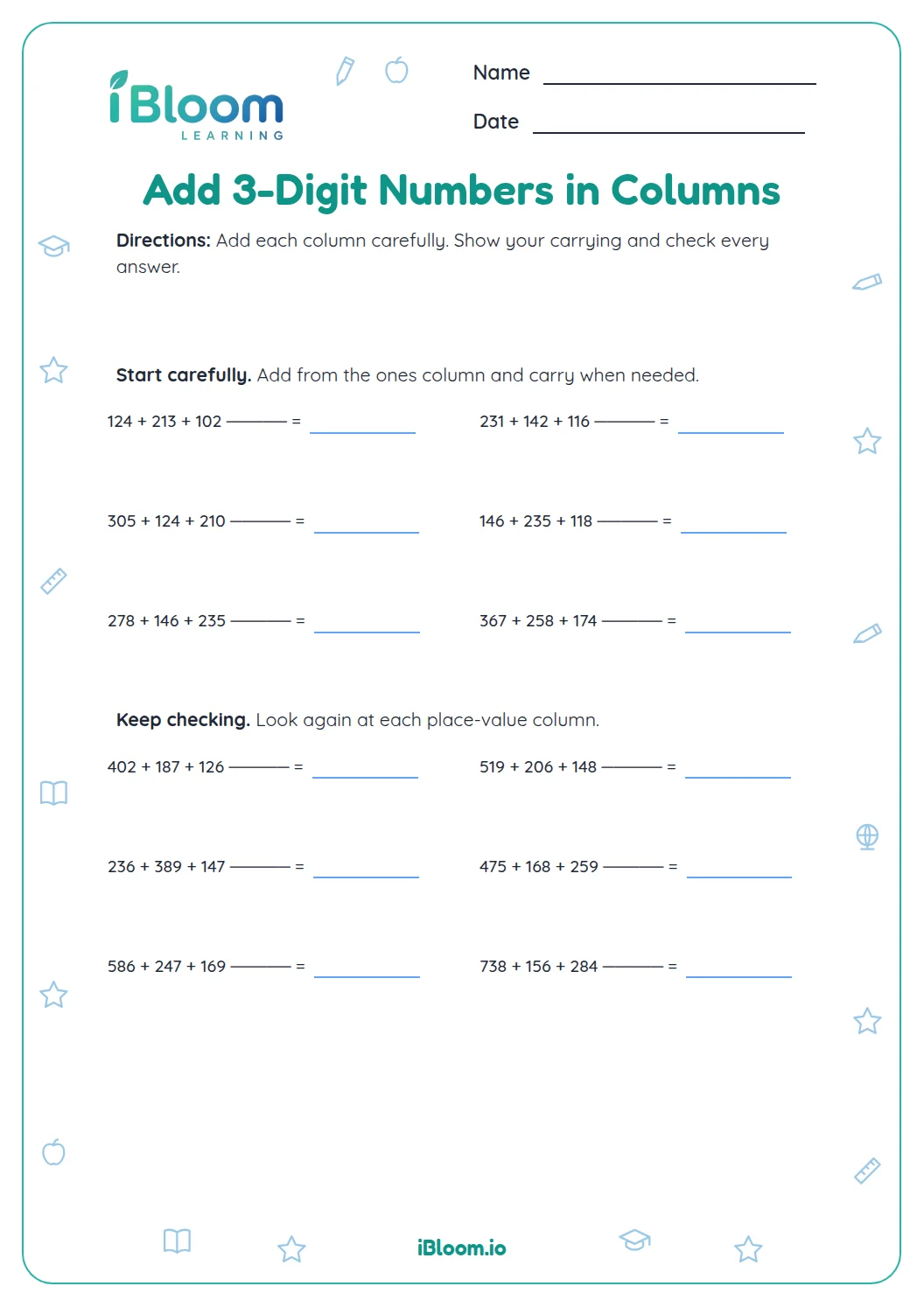
This Grade 2 concept-foundations worksheet guides students through adding three three-digit numbers in columns. Four opening questions focus attention on the three addends and place-value columns, followed by sums that model the routine and practice regrouping. Every number is printed in the student question with a plus sign between addends. The answer key supports checking the sums. The work aligns with Grade 2 place-value strategies for adding within 1,000.
Aligned to 2.NBT.B.7
How do the columns help with three numbers?
Each addend gets its own row. Lining up the ones, tens, and hundreds lets students combine digits that have the same value, even when three numbers are being added.
- 1246 + 135 + 102
- 2Add ones first, then tens and continue from right to left.
- 3Record each regrouped ten above the next place-value column.
What does regrouping mean?
Ten ones can be exchanged for one ten, and ten tens can be exchanged for one hundred. When a column total reaches ten, students write the ones digit in that column and move the tens to the next column.
Why start with the ones place?
The ones column is the first place where a group of ten may need to move into the tens column. Starting there makes the regrouping steps follow the place-value pattern from right to left.
How can a student check a sum?
Round each addend to the nearest hundred and add the rounded values for an estimate. The exact answer should be near that estimate. Students can also subtract two addends from the total and check that the remaining addend is correct.
How to use this worksheet
- 1Read the whole expression and find its three addends.
- 2Write one number on each row, lining up ones, tens, and hundreds.
- 3Add the ones first and regroup a ten if needed.
- 4Continue with the tens and then the hundreds.
- 5Compare the answer with an estimate or use subtraction to check.
Common addition mistakes
The mistake
Putting a tens digit under the ones.
The fix
Line up the last digit of every addend before starting.
The mistake
Adding only the first two numbers.
The fix
Count three rows of digits before adding each column.
The mistake
Writing 13 ones as 13 in the ones column.
The fix
Write 3 ones and regroup 1 ten into the tens column.
Common Core alignment
This worksheet practices multi-digit addition with place-value strategies.
Three three-digit addends and place value
On this sheet: Students add multi-digit whole numbers using the column method and check their totals.
Show the official wordingHide the official wording
Add and subtract within 1000, using concrete models or drawings and strategies based on place value, properties of operations, and/or the relationship between addition and subtraction; relate the strategy to a written method.
What to practice next
Make more practice
Further reading
Questions parents and teachers ask
How many questions are included?
There are 22 questions in five parts. The first four build attention to the addends and place-value columns; later questions move into regrouping and mixed three-addend sums. Students can compare each total with the answer key after completing the work.
Do students need to add three numbers at once?
Yes. Every sum has three addends. Students can add the digits in one place-value column together, then regroup before moving to the next column. Before comparing with the key, ask the student to estimate the total. A close estimate gives confidence in the result, while a large difference is a signal to review copied addends and regrouping.
What should the student do if a column total is over nine?
Write the ones digit in that column and move the groups of ten one place to the left. For example, 13 ones become 3 ones and 1 ten. A useful routine is to point to every addend while copying it into a separate row
Why does each addend have a plus sign?
The plus signs make the full expression easy to read and show that all three numbers are being added. Students should copy each of those numbers into its own aligned row. Students can explain each regrouping aloud: ten ones make one ten, and ten tens make one hundred. Naming the exchange links the written mark to the value it represents.
Which standard supports this work?
CCSS 2.NBT.B.7 asks students to add and subtract within 1,000 with place-value strategies and relate those strategies to a written method. These problems practice that written addition process. Use the answer key after completing a section, then return to the written columns for any incorrect total