

About this worksheet
How do base-ten models help with adding three 3-digit numbers?
Aligned to 2.NBT.B.7
What do the blocks tell us?
A base-ten model separates a number into hundreds, tens, and ones. When adding three numbers, combine each place, then regroup any group of ten.
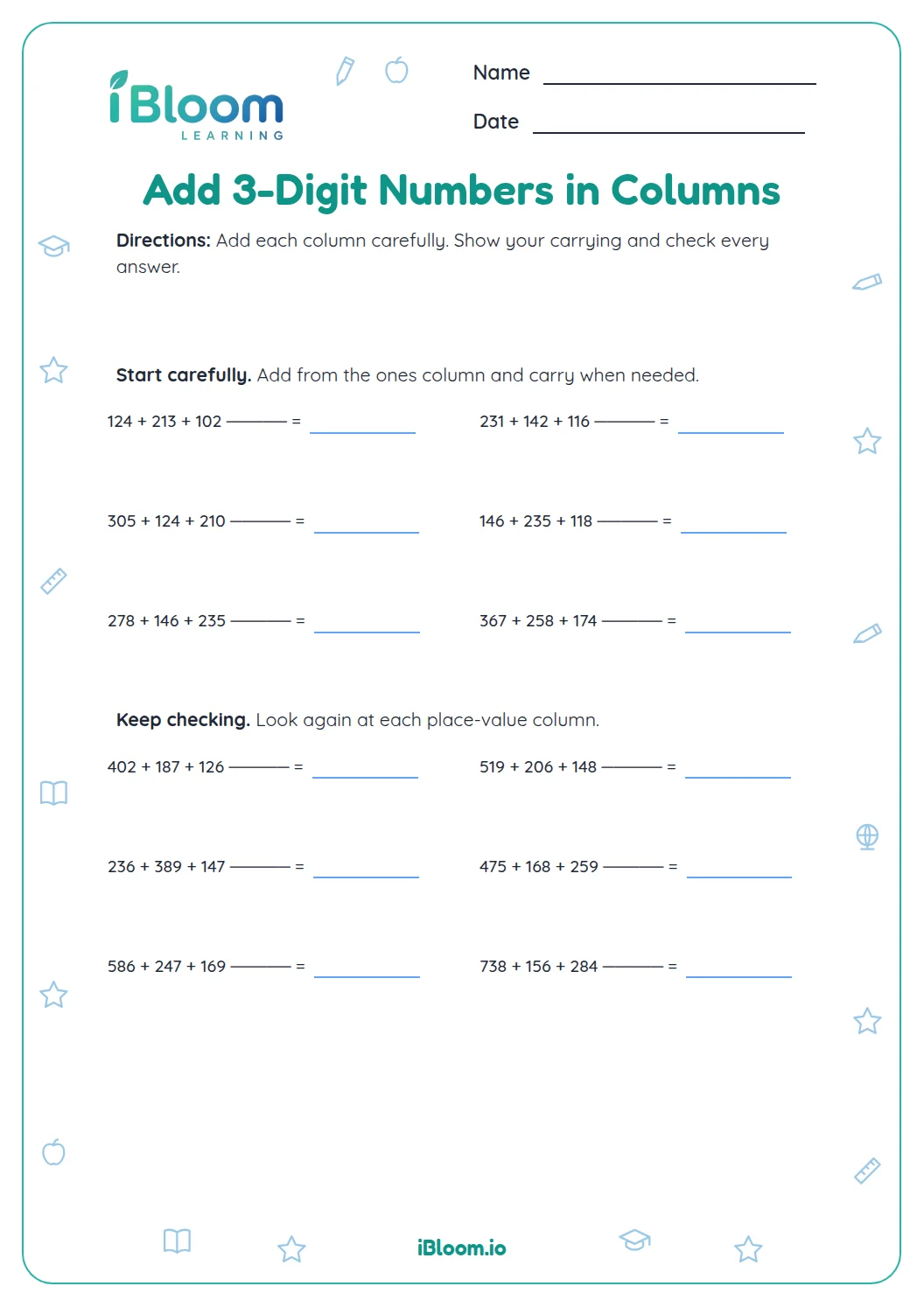
For 187 + 423 + 265, the ones are 7 + 3 + 5 = 15. Regroup 10 ones as 1 ten; the tens then total 17 tens, which regroup as 1 hundred and 7 tens. The hundreds total 8, plus the regrouped hundred, for 875.
- 1187 + 423 + 265
- 215 ones = 1 ten and 5 ones
- 316 tens + 1 ten = 17 tens
- 47 hundreds + 1 hundred = 8 hundreds
- 5Answer: 875
When do students regroup?
Regroup when a place has ten or more units. Count all three addends in one place before deciding; carrying from just two addends can miss a group.
What practice is included?
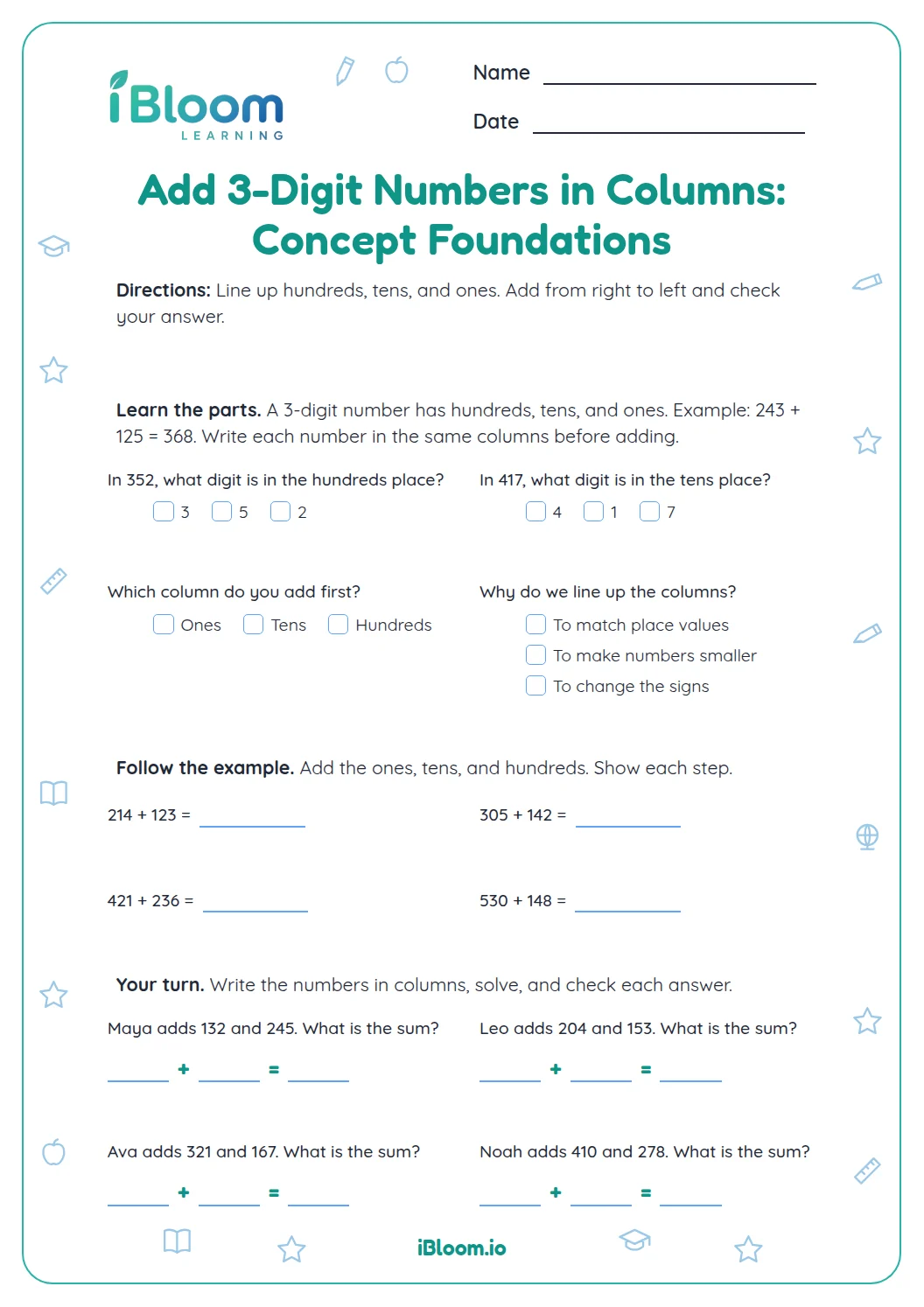
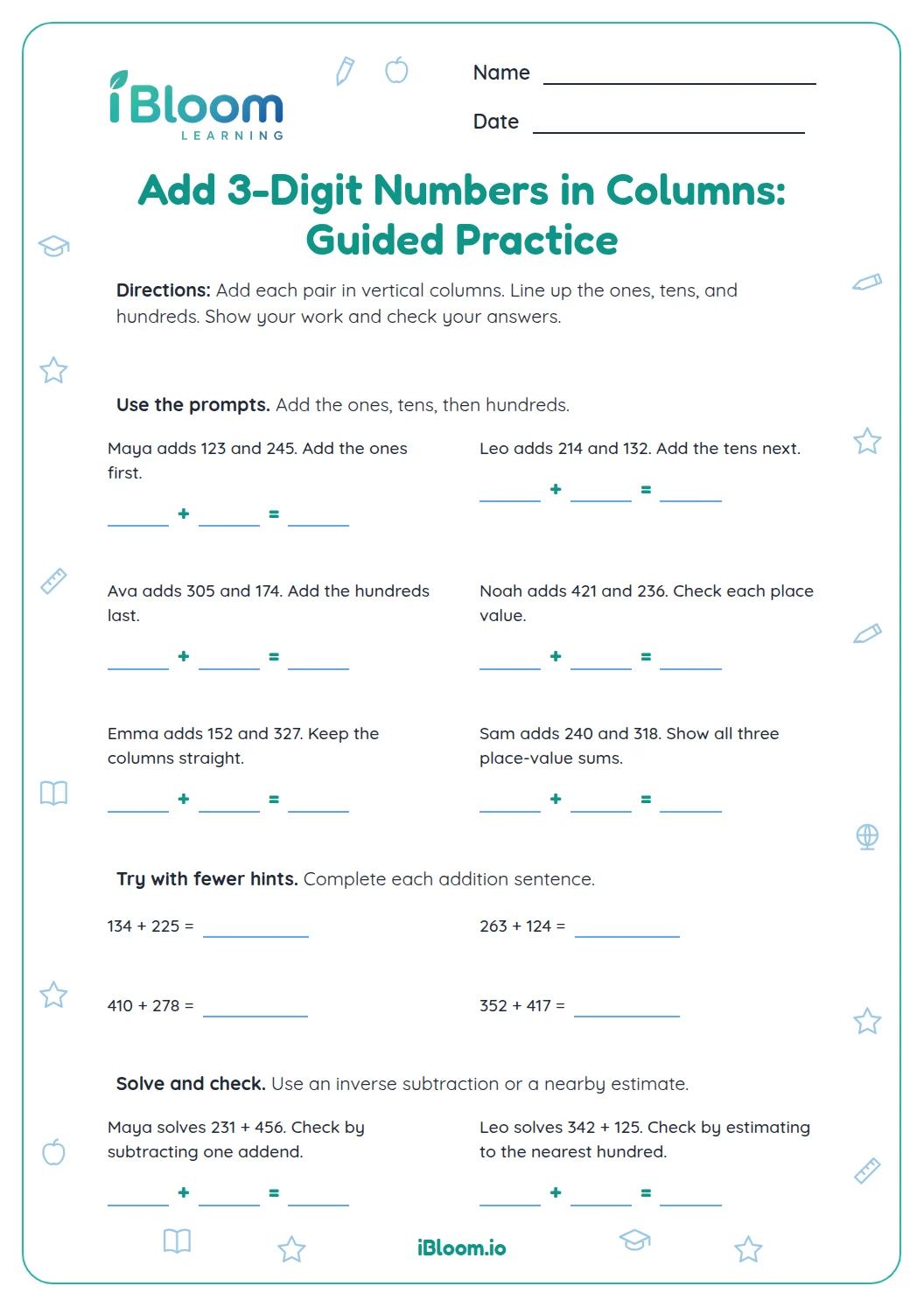
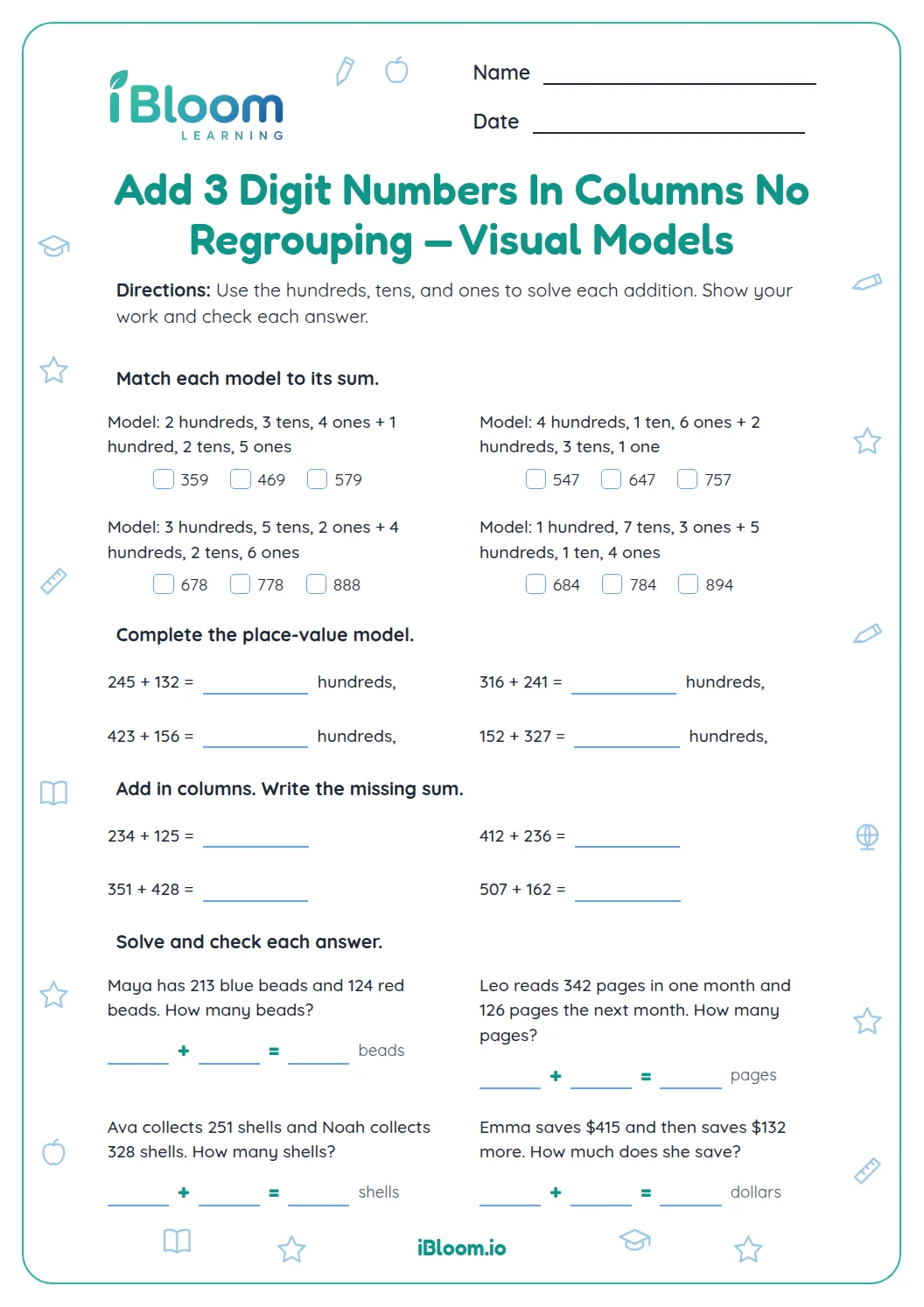
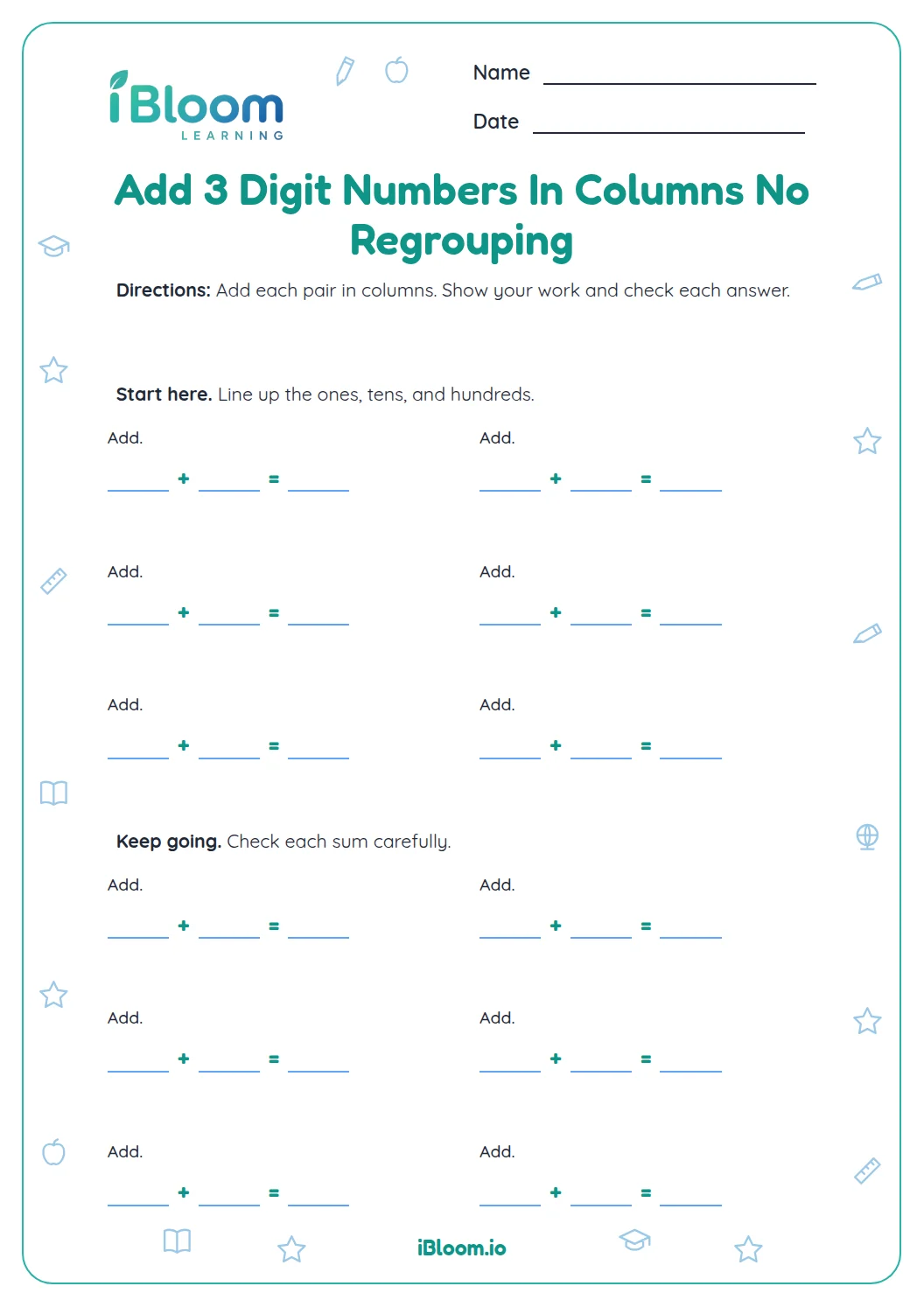
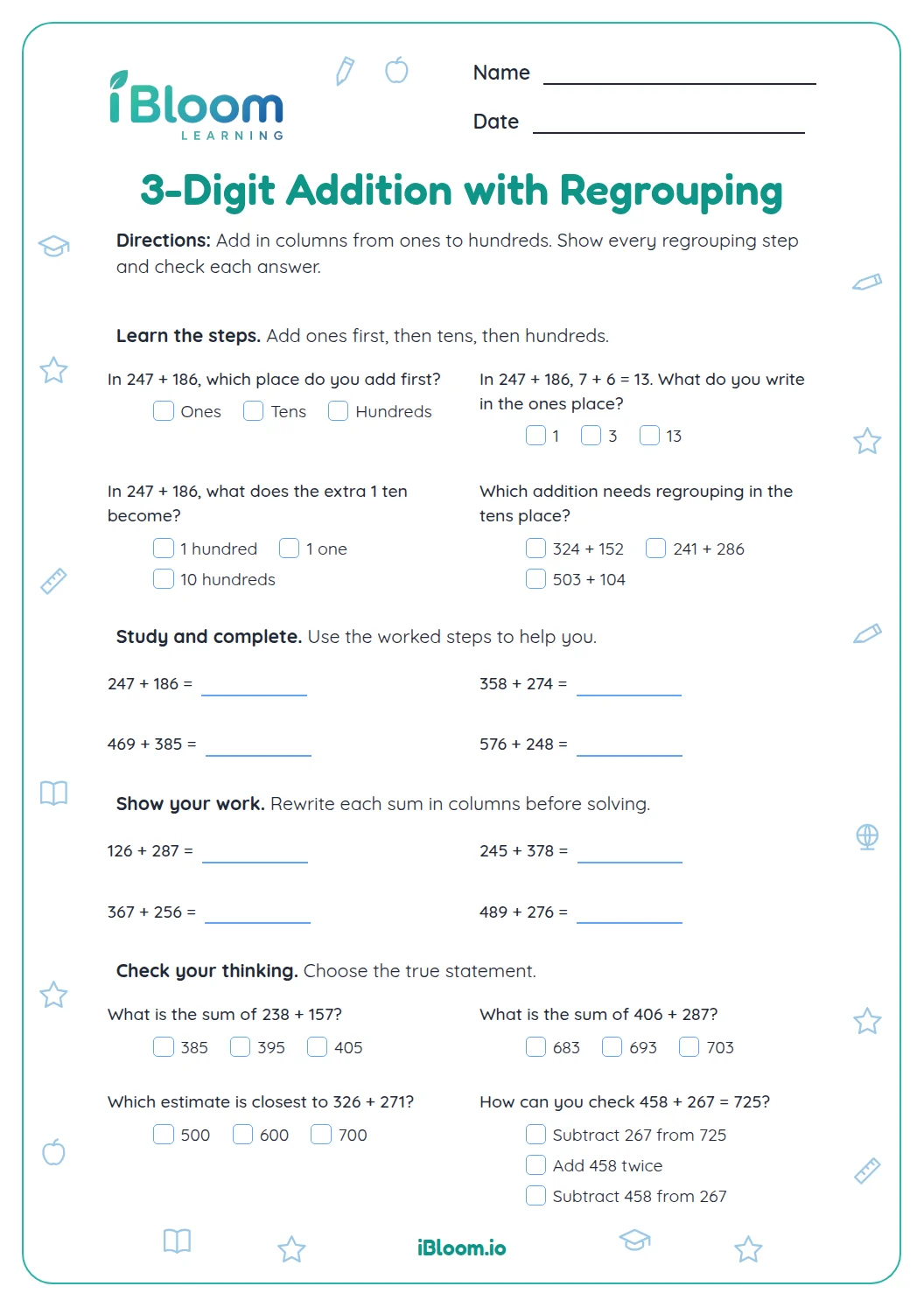
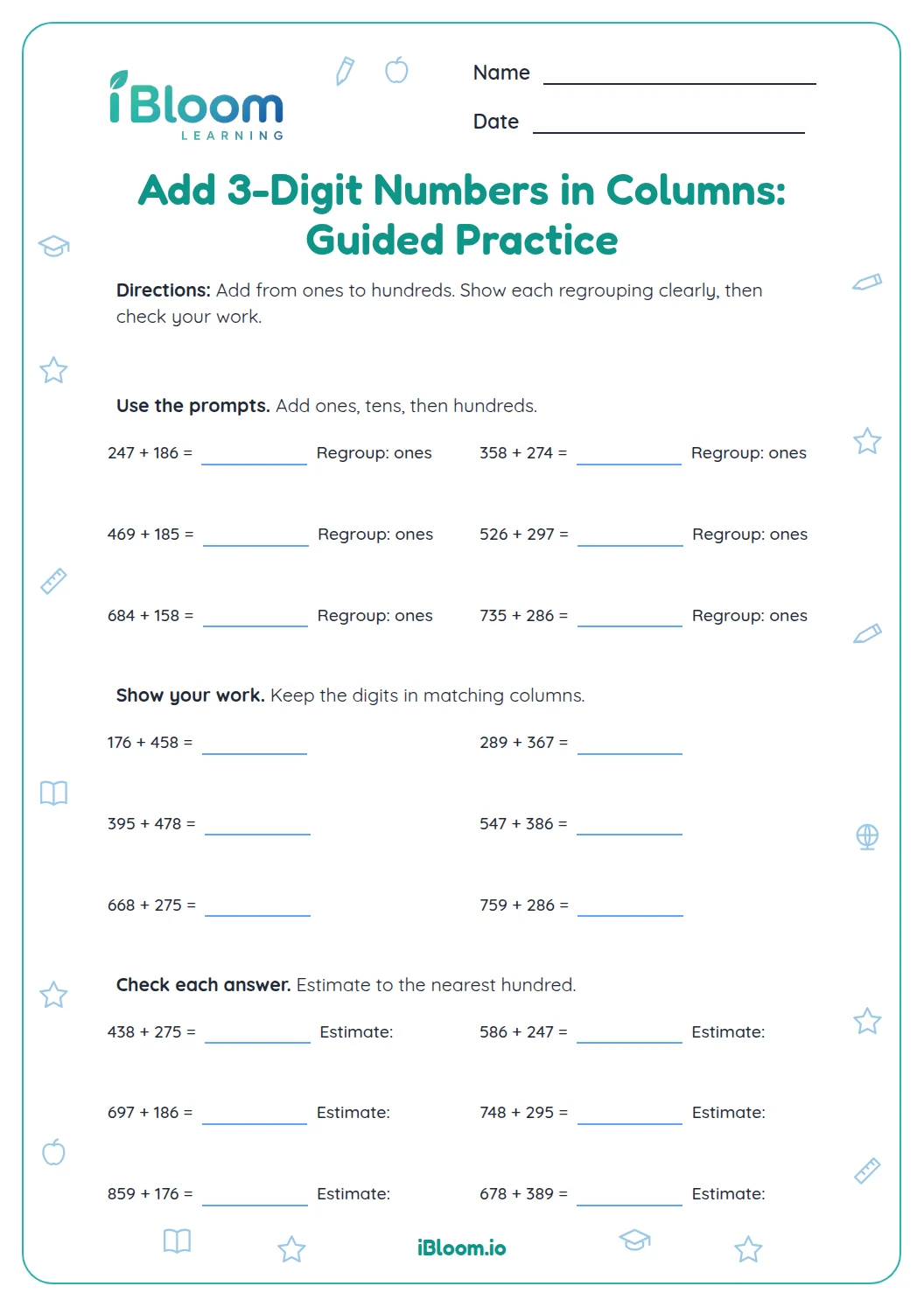
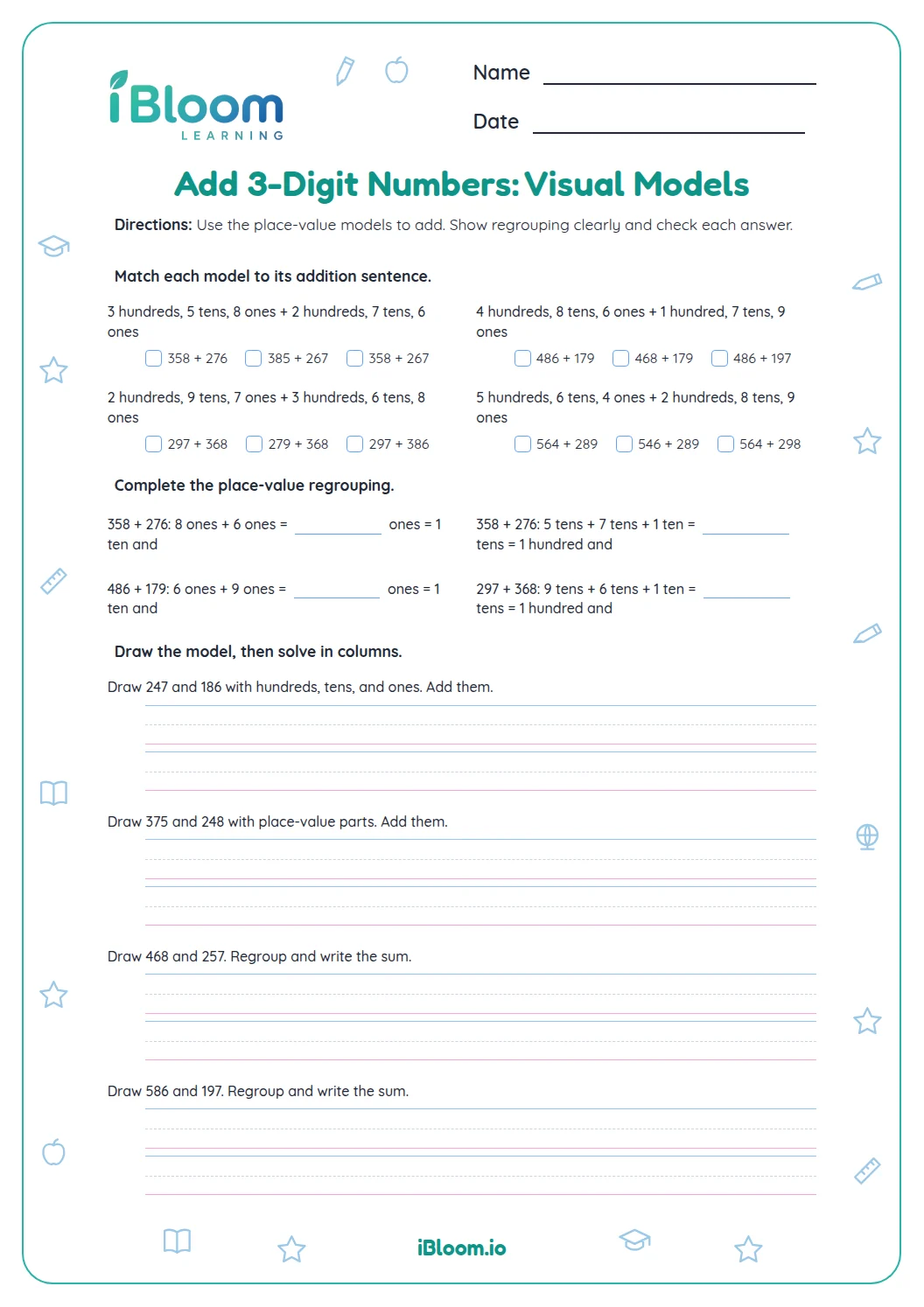
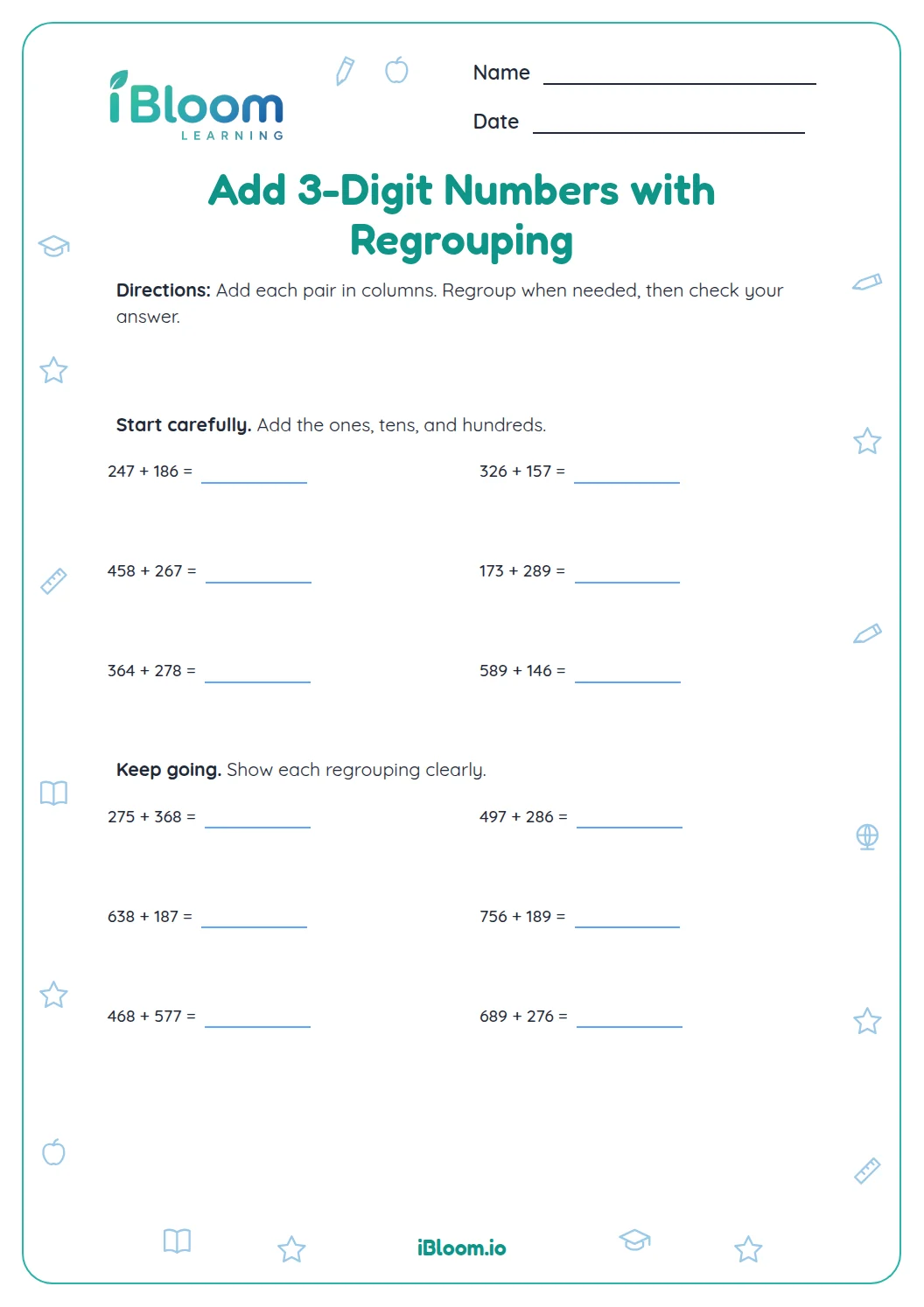
The first part connects block pictures to sums. The next part completes modeled place-value totals, and the final items give column addition with room to work.
How can I use this worksheet?
- 1Add all digits in one place.
- 2Regroup groups of ten.
- 3Continue through hundreds.
- 4Check with a second strategy.
What addition slips should I watch for?
The mistake
Leaving out a regrouped ten.
The fix
Record the trade above the next place before continuing.
The mistake
Adding only two addends in a column.
The fix
Point to all three digits in that place and include each one.
The mistake
Writing a column total as the digit.
The fix
Trade groups of ten and keep the remainder in the place.
Common Core alignment
This page practices the following Common Core math standard.
Add within 1,000 using place-value models and strategies.
On this sheet: Models and written sums connect hundreds, tens, and ones to addition within 1,000.
Show the official wordingHide the official wording
Add and subtract within 1000, using concrete models or drawings and strategies based on place value, properties of operations, and/or the relationship between addition and subtraction; relate the strategy to a written method. Understand that in adding or subtracting three-digit numbers, one adds or subtracts hundreds and hundreds, tens and tens, ones and ones; and sometimes it is necessary to compose or decompose tens or hundreds.
What to practice next
Make more practice
Further reading
Questions parents and teachers ask
What should children do when there are more than 9 ones?
Trade 10 ones for 1 ten, then add that ten with the tens in the other addends. The same idea applies when the tens total is 10 or more: trade 10 tens for 1 hundred. Ask the student to point to every group or addend as they explain the steps, then compare the result with the separate key.
How many problems are on the sheet?
There are 16 questions across three parts: matching a model, completing modeled sums, and solving addition problems in columns. The answer key gives a total for each item. Ask the student to point to every group or addend as they explain the steps, then compare the result with the separate key.
What does a base-ten drawing represent?
A large square represents one hundred, a rod represents one ten, and a small unit represents one. The drawings help students see why regrouping changes 10 smaller units into 1 larger unit. Ask the student to point to every group or addend as they explain the steps, then compare the result with the separate key.
Why can the columns total more than nine?
The columns show the combined units before trading. For 187 + 423 + 265, there are 15 ones and 16 tens; trade 10 ones for a ten and then trade 10 tens for a hundred to reach 875. Ask the student to point to every group or addend as they explain the steps, then compare the result with the separate key.
Can students use a different strategy?
Yes. They may add hundreds, tens, and ones in a different order, use an expanded form, or add vertically. The check is that regrouping preserves the value and the final sum is correct. Ask the student to point to every group or addend as they explain the steps, then compare the result with the separate key.