





About this worksheet
This Grade 2 printable practices reading analog clocks to five minutes and using familiar time units in everyday situations. Fourteen questions include clock readings, sensible-unit choices, calendar facts, and short calculations with minutes. The separate answer key supports quick checking.
Aligned to 2.MD.C.7
How do I read a clock to five minutes?
Start with the short hand to find the hour. Then count by fives around the clock for the minutes. For example, when the minute hand points to 5, it has moved 25 minutes past the hour.
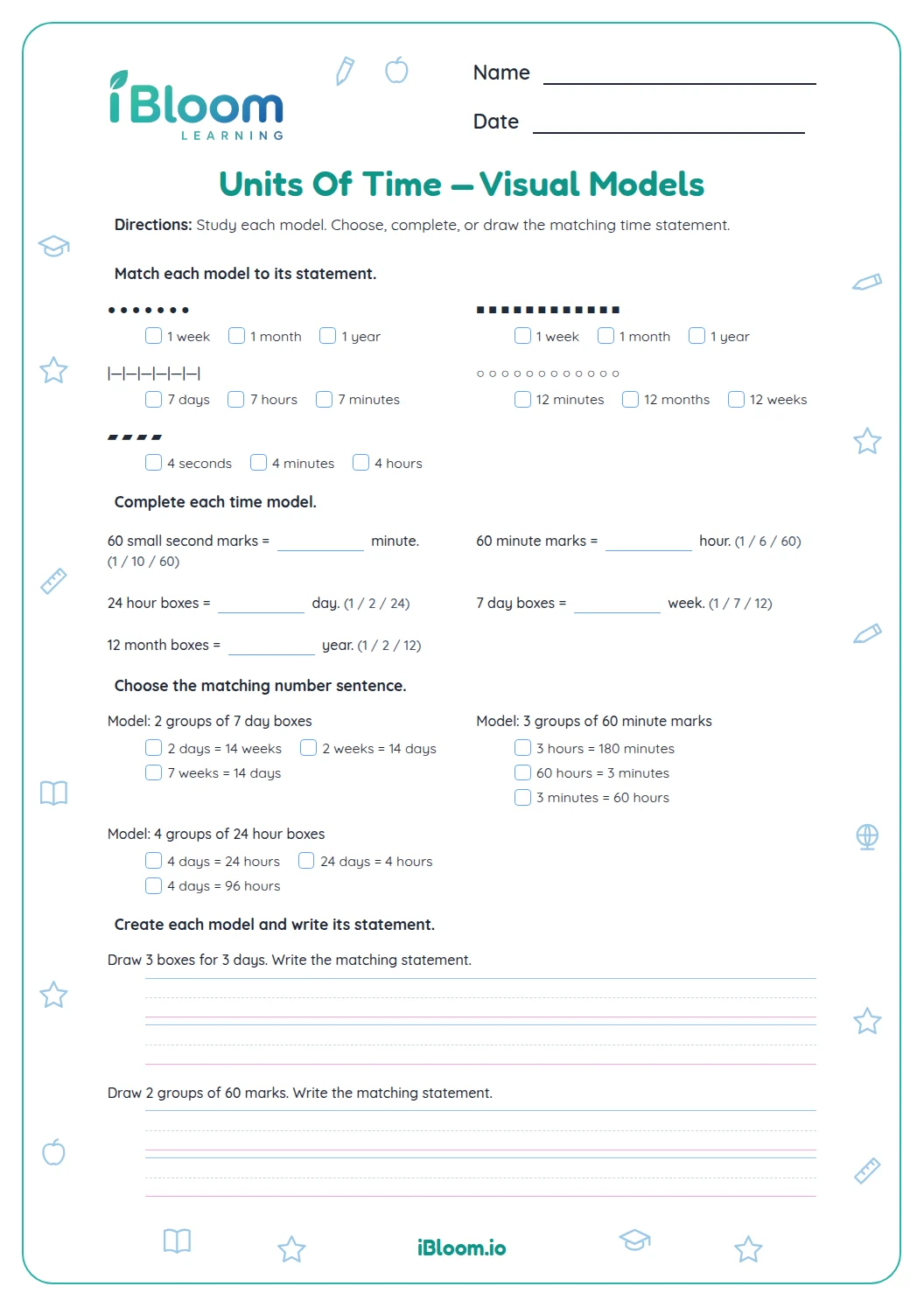
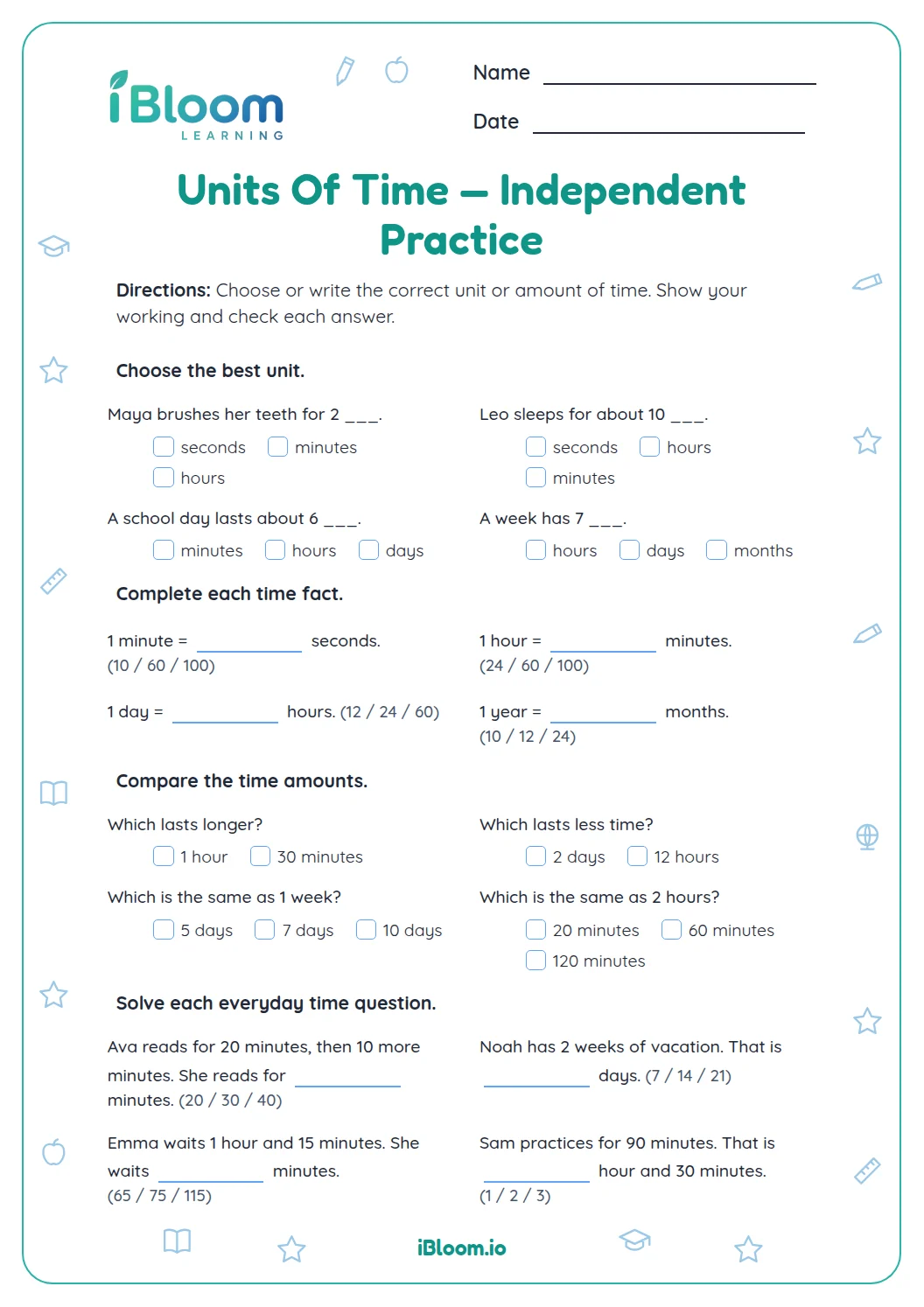
Which time unit fits each situation?
Seconds and minutes describe brief activities; hours describe longer parts of a day. Weeks and months help describe calendars. The sheet asks children to use familiar facts, including 7 days in a week and 60 minutes in an hour.
What does the worksheet include?
The printable has 14 questions in 3 parts, followed by a separate answer key.
How to use this worksheet
- 1Read each clock by naming the hour first, then counting minutes by fives.
- 2For a unit question, picture how long the event lasts before choosing.
- 3Use 7 days in a week to answer calendar questions.
- 4For the reading stories, add the two amounts of minutes.
- 5Check each answer for a sensible unit before using the key.
Time facts to check
The mistake
Reading the long hand as the hour hand.
The fix
The short hand shows the hour; the long hand shows minutes.
The mistake
Counting each clock number as one minute.
The fix
Each number is five minutes apart, so count by fives.
The mistake
Writing a number without its unit.
The fix
Add minutes, hours, days, or weeks when the question asks for a measured amount.
Common Core alignment
This worksheet practices the following Common Core skill.
Tell time on analog and digital clocks to the nearest five minutes.
On this sheet: Students read each drawn clock to the nearest five minutes.
Show the official wordingHide the official wording
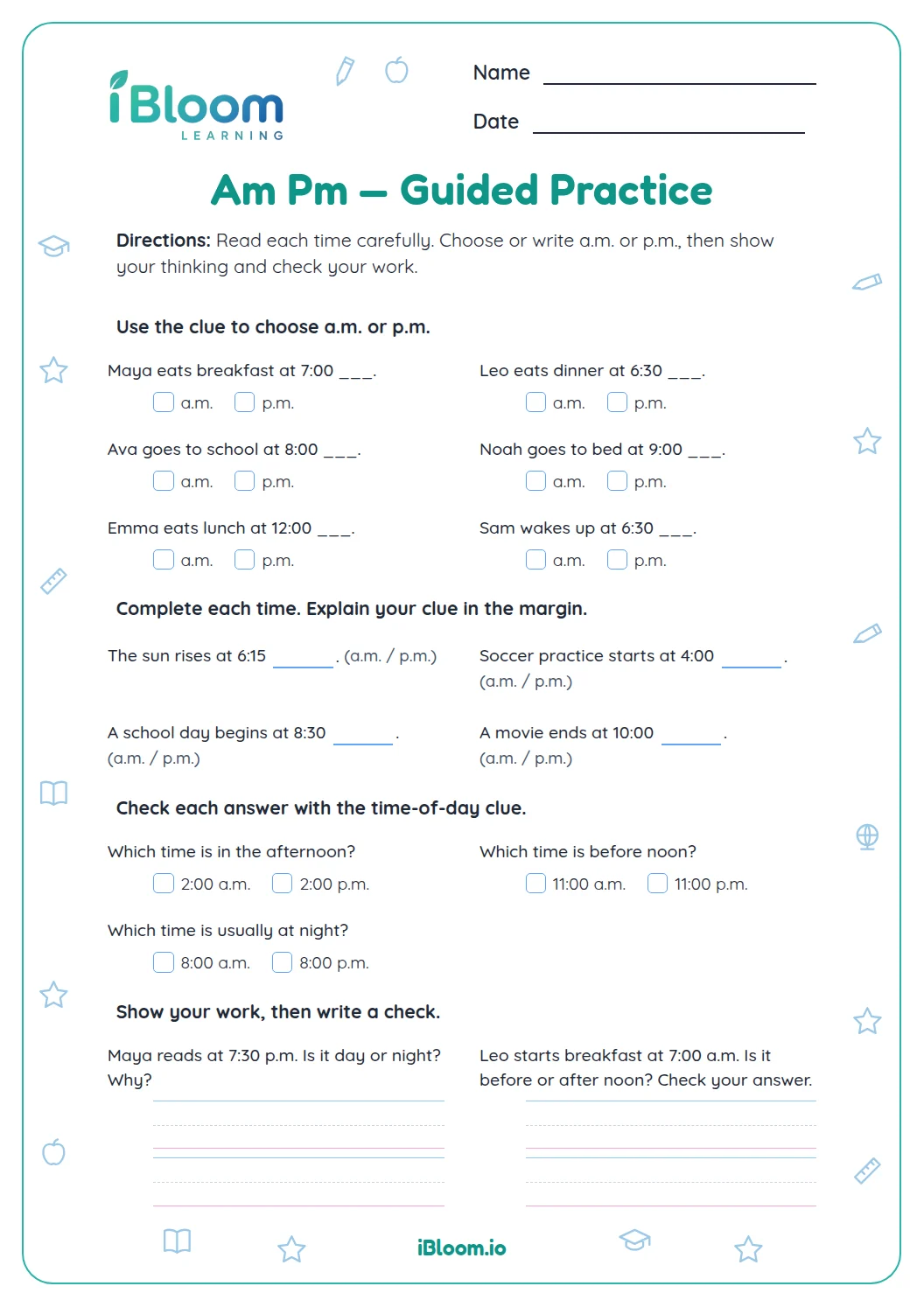
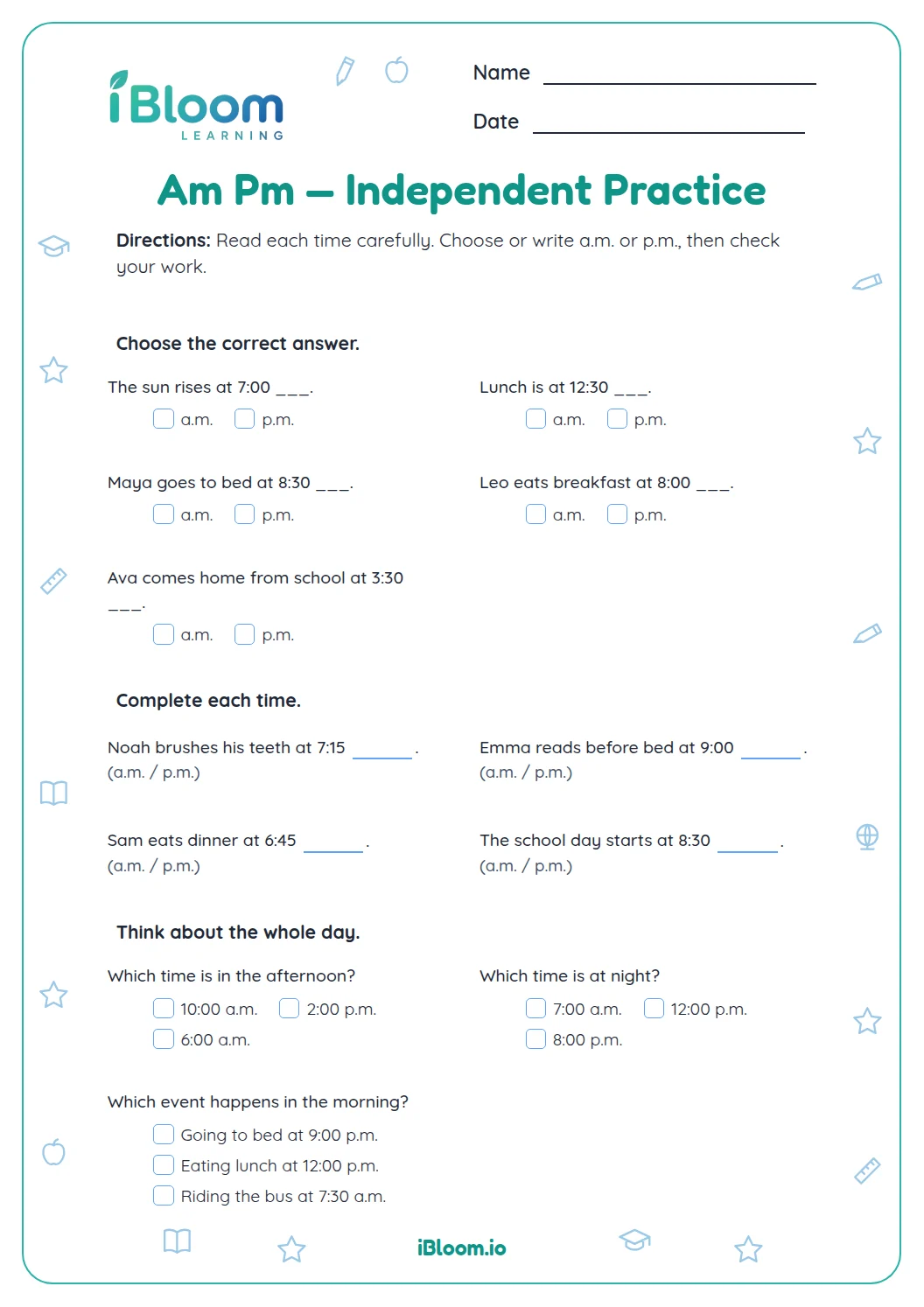
Tell and write time from analog and digital clocks to the nearest five minutes, using a.m. and p.m.
What to practice next
Make more practice
Further reading
Questions parents and teachers ask
How do I read a clock to five minutes?
Find the number the long hand points to, then count by fives from 12. If it points to 4, that is 20 minutes past the hour. Read the short hand to name the hour, and say both parts together, such as 6:20.
What does the short hand show?
The short hand shows the hour. If it sits between two numbers, use the number it has passed, then read the long hand for the minutes. For example, a short hand just past 3 with the long hand at 6 reads 3:30.
How many days are in three weeks?
There are 7 days in a week. Three groups of 7 days make 21 days, so 3 weeks is 21 days. The worksheet uses this calendar fact in a practical question; a multiplication check is 3 × 7 = 21.
Why does the worksheet ask for units?
A number alone may not describe a time clearly. Minutes fit a short activity, while days or weeks describe longer spans. Naming the unit helps show what the answer measures and makes the response easier to check. Parents can ask the student to name an example for each unit.
Is an answer key included?
Yes. The printable includes an answer key for all 14 questions. It lists the clock readings, selected units, and calculations so a student or adult can check the work after the page is complete. The key can be used after students finish the clock and calendar practice.