

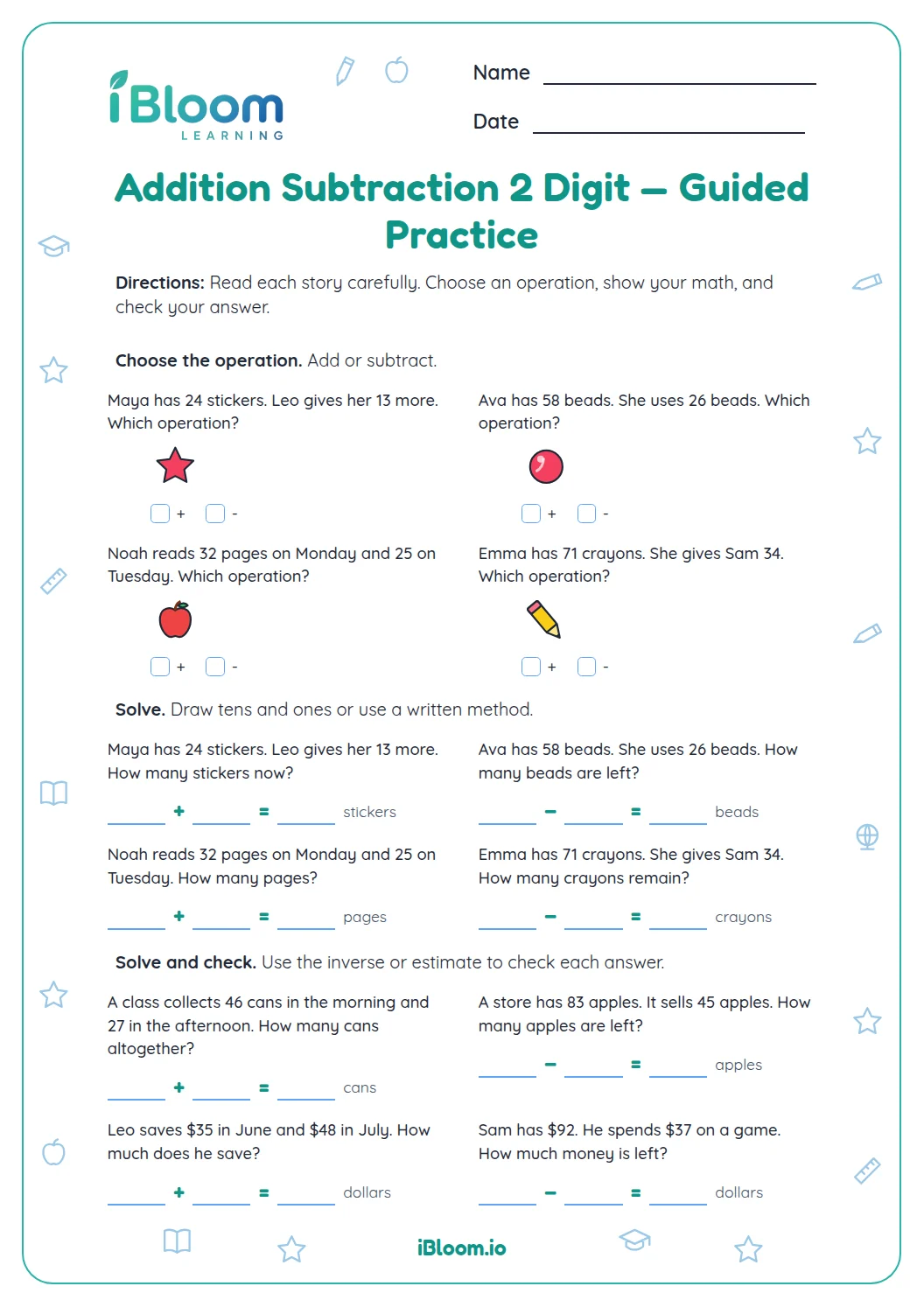
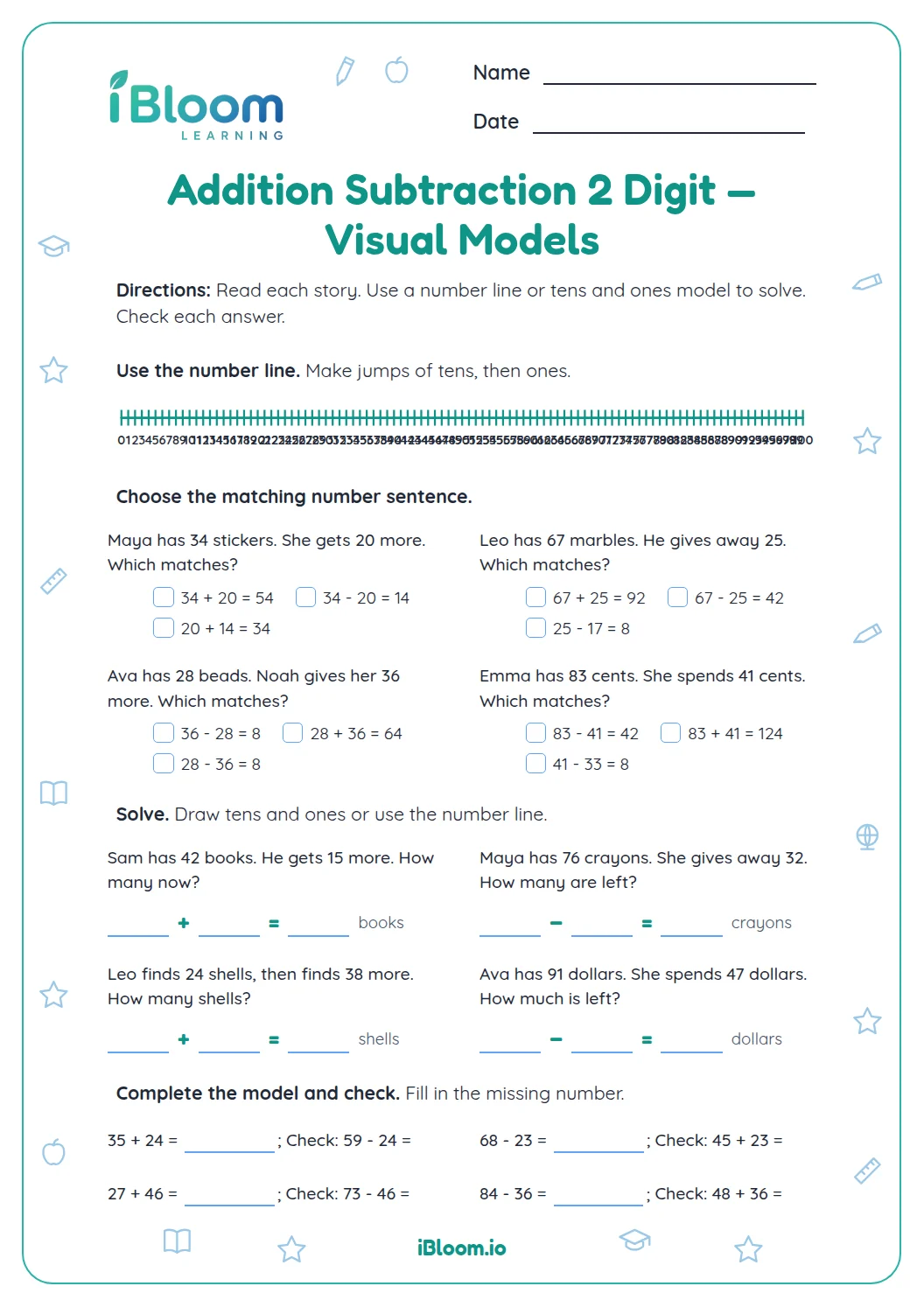
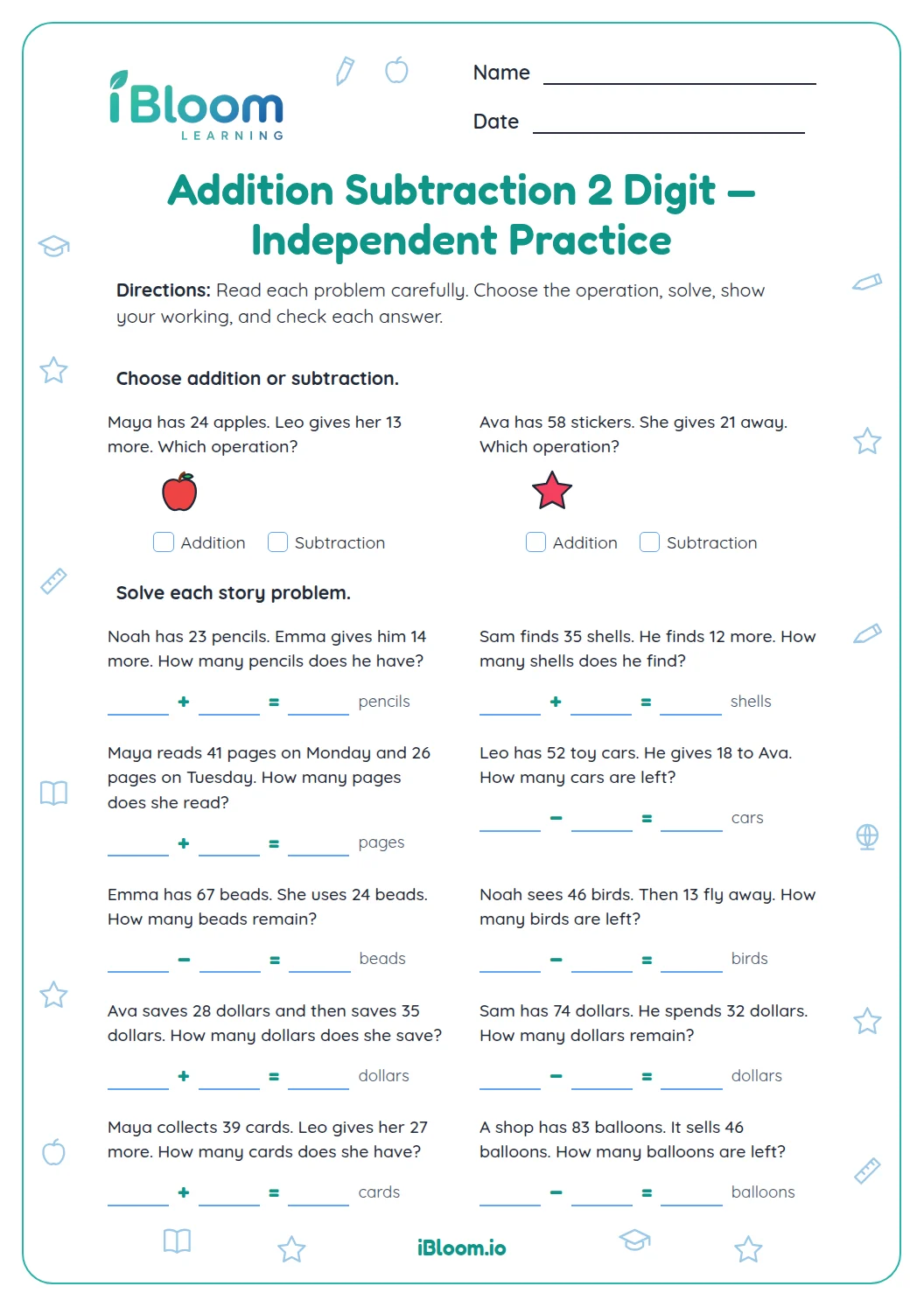
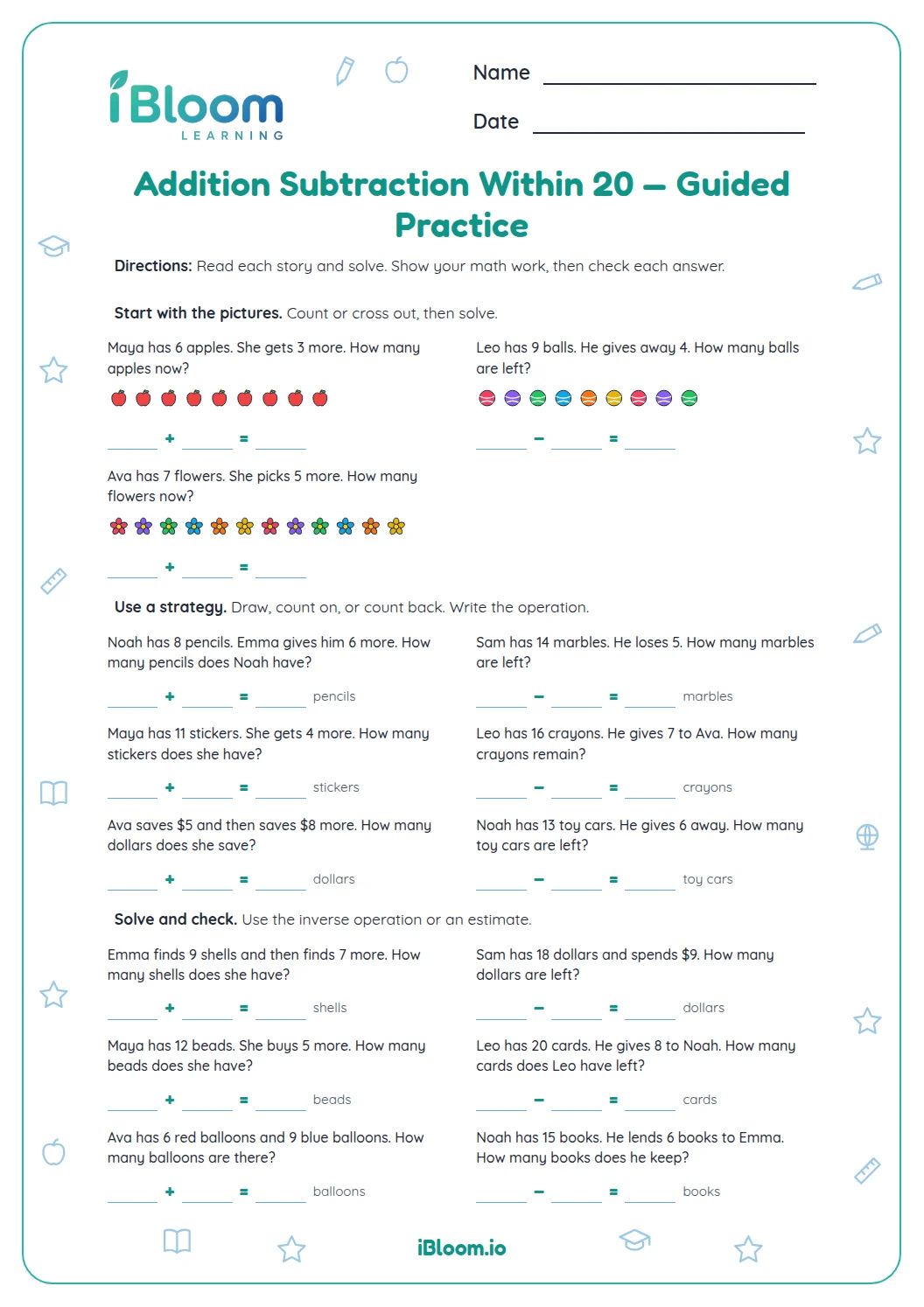
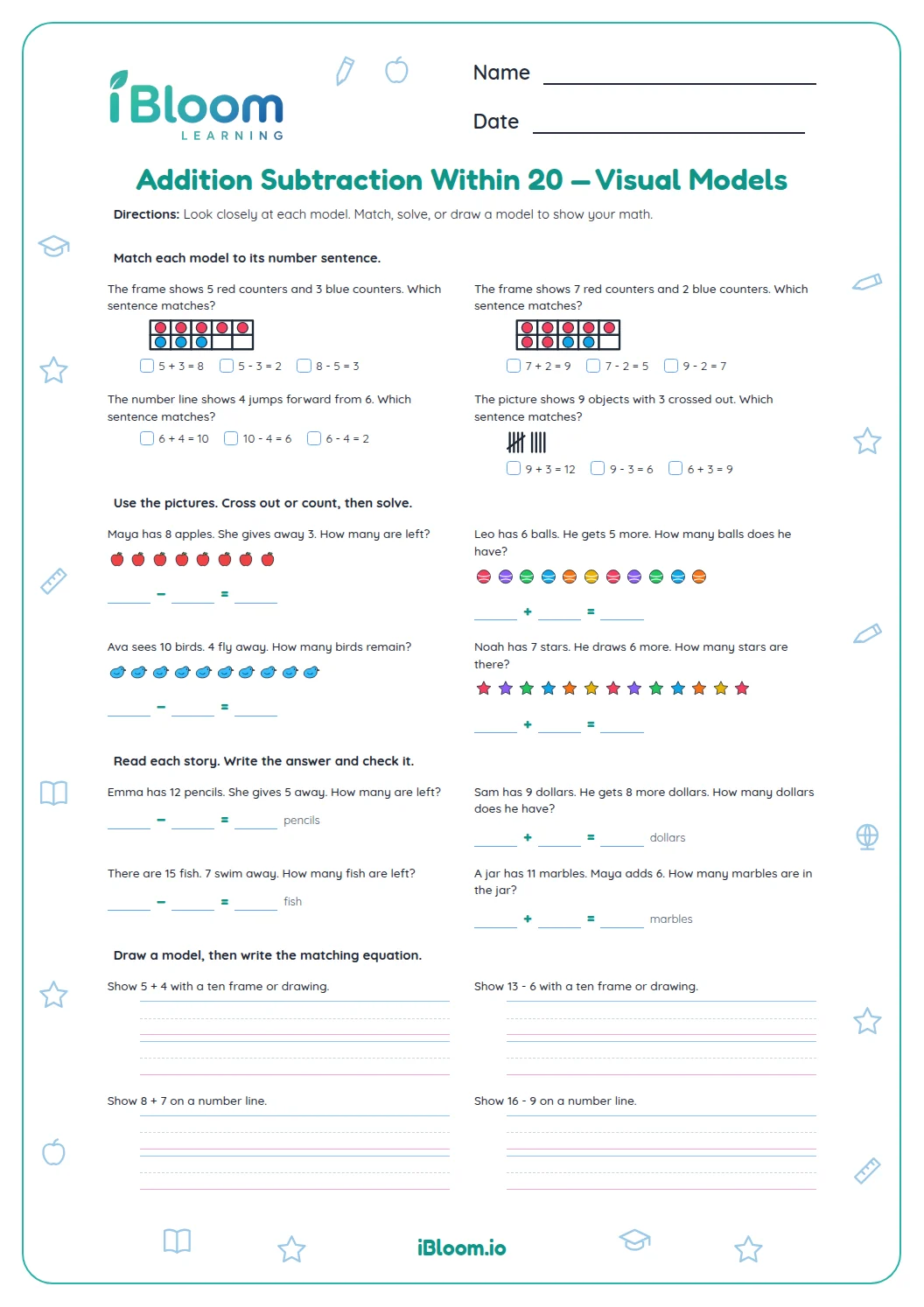
About this worksheet
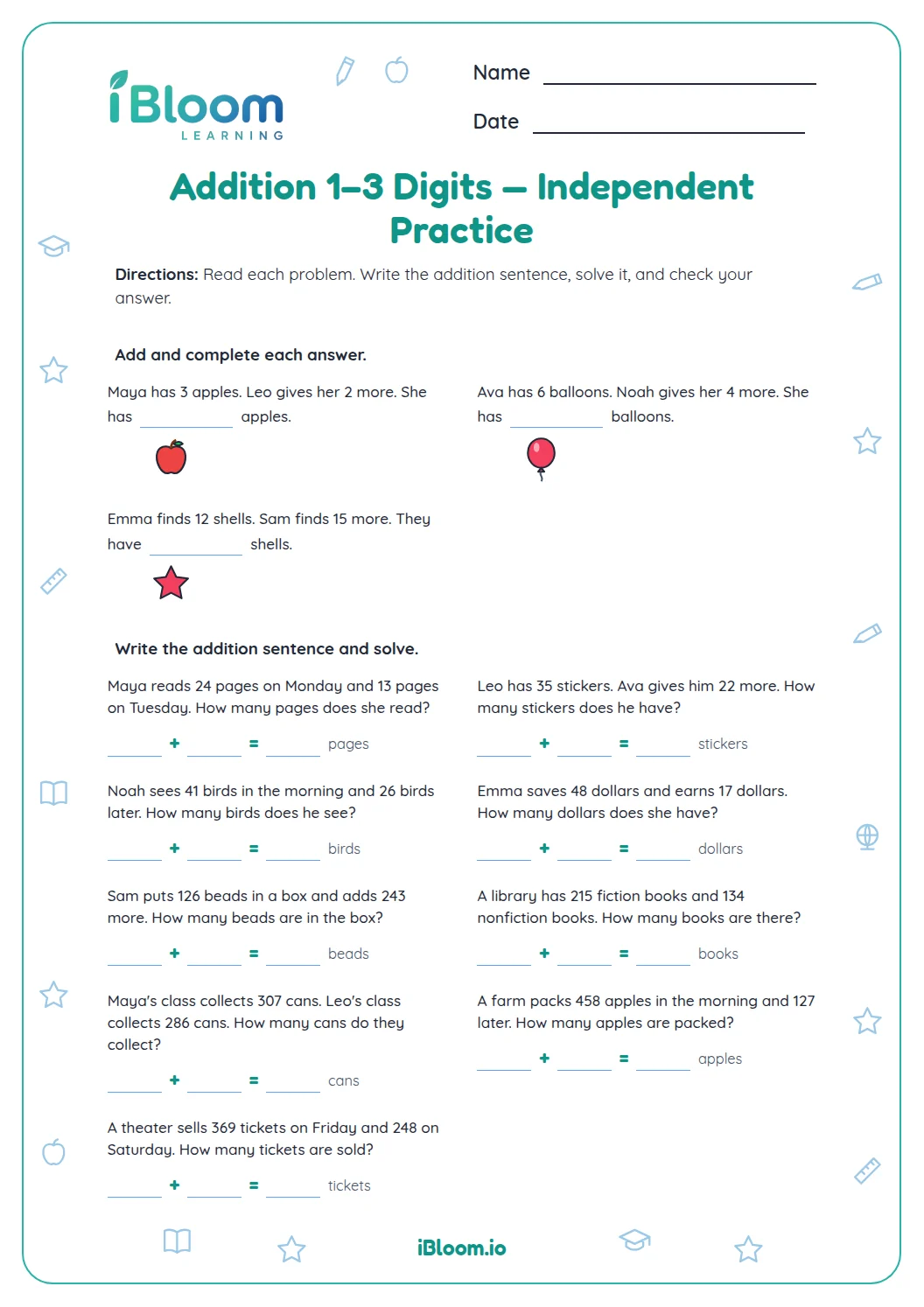
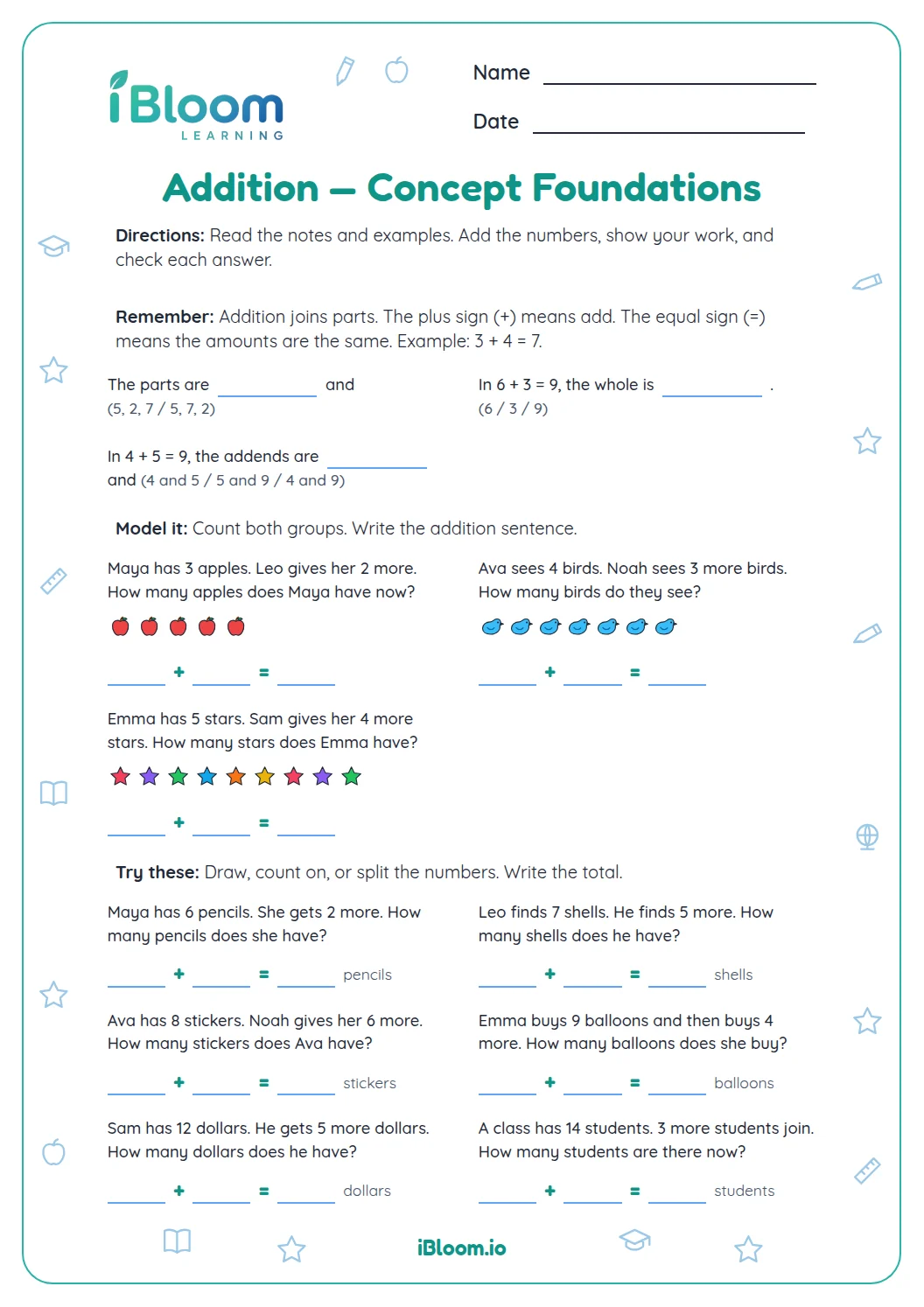
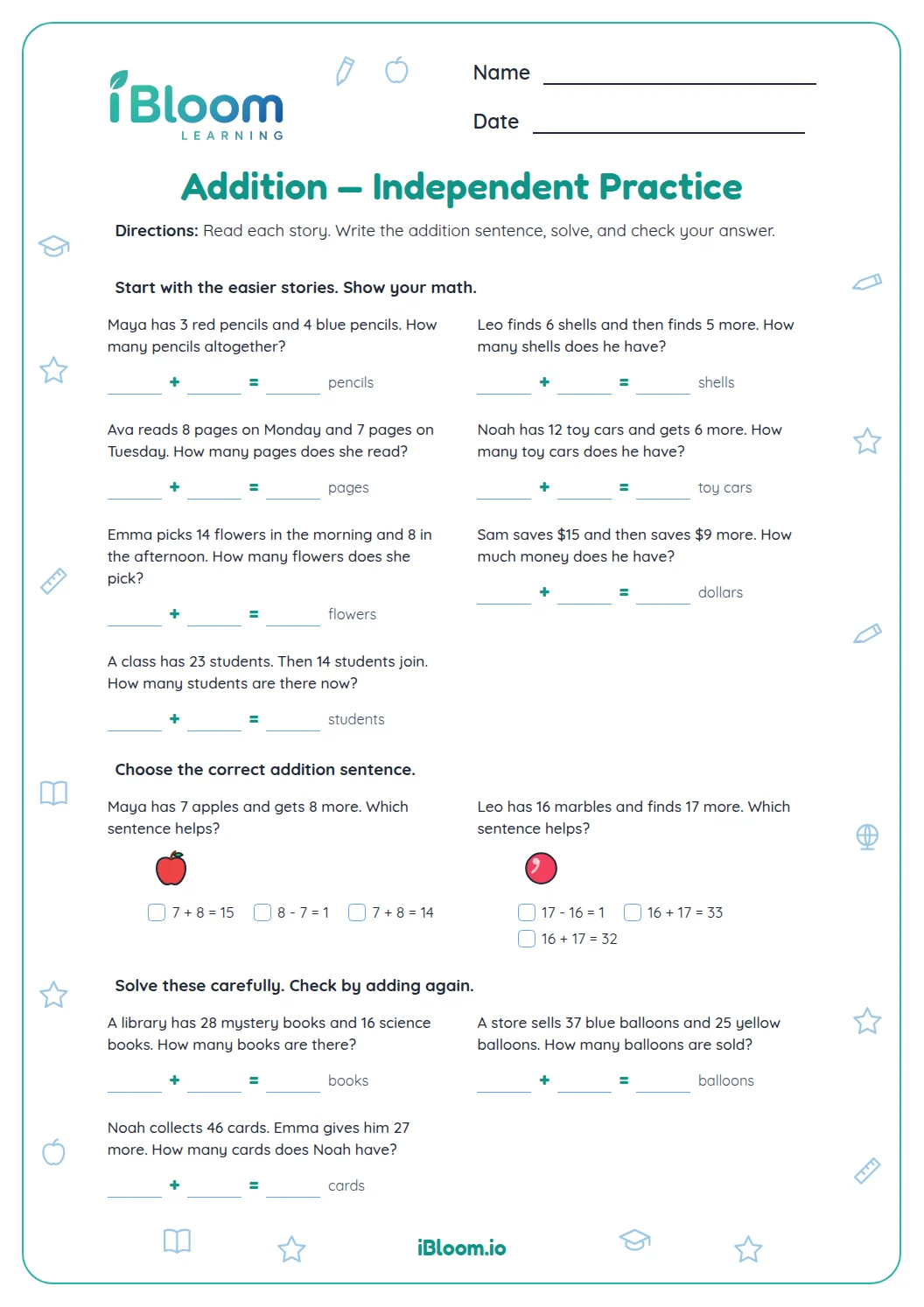
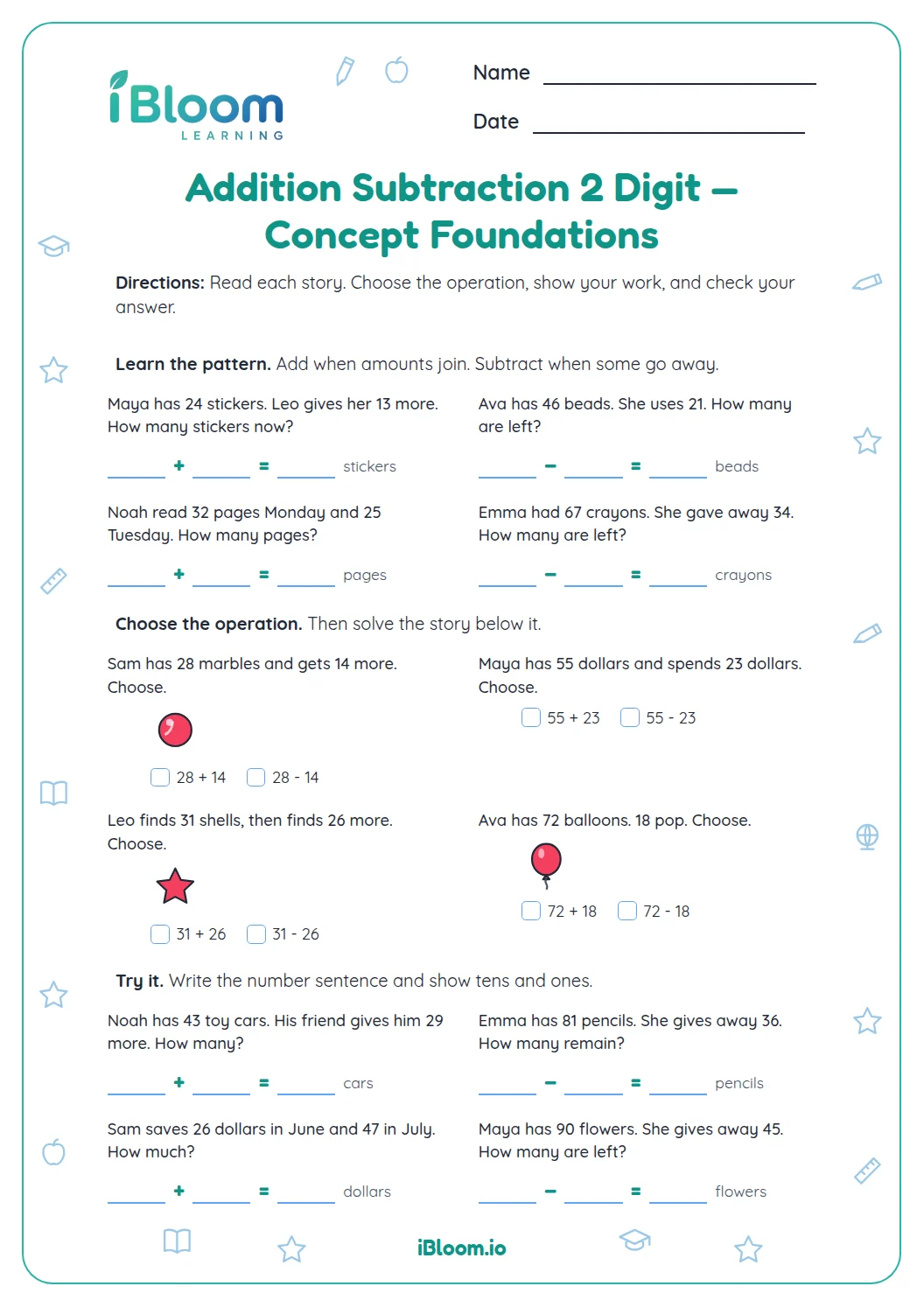
This free printable worksheet gives Grade 2 students 16 problems focused on two-digit and three-digit addition stories and equations. The practice moves from guided questions to independent work, and the answer key shows the answer to each item. The questions use grade-appropriate numbers and clear equations so students can focus on the named skill. It practices Common Core 2.OA.A.1.
Aligned to 2.OA.A.1
What will students practice?
The worksheet has 2 parts, arranged from guided practice to independent problems. The questions vary the numbers and formats while staying with two-digit and three-digit addition stories and equations.
The old page’s check items packed a sum and estimate/check value into one blank. The replacement separates each item and supplies one clear addition equation or story per question.
How can a student check an answer?
Use the equation in the question to check the missing value. For example, for 108 + 41, add ones (8 + 1 = 9), tens (0 + 4 = 4), and hundreds (1). The sum is 149. | Check: 149 − 41 = 108.
- 1For 108 + 41, add ones (8 + 1 = 9), tens (0 + 4 = 4), and hundreds (1). The sum is 149.
- 2Check: 149 − 41 = 108.
What should students notice?
Keep each addend’s ones, tens, and hundreds in matching places. When a place totals 10 or more, regroup before moving to the next place. Subtract one addend from the sum to check the total.
How to use this worksheet
- 1Read the question and identify both amounts.
- 2Choose addition when the amounts are joined.
- 3Write an equation with both addends and a plus sign.
- 4Add ones, tens, then hundreds, regrouping when needed.
- 5Name the total and check by subtracting an addend.
Common mistakes and quick fixes
The mistake
Forget the plus sign between addends.
The fix
Write the equation before calculating so both amounts have a clear operation.
The mistake
Add digits from different places together.
The fix
Line up ones under ones, tens under tens, and hundreds under hundreds.
The mistake
Write only a total without answering what it counts.
The fix
Include the story noun, such as 149 blocks.
Common Core alignment
This worksheet connects the printed practice to a specific Common Core math goal.
Represent and solve addition word problems with equations.
On this sheet: Represent and solve addition word problems with equations.
Show the official wordingHide the official wording
Use addition and subtraction within 100 to solve one- and two-step word problems involving situations of adding to, taking from, putting together, taking apart, and comparing, with unknowns in all positions, e.g., by using drawings and equations with a symbol for the unknown number to represent the problem.
What to practice next
Make more practice
Further reading
Questions parents and teachers ask
What kinds of addition problems are on this page?
Students solve eight addition stories and eight matching-style number sentences. The numbers range from two digits to three digits, with sums below 1,000. Ask the student to point to the numbers in the equation and explain what each one represents before calculating. This keeps the work connected to the question.
How can a student organize a three-digit addition problem?
Write the numbers so the ones, tens, and hundreds line up. Add each place, regroup when needed, and check by subtracting one addend from the sum. Ask the student to point to the numbers in the equation and explain what each one represents before calculating. This keeps the work connected to the question.
Why does the answer key show one answer per item?
Each question has one requested total. The old check section combined a sum with another value in the same blank; this version gives each question one number blank. Ask the student to point to the numbers in the equation and explain what each one represents before calculating. This keeps the work connected to the question.
Do the word problems all use the same story?
No. The contexts include park kites, reading, blocks, flowers, shells, books, and game points. Students still add two amounts, but they must identify the quantities and name what the sum counts. Ask the student to point to the numbers in the equation and explain what each one represents before calculating. This keeps the work connected to the question.
How many pages and questions are included?
There are 16 questions in the worksheet and a separate key. The first half asks students to translate stories into addition equations; the second half gives equations to solve and check. Ask the student to point to the numbers in the equation and explain what each one represents before calculating. This keeps the work connected to the question.
Which standard is practiced?
The questions practice 2.OA.A.1: using addition and subtraction within 100 to solve one- and two-step word problems. Some sums reach three digits because the page title explicitly asks for one- to three-digit addition. Ask the student to point to the numbers in the equation and explain what each one represents before calculating. This keeps the work connected to the question.