

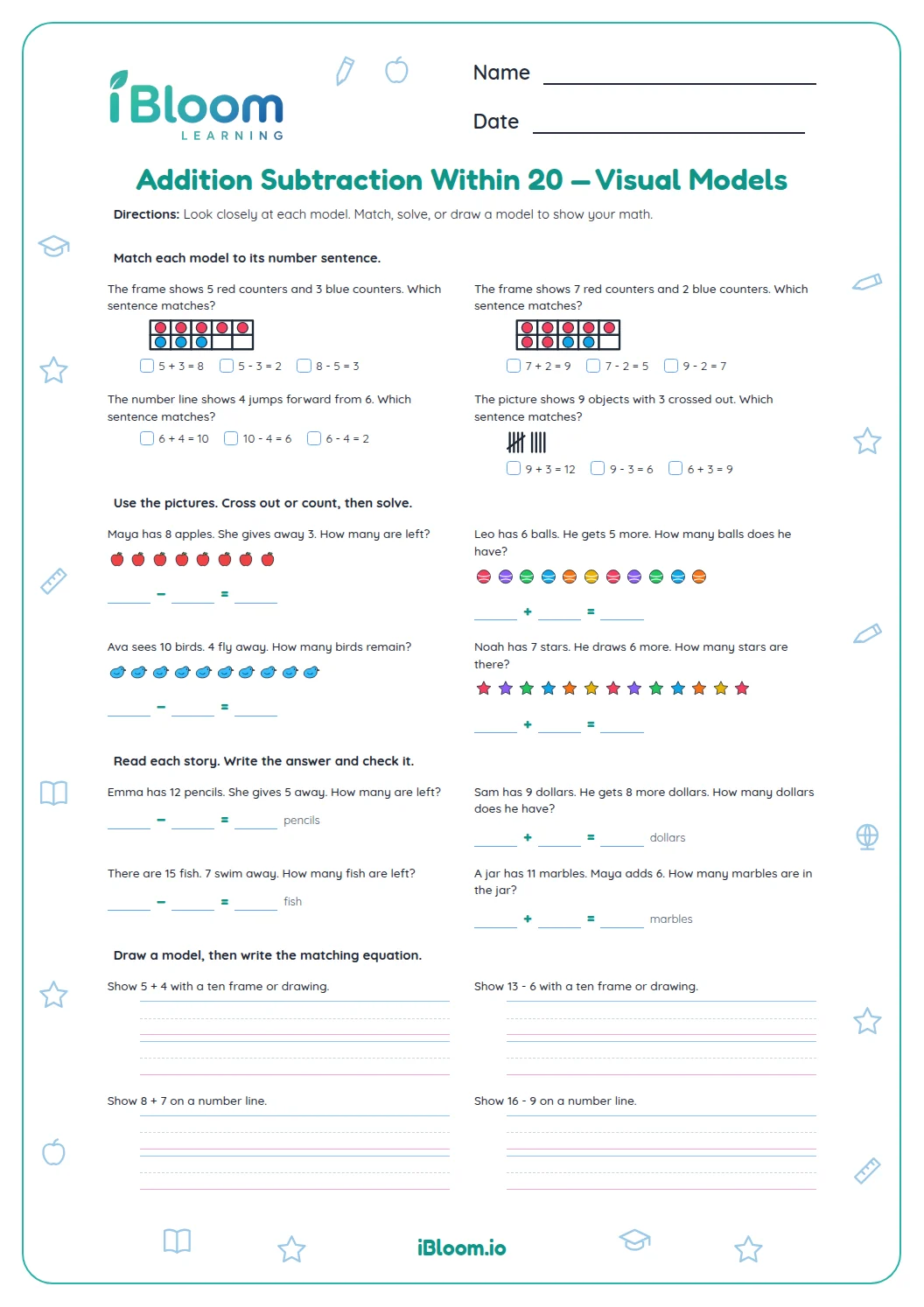
About this worksheet
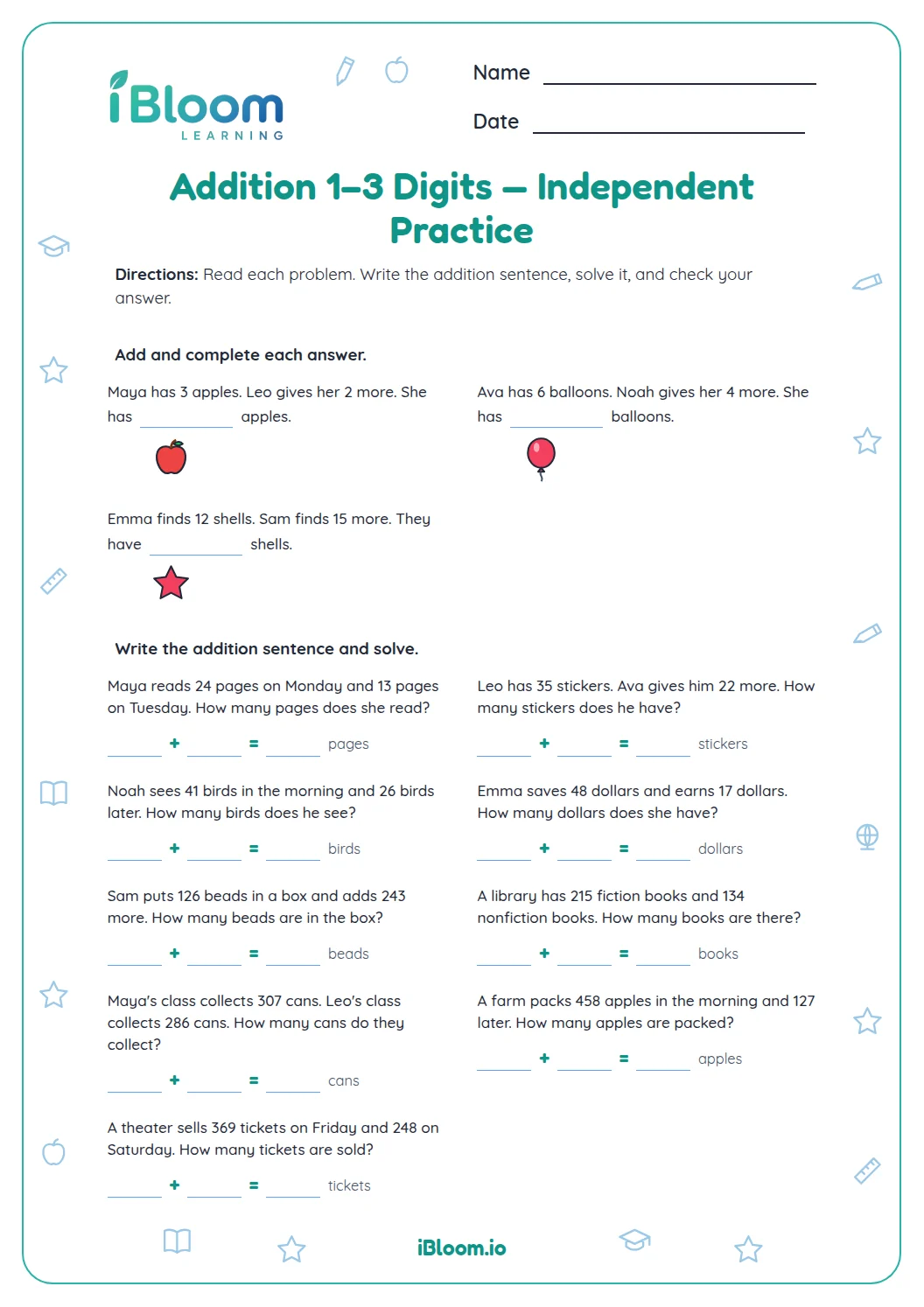
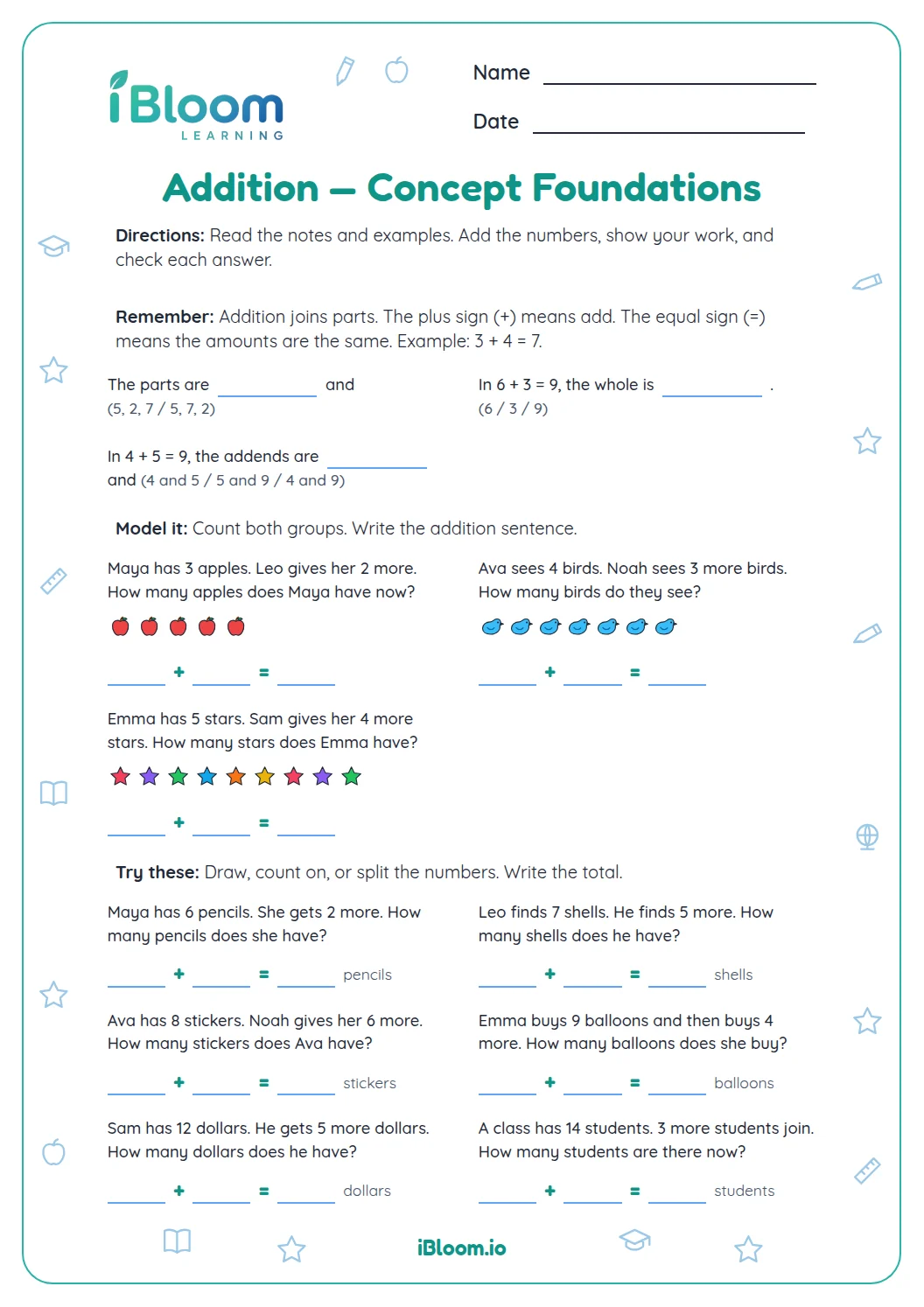
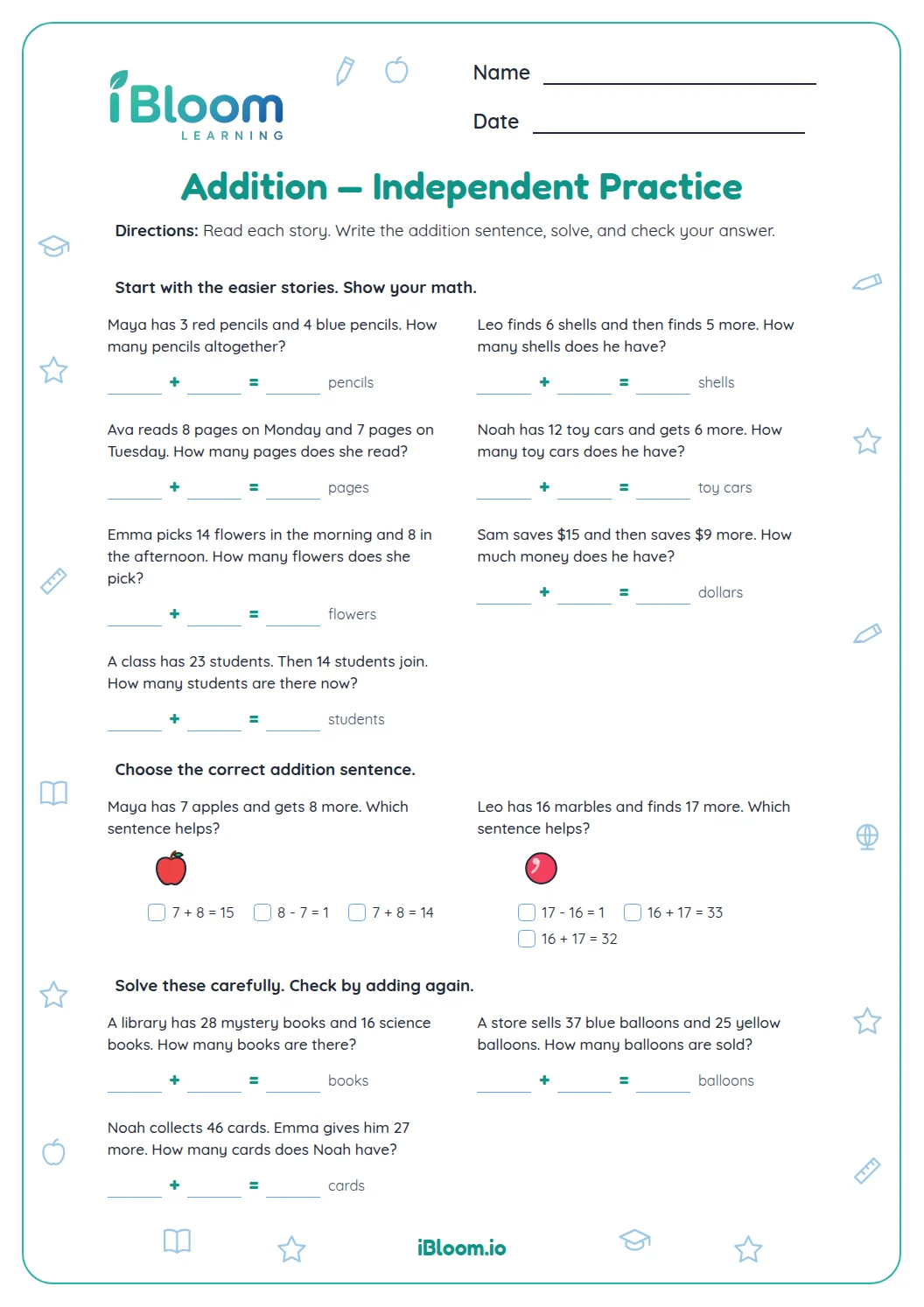
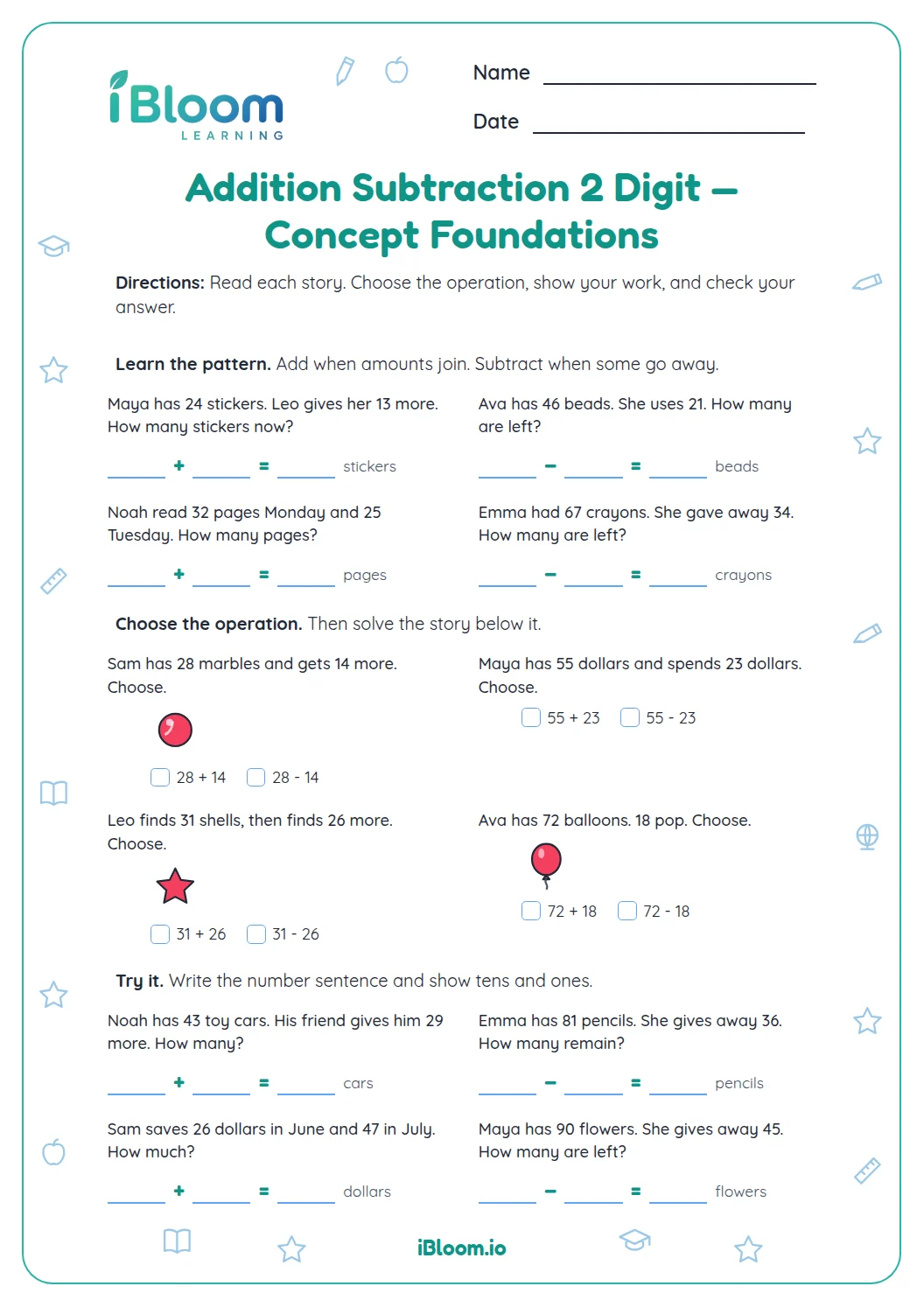
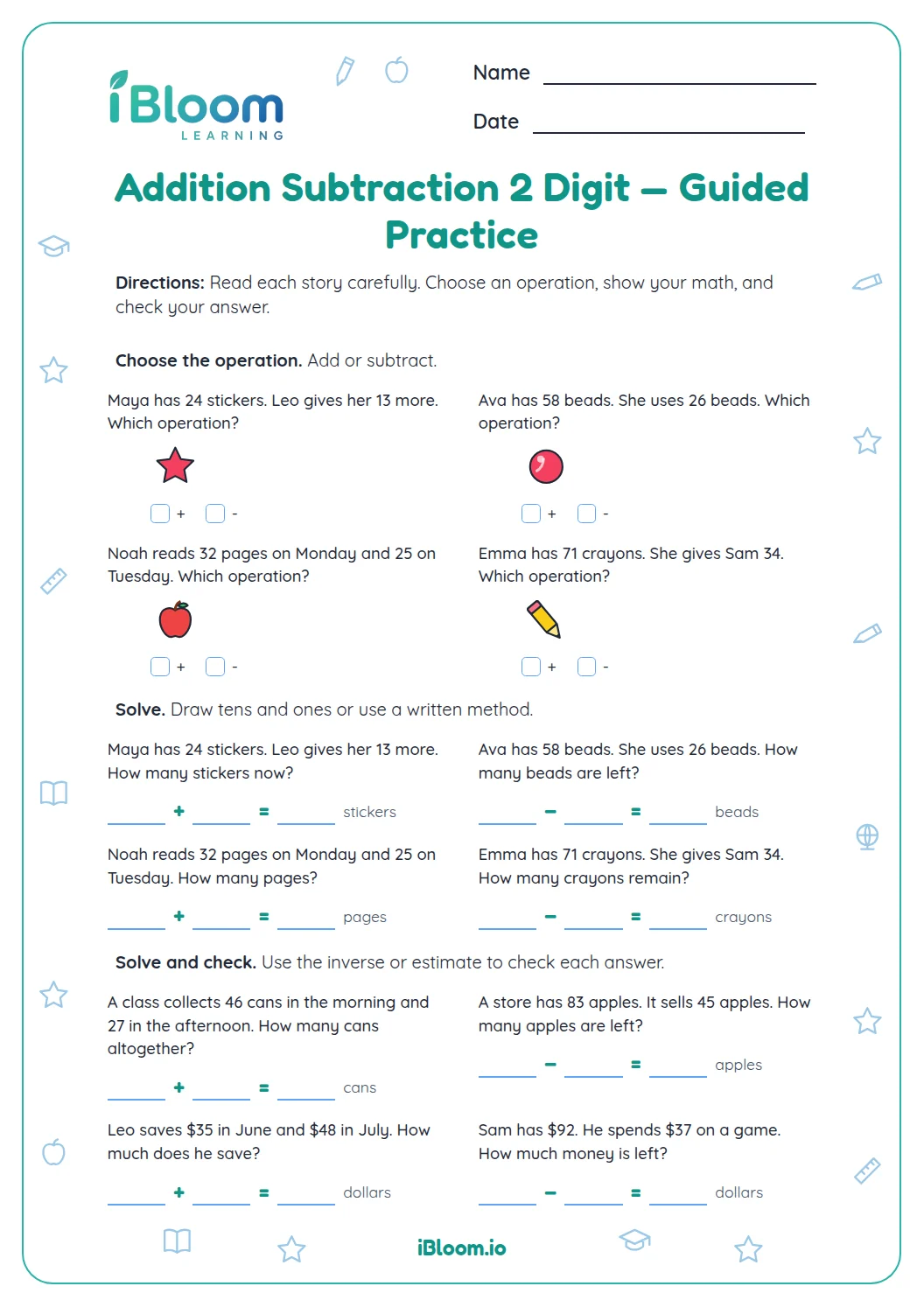
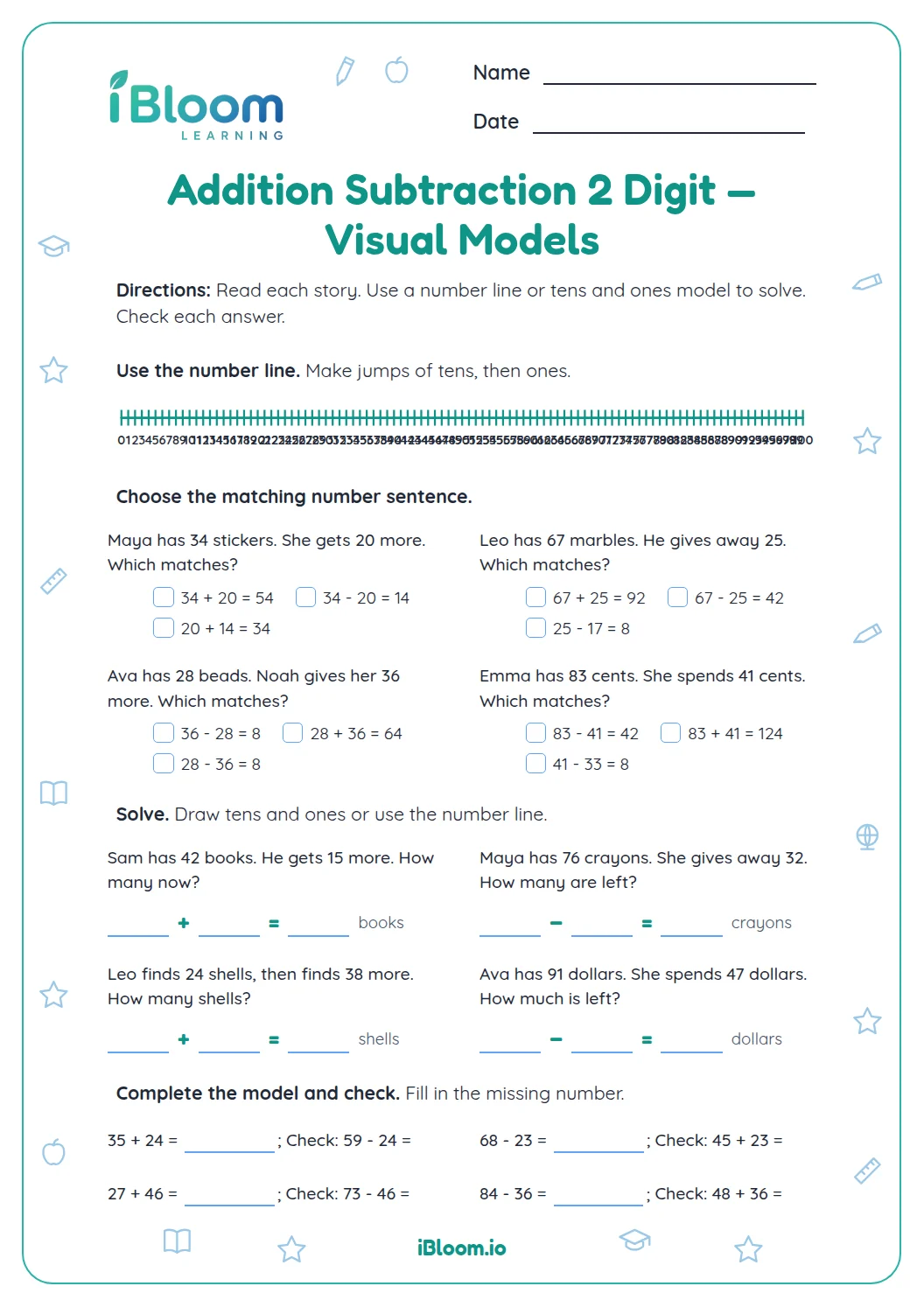
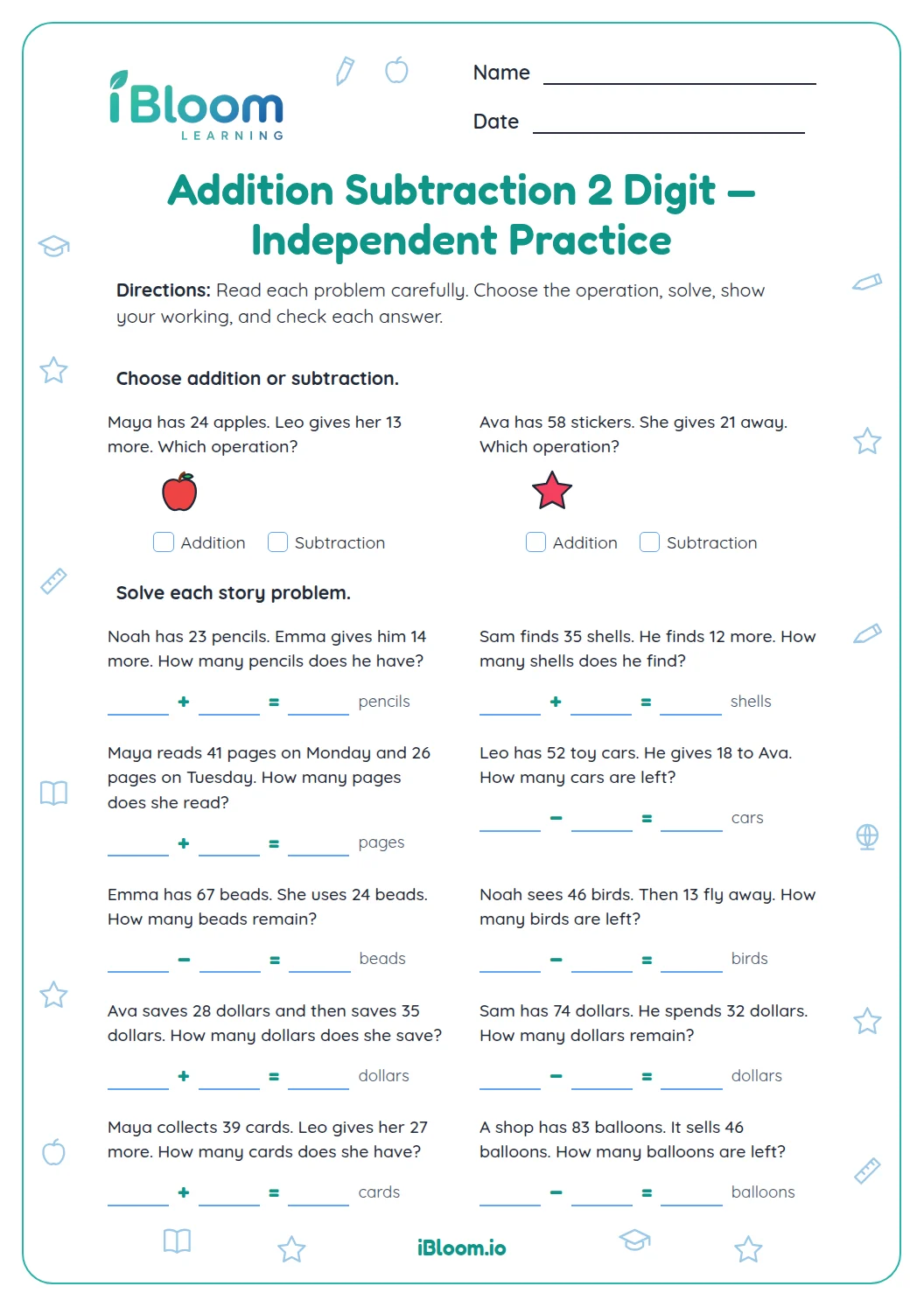
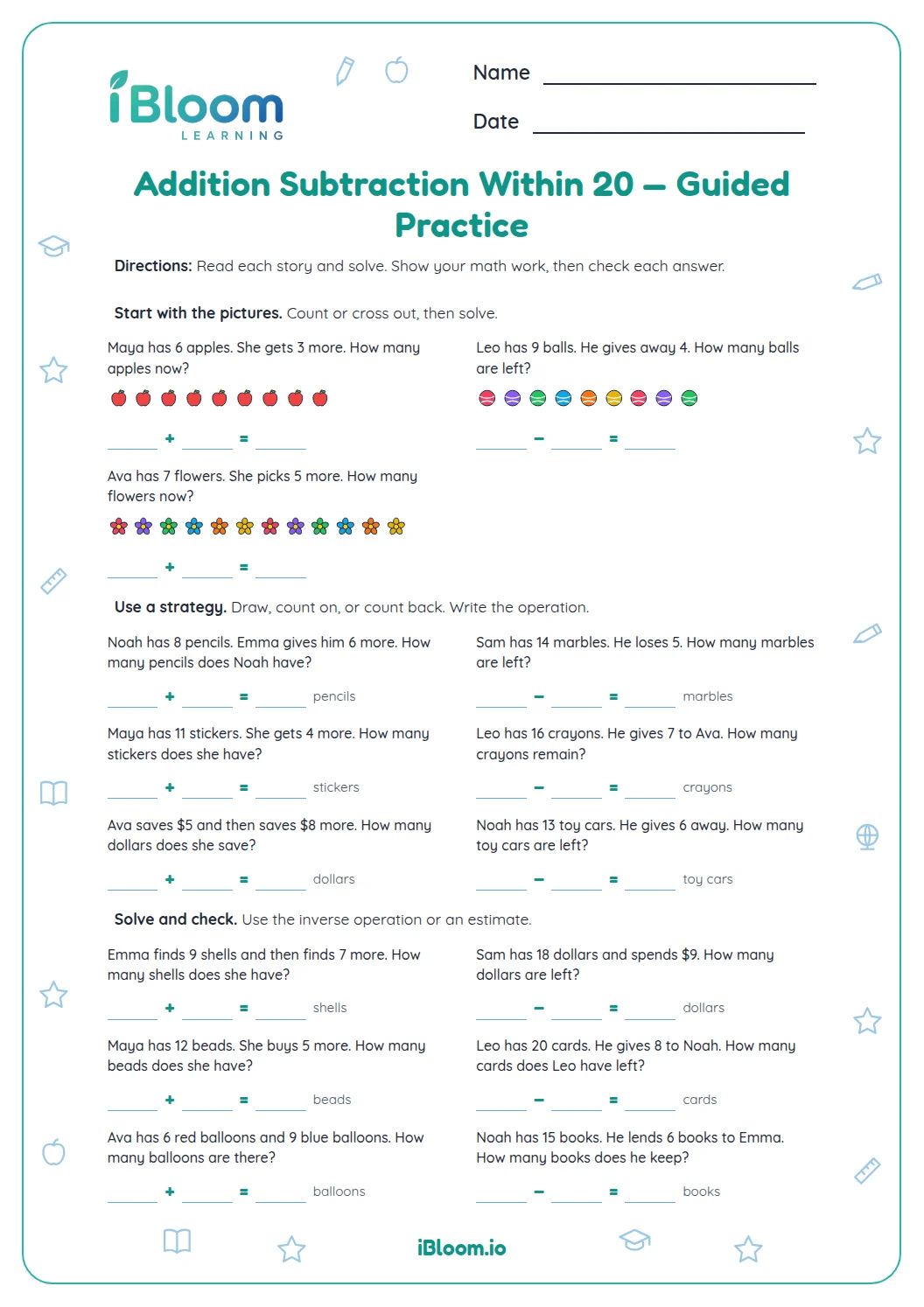
This Grade 2 worksheet builds addition reasoning through short stories and equation checks. Students add one-, two- and three-digit amounts, judge whether a claimed sum is correct, and choose a subtraction equation that truly checks an addition fact. Stories state both quantities, and every answer key entry matches the displayed numbers. The work emphasizes addition and checking strategies within CCSS 2.NBT.B.7; larger story totals are included as an extension of the page’s 1–3 digit skill. A printable answer key is included.
Aligned to 2.NBT.B.7
How can a child solve an addition story?
Identify the two amounts in the story, write an addition equation, and find the total. For 146 stickers plus 32 more, 146 + 32 = 178.
To check, subtract one addend from the total. Since 178 − 146 = 32, the addition is consistent. A check must use the actual total, not a number copied from an incorrect claim.
What kinds of reasoning appear?
Part A uses story problems. Part B asks students to test a claimed sum. Part C uses subtraction to check an addition equation. Each item asks for one answer and supplies enough information to calculate it.
How do you solve Mia’s sticker story?
Mia has 146 stickers and receives 32 more. Add 146 + 32 to get 178 stickers.
How to use this worksheet
- 1Read the part heading and note what each question asks you to find.
- 2Write or say an equation using the numbers and operation in the prompt.
- 3Solve carefully, keeping track of place value and what each blank represents.
- 4Use the answer key to check, then correct any equation that does not balance.
Common mistakes and quick fixes
The mistake
Repeating a stated sum without calculating it.
The fix
Add the two quantities independently before judging the claim.
The mistake
Choosing a subtraction check that does not undo the addition.
The fix
Subtract one addend from the correct total; the other addend should remain.
The mistake
Using a number without checking what the blank represents.
The fix
Read the words and labels beside the blank, then write the requested value or unit.
Common Core alignment
This worksheet practices 2.NBT.B.7 with place-value addition and subtraction problems.
Use place-value strategies and equations to add and check three-digit quantities within 1,000.
On this sheet: The story sums and inverse-operation checks use three-digit numbers within 1,000 and provide work grids for students to show a strategy.
Show the official wordingHide the official wording
Add and subtract within 1000, using concrete models or drawings and strategies based on place value, properties of operations, and/or the relationship between addition and subtraction; relate the strategy to a written method. Understand that in adding or subtracting three-digit numbers, one adds or subtracts hundreds and hundreds, tens and tens, ones and ones; and sometimes it is necessary to compose or decompose tens or hundreds.
What to practice next
Make more practice
Further reading
Questions parents and teachers ask
How can a student solve an addition story?
Identify both amounts, write an addition equation, and find the sum. In the sticker story, Mia starts with 146 and gets 32 more, so 146 + 32 = 178. The answer describes how many stickers she has now. Students can use the example and then try another item independently.
What is the correct sum of 146 and 32?
146 + 32 = 178. Add the ones, then the tens and hundreds: 6 + 2 = 8 ones, and 140 + 30 = 170. This corrects the mistaken total of 168. Students can use the example and then try another item independently.
How can subtraction check an addition answer?
Subtract one addend from the sum to see whether the other addend remains. For 67 + 19 = 86, the check is 86 − 67 = 19. This verifies both the sum and the addends used in the story. Students can use the example and then try another item independently.
What kinds of questions are included?
The 18 questions include addition stories, decisions about claimed sums, and subtraction checks. The amounts range from two-digit numbers to three-digit numbers, and the separate answer key lists the results. Students can use the example and then try another item independently.
Why should a student calculate before choosing?
A statement in a question may contain an error, so calculate the sum independently before selecting or writing a correction. Then compare the result with the claim and use subtraction to verify the addends. Students can use the example and then try another item independently.