

About this worksheet
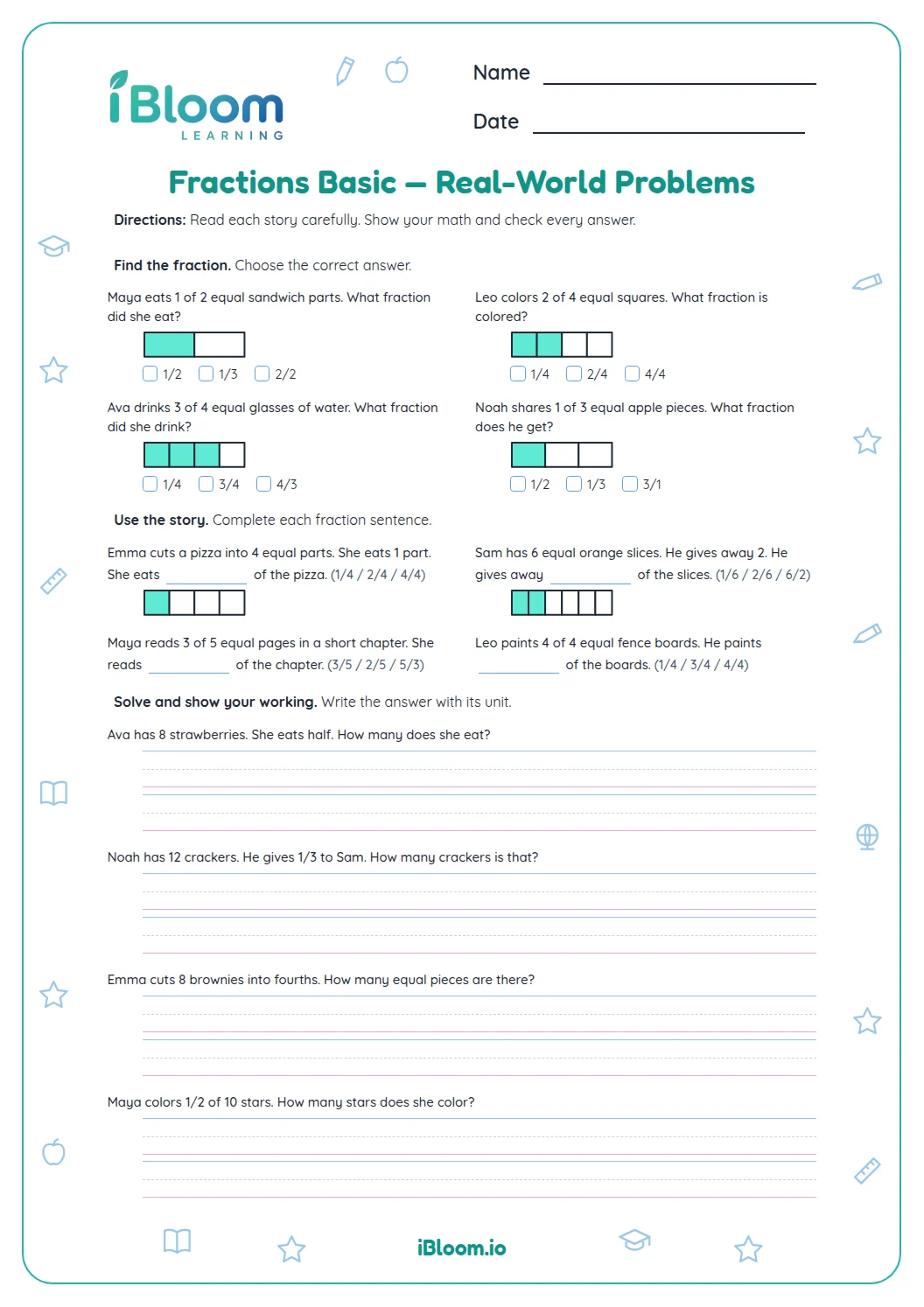
This Grade 2 fraction word problems worksheet uses clear, short situations about food, classroom objects, teams, and flowers. Children first read shaded circle, bar, and square models, then solve equal-sharing problems with complete sets pictured. The 14 questions move from naming a fraction to finding one equal group, followed by a separate answer key. The work practices equal shares in CCSS 2.G.A.3.
Aligned to 2.G.A.3
How can a model help with a fraction story?
A fraction story describes a whole and equal shares of it. Read what is being shared, then decide how many equal parts make the whole. In question 3, the paper is split into four equal pieces and three are colored, so 3/4 is colored.
- 1The paper has 4 equal pieces.
- 23 pieces are colored.
- 3The colored fraction is 3/4.
How do you find one share of a group?
When objects are shared equally, split the total into equal groups. For question 7, 12 crayons shared across four equal groups gives 3 in each group. One-fourth of 12 is 3 crayons.
Which stories appear on the worksheet?
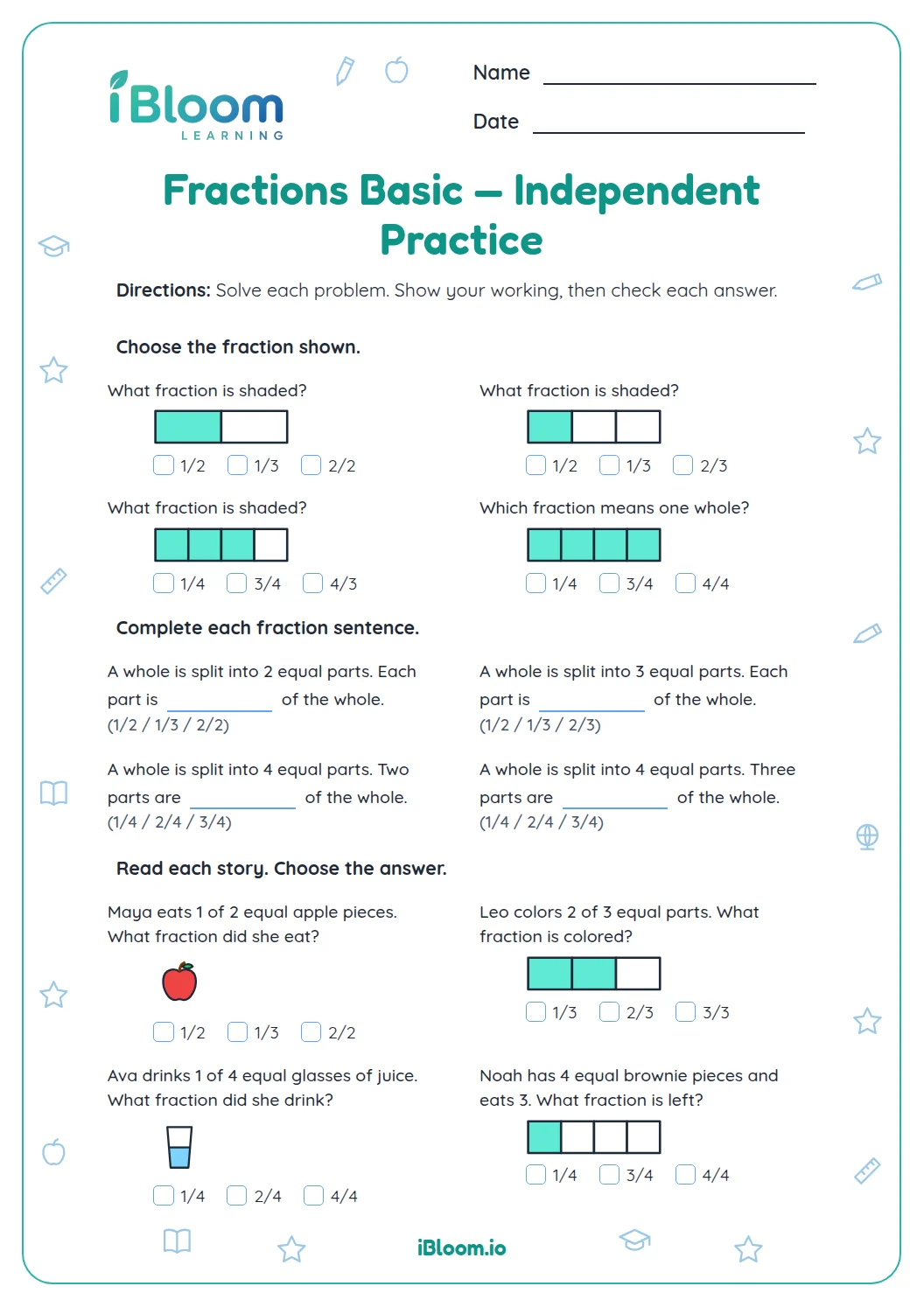
Fourteen questions use food, classroom objects, teams, and flowers. Shaded models come first, followed by short equal-sharing stories.
- Part A: read shaded fraction models
- Part B: solve equal-group stories
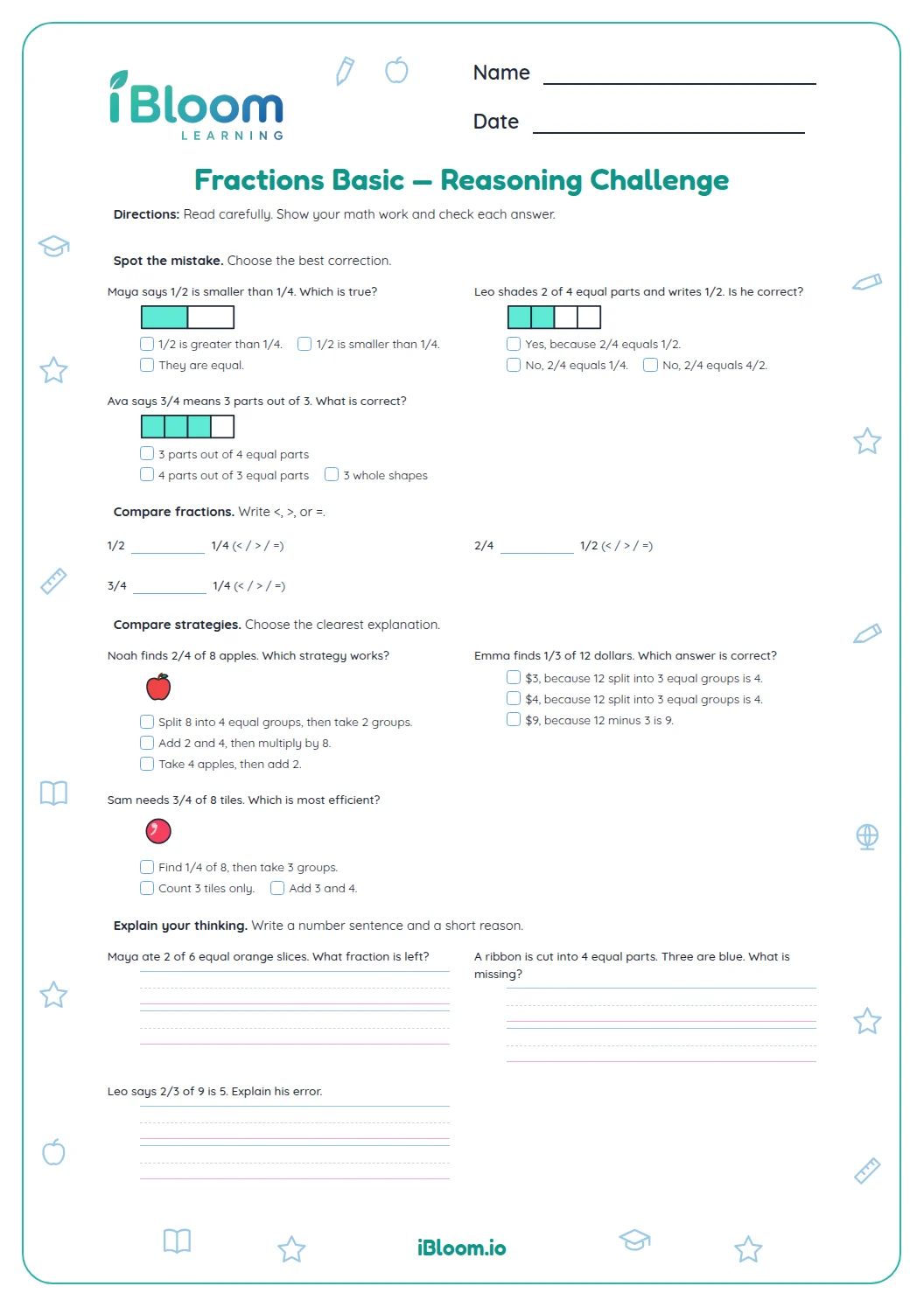
- Part C: check what fair shares mean
How can an adult guide this practice?
- 1Read the story and identify the whole being shared.
- 2Notice the number of equal pieces or groups.
- 3For a set, divide the objects into equal groups before counting.
- 4Write the fraction or number of objects requested.
- 5Check that the answer matches the story and key.
Common fraction mistakes and fixes
The mistake
Dividing by the numerator instead of the denominator.
The fix
Use the number of equal groups in the story to make the shares.
The mistake
Reporting the total group instead of one share.
The fix
Count only the objects in one equal group.
The mistake
Naming a fraction without checking equal parts.
The fix
Confirm that all parts of the shape or group are the same size.
Common Core alignment
This worksheet gives children focused practice with the ideas named in the standards below.
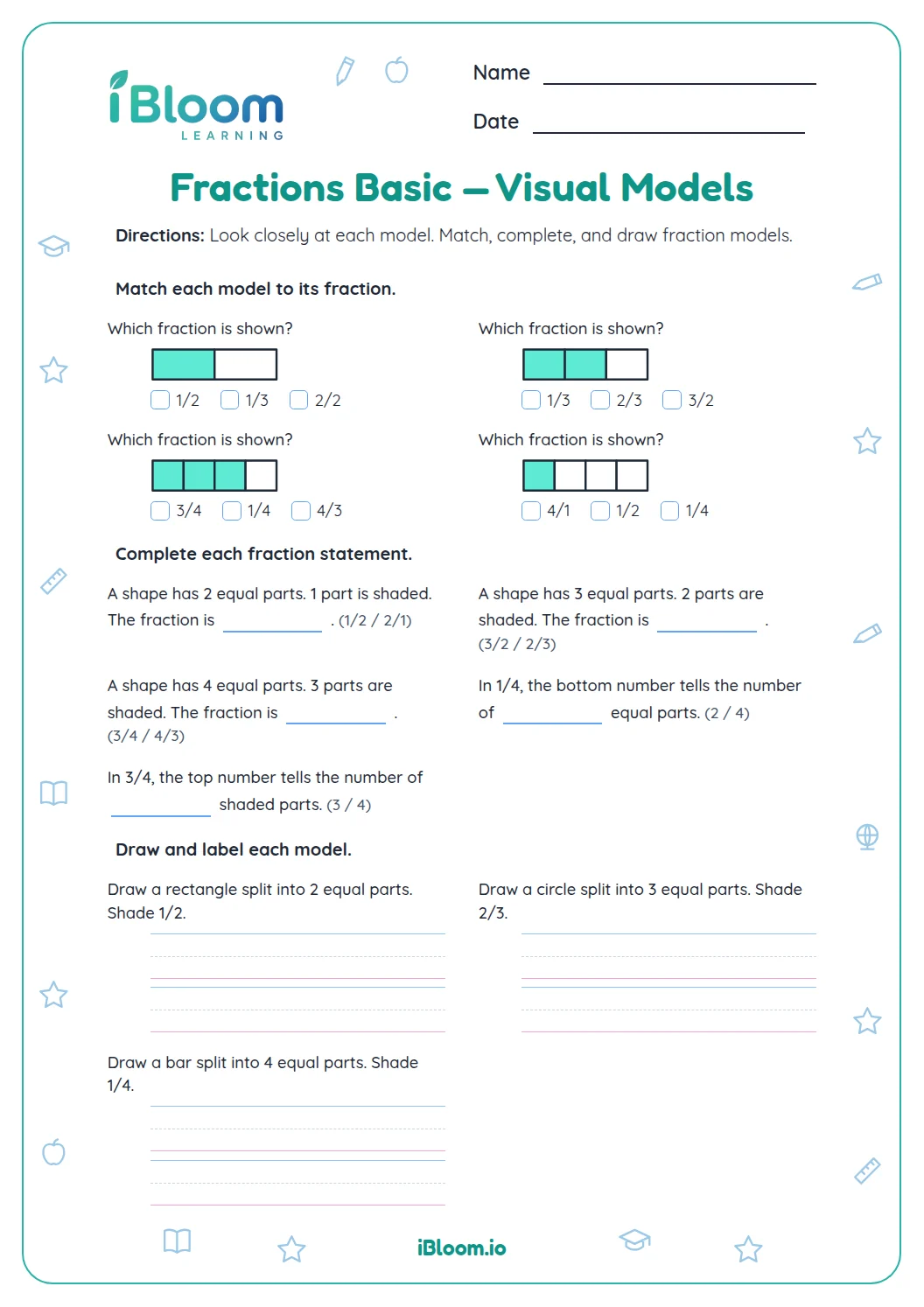
Name halves, thirds, and fourths in equal shares of circles and rectangles.
On this sheet: Children identify and describe equal shares in circle and rectangle models.
Show the official wordingHide the official wording
Partition circles and rectangles into two, three, or four equal shares, describe the shares using the words halves, thirds, half of, a third of, etc., and describe the whole as two halves, three thirds, four fourths. Recognize that equal shares of identical wholes need not have the same shape.
What to practice next
Make more practice
Further reading
Questions parents and teachers ask
How does a child solve one-fourth of 12?
Share 12 objects into four equal groups. There are 3 objects in each group, so one-fourth of 12 is 3. The crayons in question 7 show the full set. Ask the child to point to the related question and explain the clue before checking the answer key.
What is the difference between a fraction of a shape and a fraction of a group?
A shape fraction describes equal pieces of one whole shape. A group fraction describes an equal share of separate objects. In both cases, the parts must be equal. Ask the child to point to the related question and explain the clue before checking the answer key.
Why does equal sharing matter?
The words half, third, and fourth describe equal shares. If groups have different numbers of objects or shape parts have different sizes, they do not show fair equal shares. Ask the child to point to the related question and explain the clue before checking the answer key.
What kinds of stories are included?
The page uses familiar items such as apples, cookies, crayons, pears, muffins, cupcakes, roses, and crackers. Children either name a fraction or find how many objects belong in an equal share. Ask the child to point to the related question and explain the clue before checking the answer key.
Is there a separate answer key?
Yes. The answer key gives the fraction or number of objects for each problem. It can be used after the child has tried the stories and checked that each share is equal. Ask the child to point to the related question and explain the clue before checking the answer key.