




About this worksheet
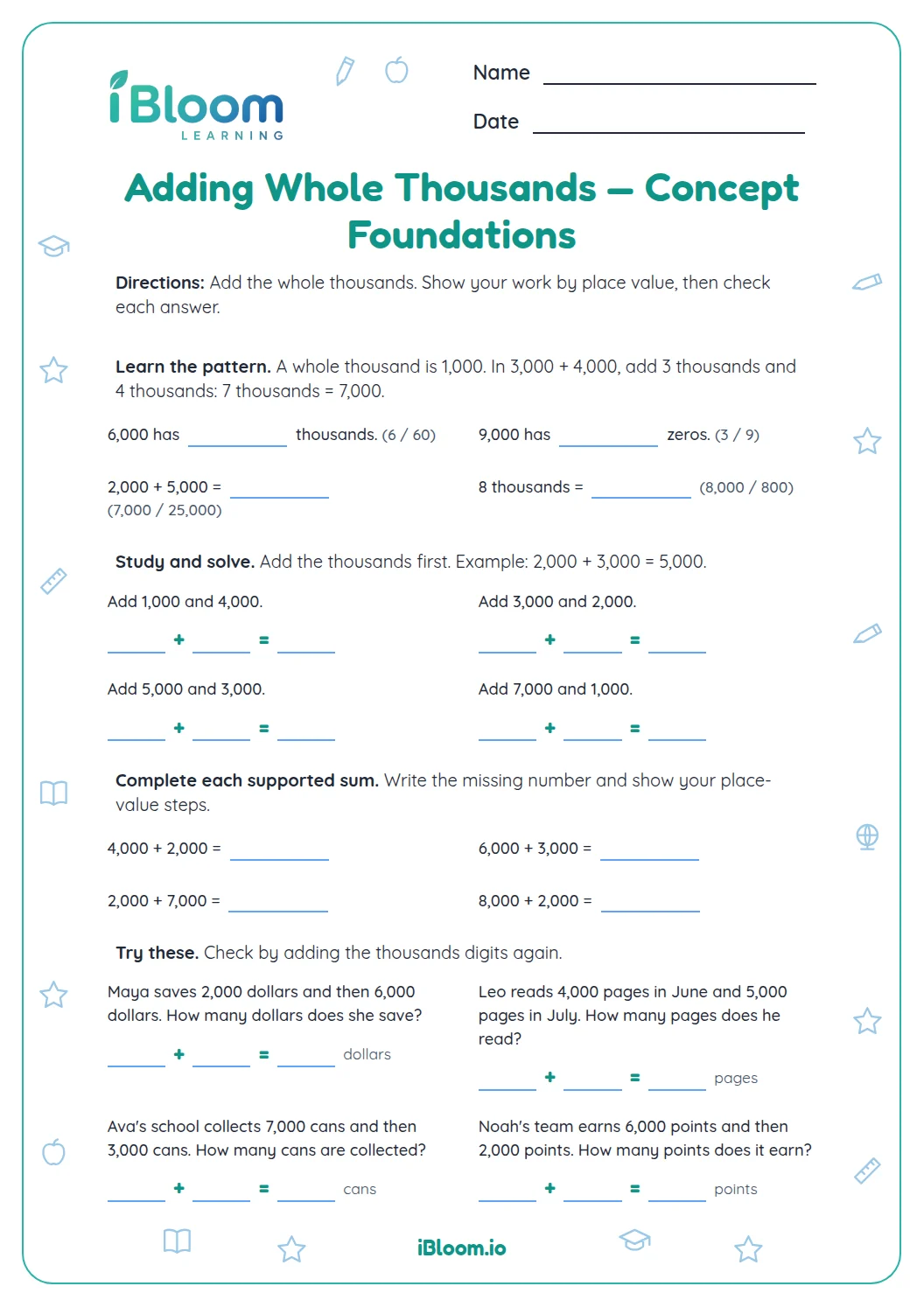
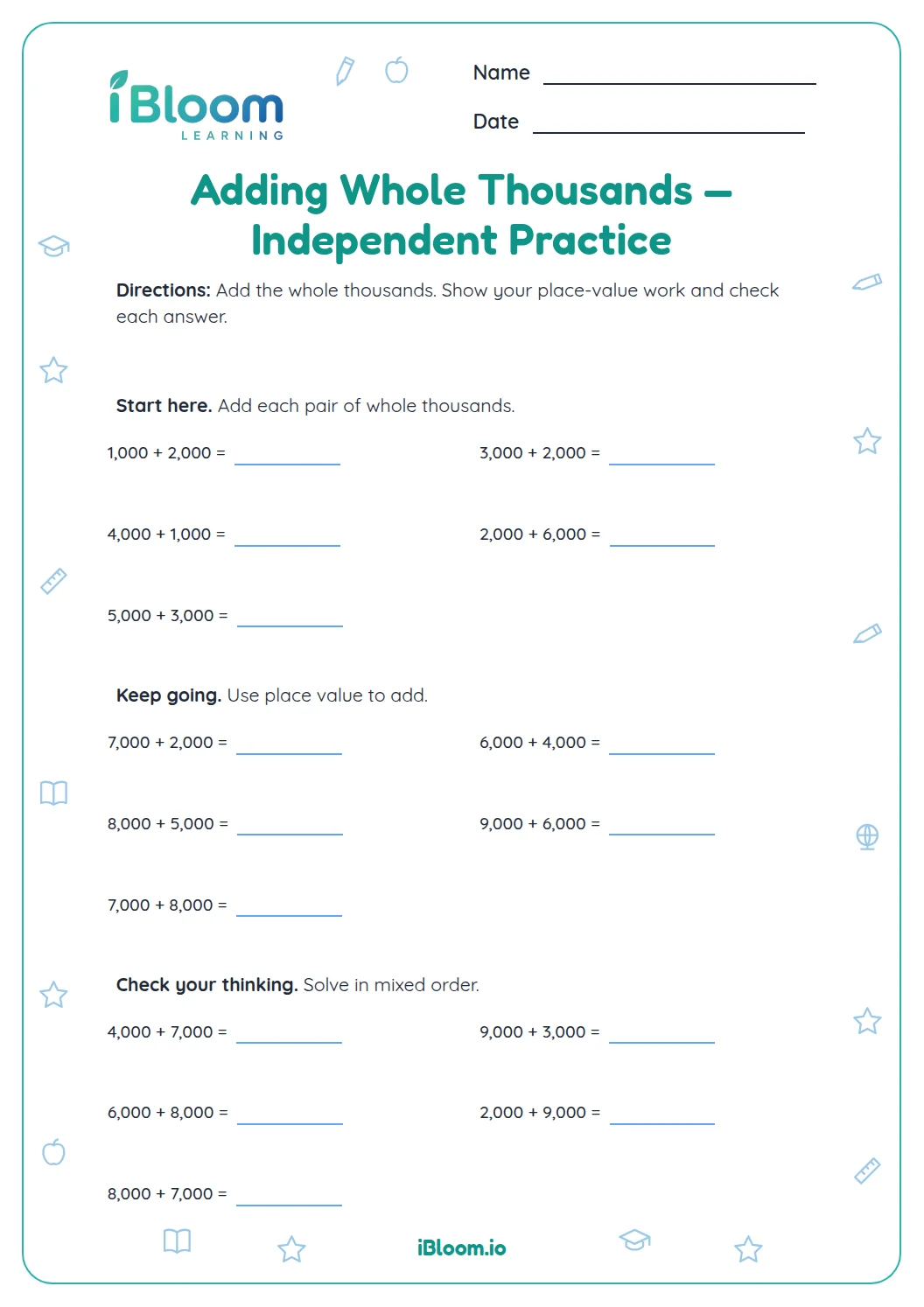
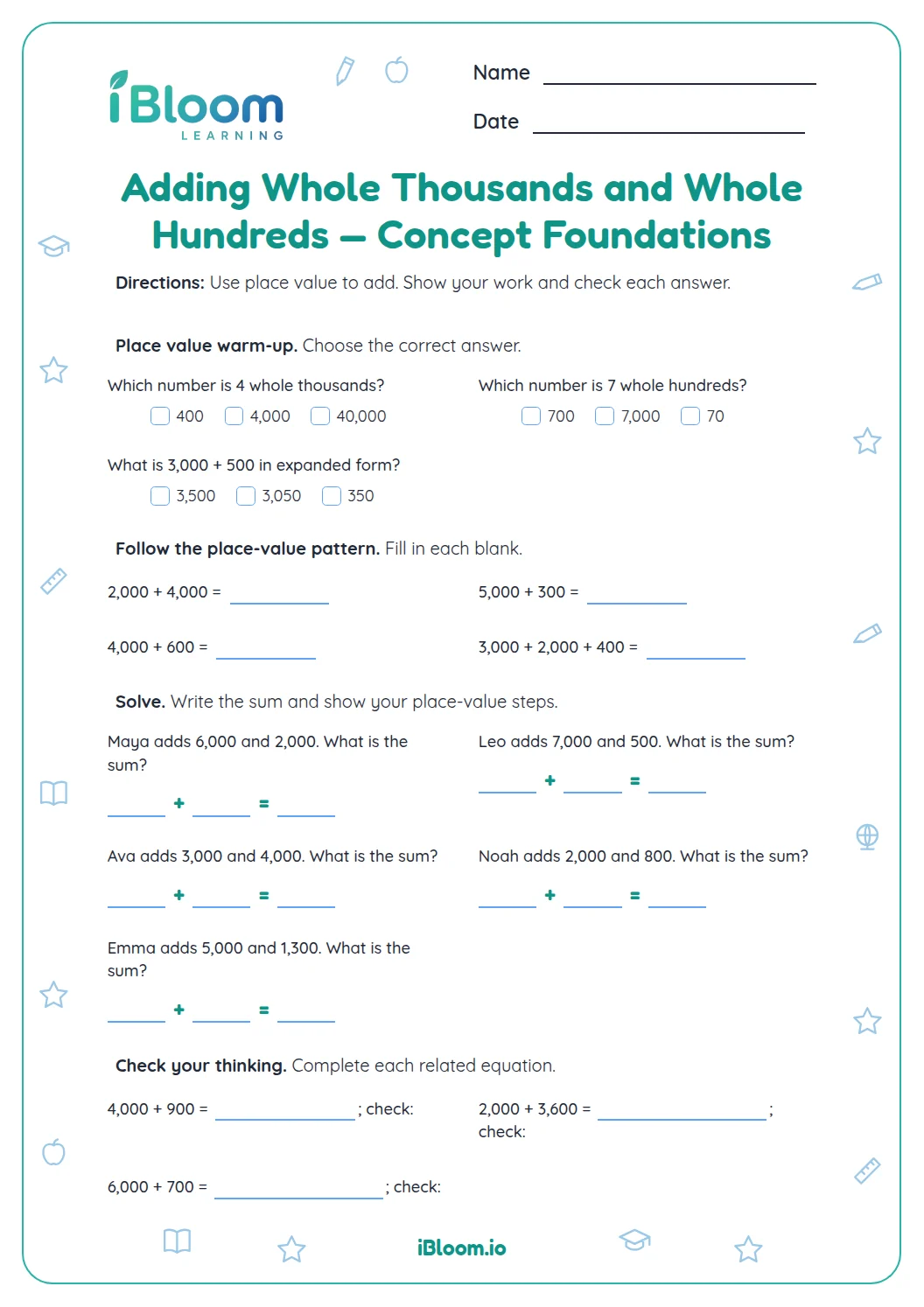
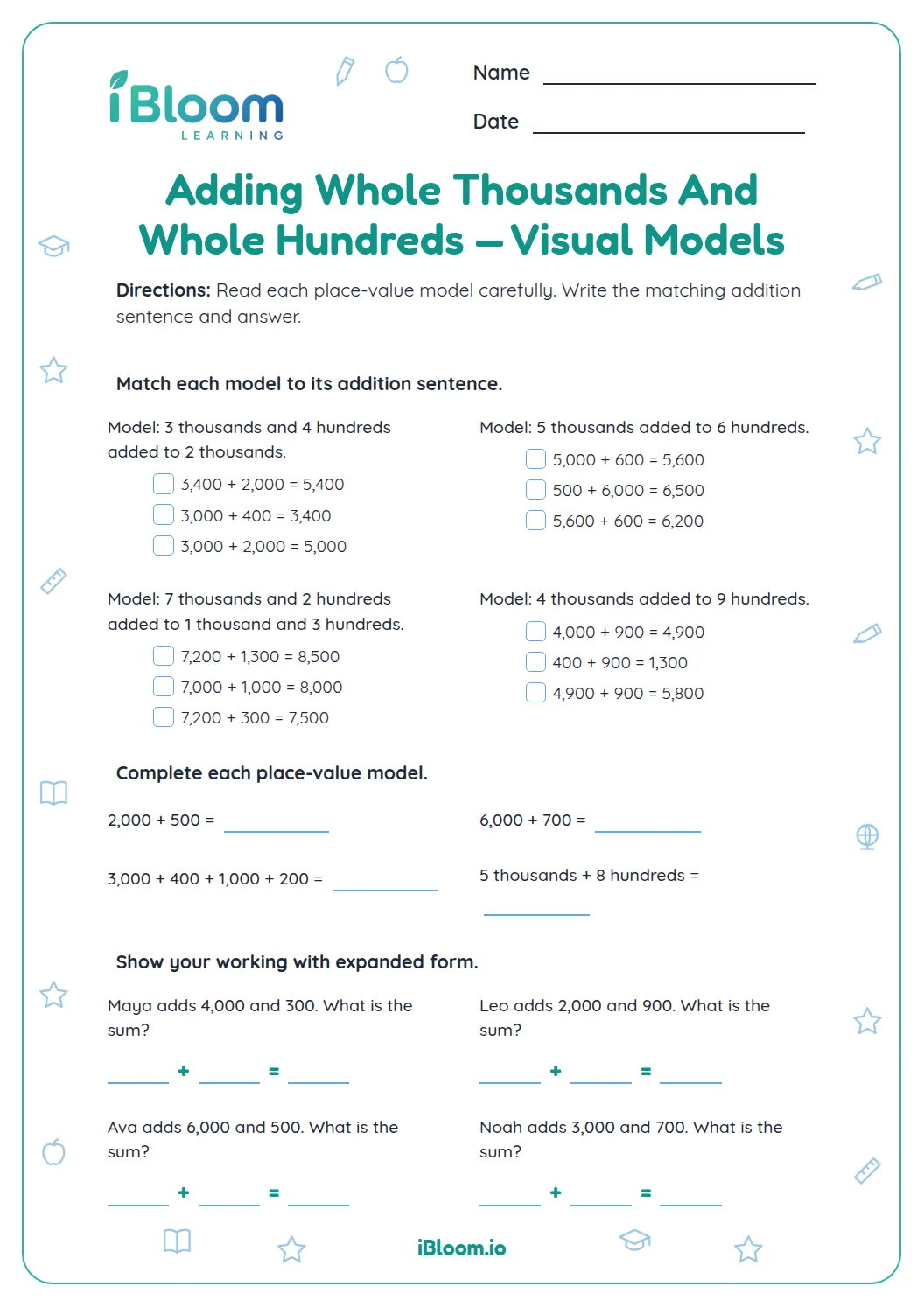
This free printable worksheet helps students add whole-thousands amounts using number-line models. Fifteen equations pair four-digit addends with number lines marked in 1,000-unit intervals, so students can count the distance from a starting amount to the sum. A separate answer key gives each total.
What is the key idea?
Each addend is a whole number of thousands. Add the thousands, then check the total by counting 1,000-unit intervals from the first addend to the sum.
How does one problem work?
For question 1, 2,000 + 3,000 is 2 thousands plus 3 thousands, or 5 thousands. On the number line, the distance from 2,000 to 5,000 is three jumps of 1,000.
- 12,000 + 3,000 = ___
- 22 thousands + 3 thousands = 5 thousands.
- 3Count three 1,000-unit jumps from 2,000.
- 4Answer: 5,000
What is on the worksheet?
There are 15 equations across three parts. Every item has a number line with a labeled starting value and total, and all addends are whole thousands.
How can I use the sheet?
- 1Read both addends and name how many thousands each contains.
- 2Add the number of thousands.
- 3Write the total with three zeros.
- 4Use the line to count 1,000-unit jumps from the first addend.
- 5Check that the last labeled value matches the sum.
Common mistakes and quick fixes
The mistake
Adding the digits but forgetting the place value.
The fix
Write the number of thousands, then add three zeros.
The mistake
Counting the starting point as a jump.
The fix
Count the intervals between tick marks.
The mistake
Stopping one 1,000-unit interval early.
The fix
Count each jump from the first addend to the labeled total.
What to practice next
Make more practice
Further reading
Questions parents and teachers ask
How do you add whole thousands?
Add the numbers of thousands in the two addends. For example, 2,000 + 3,000 is 2 thousands plus 3 thousands, or 5,000. Then check the sum against the number line. The second addend names the number of jumps to take.
What does the number line show?
The number lines use 1,000-unit intervals. Each one labels the starting addend and the total, so the student can count the intervals between those points to check the second addend. The labels let students compare the written equation with its model.
Why are all the addends four-digit numbers?
Each addend is a whole-thousands number such as 2,000 or 7,000. The equations combine these amounts, and the number lines show the same values in 1,000-unit steps. This keeps the practice focused on adding whole-thousands amounts. The model makes the size of each addend visible in the same unit.
How many questions are included?
There are 15 questions in three parts. Each question pairs a whole-thousands addition equation with a number line, and all sums are included in the separate key. The key repeats the equations with the correct totals. Students can use the labels to make a quick visual check.
How can a student check a sum?
Count the number of intervals from the first addend to the total. Each interval is 1,000, so the distance should equal the second addend. You can also add the number of thousands directly. This check works because each interval represents one thousand.