

About this worksheet
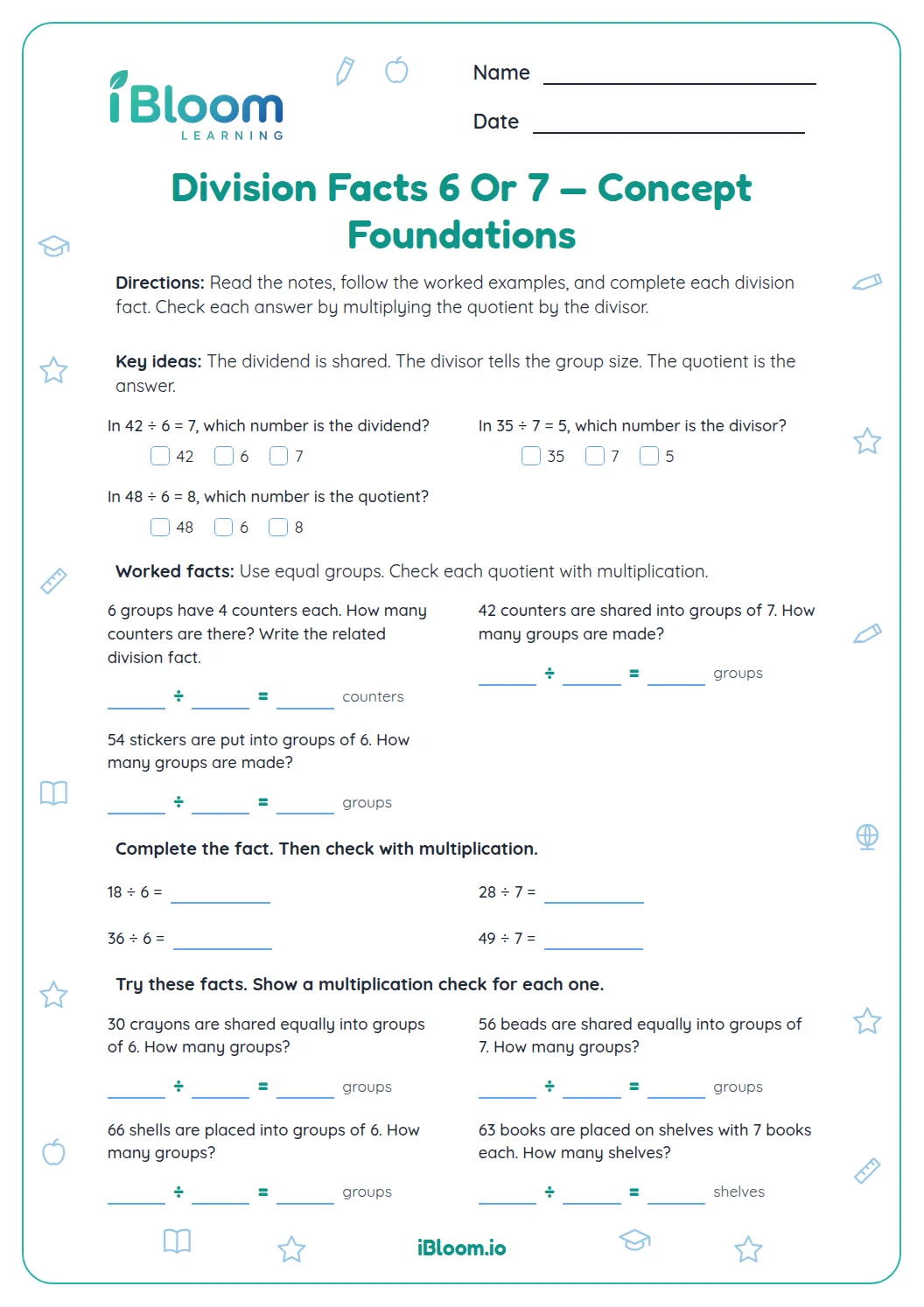
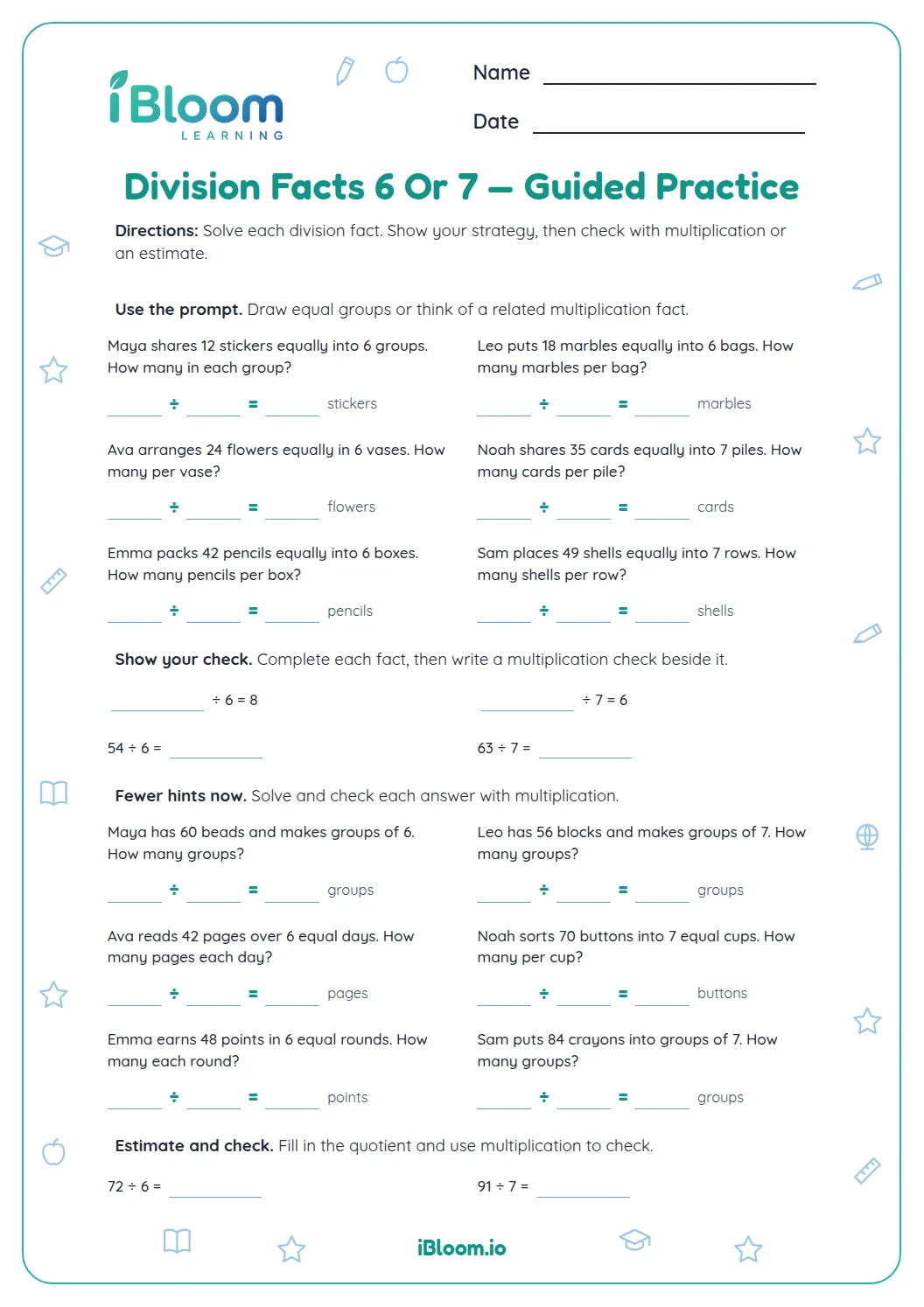
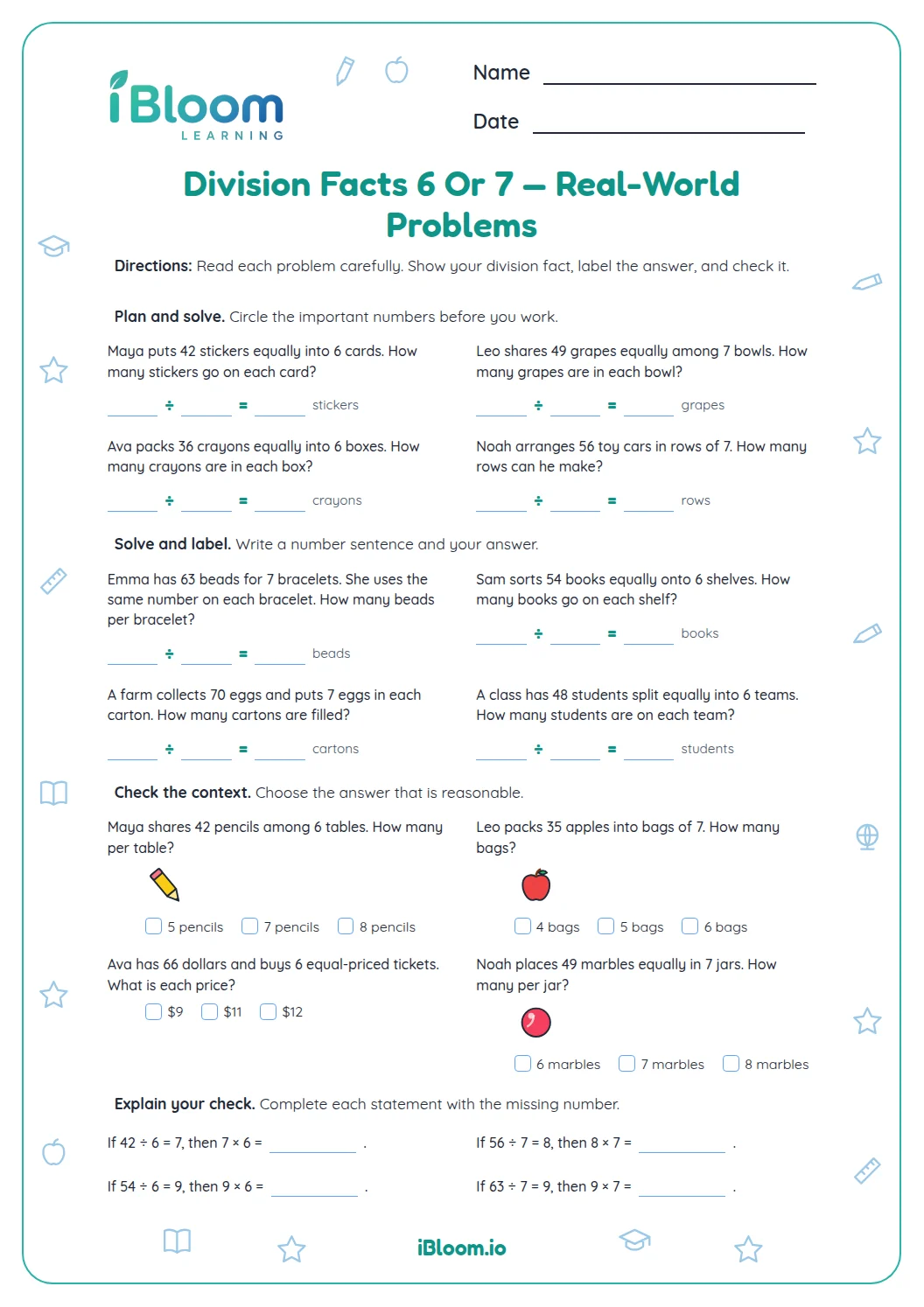
This Grade 3 printable gives students 14 questions on division facts with 6 and 7. They solve quotients, choose related multiplication checks, work through two equal-groups stories, fill missing numbers, and compare quotients. The two-page student sheet includes a separate answer key and practices CCSS 3.OA.C.7.
Aligned to 3.OA.C.7
How do the facts connect?
The first four items ask for quotients using 6 or 7. For 24 ÷ 6, ask which number multiplied by 6 makes 24; 6 × 4 = 24, so the quotient is 4. The next items choose multiplication facts that verify division answers.
Where do students use the facts?
Two equal-groups stories connect the facts to quantities: 56 crayons shared among 7 desks and 48 tiles arranged in rows of 6. Students then find missing dividends or divisors, compare two quotients, and solve one multiplication story.
How can I check the work?
For a division fact, multiply the quotient by the divisor and see whether the product equals the dividend. In a story, check that the unit in the answer describes what the question asks for, such as crayons per desk or total muffins.
How to use this worksheet
- 1Read each part’s direction before starting.
- 2Solve each quotient by recalling a related multiplication fact.
- 3Check division by multiplying the quotient by the divisor.
- 4For stories, identify the groups and what the question asks you to count.
- 5Use the separate key to check each answer and revisit missed facts.
Common mistakes and quick fixes
The mistake
Using the quotient as the divisor in the check.
The fix
Multiply the quotient by the divisor; the product should match the dividend.
The mistake
Confusing the number of groups with the number in each group.
The fix
Reread the story question and label what the quotient counts.
The mistake
Comparing the dividends instead of the quotients.
The fix
Find both quotients first, then compare those results.
Curriculum alignment
This worksheet practices a foundational skill commonly taught at this grade.
Fluently multiply and divide within 100.
On this sheet: Students solve division facts with 6 and 7 and use multiplication to check quotients.
Show the official wordingHide the official wording
Fluently multiply and divide within 100, using strategies such as the relationship between multiplication and division.
What to practice next
Make more practice
Questions parents and teachers ask
How can multiplication check a division fact?
Multiply the quotient by the divisor. For 42 ÷ 7 = 6, the check is 6 × 7 = 42. A product equal to the starting dividend confirms the quotient. Students use this relationship in the first parts of the worksheet.
Which division facts are on the page?
The short fact section uses divisors 6 and 7, with dividends that divide evenly. Later items use related multiplication facts and missing numbers, so students work with the same fact relationships in more than one form. The numbers stay within Grade 3 multiplication and division facts, and each answer is a whole number.
What do the story problems ask students to find?
One story shares 56 crayons equally among 7 desks, and another arranges 48 tiles in rows of 6. The questions ask for crayons per desk and the number of rows. A final story uses 6 muffins on each of 7 trays.
How many questions and pages are included?
There are 14 numbered questions arranged in six parts. The student worksheet uses two pages, followed by a separate two-page answer key. The parts move from direct facts to checks, stories, missing numbers, and comparison. Each numbered prompt has one answer, and the key follows the same question numbering on the student pages.
What if a student is unsure of a quotient?
Use the related multiplication fact. For 48 ÷ 6, ask what number times 6 equals 48. A student can also sketch equal groups, then multiply the quotient by 6 to check that the groups account for all 48 tiles.