

About this worksheet
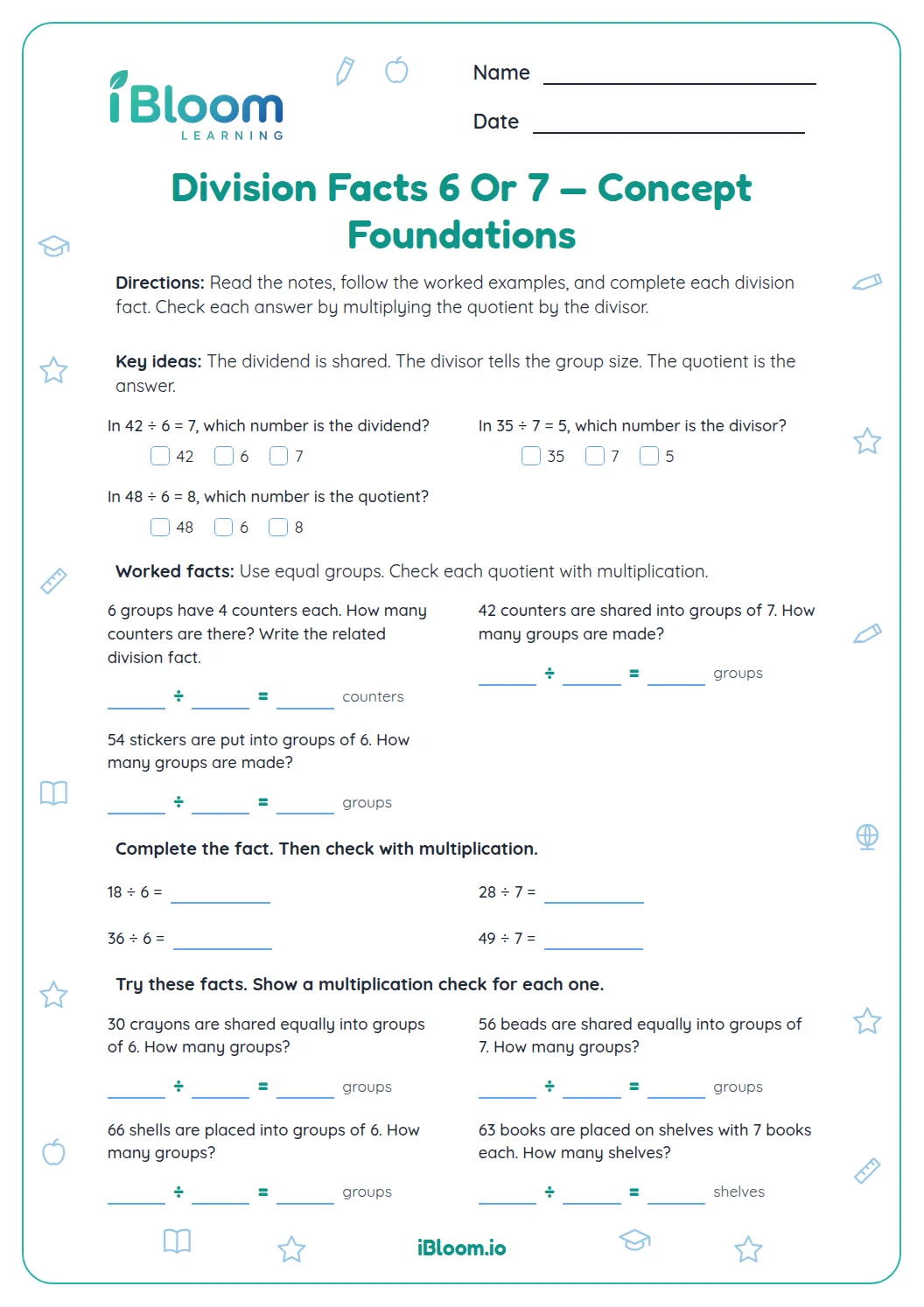
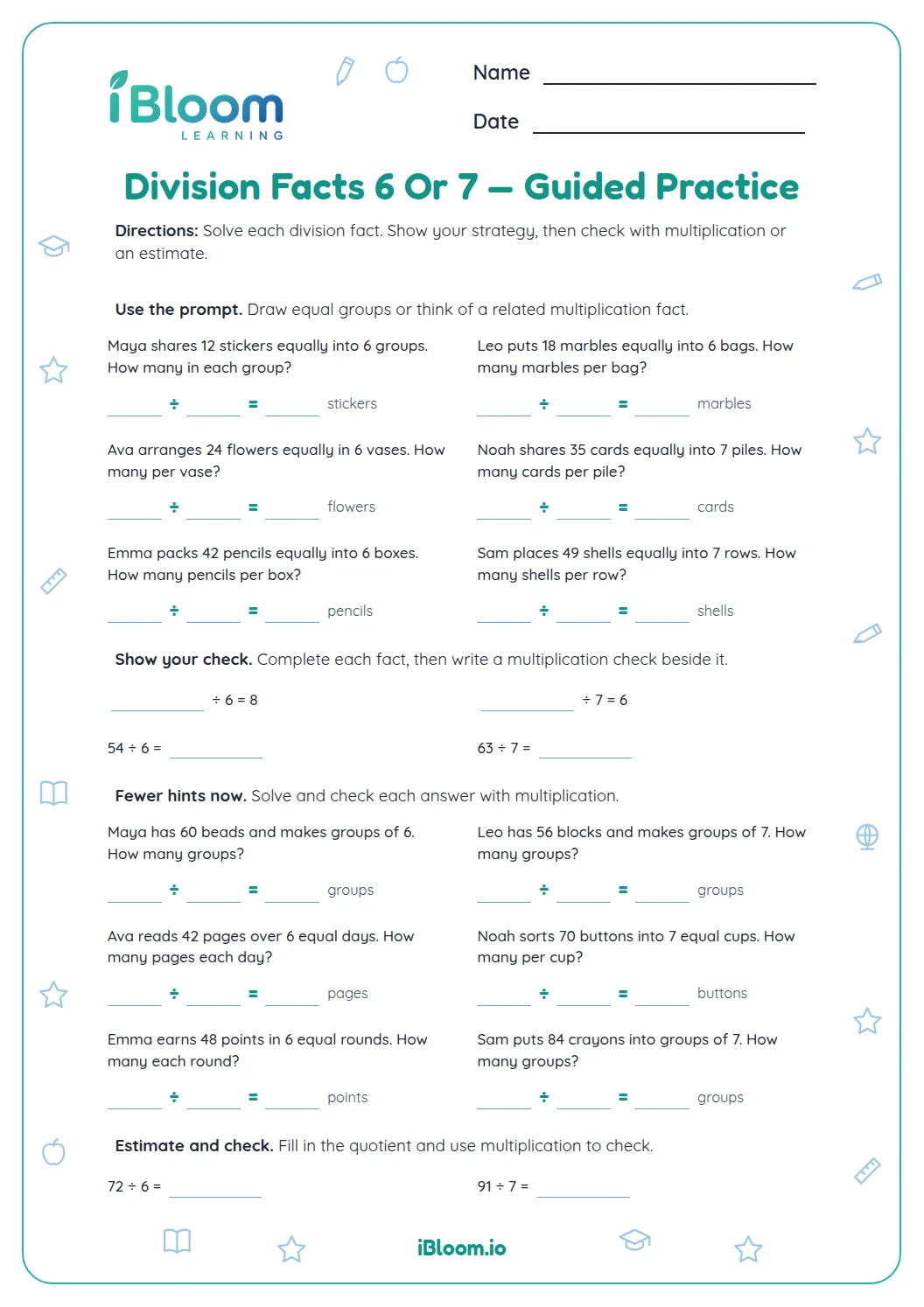
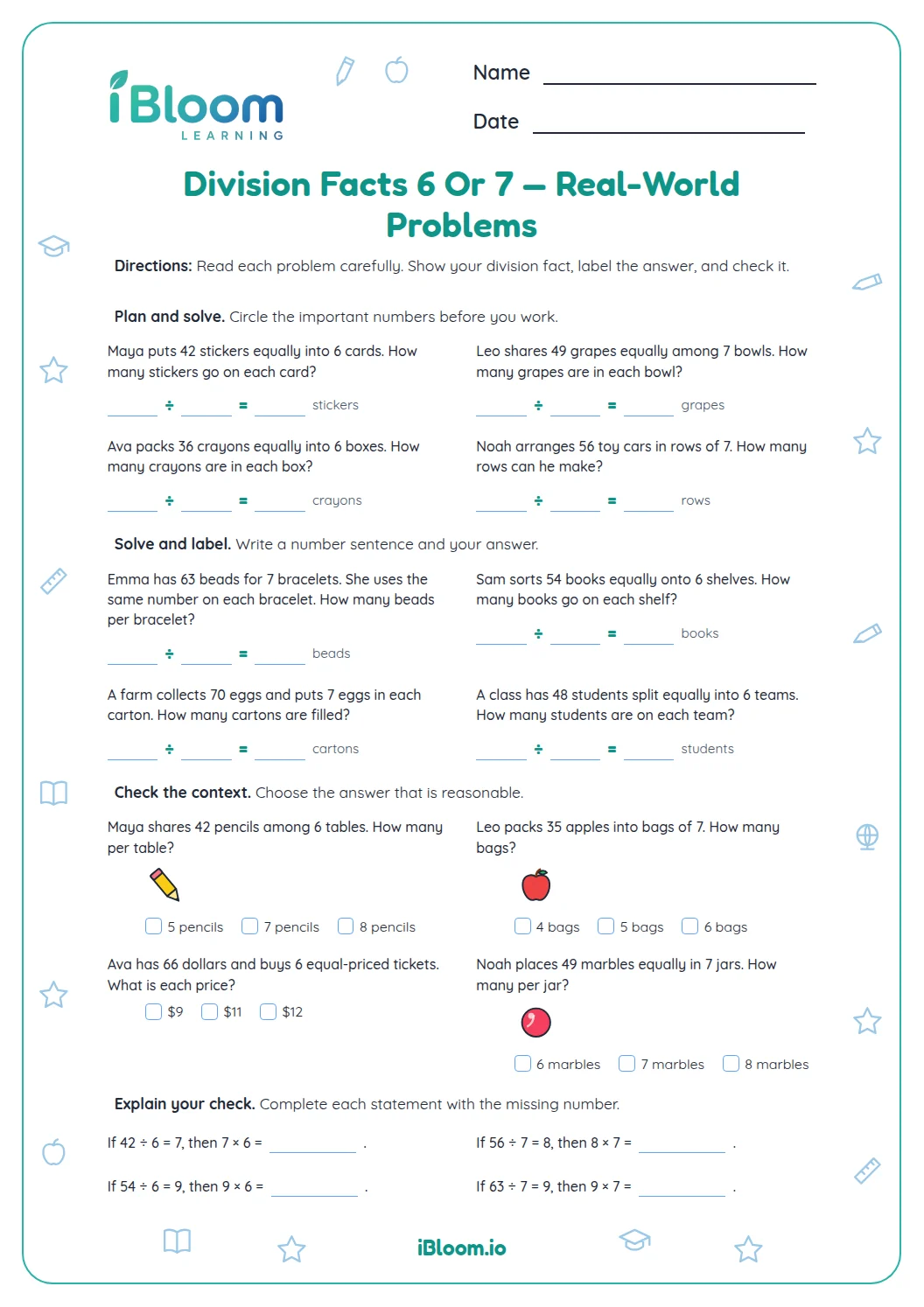
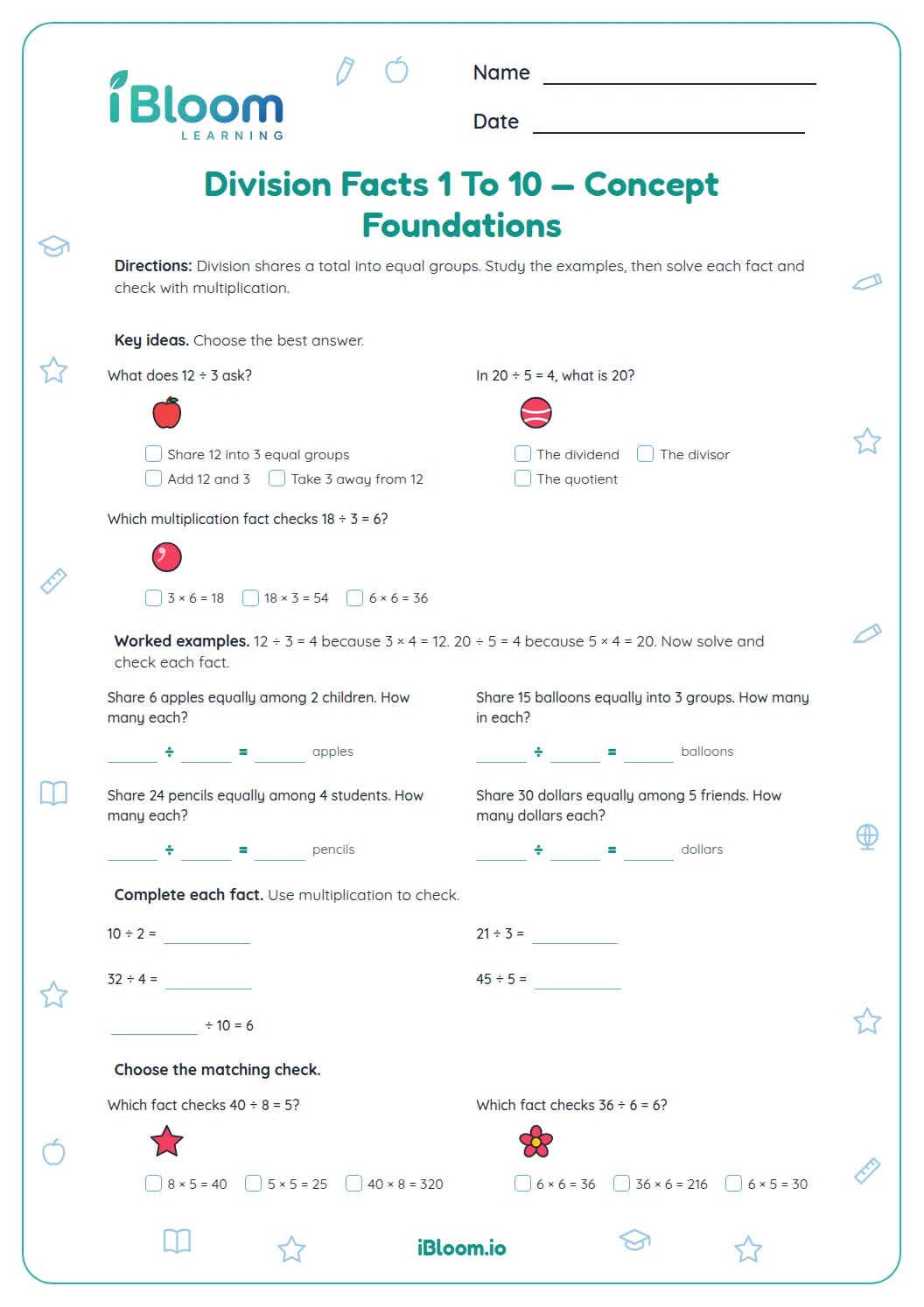
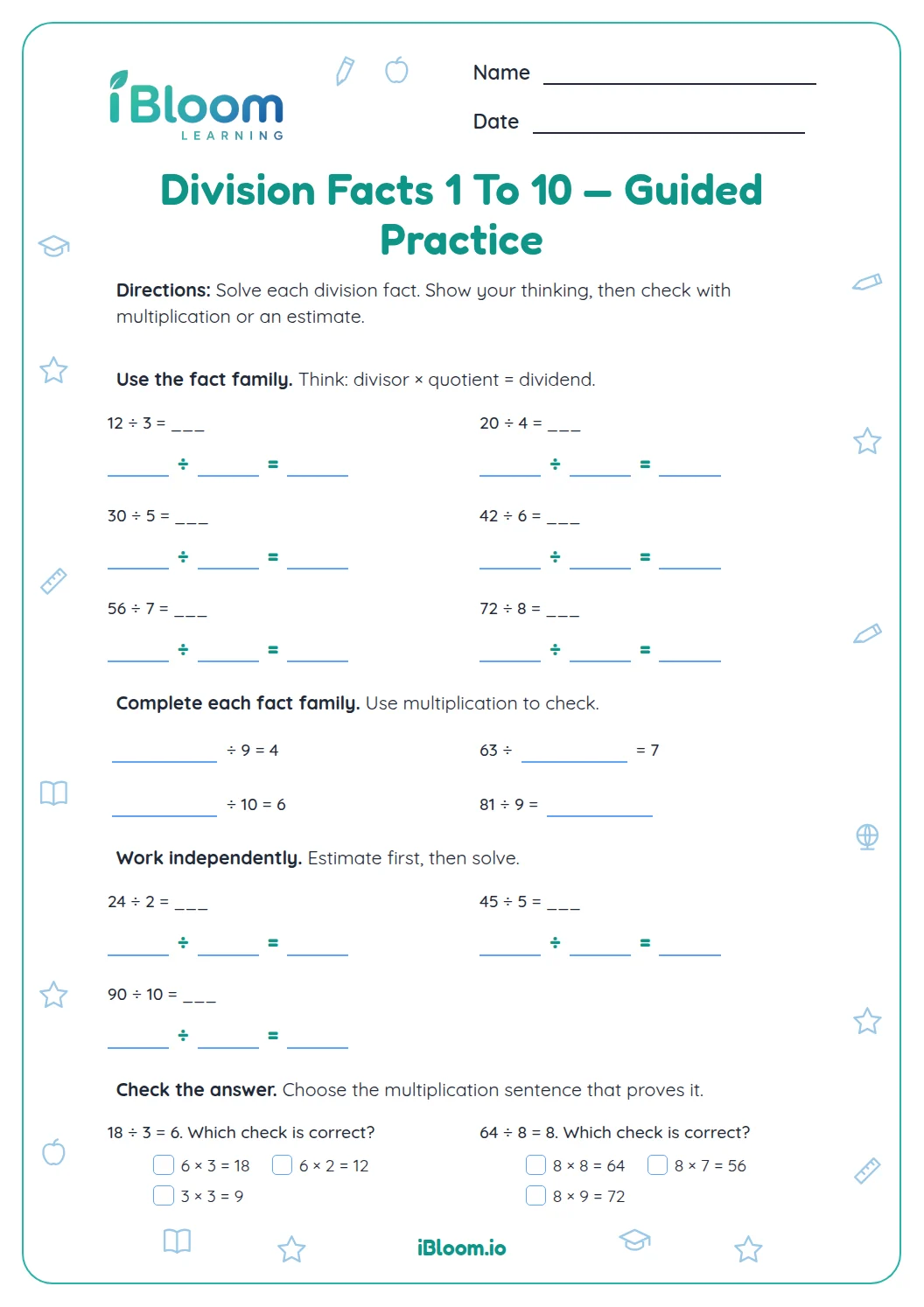
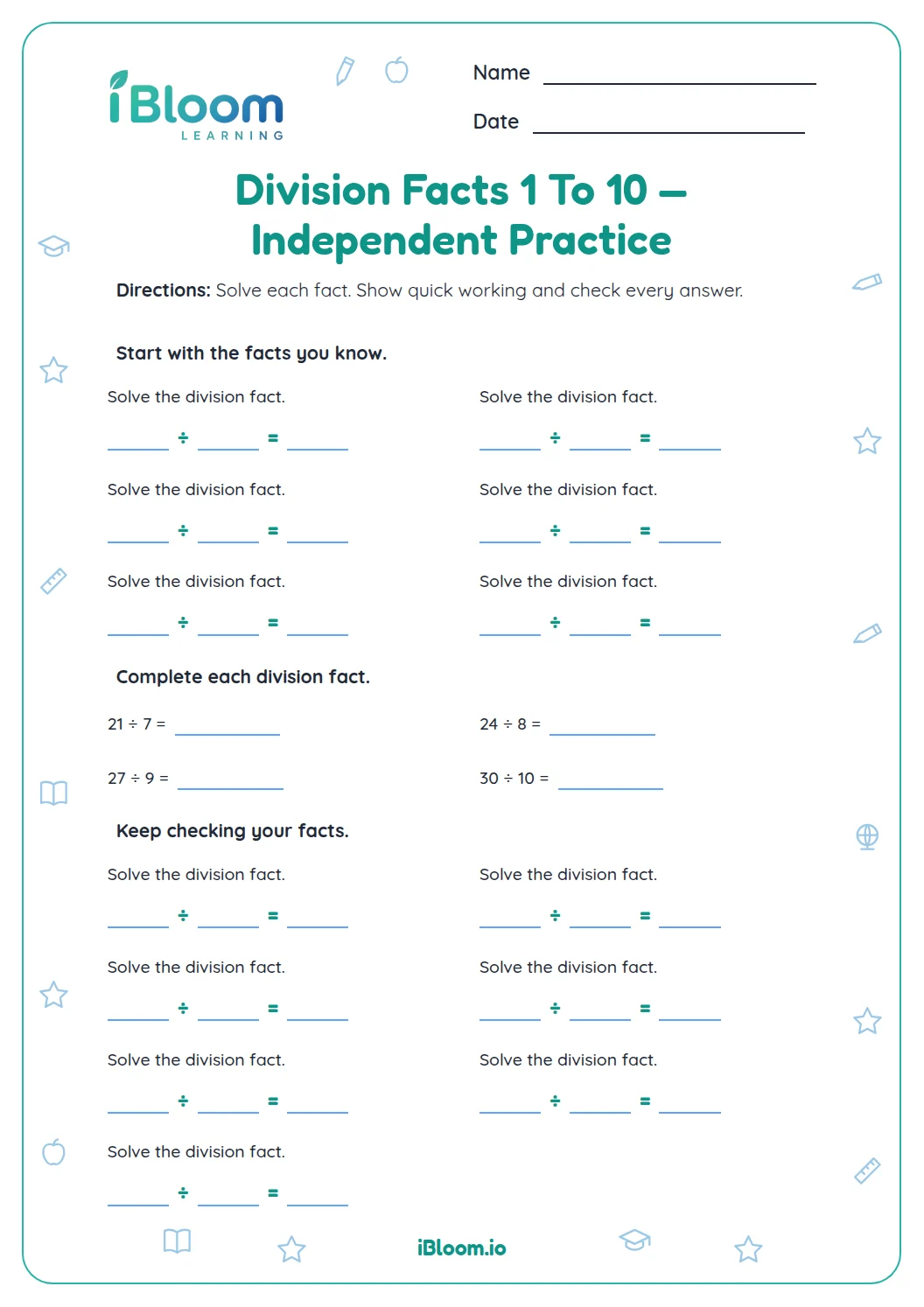
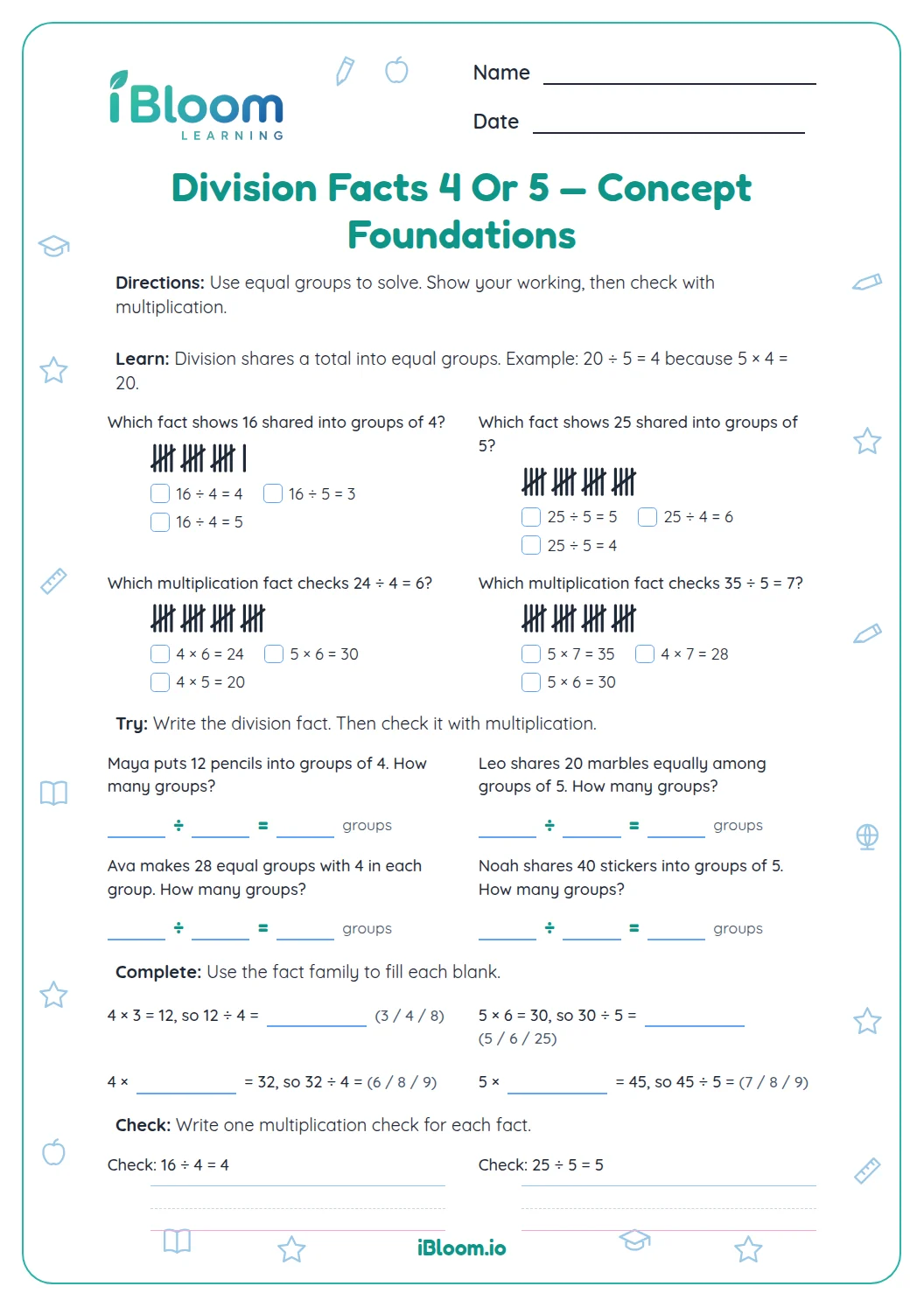
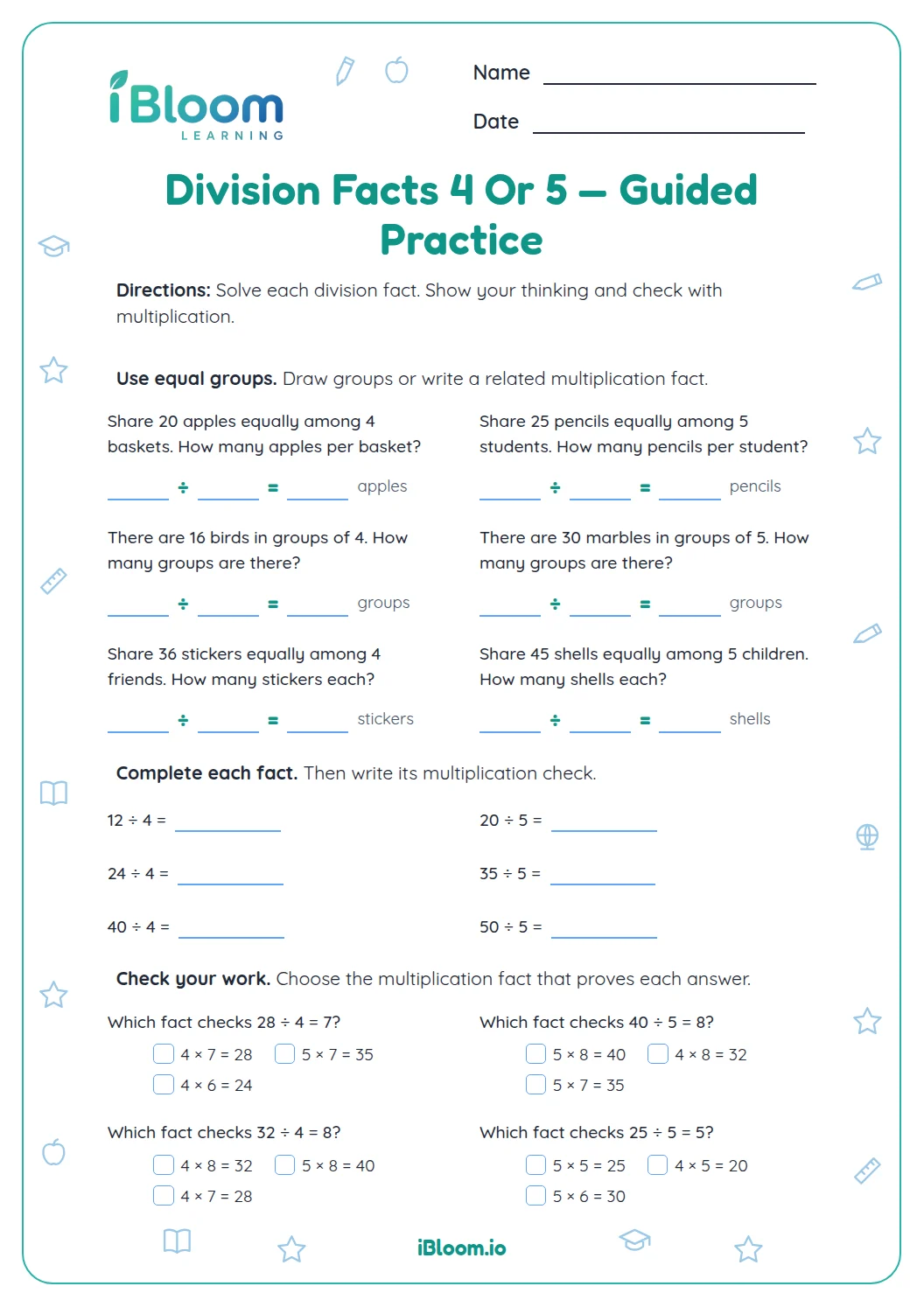
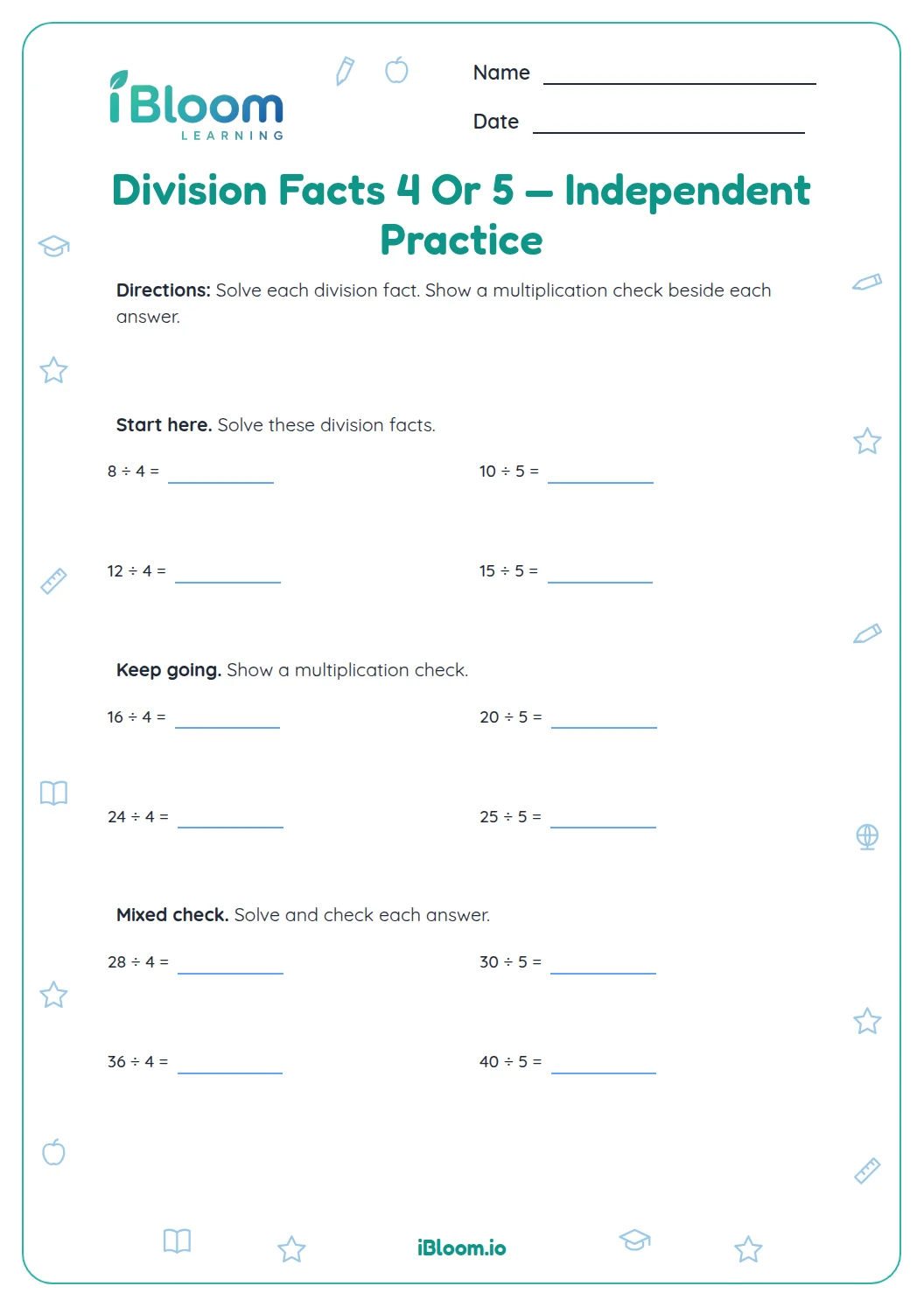
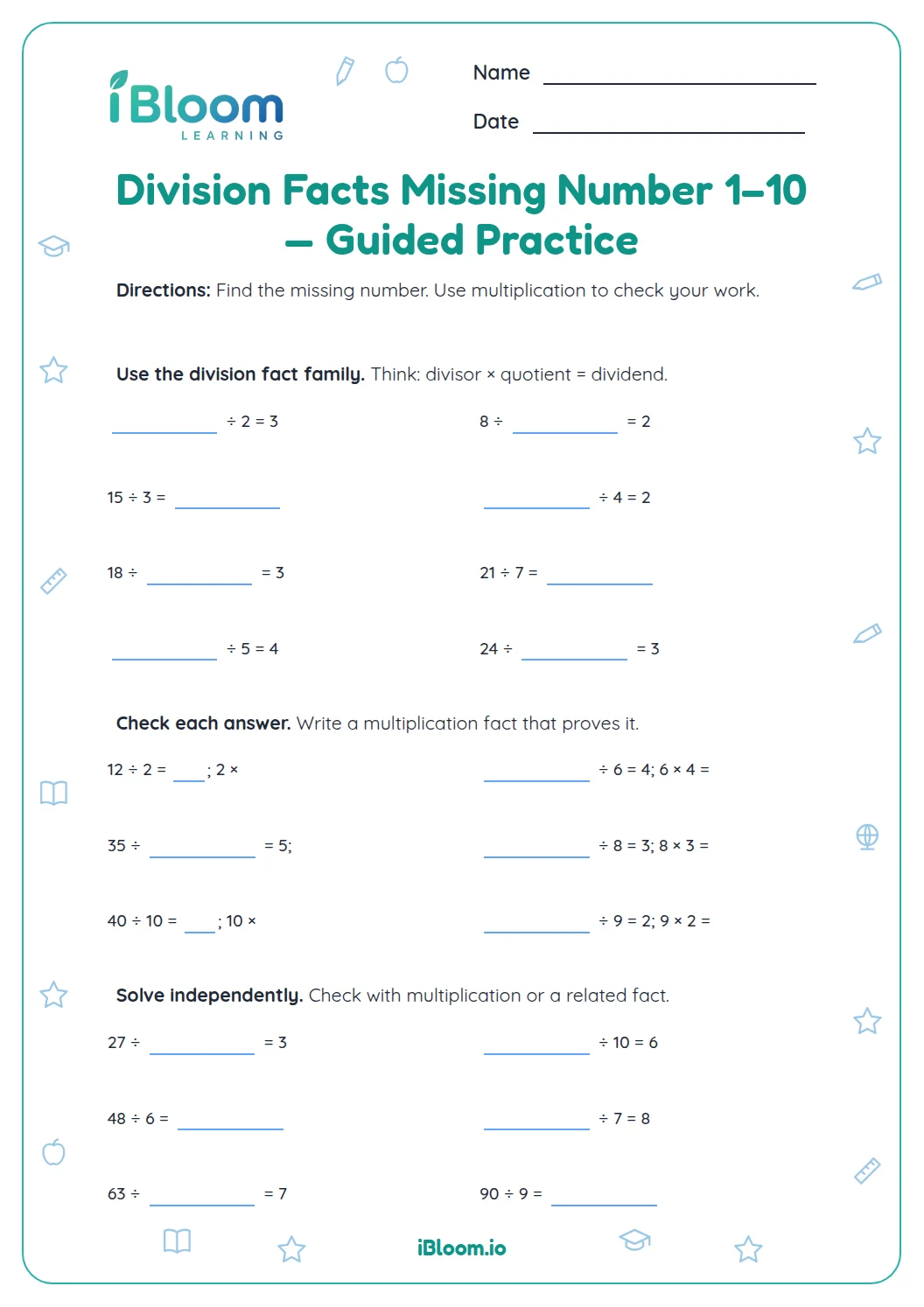
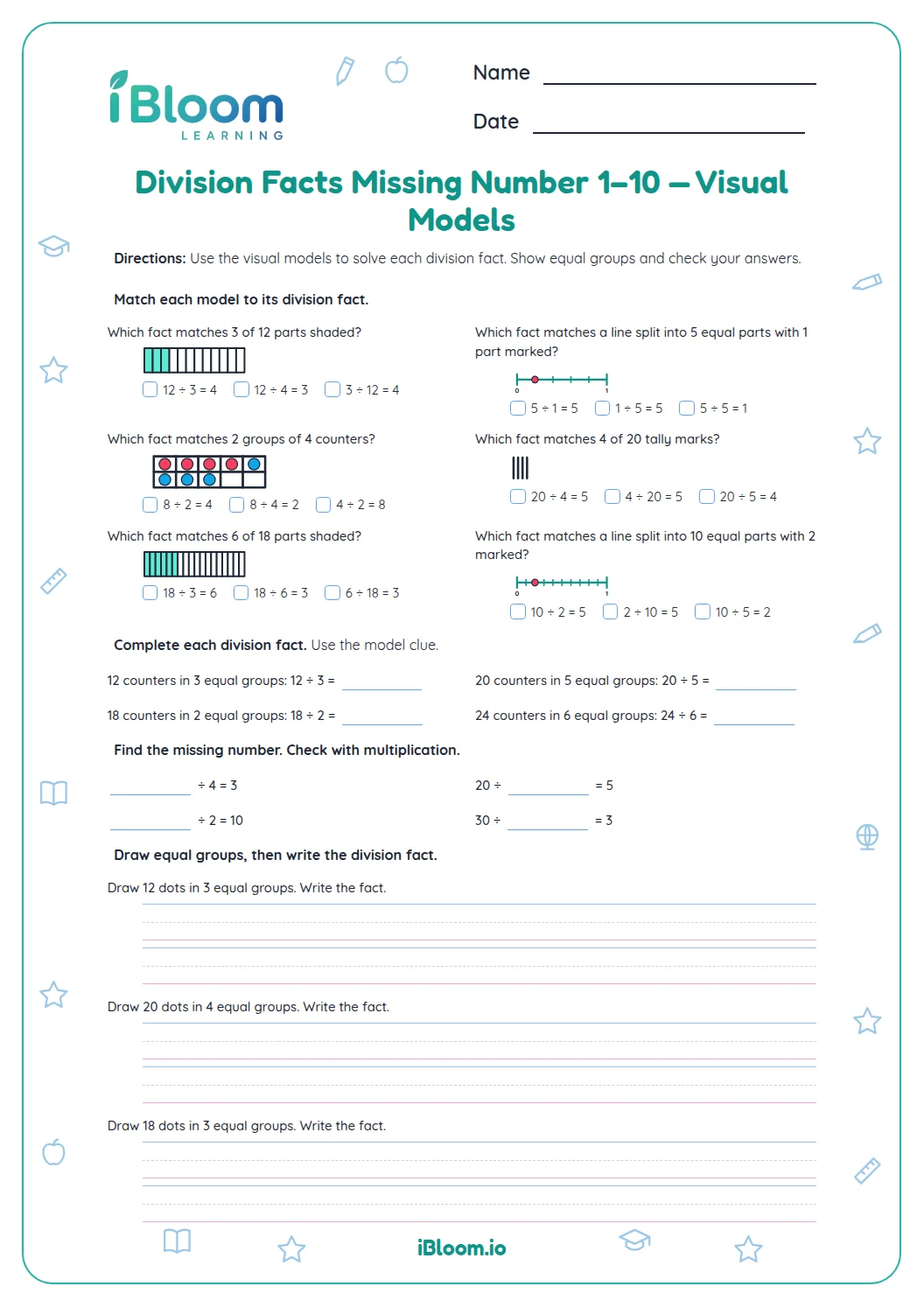
This Grade 3 worksheet practices division facts with 6 and 7 through equal-group arrays, number sentences, and short sharing situations. Students write division facts from visual models, solve quotients, and check with multiplication. A separate answer key covers all 14 questions.
Aligned to 3.OA.A.2
How can an array show division?
An array has equal rows and equal columns. If 24 apples make 6 equal rows, count the apples in one row to find 24 ÷ 6 = 4. Multiplication checks the relationship: 6 × 4 = 24.
How do multiplication facts help?
Think of division as finding a missing factor. For 42 ÷ 6, ask what number times 6 equals 42. The quotient is 7 because 6 × 7 = 42.
What does the worksheet include?
The printable has 16 questions in 3 parts, followed by a separate answer key.
How to solve each division fact
- 1For an array, identify the number of equal rows.
- 2Find how many objects are in each row.
- 3Write that amount as the quotient.
- 4For a number sentence, think of the matching multiplication fact.
- 5Multiply the quotient by the divisor to check.
Division checks
The mistake
Counting the rows as the quotient when the question asks for objects in each row.
The fix
Count the objects across one row.
The mistake
Switching the divisor and quotient.
The fix
Use the divisor as the number of equal groups, then find the size of one group.
The mistake
Describing the right quotient with the wrong total.
The fix
Multiply groups by objects per group to make sure the total matches.
Common Core alignment
This worksheet practices the following Common Core skill.
Interpret division as finding the number in each equal group.
On this sheet: Students use arrays and equal-group situations to find the quotient.
Show the official wordingHide the official wording
Interpret whole-number quotients of whole numbers, e.g., interpret 56 ÷ 8 as the number of objects in each share when 56 objects are partitioned equally into 8 shares, or as a number of shares when 56 objects are partitioned into equal shares of 8 objects each.
What to practice next
Make more practice
Further reading
Questions parents and teachers ask
How does an array show a division fact?
The rows show equal groups, and the objects in each row show the size of one group. With 24 apples in 6 rows, each row has 4 apples, so 24 divided by 6 equals 4. Count one row to see the group size.
What multiplication fact checks 42 ÷ 6?
The matching fact is 6 × 7 = 42. The quotient is 7 because six groups of seven make 42. Multiplication can check each division answer in the second part of the sheet. Try the fact family in reverse to check.
How can I check a group story?
Multiply the number of groups by the number in each group. For 30 dots split into 6 groups of 5, 6 × 5 equals 30, so the groups account for every dot. The quotient is 5. Draw six circles if a visual check helps.
Why are both 6 and 7 used as divisors?
The worksheet focuses on division facts with 6 or 7. Students can use the related multiplication tables to find each quotient, then check that the total is made by the stated number of equal groups. That reinforces equal groups and quotient meaning.
Is an answer key included?
Yes. A separate key lists the division equation for each array and the quotient for each division fact. Check that the divisor times the answer returns the total shown by the equal groups. The answers are grouped by question number.