





About this worksheet
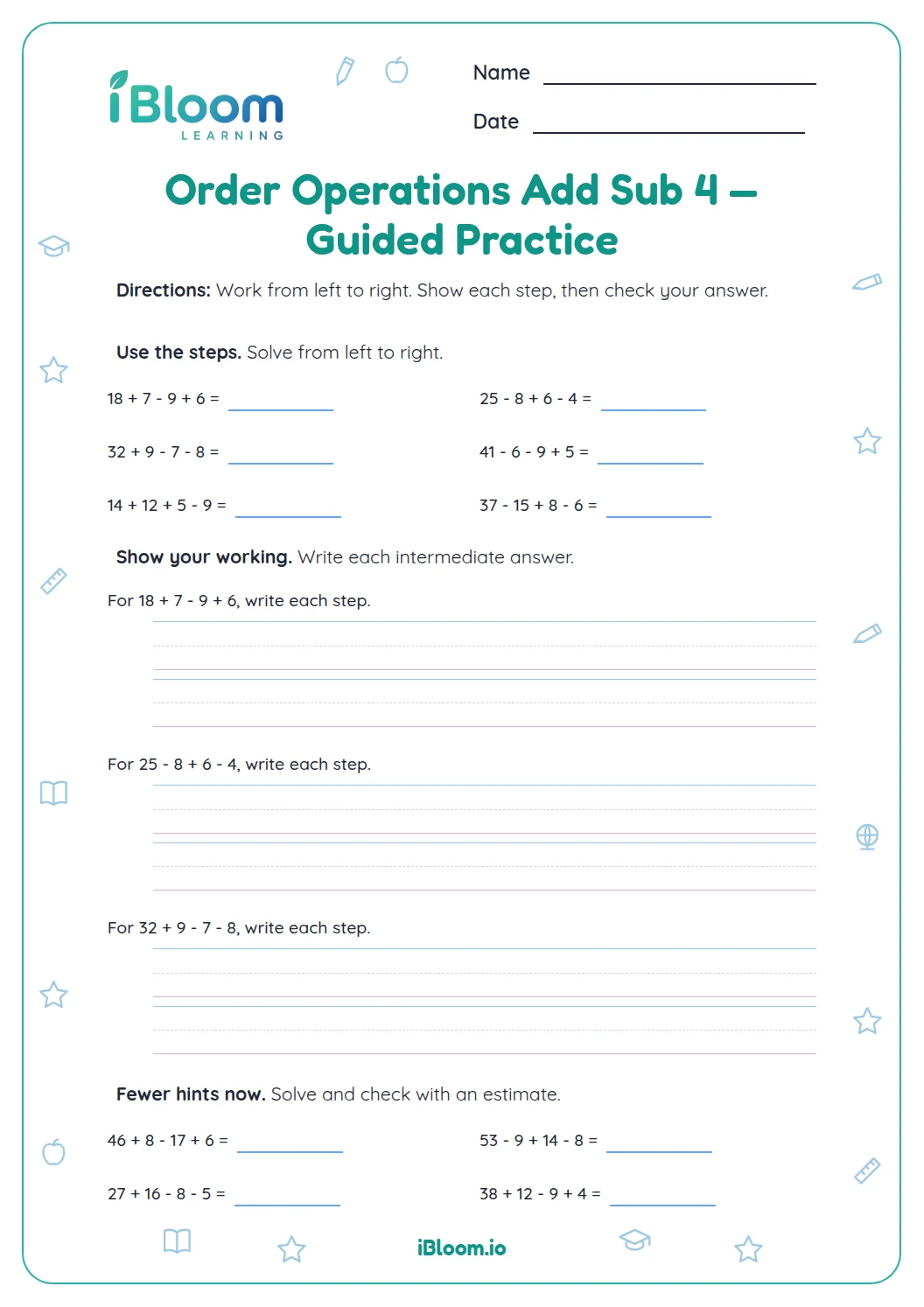
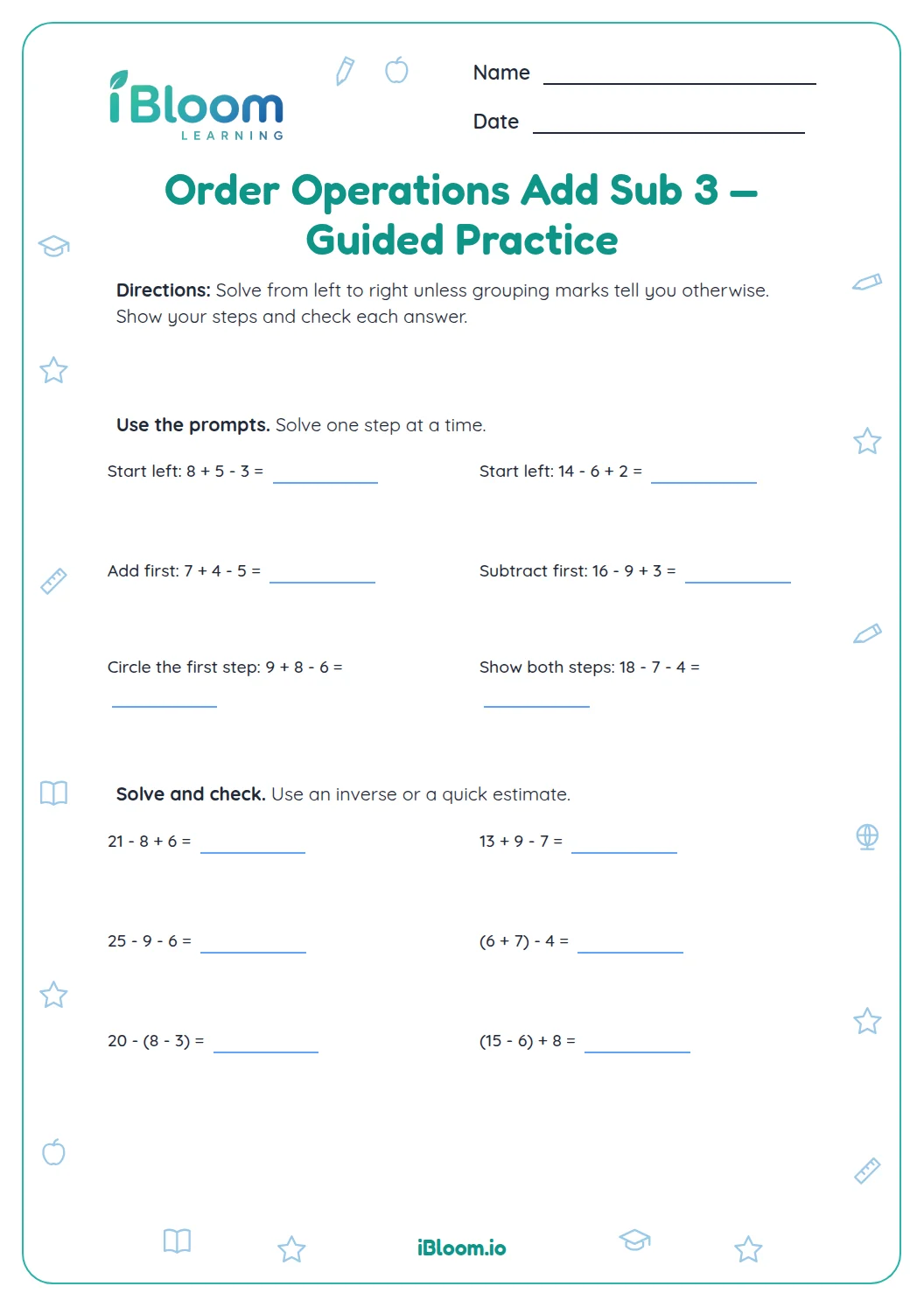
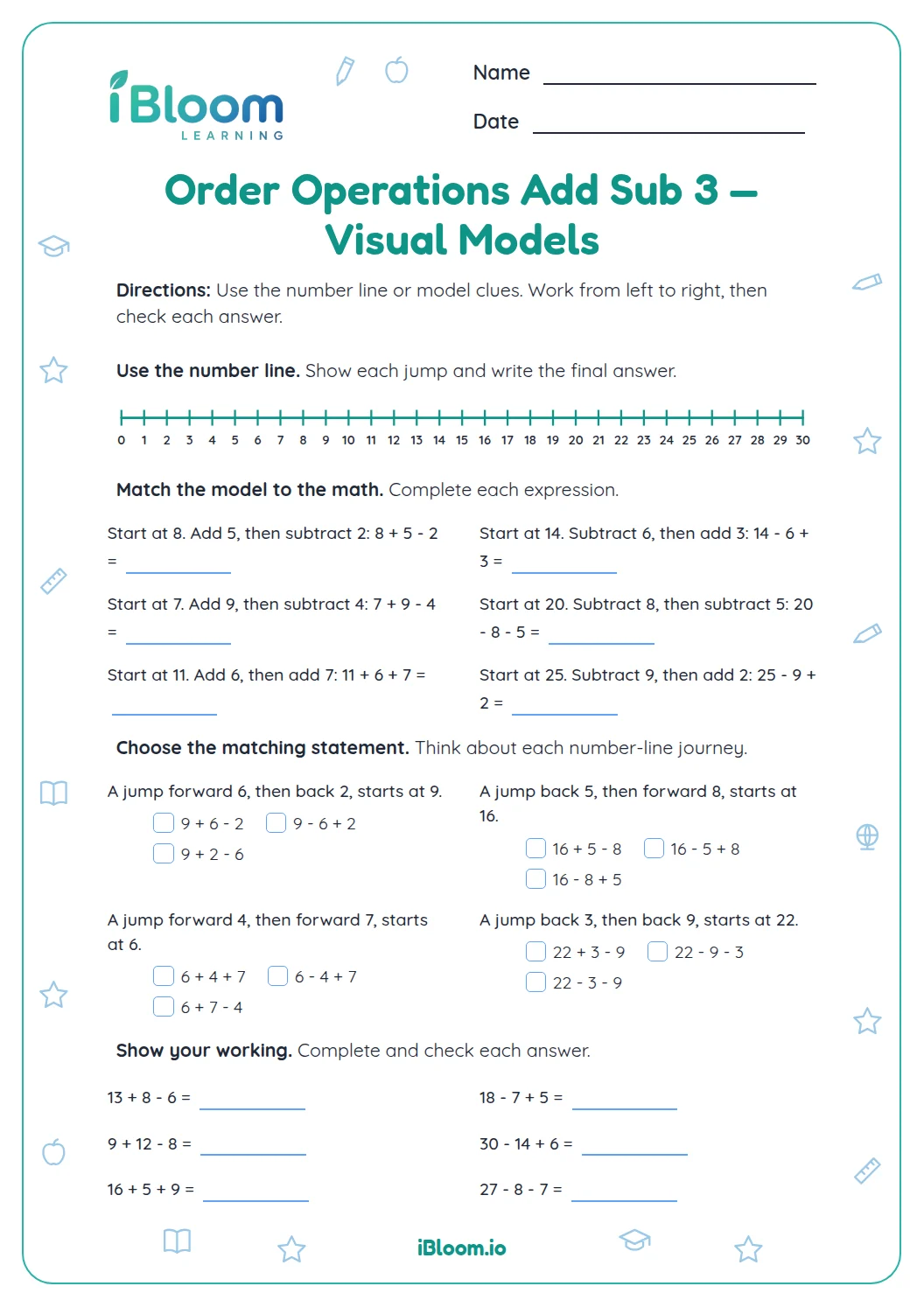
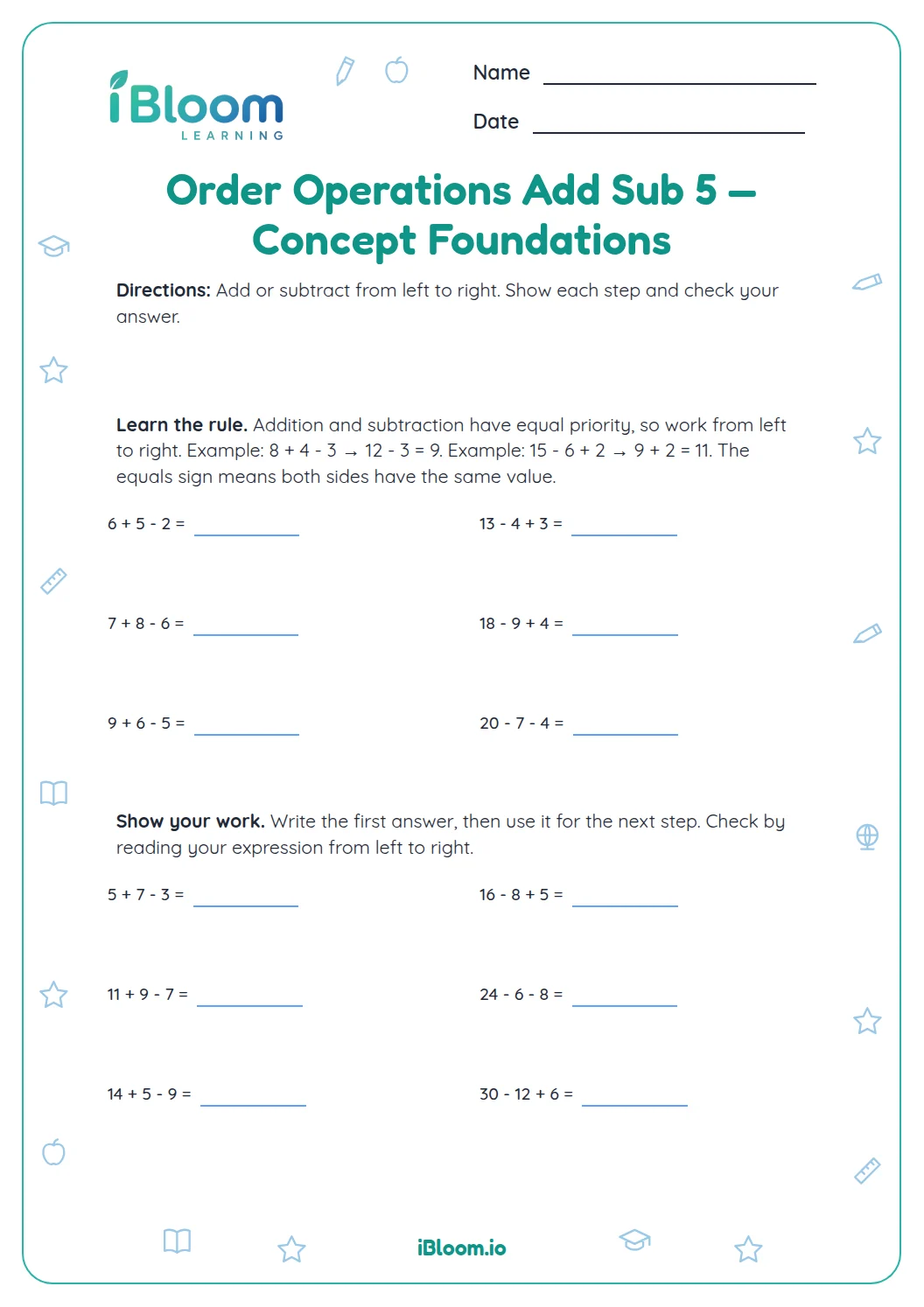
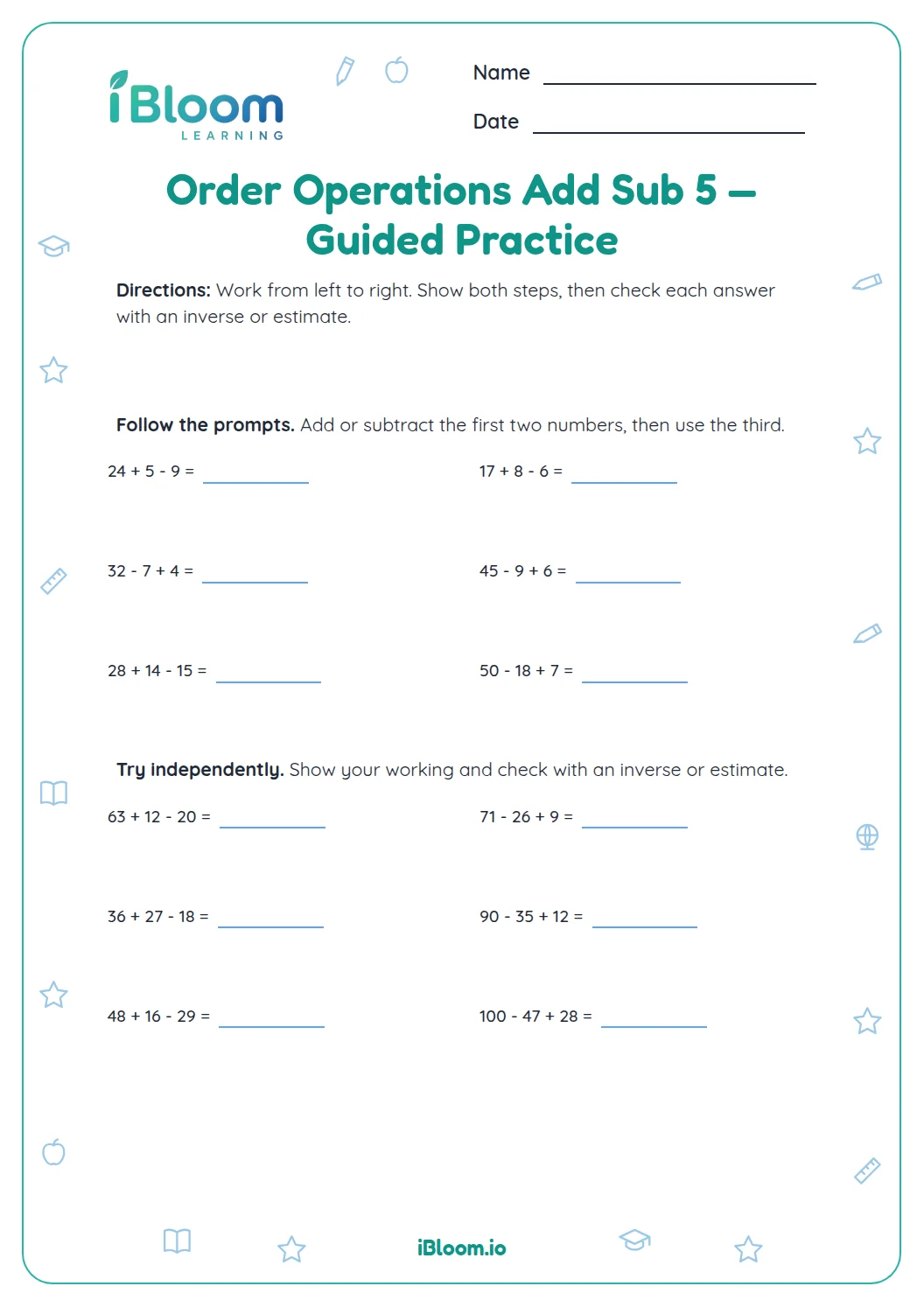
This free Grade 3 worksheet practices addition and subtraction in multi-step expressions. Students work from left to right, solve two missing-number equations, judge whether statements are correct, and check a classmate’s claim. It has 15 questions in three parts across two printable pages, with a separate answer key.
How do you solve addition and subtraction expressions?
When an expression has addition and subtraction but no parentheses, begin at the left and calculate each operation in order. Keep the new value in the expression as you go.
For question 4, 40 − 7 + 5 − 9 becomes 33 + 5 − 9, then 38 − 9, so the value is 29.
- 140 − 7 + 5 − 9
- 240 − 7 = 33, so 33 + 5 − 9
- 333 + 5 = 38, so 38 − 9 = 29
How can you check a missing number?
Use the known operations in their written order, then substitute your value back into the original equation. In question 1, the known terms make 24 − 7 + 5 = 22, so the blank must be 8 to reach 30.
The second part asks students to choose expressions and statements, including one equation that is already correct. Read each claim before deciding that it contains an error.
What does each part ask students to do?
Part A has five expressions, including two missing values. Part B has five multiple-choice reasoning questions. Part C has five expressions and applications, including evaluating Noah’s claim. The answer key gives a result or the exact correct choice for all 15.
How to use this worksheet
- 1Read the full expression before calculating.
- 2Start with the operation farthest left.
- 3Write each new value before doing the next operation.
- 4For a missing number, substitute your result to check the original equation.
- 5Read each classmate claim carefully; it may be correct.
Common slips and fixes
The mistake
Doing subtraction before an addition just because subtraction seems more important.
The fix
Addition and subtraction have equal rank here; follow the written order from left to right.
The mistake
Changing a plus sign to a minus sign while copying.
The fix
Copy the expression once, then check every sign against the prompt.
The mistake
Assuming every classmate claim is wrong.
The fix
Evaluate the full expression first; question 7’s equation is already true.
What to practice next
Make more practice
Questions parents and teachers ask
What is the rule for addition and subtraction in these problems?
Addition and subtraction have equal rank, so start at the left and work toward the right. For question 4, calculate 40 − 7 first, then add 5, then subtract 9. Keeping each intermediate result visible makes it easier to catch a sign or copying error.
Is the equation in question 7 wrong?
No. The equation 25 + 6 − 4 + 3 = 30 is correct when calculated left to right: 25 + 6 = 31, 31 − 4 = 27, and 27 + 3 = 30. The question asks students to recognize a true equation rather than assume that every displayed statement has a mistake.
How does the worksheet check missing numbers?
Two questions use a blank inside an equation. For question 1, combine the known terms in order: 24 − 7 + 5 equals 22, so the missing number is 8. Substitute 8 into the original expression to check that its value is 30.
Does this worksheet include an answer key?
Yes. A separate printable key gives the values for the expressions and the exact choices for the reasoning questions. Students can finish a part first, then use the key to find which step needs another look instead of copying the answer before trying.
How long will the 15 questions take?
Plan for about 25 minutes, with extra time if a student writes every intermediate step. The first part is direct calculation; the later parts ask students to check statements and explain a result. The two worksheet pages can also be completed in separate sittings.