

About this worksheet
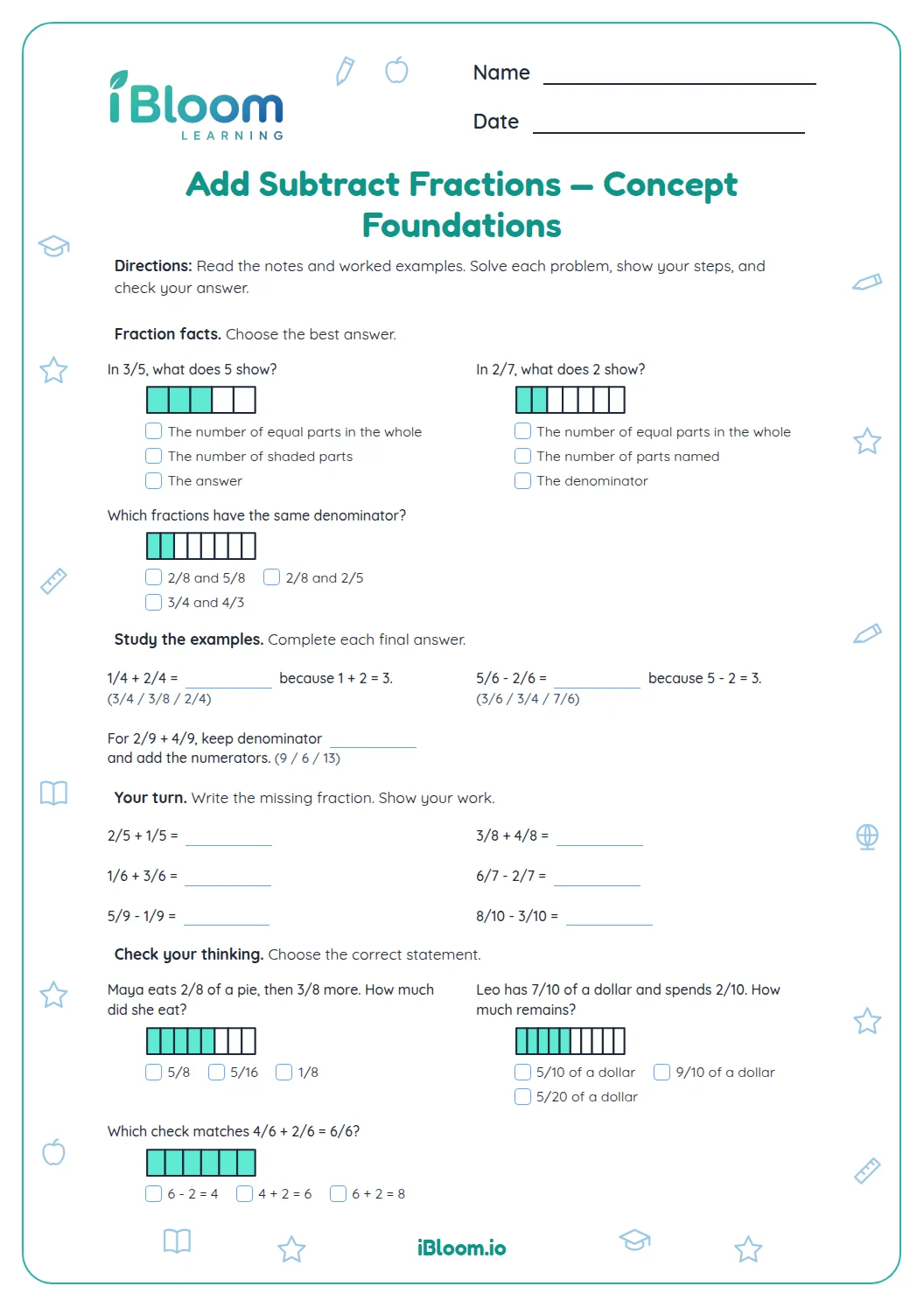
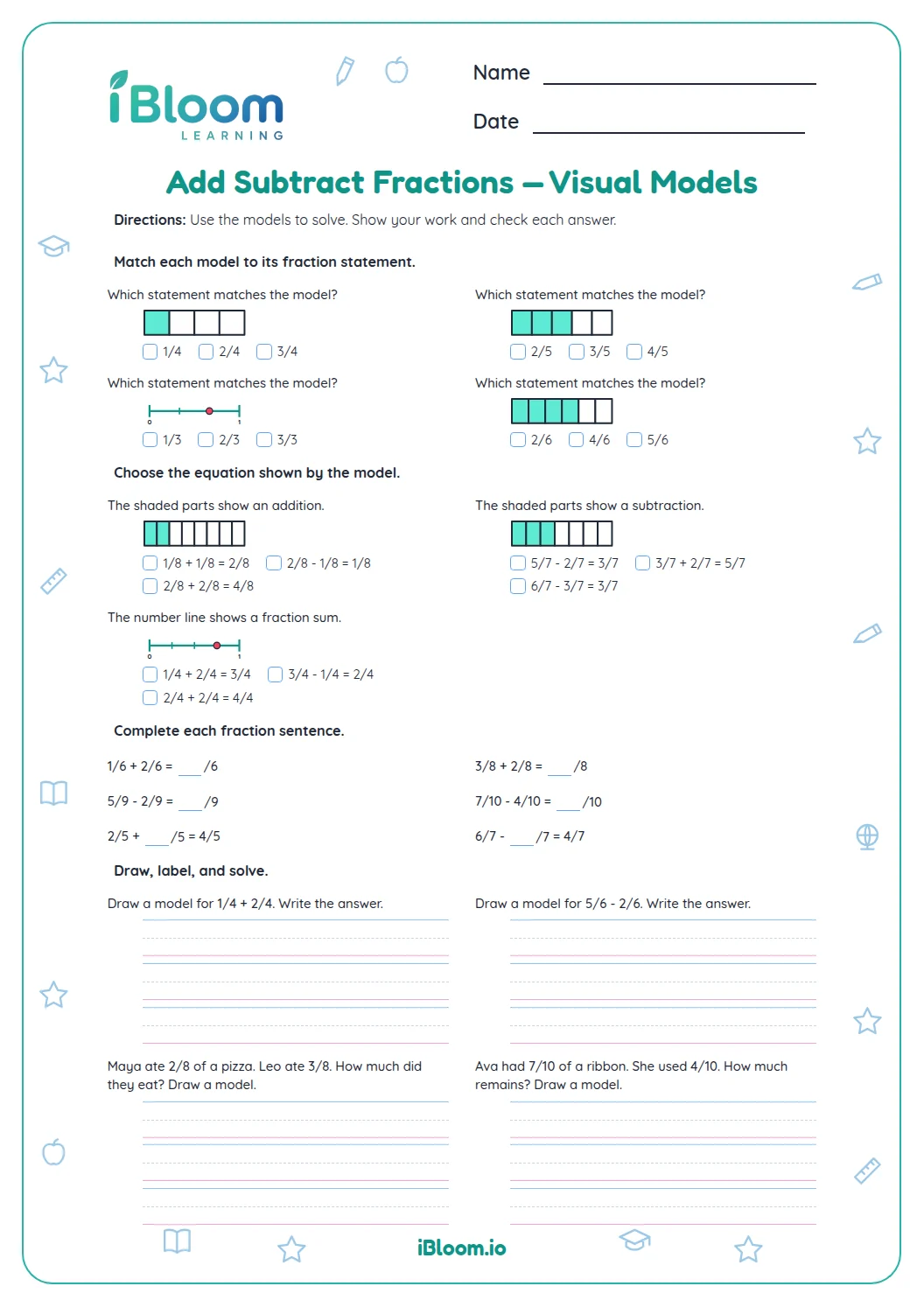
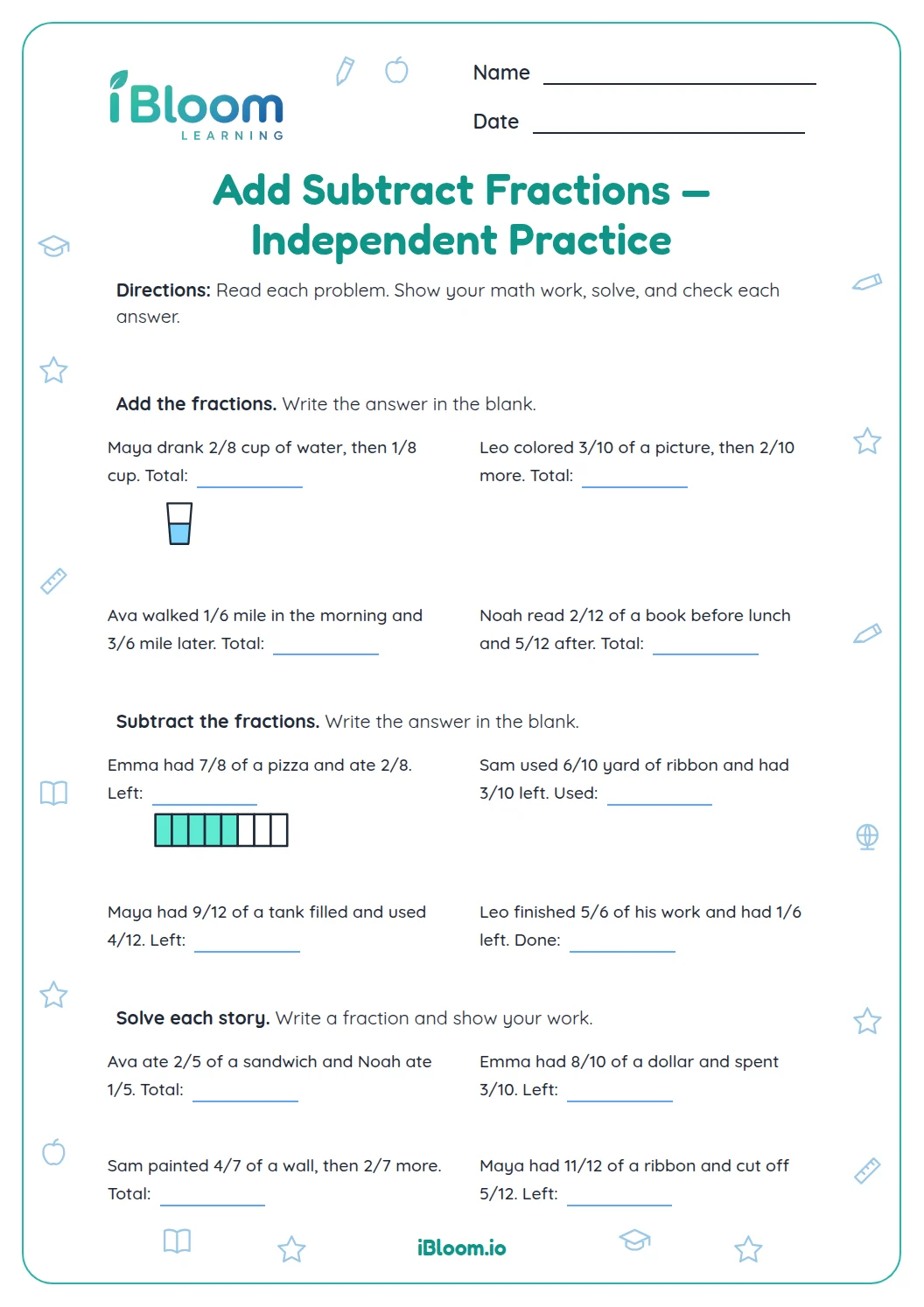
This Grade 3 reasoning worksheet has 16 fraction word problems and expression checks. Children add or subtract fractions with like denominators, compare results, and correct a common denominator error. The answer key gives one result for each item. It aligns with CCSS 3.NF.A.3.d through fraction comparison and reasoning about the size of fractions.
Aligned to 3.NF.A.3.d
How do you add and subtract like fractions?
Use the matching denominators to identify the piece size. Add or subtract only the numerators. Questions 1–6 place this idea in familiar stories.
- 12/8 + 3/8 = 5/8
- 2The pieces are eighths, so the denominator stays 8.
How do you check a fraction claim?
Work out each expression with the common denominator and check that the result makes sense. Questions 7–16 include comparisons, correction of a denominator error, and missing amounts.
What kinds of stories are included?
Food, ribbon, a path, a board, and a recipe give context for combining or taking away fractional amounts. Each question asks one clear thing.
How to use this worksheet
- 1Read what amount is present and what changes.
- 2Choose addition when amounts are combined and subtraction when an amount is removed or a remainder is asked for.
- 3Keep the shared denominator.
- 4Add or subtract the numerators.
- 5Check that the answer fits the story.
Common mistakes and quick fixes
The mistake
Adding the denominators along with the numerators.
The fix
Keep the shared denominator because the pieces have the same size.
The mistake
Subtracting the larger numerator from the smaller without considering the story.
The fix
Identify the starting amount and the amount removed before subtracting.
The mistake
Treating a remaining amount and an amount used as the same thing.
The fix
Reread whether the question asks how much was used or how much remains.
Common Core alignment
This worksheet practices the following Common Core mathematics standard.
Like denominators name equal-size pieces; add or subtract numerators.
On this sheet: The questions directly practice the stated skill.
Show the official wordingHide the official wording
Compare two fractions with the same numerator or the same denominator by reasoning about their size. Recognize that comparisons are valid only when the two fractions refer to the same whole. Record the results of comparisons with the symbols >, =, or <, and justify the conclusions, e.g., by using a visual fraction model.
What to practice next
Make more practice
Further reading
Questions parents and teachers ask
What is the rule for adding fractions with the same denominator?
Add the numerators and keep the common denominator. For example, 2/8 + 3/8 = 5/8 because the pieces are all eighths. Question 1 applies that rule in a short story about cornbread. Use the printed question and the separate answer key to check the result carefully.
How do you subtract fractions with like denominators?
Subtract the numerators and keep the denominator. In question 4, 6/8 − 2/8 = 4/8, since four eighth-size pieces remain after two are removed. Use the printed question and the separate answer key to check the result carefully. Use the printed question and the separate answer key to check the result carefully.
Why is 2/6 + 3/6 not 5/12?
The denominator tells the size of each piece, and that size stays sixths throughout the addition. Count two sixths plus three sixths to get five sixths: 5/6. Use the printed question and the separate answer key to check the result carefully.
Can students compare an addition expression with a subtraction expression?
Yes. Work out each expression first, then compare the results. Question 7 gives 3/8 + 2/8 and 7/8 − 1/8; these equal 5/8 and 6/8, respectively. Use the printed question and the separate answer key to check the result carefully.
What does the worksheet mean by mixed addition and subtraction?
The story problems include both adding like fractions and subtracting them. Students identify whether the story combines amounts, removes an amount, or asks how much more is needed. Use the printed question and the separate answer key to check the result carefully.
Is there an answer key?
Yes. A separate key gives the fraction or amount for every story and reasoning item. It also shows the corrected results for the common denominator errors. Use the printed question and the separate answer key to check the result carefully.