
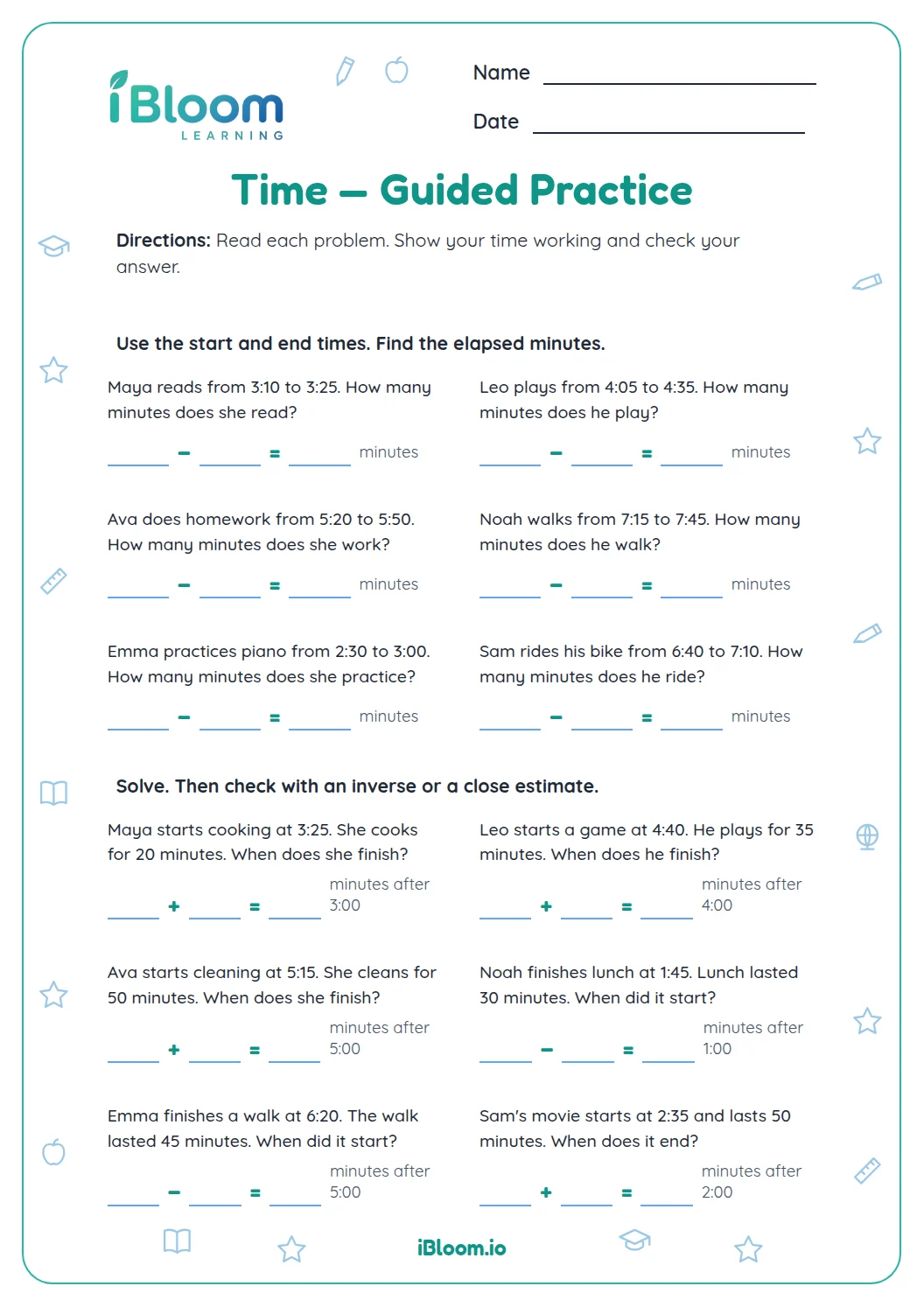
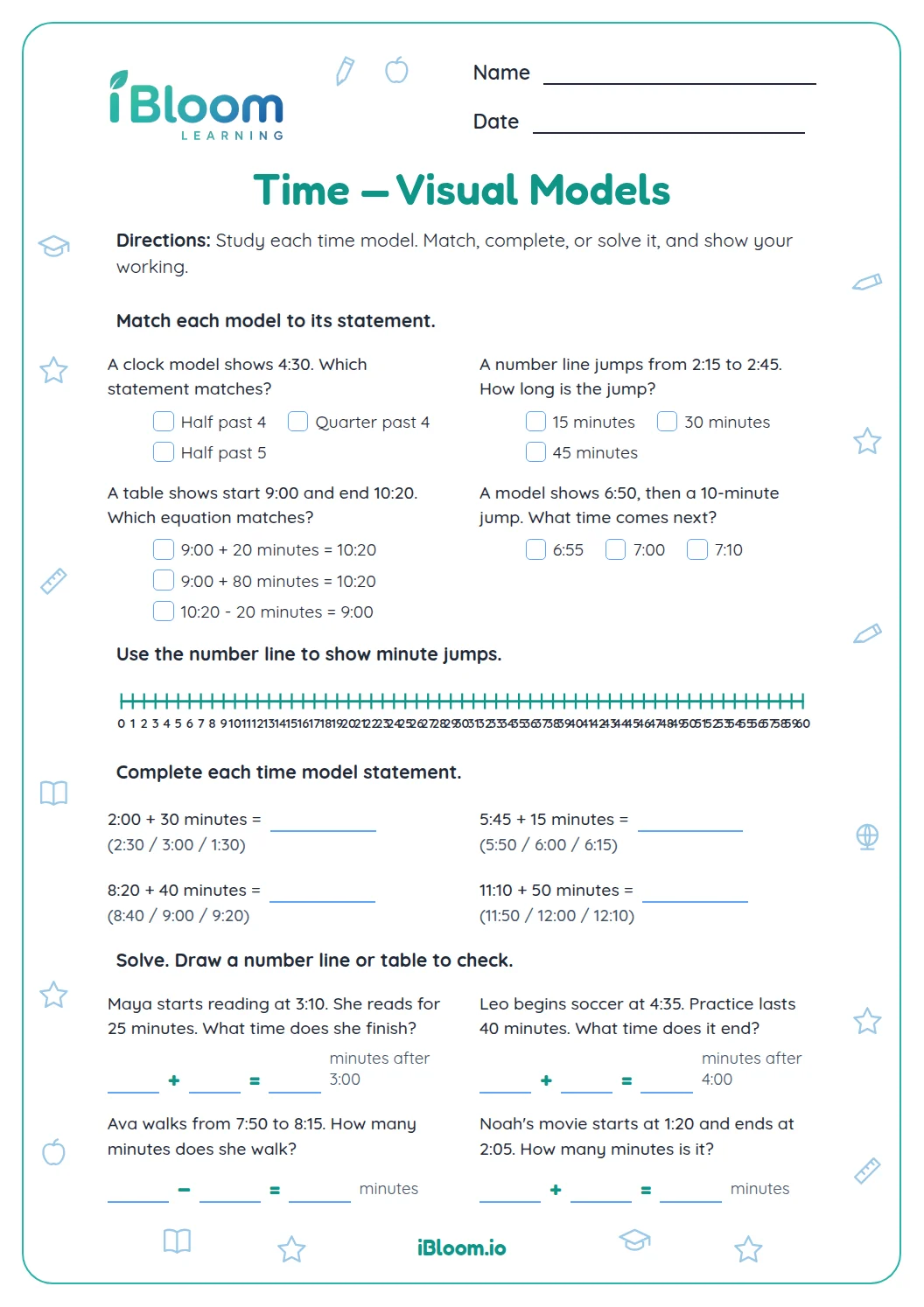
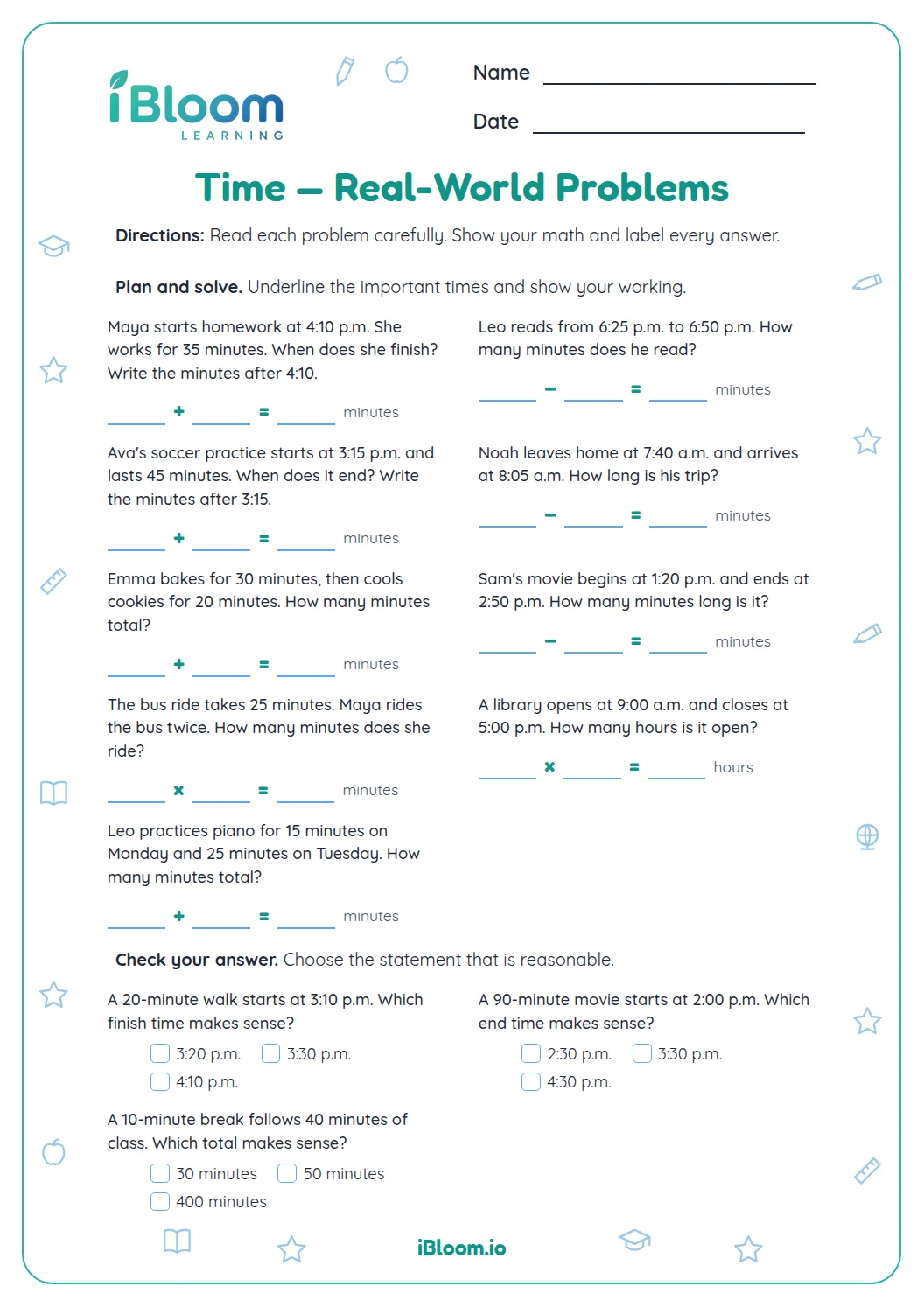
About this worksheet
This Grade 3 worksheet has 16 time word problems. Students find event end times and elapsed durations, including intervals that cross an hour or noon. For example, a 3:40 p.m. start plus 20 minutes ends at 4:00 p.m. The key lists full clock times or durations. The sheet practices CCSS 3.MD.A.1.
Aligned to 3.MD.A.1
How do you find an ending time?
Move forward by the elapsed time. Add hours first, then minutes, and regroup 60 minutes as 1 hour when needed. In question 2, 3:40 p.m. plus 20 minutes reaches 4:00 p.m.
A time can cross noon or midnight, so keep track of a.m. and p.m. In question 1, 11:15 a.m. plus two hours is 1:15 p.m.
- 1Start at 3:40 p.m.
- 2Move 20 minutes forward to the next hour.
- 3End time: 4:00 p.m.
How do you find how long an event lasts?
Count forward from the start time to the end time, using friendly hour or quarter-hour landmarks. Question 7 runs from 6:20 p.m. to 7:05 p.m.: 40 minutes to 7:00, then 5 more, for 45 minutes.
What if the minutes cross an hour?
Keep the minutes and hours together. For a duration that crosses the hour, count to the next hour and continue with the remaining minutes. The items include both end-time and elapsed-time questions.
How to use this worksheet
- 1Underline the start time and the number of hours or minutes.
- 2Decide whether the question asks for an ending time or a duration.
- 3For an ending time, move forward by the interval.
- 4For a duration, count forward from start to end.
- 5Regroup 60 minutes as one hour and keep a.m./p.m. labels clear.
Common mistakes and quick fixes
The mistake
Writing minutes after an hour without regrouping.
The fix
Trade 60 minutes for one hour; 3:60 p.m. becomes 4:00 p.m.
The mistake
Reporting only the added minutes when the question asks for a clock time.
The fix
Give the full ending time, including the hour and a.m. or p.m. when needed.
The mistake
Forgetting that noon changes a.m. to p.m.
The fix
Track whether the event passes noon or midnight.
Common Core alignment
This worksheet practices the following Common Core mathematics standard.
Track both clock minutes and whether a time is a.m. or p.m.
On this sheet: The questions directly practice the stated skill.
Show the official wordingHide the official wording
Tell and write time to the nearest minute and measure time intervals in minutes. Solve word problems involving addition and subtraction of time intervals in minutes, e.g., by representing the problem on a number line diagram.
What to practice next
Make more practice
Further reading
Questions parents and teachers ask
How do you find an ending time after adding minutes?
Start with the given clock time and move forward by the number of minutes. If the minutes reach 60, trade them for one hour. For example, 3:40 p.m. plus 20 minutes is 4:00 p.m. Use the printed question and the separate answer key to check the result carefully.
What is the answer when 11:15 a.m. is two hours later?
It is 1:15 p.m. Two hours after 11:15 a.m. is 12:15 p.m., then 1:15 p.m. The time changes from a.m. to p.m. at noon. Use the printed question and the separate answer key to check the result carefully. Use the printed question and the separate answer key to check the result carefully.
How can you find elapsed time?
Count forward from the start time to the end time, using hour or quarter-hour landmarks. For 6:20 p.m. to 7:05 p.m., count 40 minutes to 7:00 and 5 more minutes, for 45 minutes. Use the printed question and the separate answer key to check the result carefully.
Why can 3:40 plus 20 minutes be 4:00?
The 40 minutes and 20 minutes make 60 minutes, which equals one hour. Add that hour to 3:00 to get 4:00 p.m. Use the printed question and the separate answer key to check the result carefully. Use the printed question and the separate answer key to check the result carefully.
Does the sheet include durations as well as ending times?
Yes. Some questions ask what time an event ends, while others give both start and end times and ask for the duration. Read the final question carefully to decide what kind of answer to write. Use the printed question and the separate answer key to check the result carefully.
Is an answer key included?
Yes. A separate key lists each ending time or elapsed duration. Times include a.m. or p.m. where needed so the answer is unambiguous. Use the printed question and the separate answer key to check the result carefully. Use the printed question and the separate answer key to check the result carefully.