



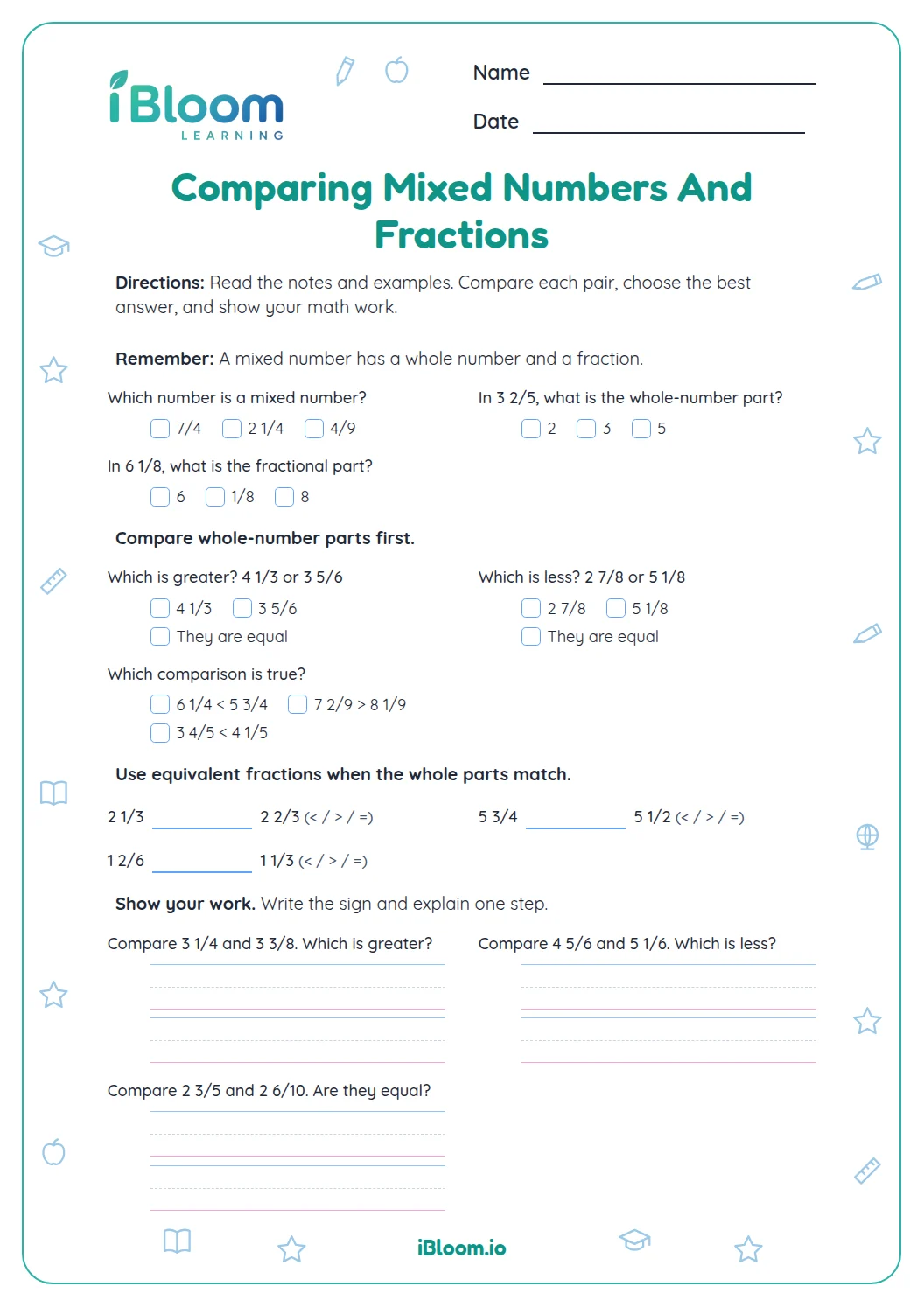

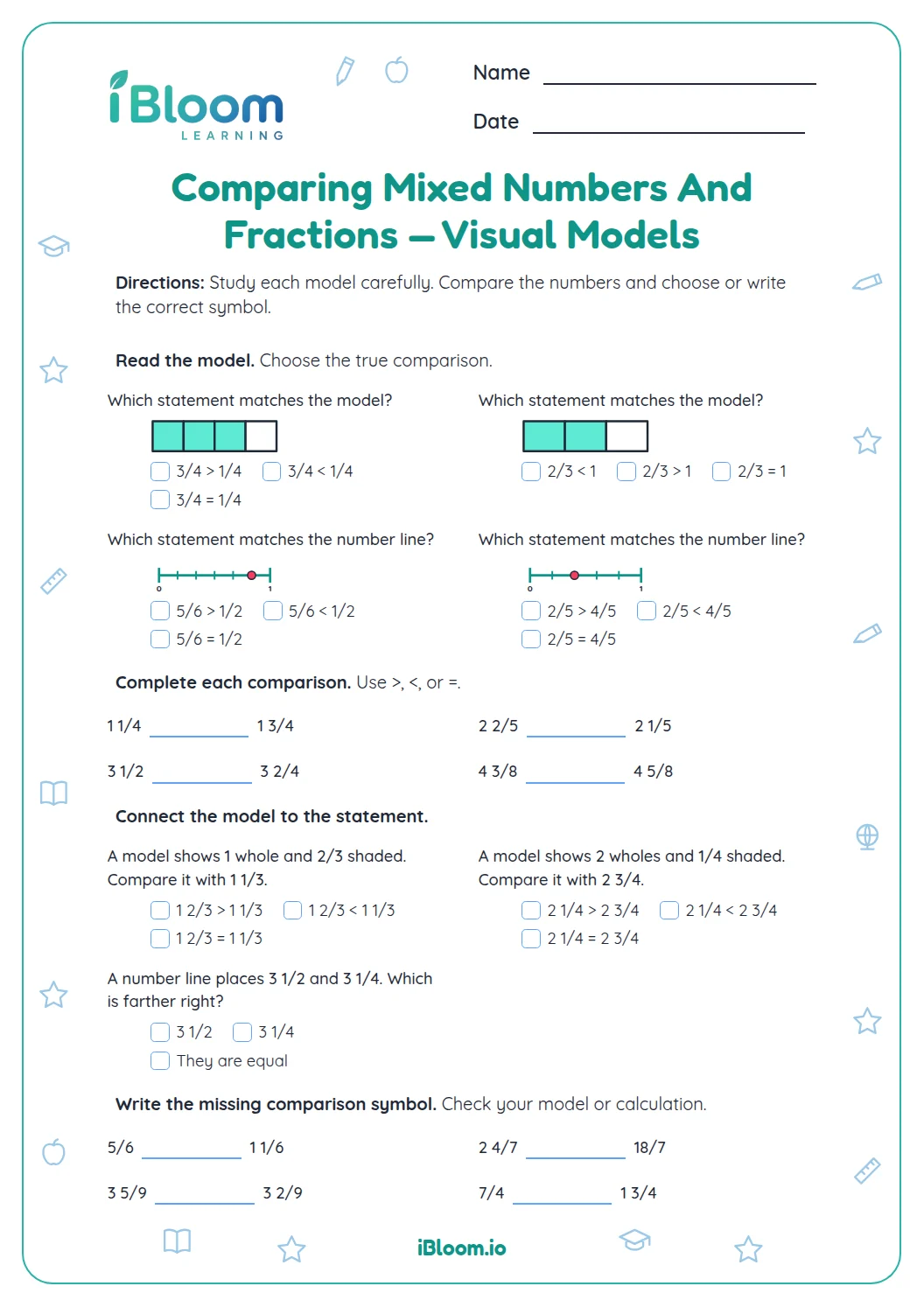
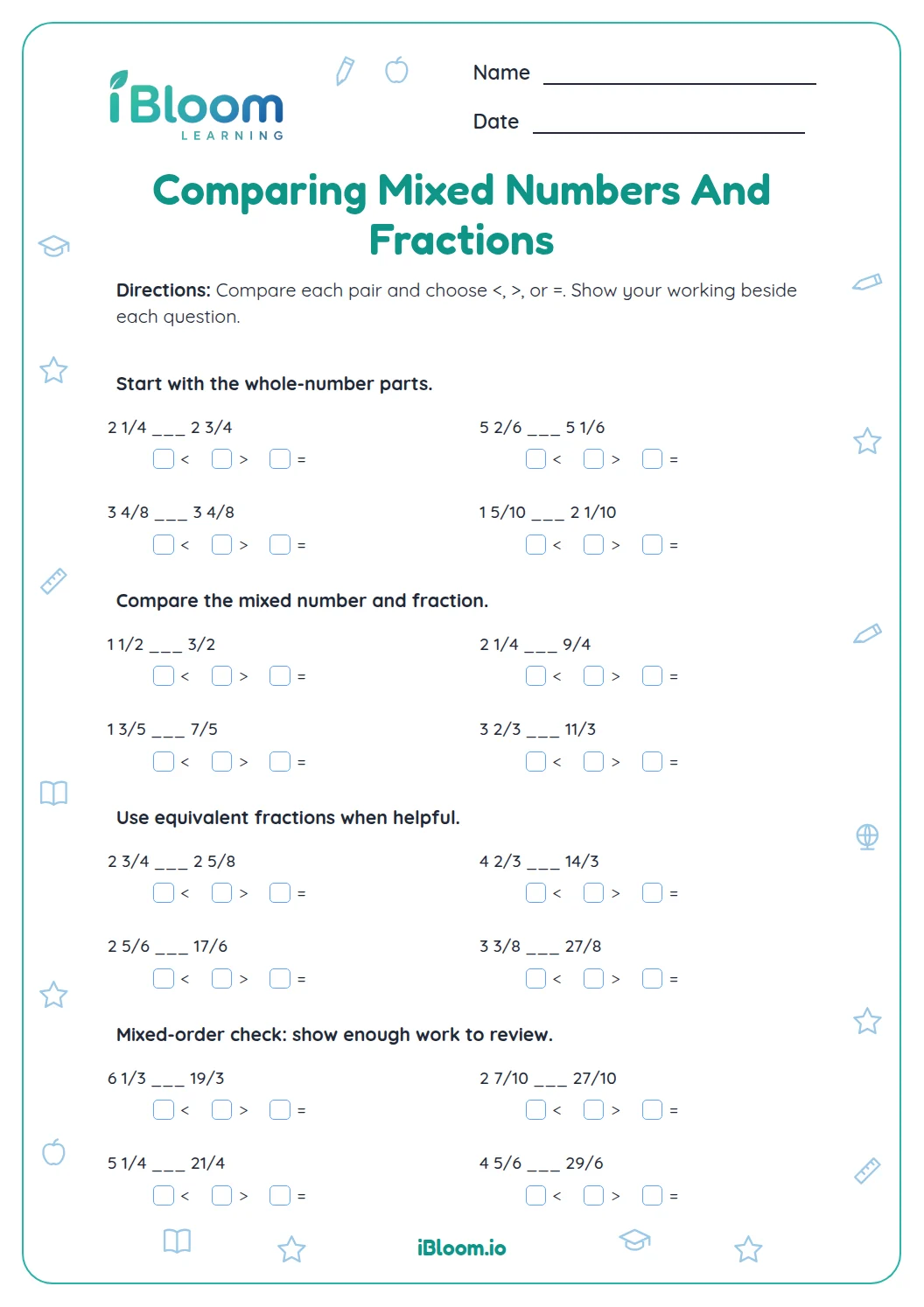

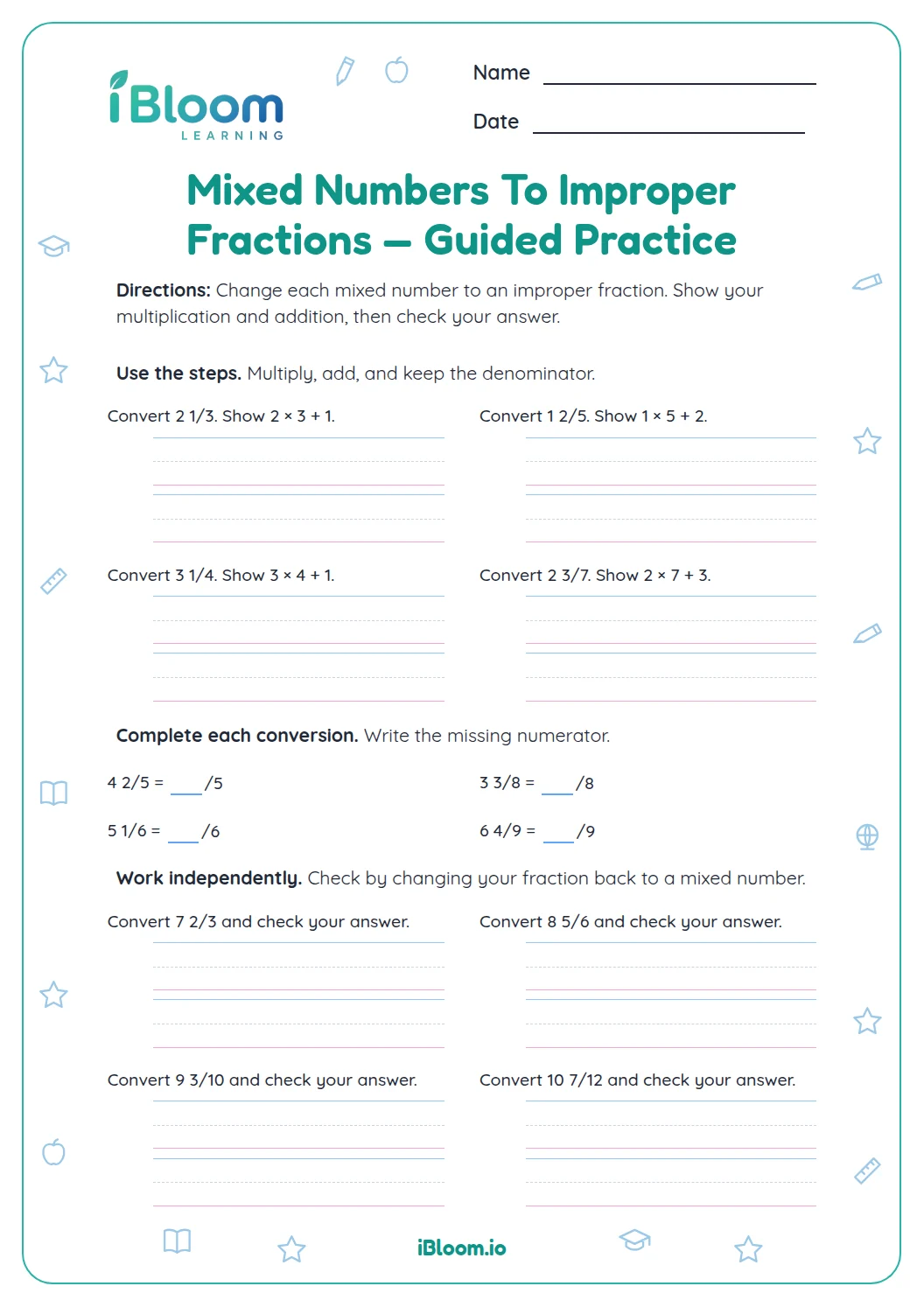

About this worksheet
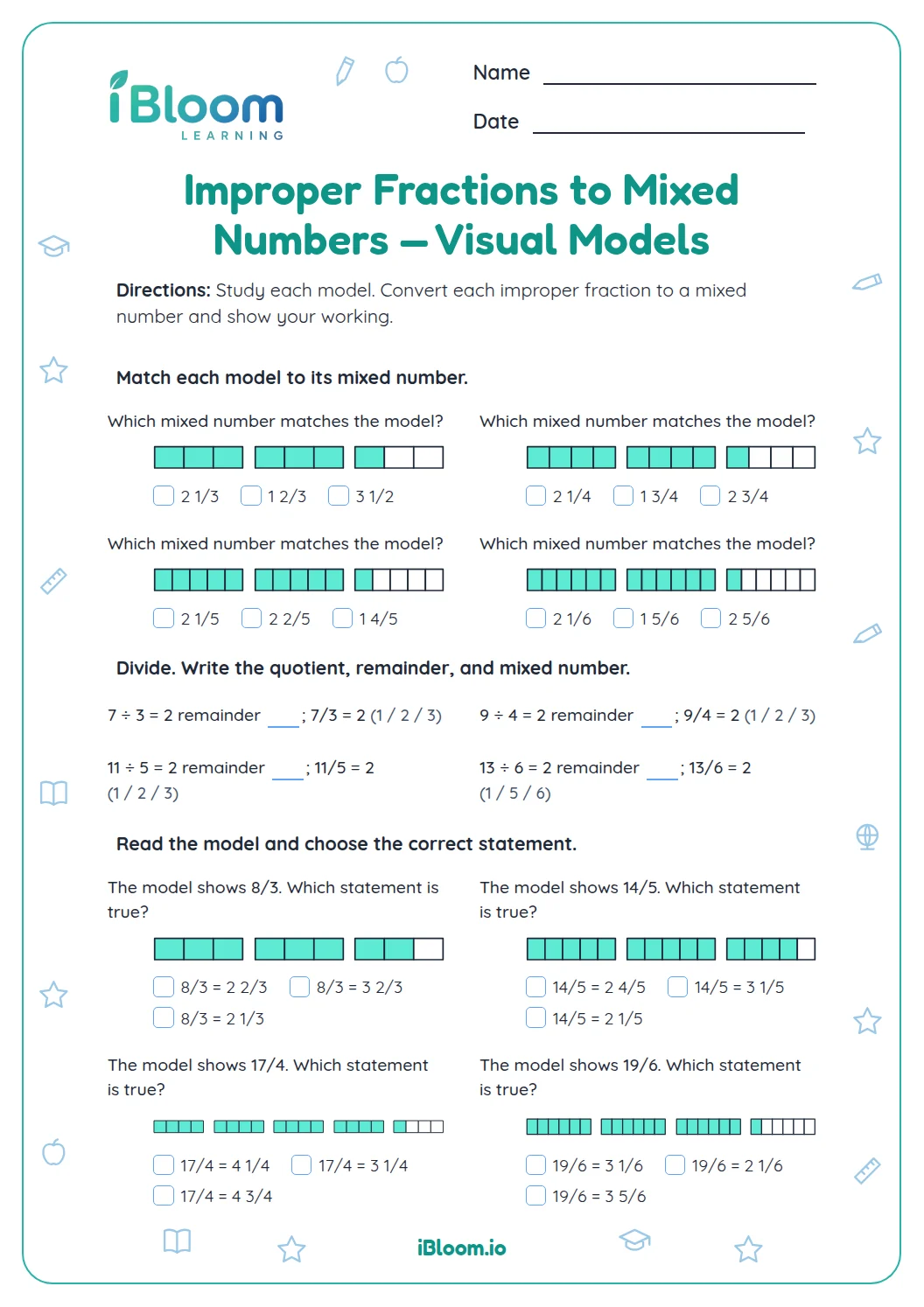
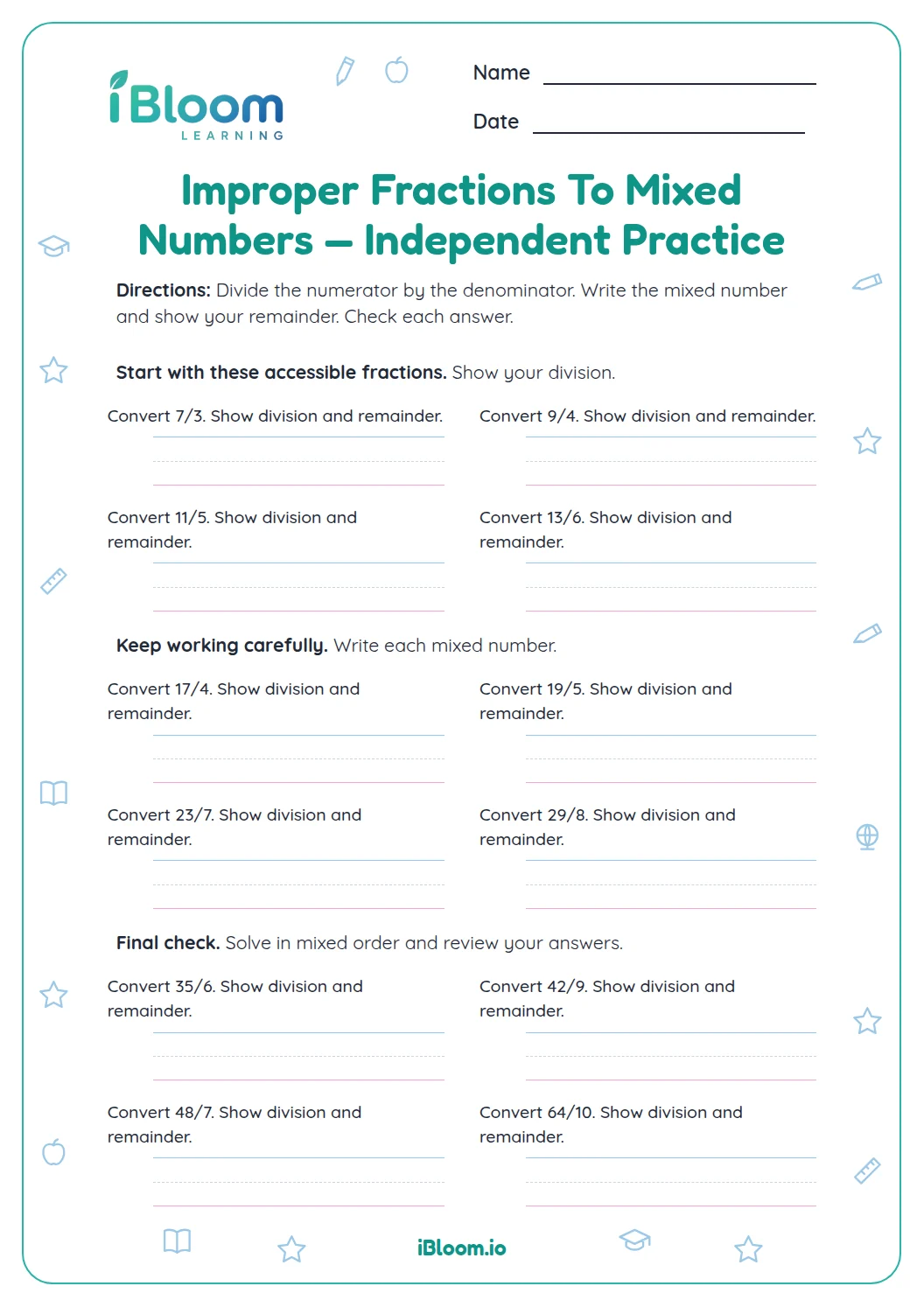
An improper fraction counts equal-size parts. Divide its numerator by the denominator: the quotient counts whole groups and the remainder gives the fractional part. Then check by multiplying the whole number by the denominator and adding the remainder.
Aligned to 4.NF.B.3.b
How do you convert an improper fraction?
Divide the numerator by the denominator. The quotient is the number of whole groups, and the remainder is the numerator of the fractional part. For 17/5, 17 ÷ 5 gives 3 remainder 2, so 17/5 = 3 2/5.
Check by multiplying 3 × 5 and adding 2; the result returns to 17.
How does the challenge ask students to reason?
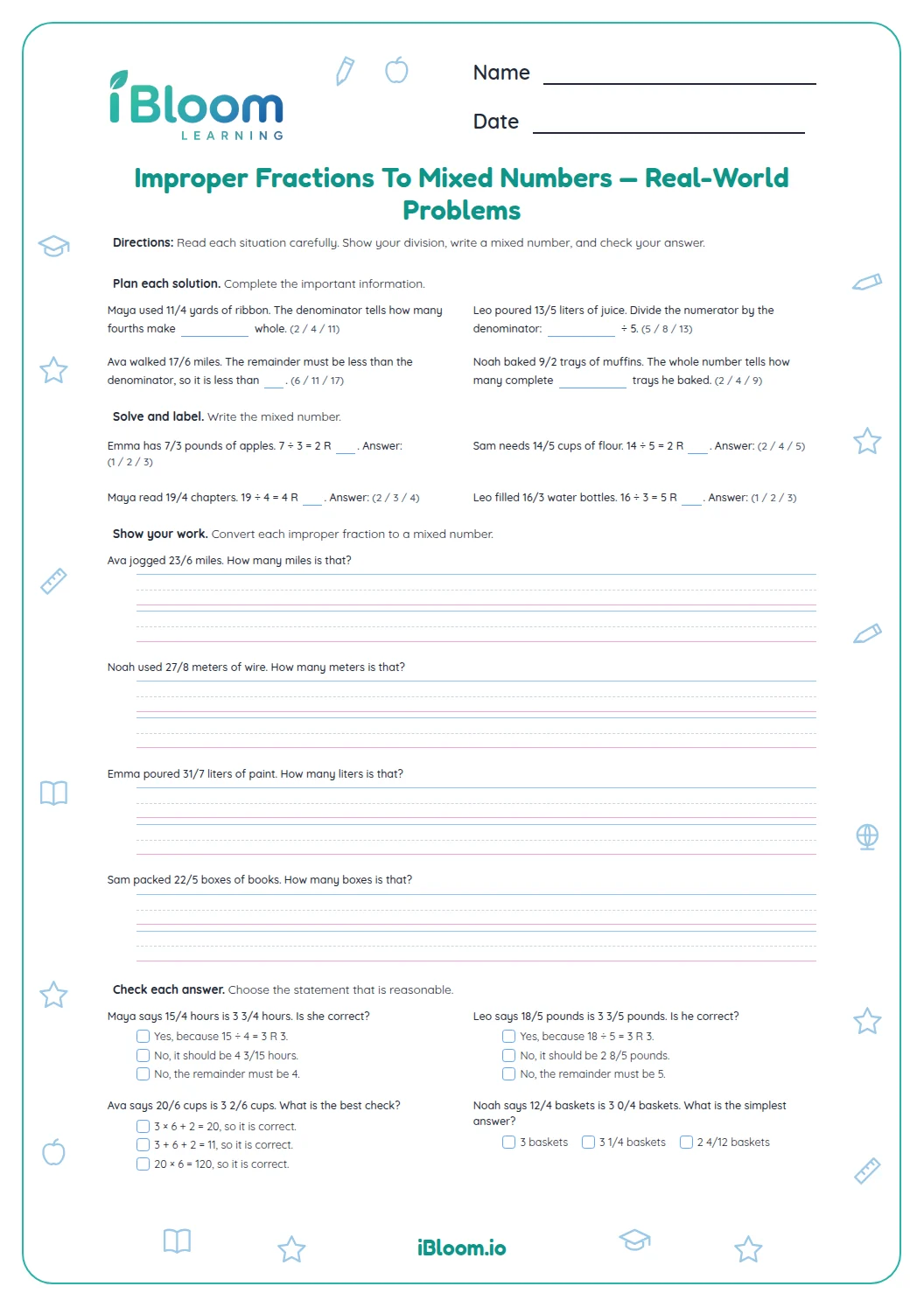
Students convert fractions, compare equivalent forms, interpret fractions in context, and decide whether sample claims are correct. Leo’s 17/5 = 3 2/5 statement is true, so students must test a claim instead of assuming it contains an error.
What makes a conversion correct?
The remainder must be smaller than the denominator, and the original denominator stays the same. Multiply the whole number by the denominator and add the numerator part; the result should equal the original numerator.
How to use this worksheet
- 1Divide the numerator by the denominator.
- 2Write the quotient as the whole number.
- 3Place the remainder over the original denominator.
- 4Check that the remainder is smaller than the denominator.
- 5Multiply and add to confirm the conversion returns to the original numerator.
Mistakes to watch for
The mistake
Using the denominator as the whole number.
The fix
The quotient counts whole groups; the denominator names each part.
The mistake
Leaving a remainder as large as the denominator.
The fix
Trade another full group for one whole until the remainder is smaller.
The mistake
Changing the denominator after division.
The fix
Keep the original denominator because the size of each part stays the same.
Common Core alignment
This Grade 4 sheet practices the Common Core skill listed here.
Decompose fractions into sums of fractions with the same denominator.
On this sheet: Students decompose improper fractions into whole groups and a remainder with the same denominator.
Show the official wordingHide the official wording
Decompose a fraction into a sum of fractions with the same denominator in more than one way, recording each decomposition by an equation. Justify decompositions, e.g., by using a visual fraction model.
What to practice next
Make more practice
Further reading
Questions parents and teachers ask
Is Leo correct that 17/5 = 3 2/5?
Yes. Dividing 17 by 5 gives 3 remainder 2, so the mixed number is 3 2/5. Check it by calculating 3 × 5 + 2 = 17. The worksheet includes this true claim so students practice checking each statement on its mathematics.
How do you change an improper fraction to a mixed number?
Divide the numerator by the denominator. The quotient is the whole-number part, and the remainder goes over the original denominator. For example, 29 ÷ 6 is 4 remainder 5, so 29/6 is 4 5/6. A quick estimate or labeled sketch helps students check that the result fits the question.
Why does the denominator stay the same?
The denominator names the size of the fractional parts. Converting to a mixed number groups some of those parts into whole units but does not change their size. The remainder therefore stays over the original denominator. A quick estimate or labeled sketch helps students check that the result fits the question.
How can a student check a conversion?
Multiply the whole-number part by the denominator, then add the numerator of the fractional part. That result should match the original numerator. Also confirm the remainder is smaller than the denominator so no additional whole group remains. A quick estimate or labeled sketch helps students check that the result fits the question.
What is included in the reasoning challenge?
The 15 questions include conversions, equivalent forms, true and false claims, comparison, fraction contexts, and an example to create. The worksheet and separate answer key each span two pages, with the claim checks included. A quick estimate or labeled sketch helps students check that the result fits the question.