



About this worksheet
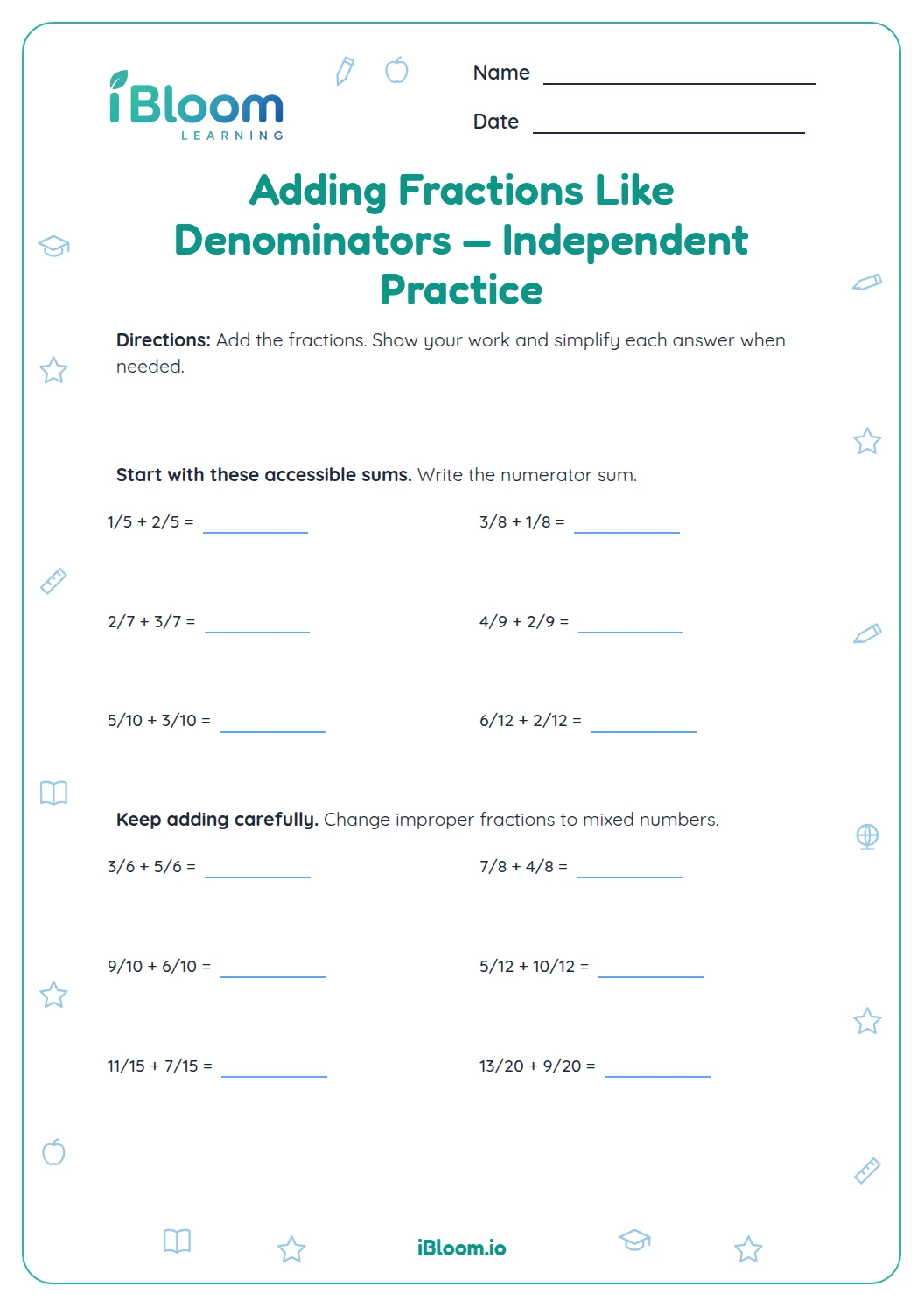
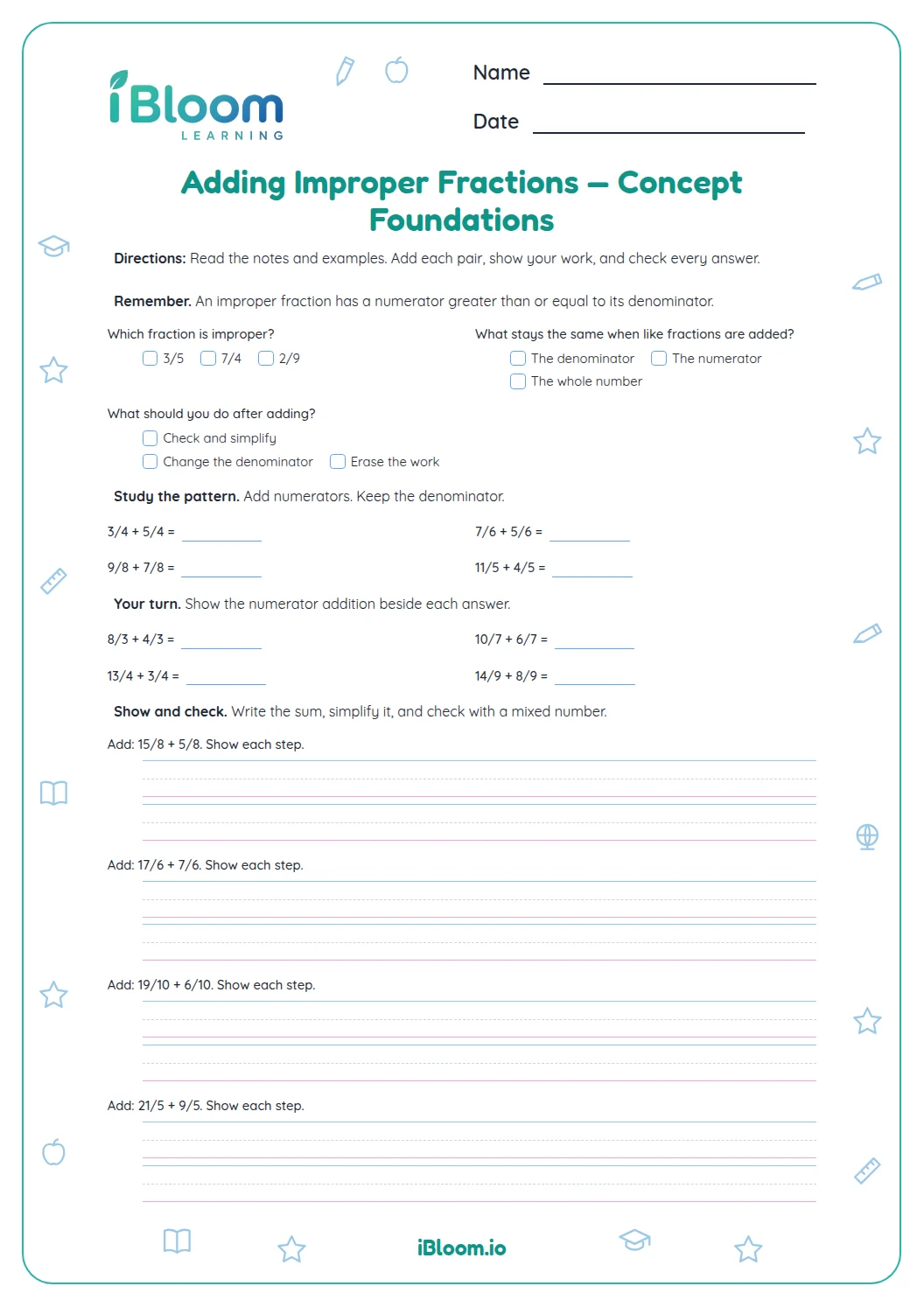
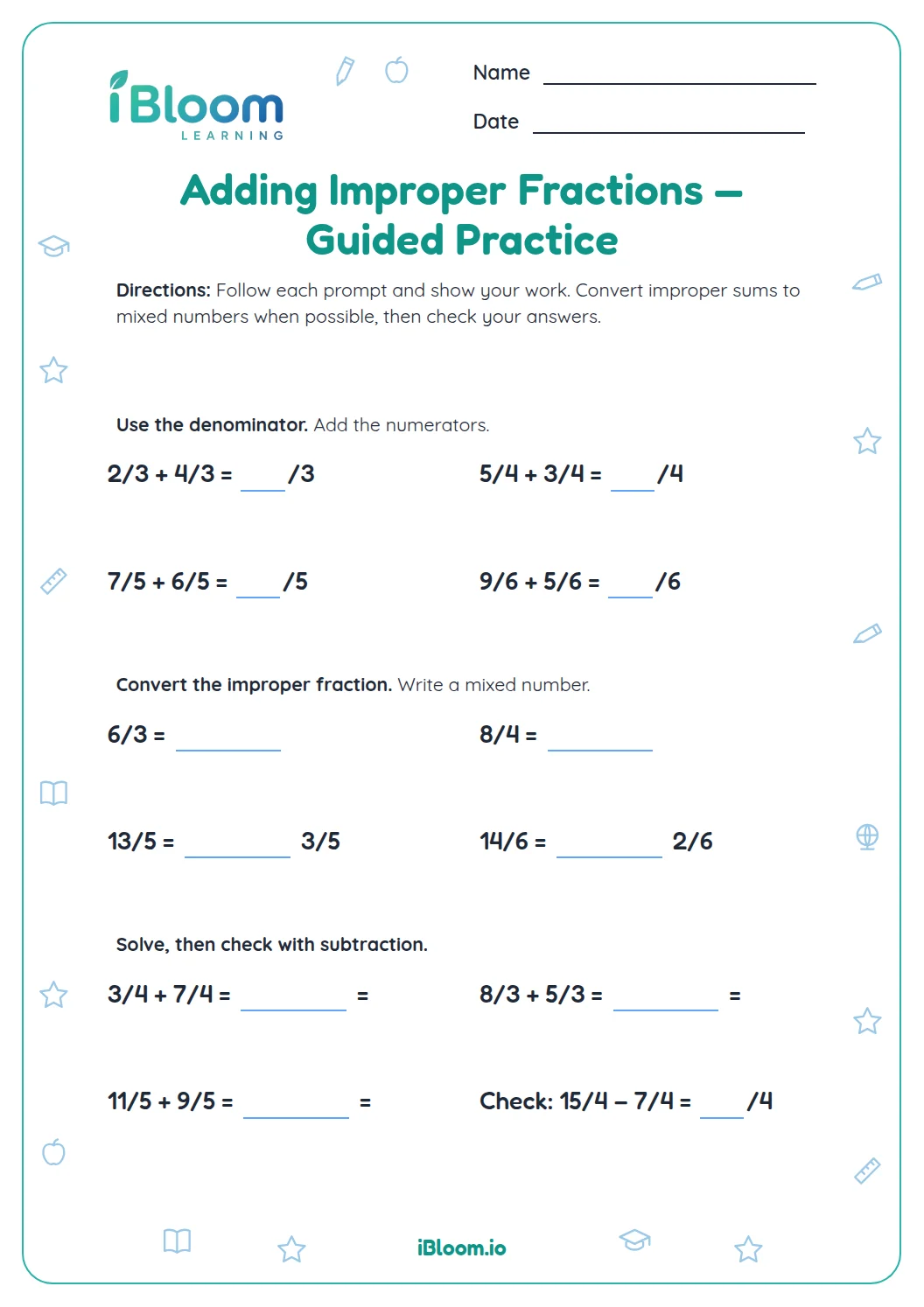
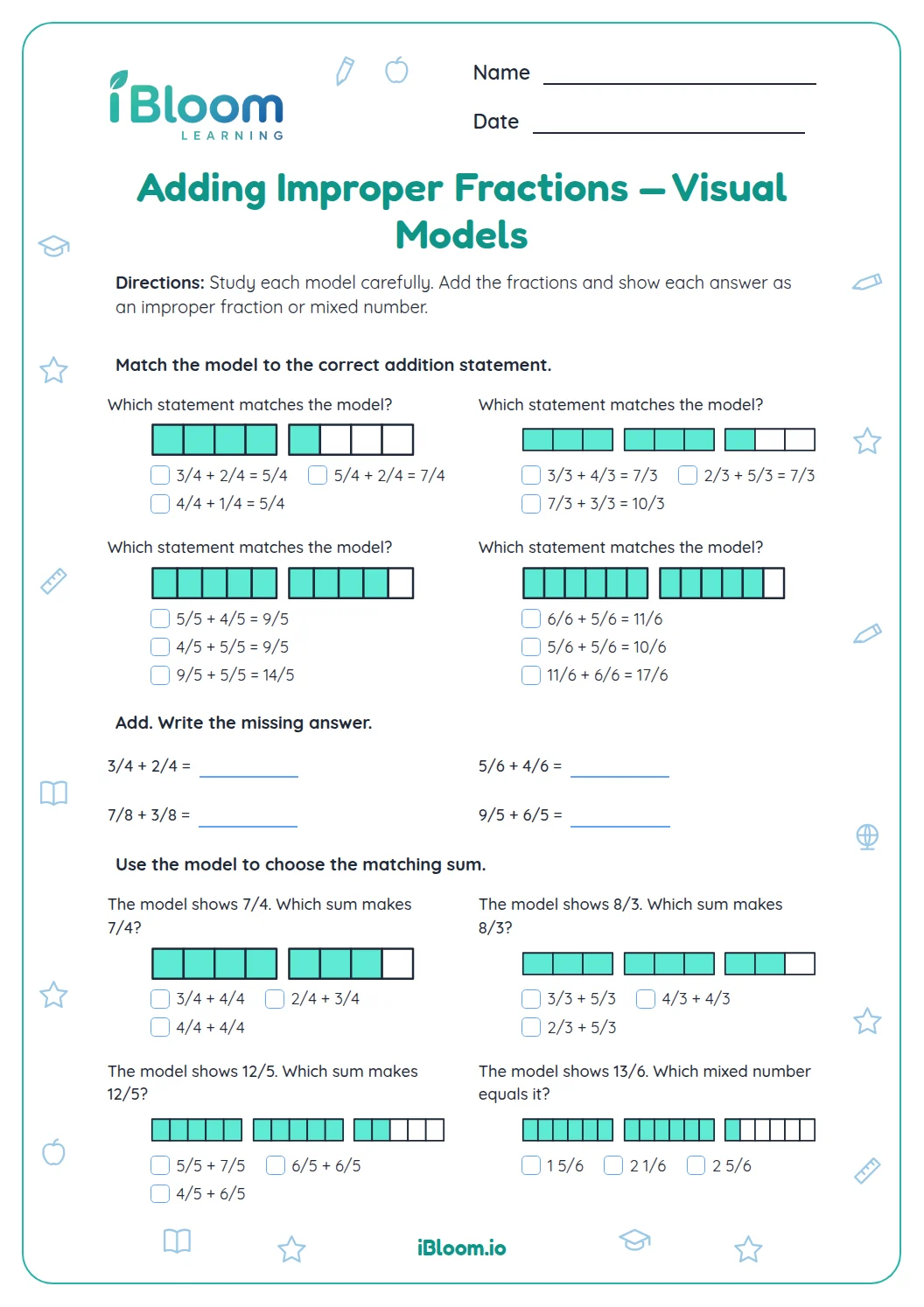
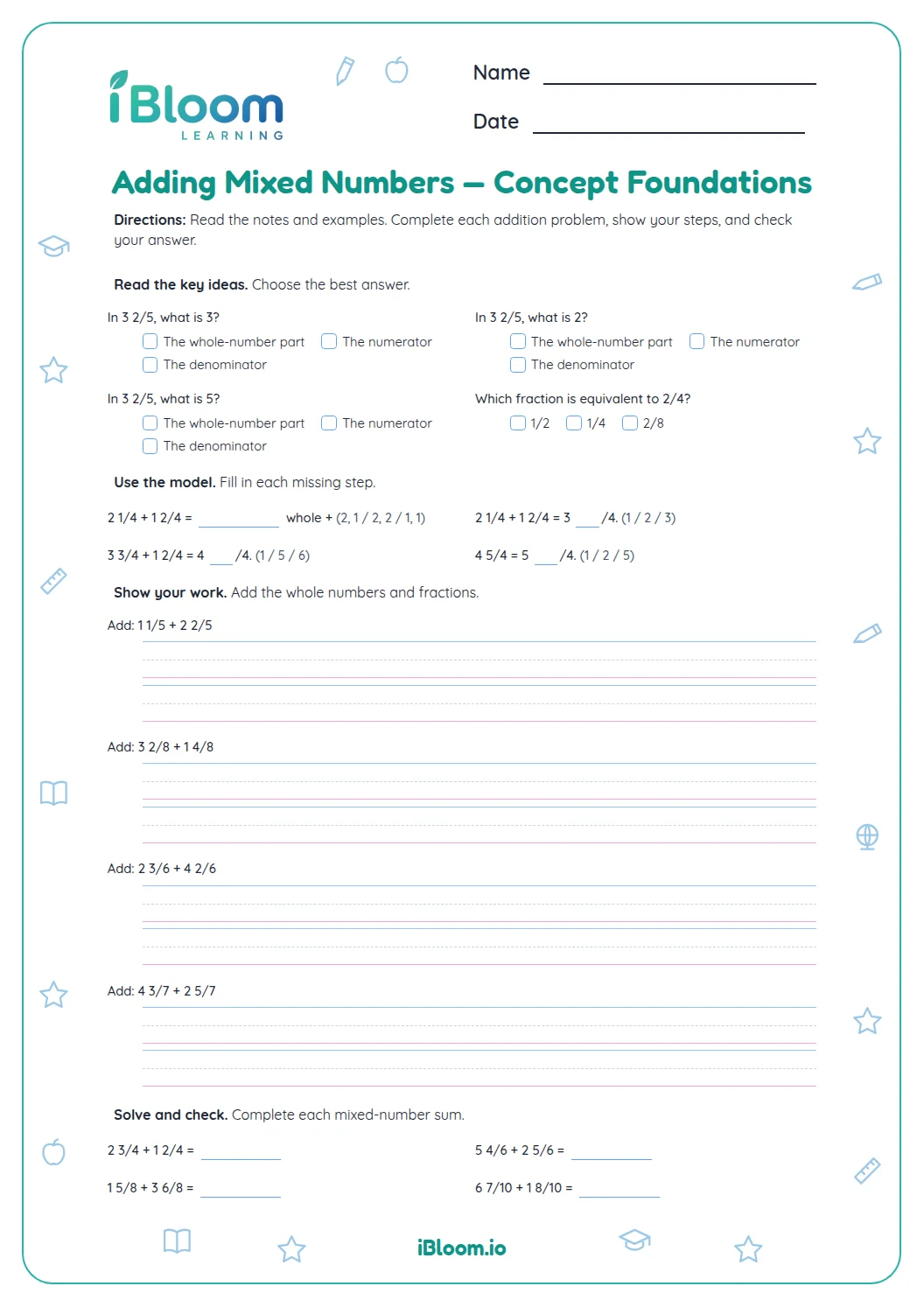
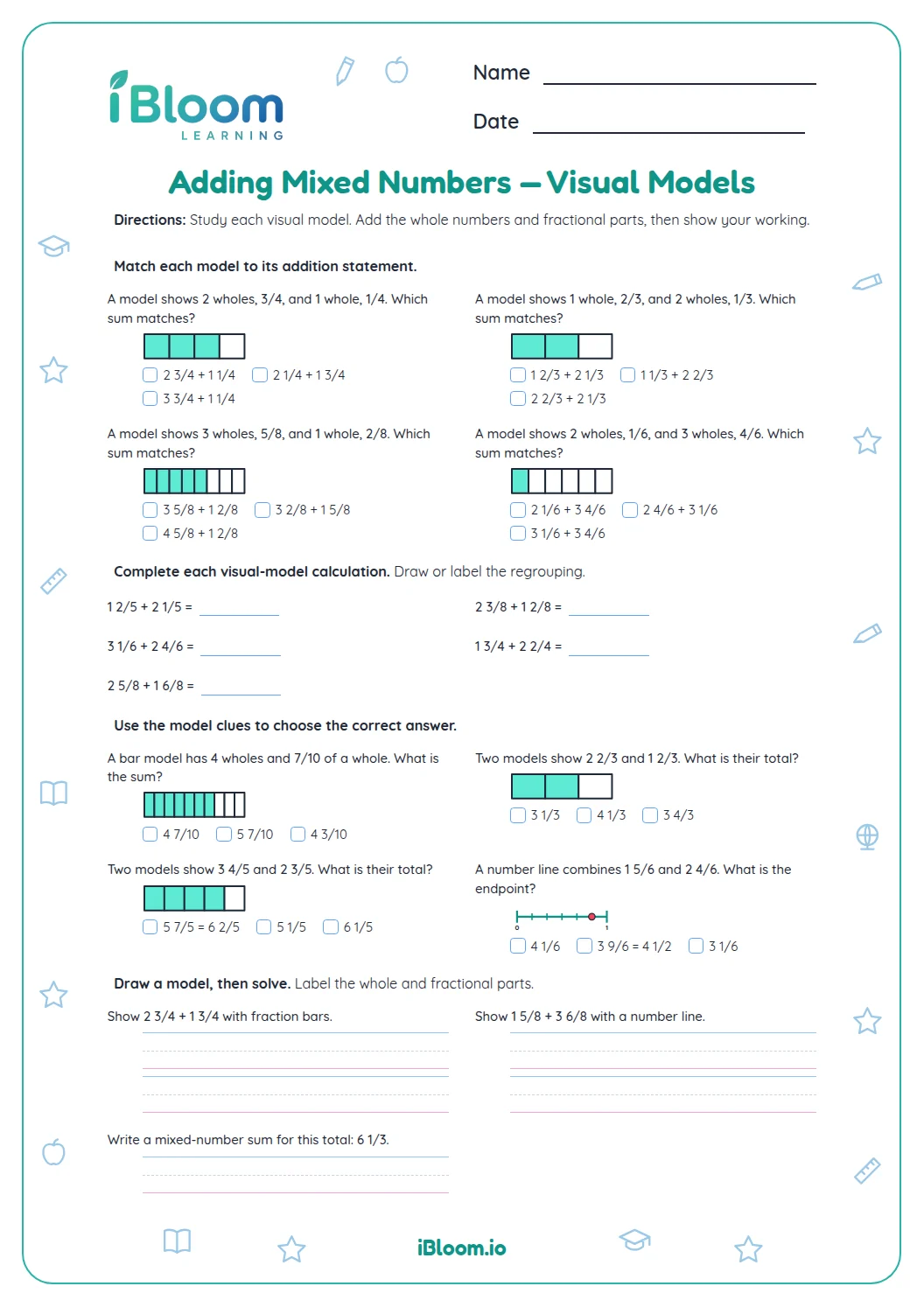
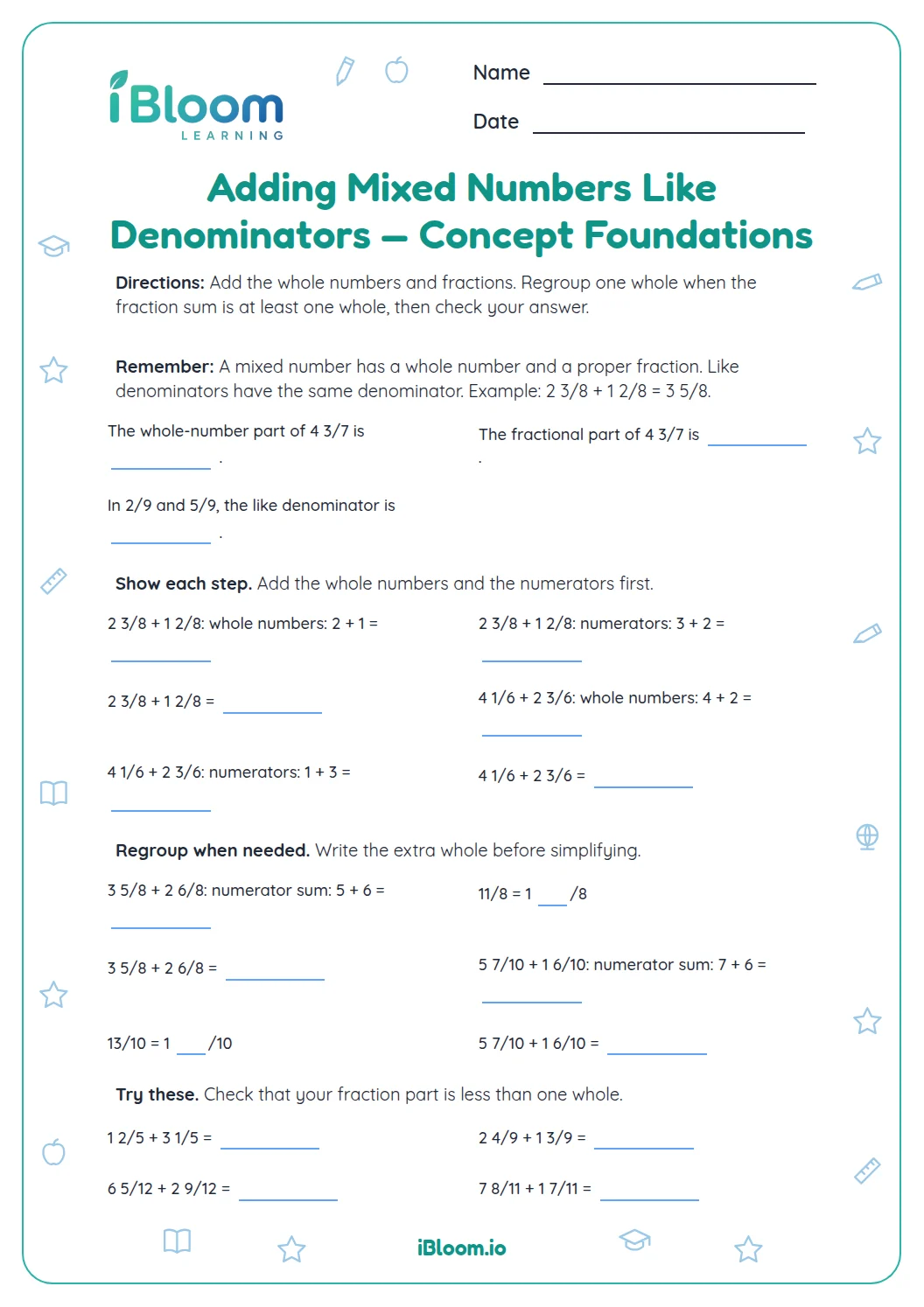
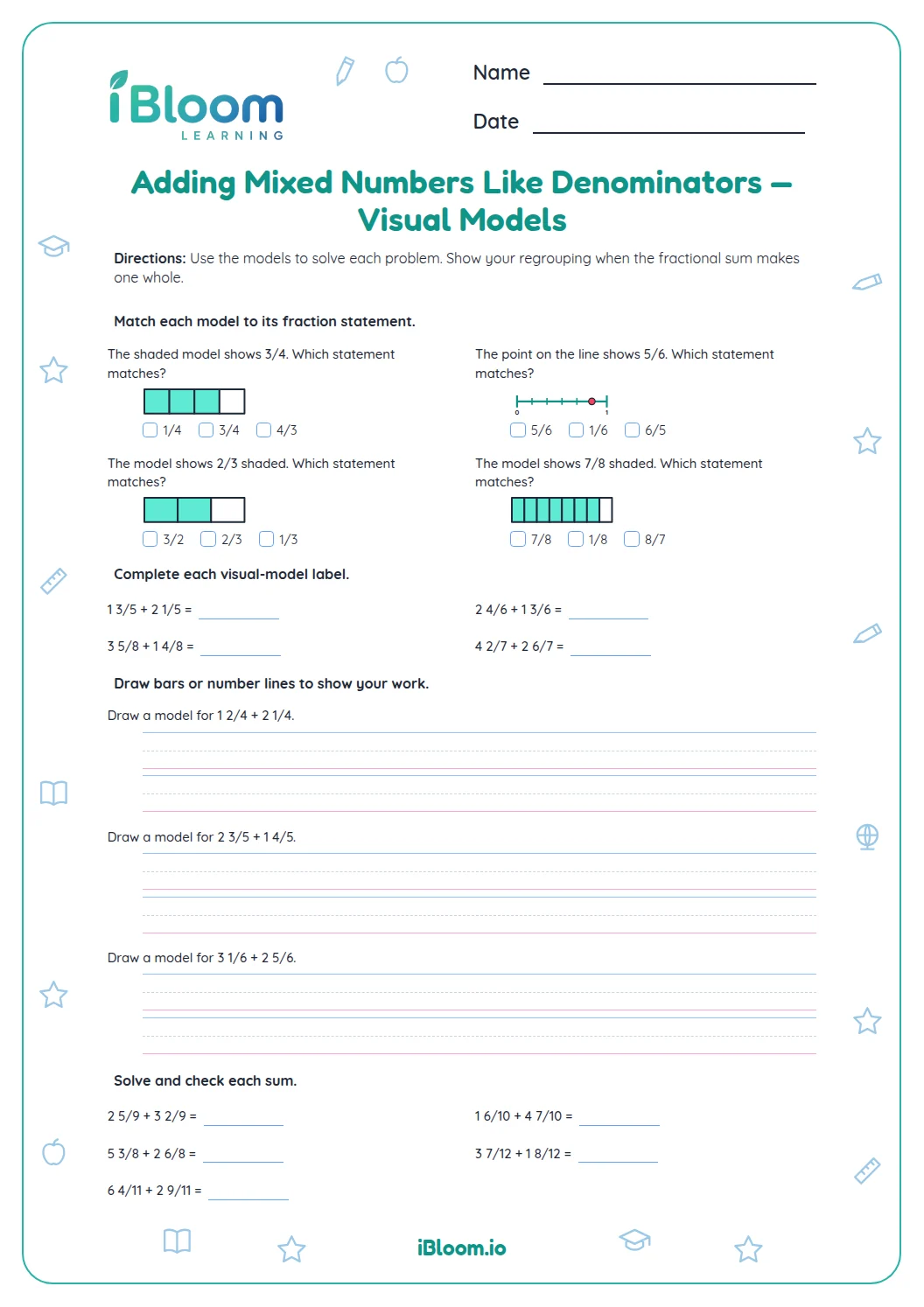
This free Grade 4 worksheet uses shaded fraction bars to show addition with like denominators. Students match models to addition sentences, add numerators while keeping the shared denominator, and solve short situations with visual support. Several questions show totals greater than one whole. The 14 questions come with a separate answer key and practice CCSS 4.NF.B.3.a and 4.NF.B.3.b.
Aligned to 4.NF.B.3.a and 4.NF.B.3.b
Why does the denominator stay the same?
The denominator names the size of each piece. With like denominators, both addends count the same-sized pieces of the same whole, so students combine the numerators and keep that denominator.
Question 7 asks for 2/7 + 3/7. Two sevenths and three more sevenths make five sevenths.
- 12/7 + 3/7 = ___/7
- 22 parts + 3 parts = 5 parts
- 3The pieces are still sevenths, so the sum is 5/7.
What happens when the sum is greater than one?
If the number of shaded parts reaches the denominator, the model contains a whole. Any extra parts remain as a fraction. In question 13, 3/4 + 2/4 makes 5/4, which is one whole and one fourth.
Keep the fraction form requested by the item, then use the model to check the amount.
What does the worksheet ask students to do?
The 14 items fit in two parts. Students match sums to shaded bars, then add equal-sized parts in equations and short contexts. The final two models show totals greater than one whole.
- Part A: match bars with like-denominator addition sentences
- Part B: choose correct sums in equations and short contexts
- The final models show sums past one whole
How to use this worksheet
- 1Point to one equal part in a bar and name its denominator.
- 2Count the parts from the first addend, then continue counting the second addend.
- 3Add the numerators and copy the common denominator.
- 4When the shaded total passes one whole, count the whole and leftover parts.
- 5Check that the answer has the same part size as the addends.
Common mistakes and quick fixes
The mistake
Adding the denominators too.
The fix
The parts are already the same size, so only the number of parts changes.
The mistake
Changing the denominator after crossing one whole.
The fix
Count the extra parts in the same-sized pieces; 5/4 is one whole and one fourth.
The mistake
Leaving out the second addend.
The fix
Read both signed addends aloud and shade each group before combining them.
Common Core alignment
This worksheet practices the fraction ideas named below.
Join fraction parts that refer to the same whole.
On this sheet: Each sum joins equal-sized parts of one whole, shown with a shaded fraction bar.
Show the official wordingHide the official wording
Understand addition and subtraction of fractions as joining and separating parts referring to the same whole.
Decompose fractions into sums with the same denominator.
On this sheet: The models connect a fraction total to a sum of like-denominator parts.
Show the official wordingHide the official wording
Decompose a fraction into a sum of fractions with the same denominator in more than one way, recording each decomposition by an equation. Justify decompositions, e.g., by using a visual fraction model. Examples: 3/8 = 1/8 + 1/8 + 1/8 ; 3/8 = 1/8 + 2/8 ; 2 1/8 = 1 + 1 + 1/8 = 8/8 + 8/8 + 1/8.
What to practice next
Make more practice
Further reading
Questions parents and teachers ask
Why do you add only the numerators?
The denominator tells the size of each piece. When both fractions have the same denominator, the pieces match, so you count how many pieces there are by adding the numerators. The size of each piece stays the same. Question 1 shows four shaded fourths after joining one fourth and three fourths.
What is 3/4 + 2/4?
The sum is 5/4, or one whole and one fourth. Four fourths complete one whole, with one fourth remaining. Question 13 asks for the improper-fraction form and its model shows that total, so the shaded whole and extra fourth can be counted directly.
Can the sum be greater than one?
Yes. If the total number of like-sized parts is greater than the denominator, the sum is greater than one whole. For example, 6/8 + 3/8 = 9/8, or one whole and one eighth. Question 14 also passes one whole, with one eighth left after eight eighths.
How many problems are included?
There are 14 questions in two parts. Students read shaded totals, complete fraction addition sentences, and use models to answer short situations. The final two models show sums greater than one whole, including one whole and one fourth and one whole and one eighth.
Does the answer key include the models?
The answer key identifies the correct sum or matching sentence for every question. The student page itself includes the shaded bars so learners can count and check the parts. Students can compare the written sums with the shaded bars to check their counting.
Is an answer key included?
Yes. A separate answer key page shows the answers for all 14 questions. It is useful for checking work after the student page is complete, or for reviewing one example together before independent practice. The key lists each sum and the correct matching equation.