


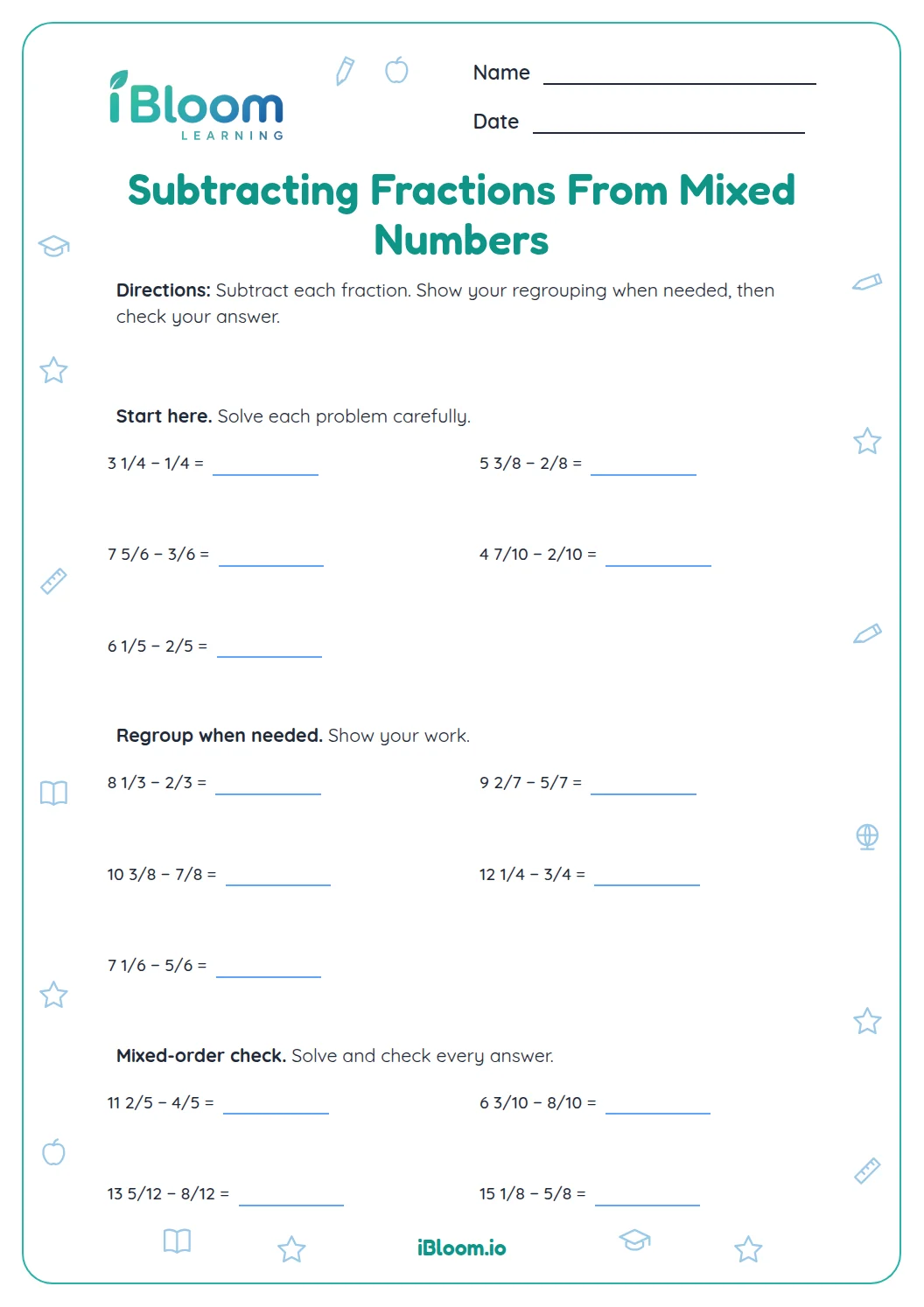
About this worksheet
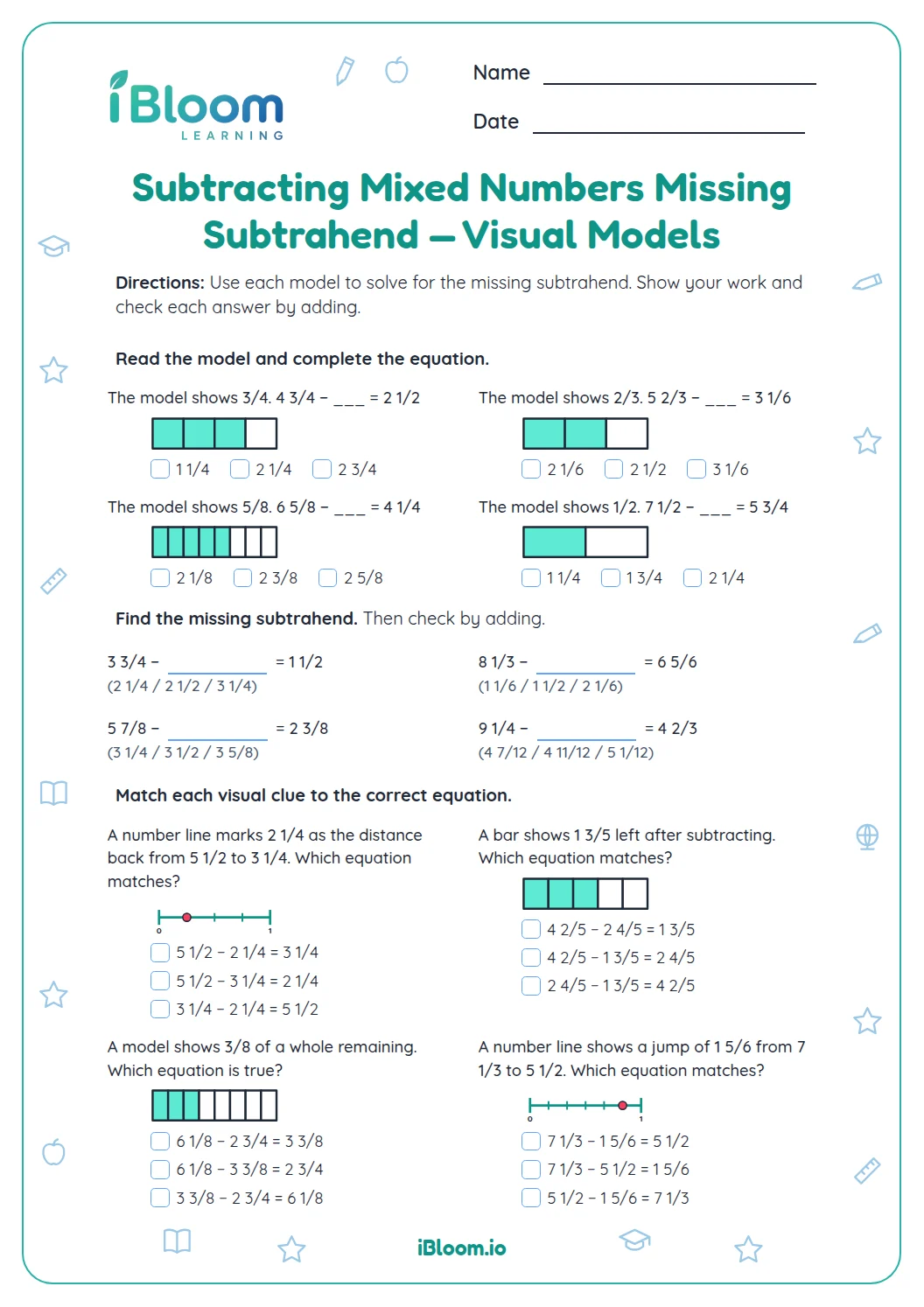
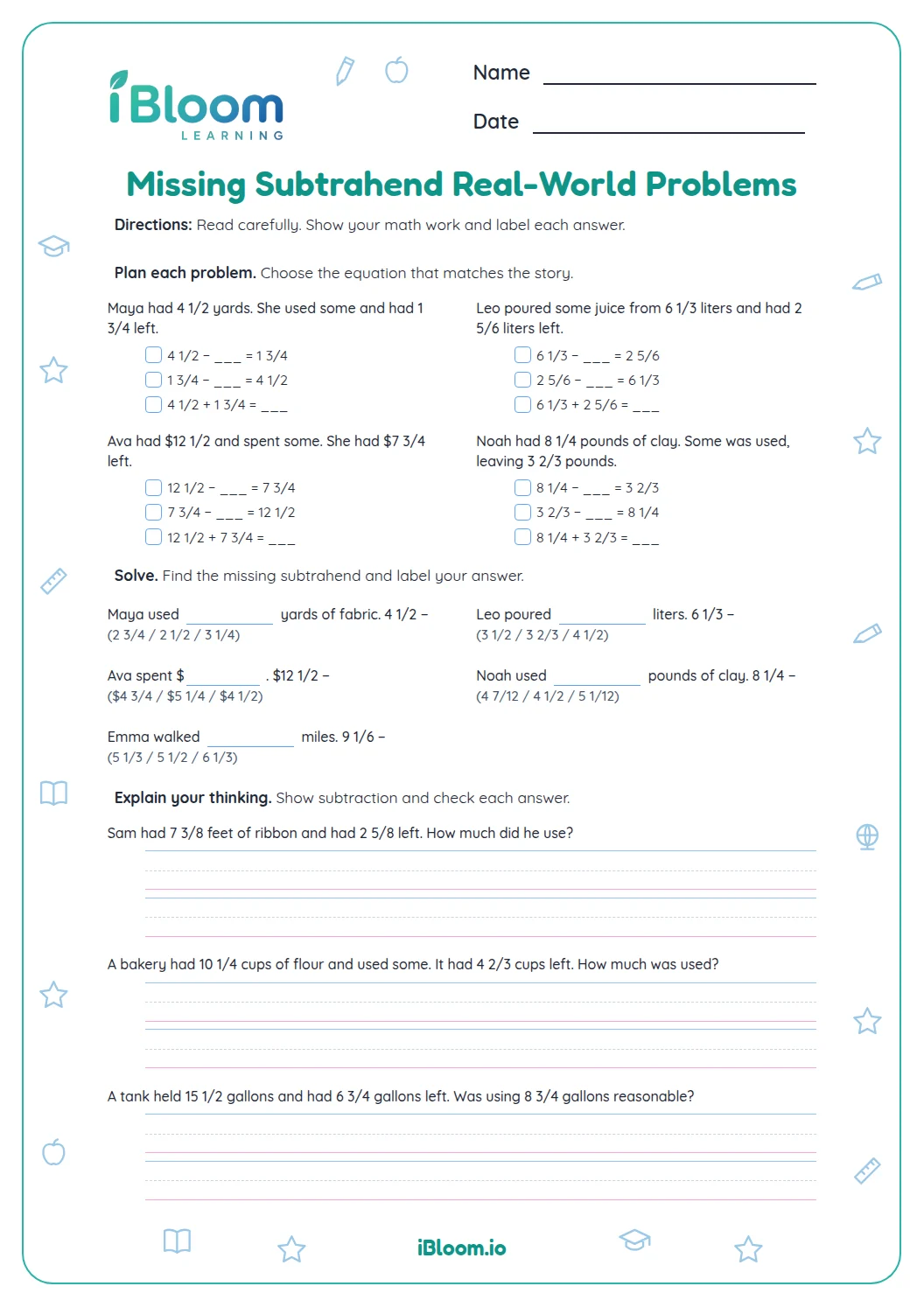
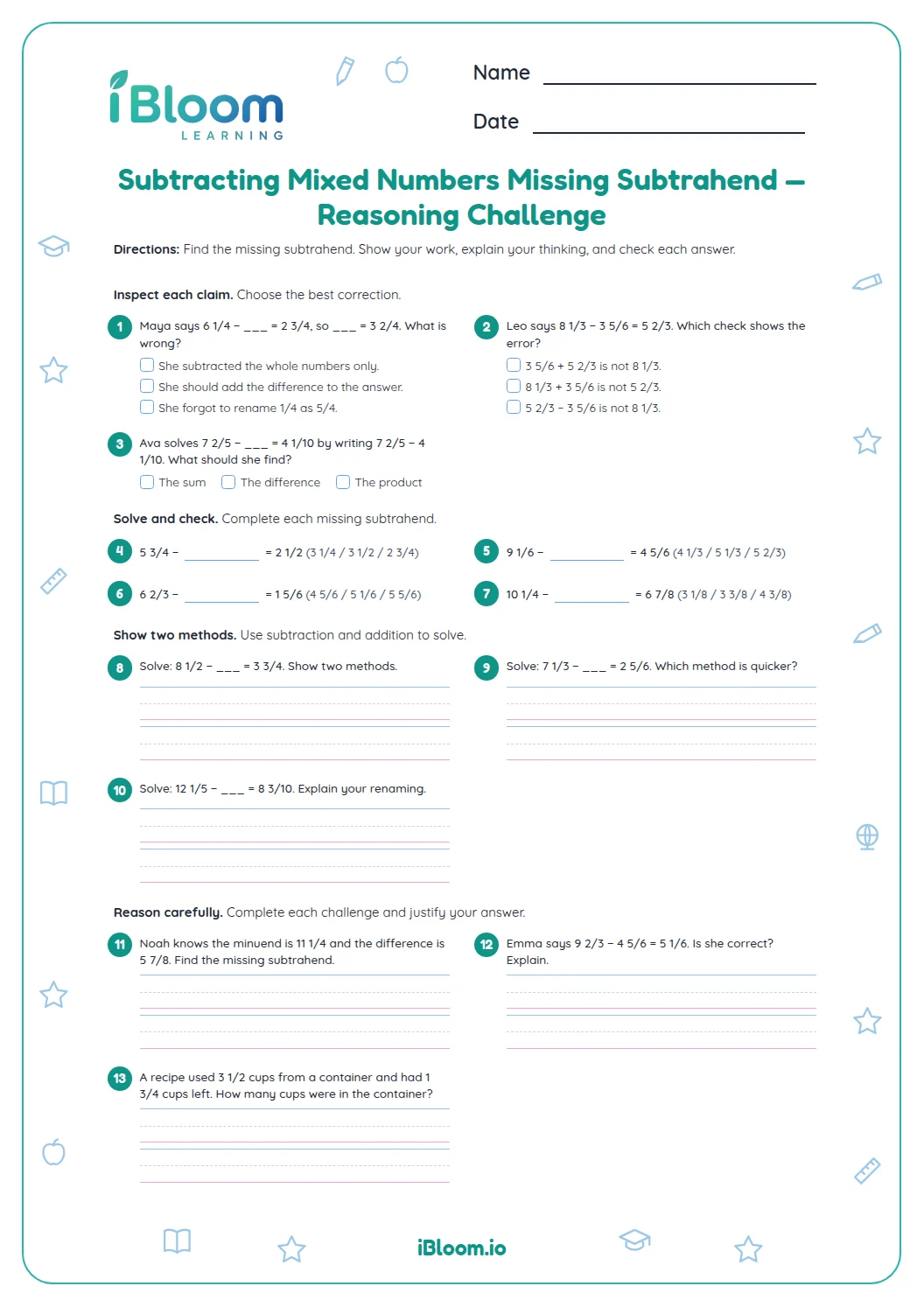
This printable Grade 4 worksheet builds a clear subtraction relationship: starting mixed number minus an unknown subtrahend equals the difference. Fourteen equations use like denominators and require regrouping when the starting fraction is smaller than the fraction in the difference. Students can check each answer by adding the subtrahend and difference. The work aligns with CCSS 4.NF.B.3.c and has a separate answer key.
Aligned to 4.NF.B.3.c and 4.NF.B.3.a
How does subtraction reveal the missing number?
In a sentence such as 8 2/5 − ___ = 5 4/5, the unknown amount is what was taken away. Subtract the ending amount from the starting amount. Because 2/5 is smaller than 4/5, regroup one whole as 5/5: 7 7/5 − 5 4/5 = 2 3/5.
Check the result in the original equation: 8 2/5 − 2 3/5 = 5 4/5.
When do you need to regroup?
Regroup whenever the fraction in the starting number is less than the fraction in the difference. Rename one whole using the denominator: one whole is 8/8, 10/10, or 12/12. Keep the denominator the same as you compare and subtract the fractional parts.
What does this worksheet ask students to do?
The worksheet has 14 equations, each with room to work through a regrouping step. Every equation has one unknown subtrahend; several require regrouping. The answer key lists the missing mixed numbers.
How to work through the equations
- 1Read the starting number and the difference.
- 2Compare their fractional parts.
- 3If needed, regroup one whole using the denominator.
- 4Subtract the difference from the starting amount.
- 5Check by adding the subtrahend and difference.
Common mistakes and quick fixes
The mistake
Subtracting the smaller fraction from the larger without regrouping.
The fix
Rename a whole as fractional parts first.
The mistake
Changing the denominator while regrouping.
The fix
Use the same denominator; one whole becomes that many parts.
The mistake
Using the difference minus the starting number.
The fix
Missing subtrahend equals starting amount minus difference.
Common Core alignment
This sheet practices mixed-number subtraction and its relationship to addition.
Subtract mixed numbers with like denominators using equivalent fractions or subtraction relationships.
On this sheet: The missing-subtrahend equations use subtraction and its inverse with like denominators.
Show the official wordingHide the official wording
Add and subtract mixed numbers with like denominators, e.g., by replacing each mixed number with an equivalent fraction, and/or by using properties of operations and the relationship between addition and subtraction.
Treat subtraction as separating parts that refer to the same whole.
On this sheet: Each equation separates fractional parts from mixed numbers with a shared denominator.
Show the official wordingHide the official wording
Understand addition and subtraction of fractions as joining and separating parts referring to the same whole.
What to practice next
Make more practice
Further reading
Questions parents and teachers ask
How do I find a missing subtrahend?
Subtract the difference from the starting number. For 8 2/5 − ___ = 5 4/5, regroup 8 2/5 as 7 7/5, then subtract 5 4/5 to get 2 3/5. Add 2 3/5 and 5 4/5 to confirm the total is 8 2/5.
Why do some questions need regrouping?
Regroup when the starting fraction is smaller than the fraction in the difference. For example, 2/5 is smaller than 4/5, so rename one whole as 5/5 before subtracting. Keep the denominator unchanged throughout the calculation. This keeps the pieces the same size, which is necessary for a correct subtraction.
Should the answer include a fraction?
Yes, write the missing subtrahend as a mixed number or whole number as needed. In each equation, the denominator stays the same as the other fractions. The answer key uses the matching denominator so students can compare and check easily.
How can students check an answer?
Add the missing subtrahend to the difference. The sum should equal the starting mixed number. This inverse check catches regrouping errors and confirms the missing amount. A quick addition check is a reliable way to catch a regrouping slip. A quick addition check is a reliable way to catch a regrouping slip.
What is the answer to 8 2/5 − ___ = 5 4/5?
The missing subtrahend is 2 3/5. Regroup 8 2/5 as 7 7/5, then subtract 5 4/5. Check: 2 3/5 + 5 4/5 = 8 2/5 after regrouping the fractional parts. Use this equation as a worked check before moving on to the next problem.
Is an answer key included?
Yes. The separate key gives one missing mixed number for each of the 14 equations. Students can first solve the equations, then use addition to check whether each answer restores the starting amount. The key is separate so the student page stays clear for solving.