


About this worksheet
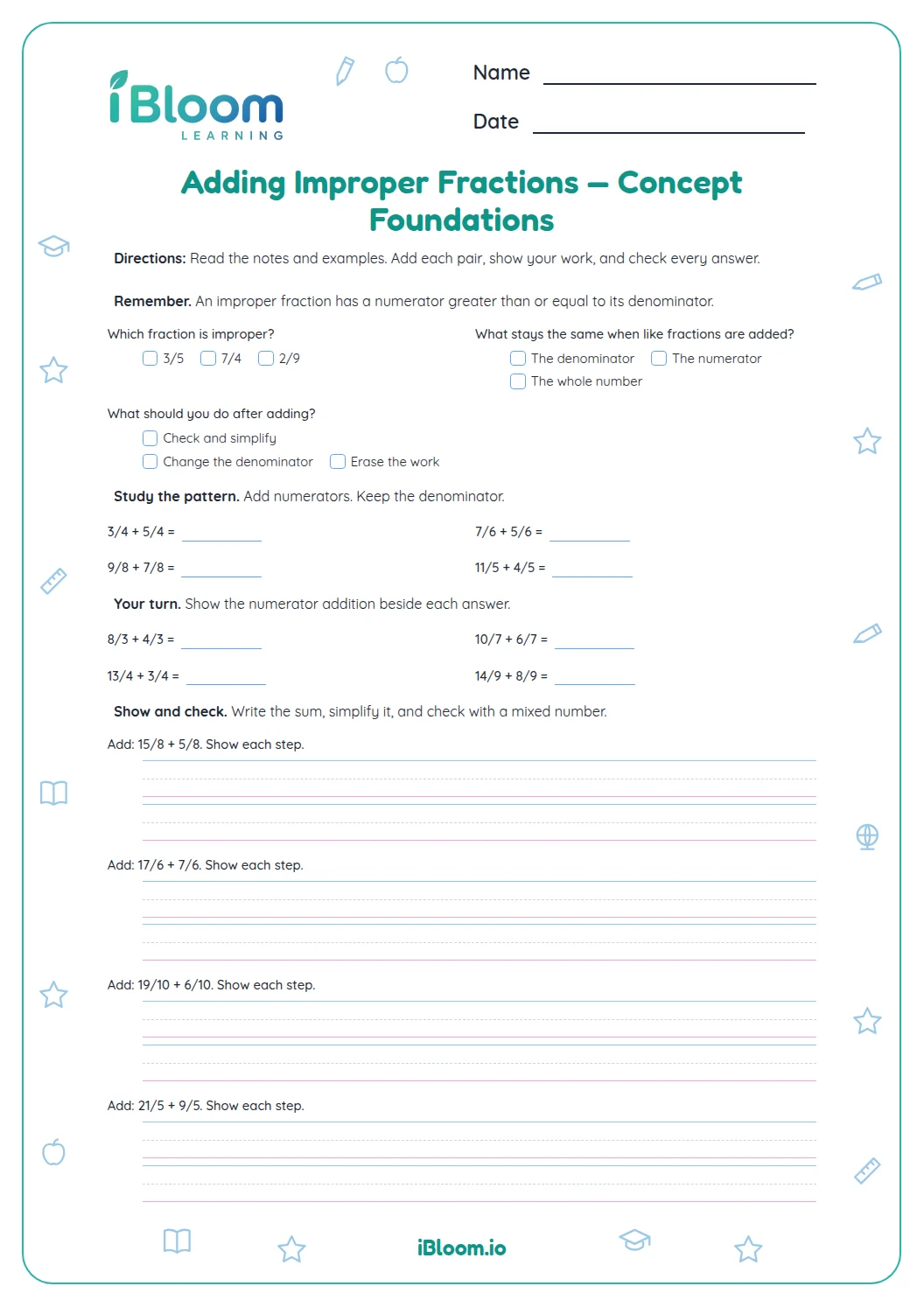
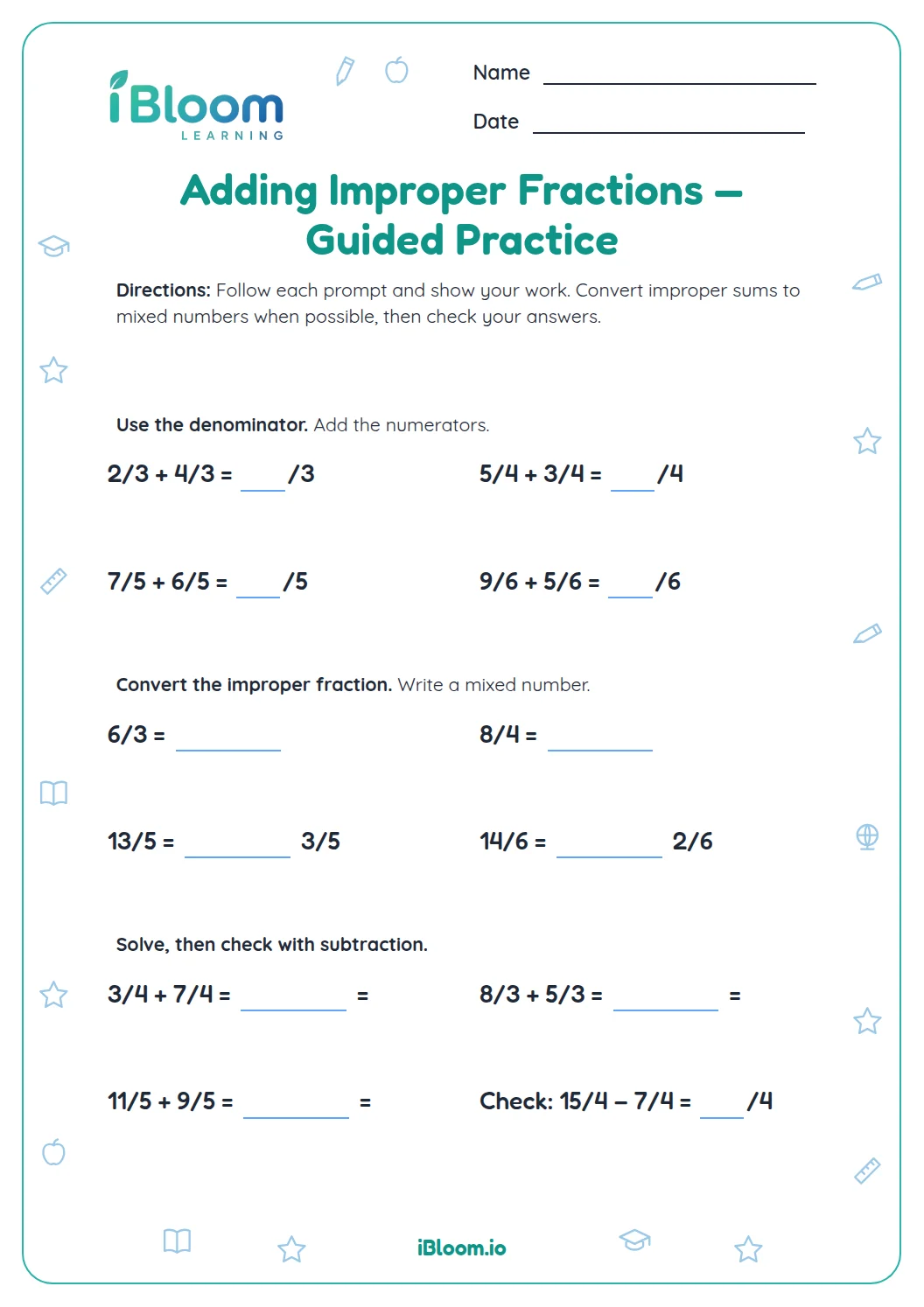
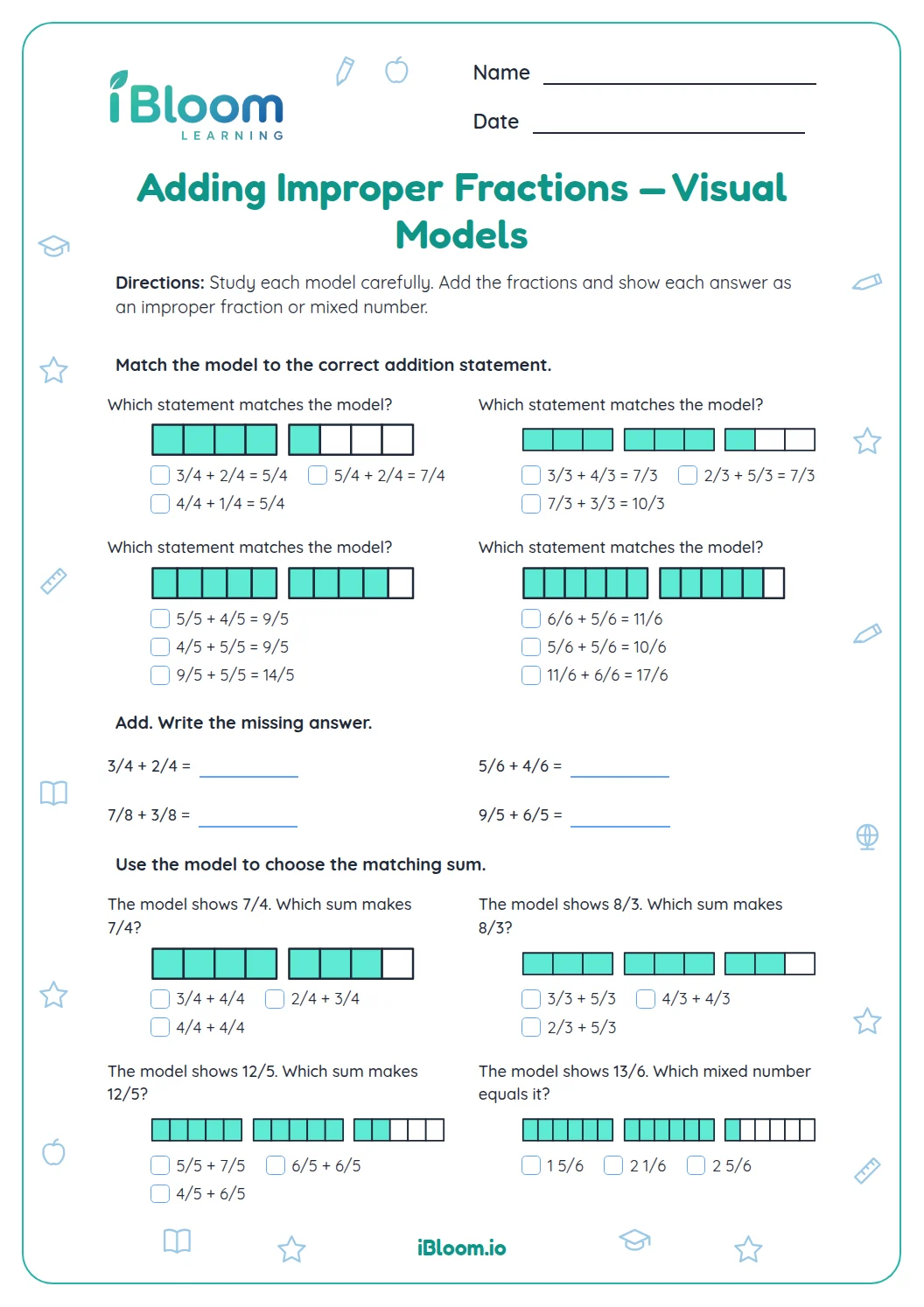
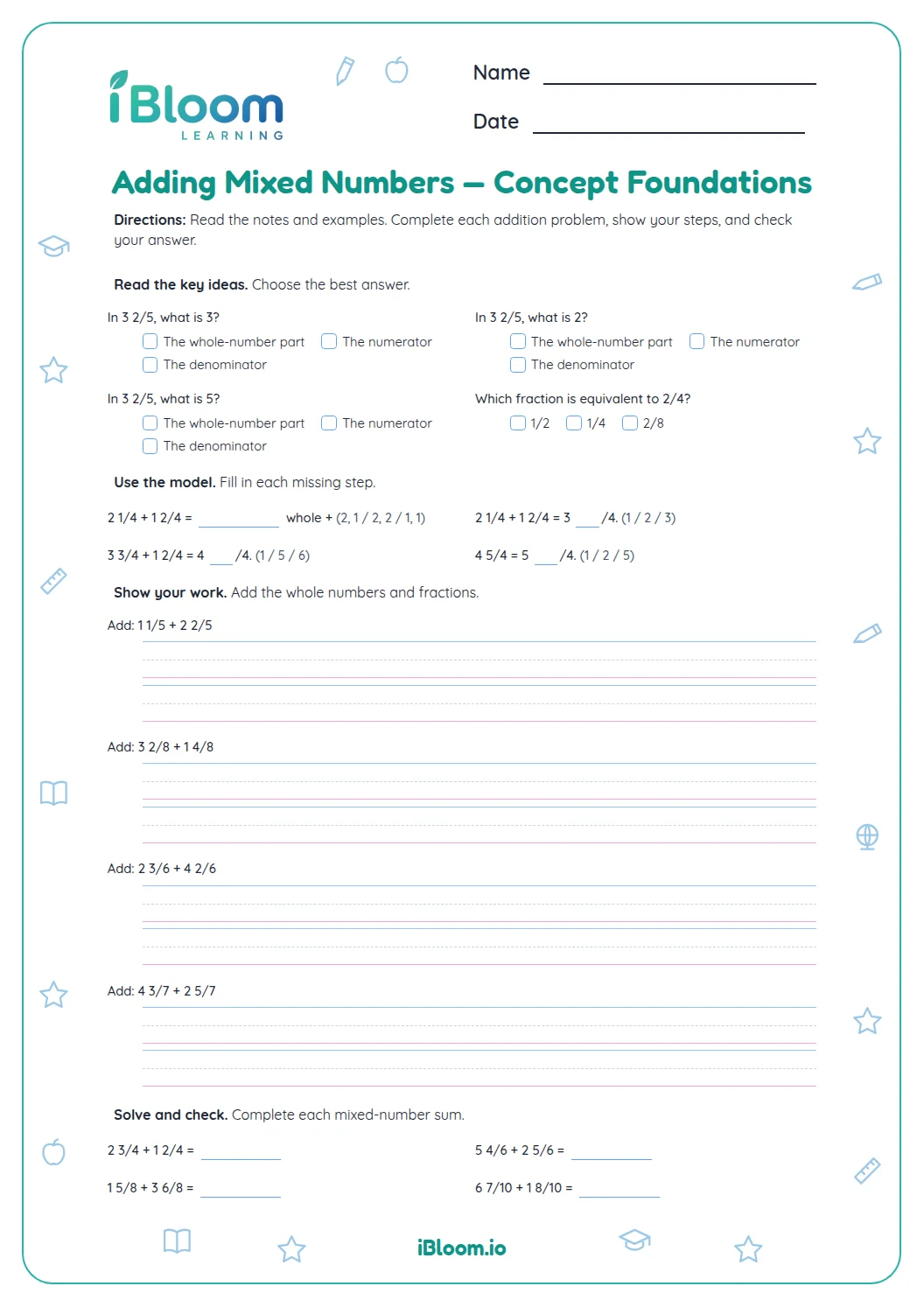
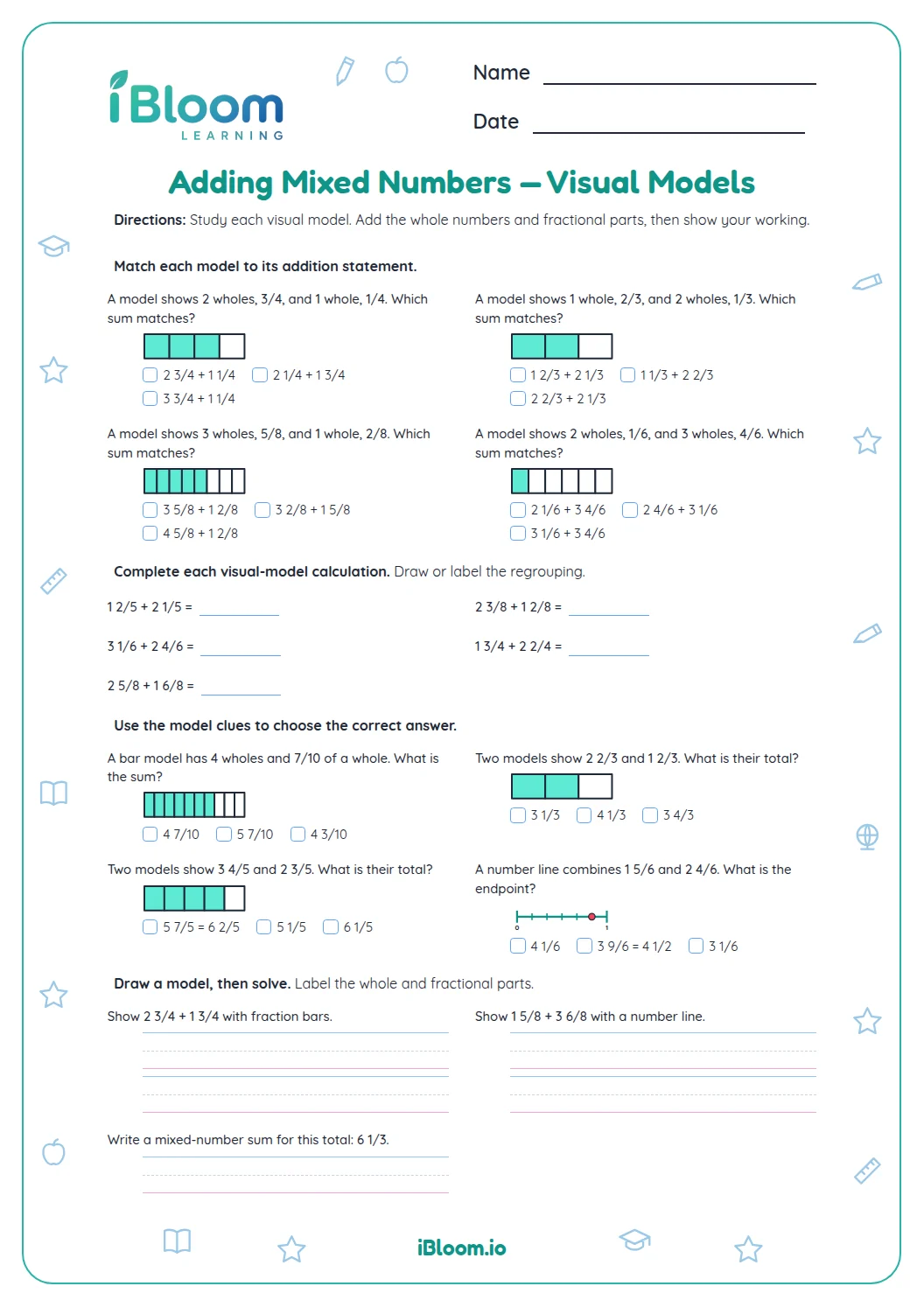
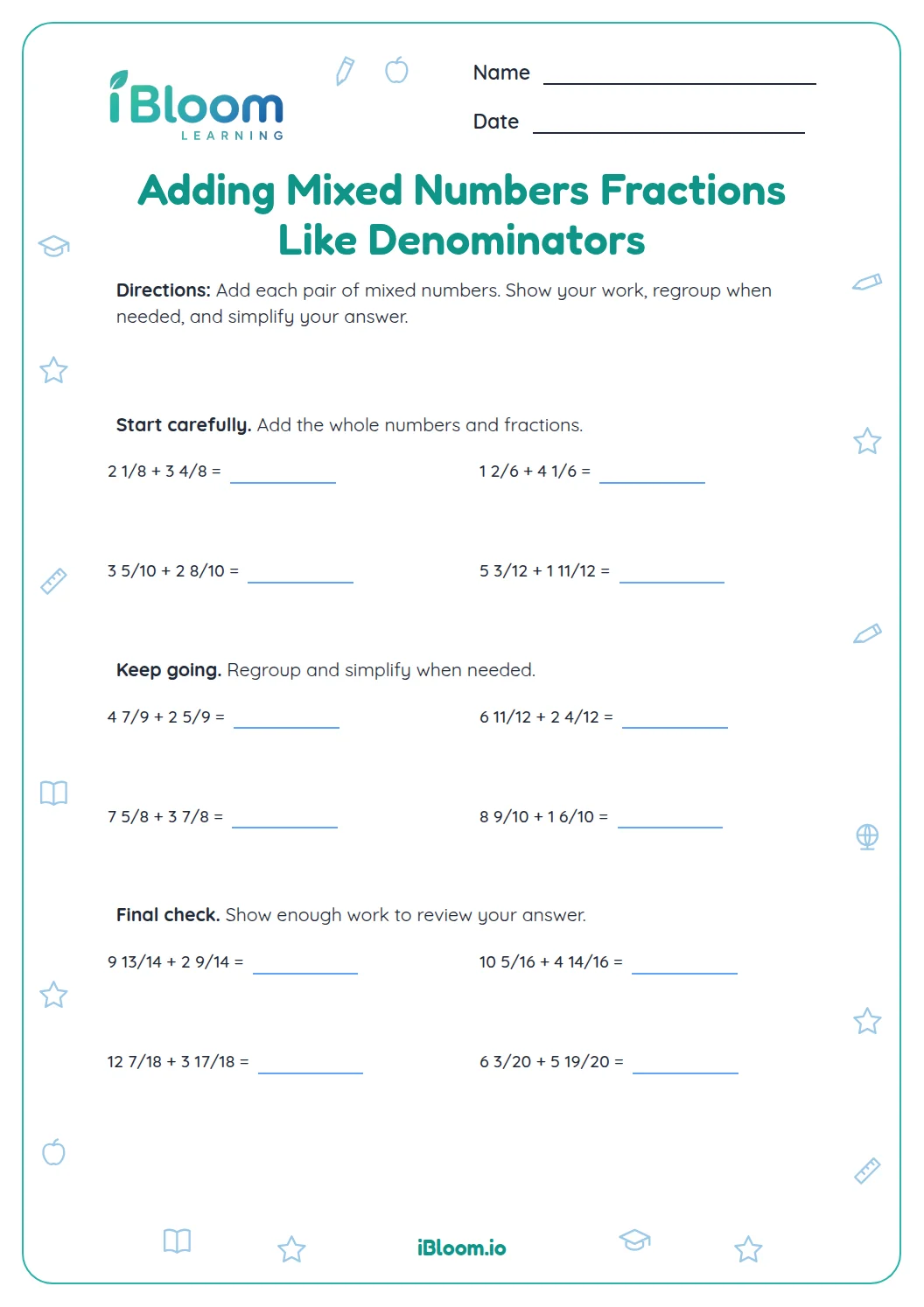
This free printable Grade 4 worksheet helps students practice subtracting fractions from mixed numbers. It includes shaded fraction and number-line models, focused problems, and short situations that apply the same idea. Students can use the models to connect equal parts with fraction notation. The sheet has 16 questions in three parts and a separate answer key. It practices CCSS 4.NF.B.3.c.
Aligned to 4.NF.B.3.c
How do the models show the math?
The drawings make when subtracting a fraction from a mixed number, regroup one whole if the fractional part is too small. visible. Count equal parts first, then identify how many are shaded or marked.
For each model question, use only the values printed with the drawing and prompt.
- 1Question 1 asks for 2 3/4 − 1/4. Subtract the fourths to leave 2 2/4, or 2 1/2.
- 2Check that the model and the written expression describe the same value.
How should students solve each problem?
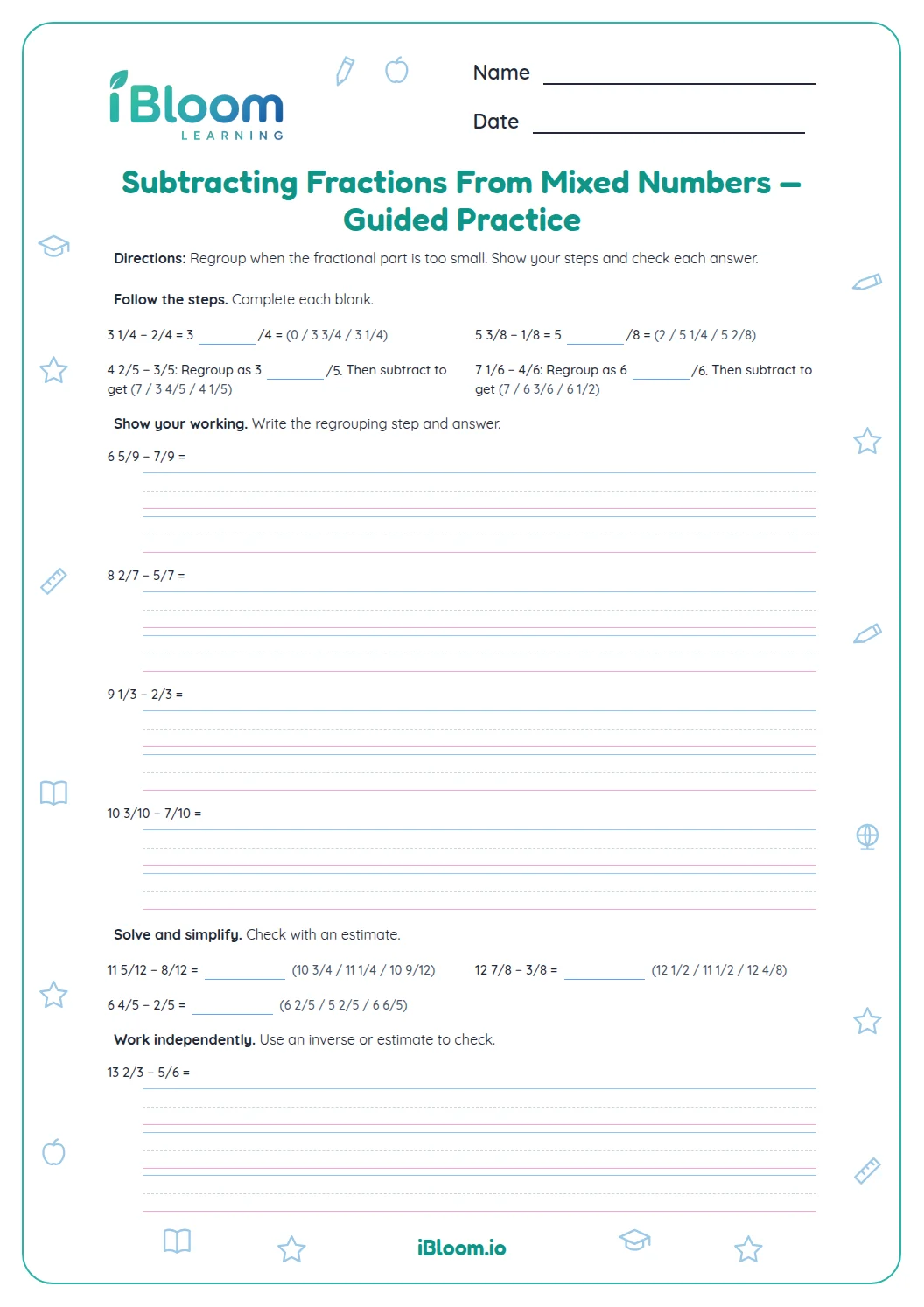
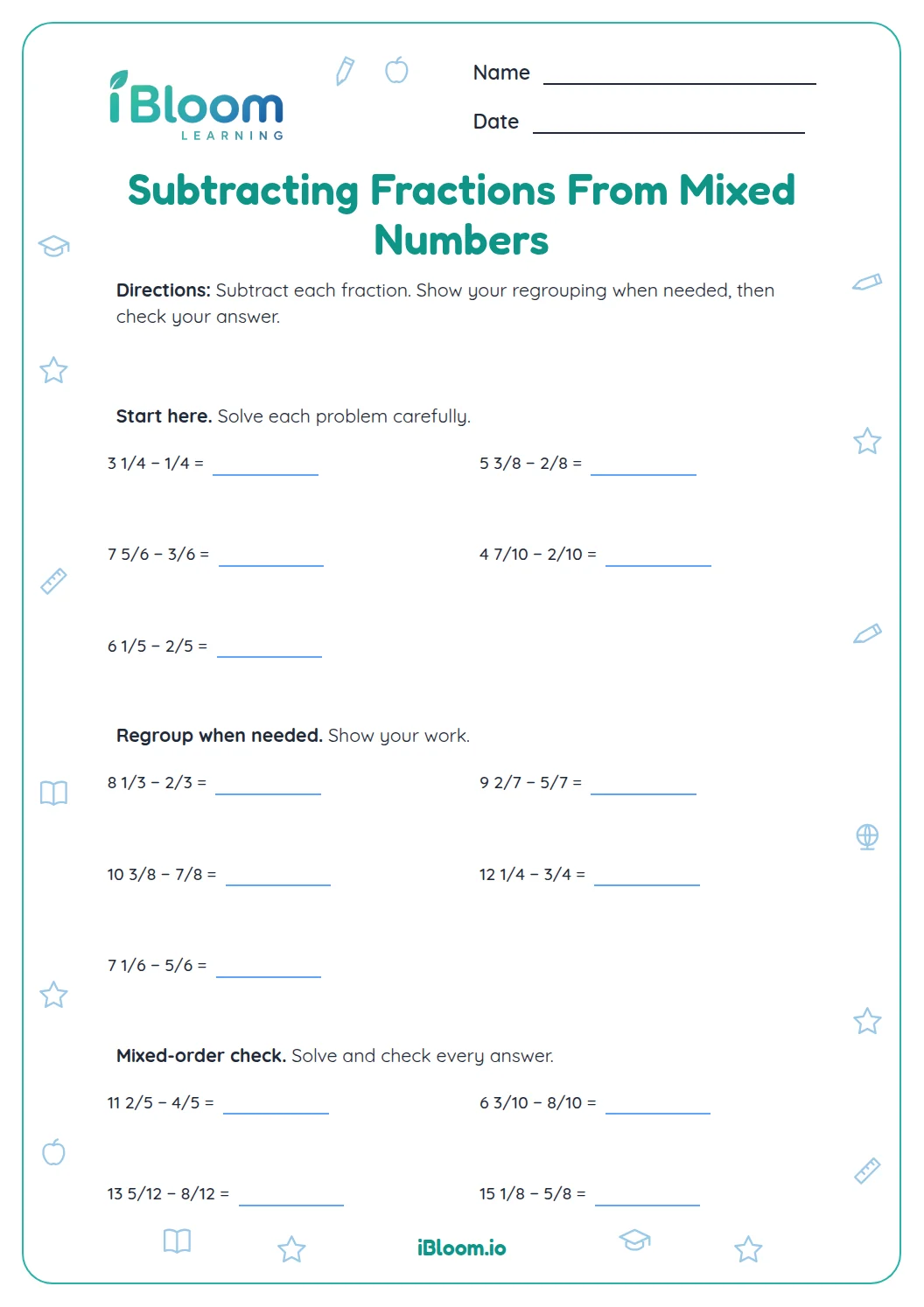
If the fraction part in the first number is too small, trade one whole for equal fractional parts before subtracting.
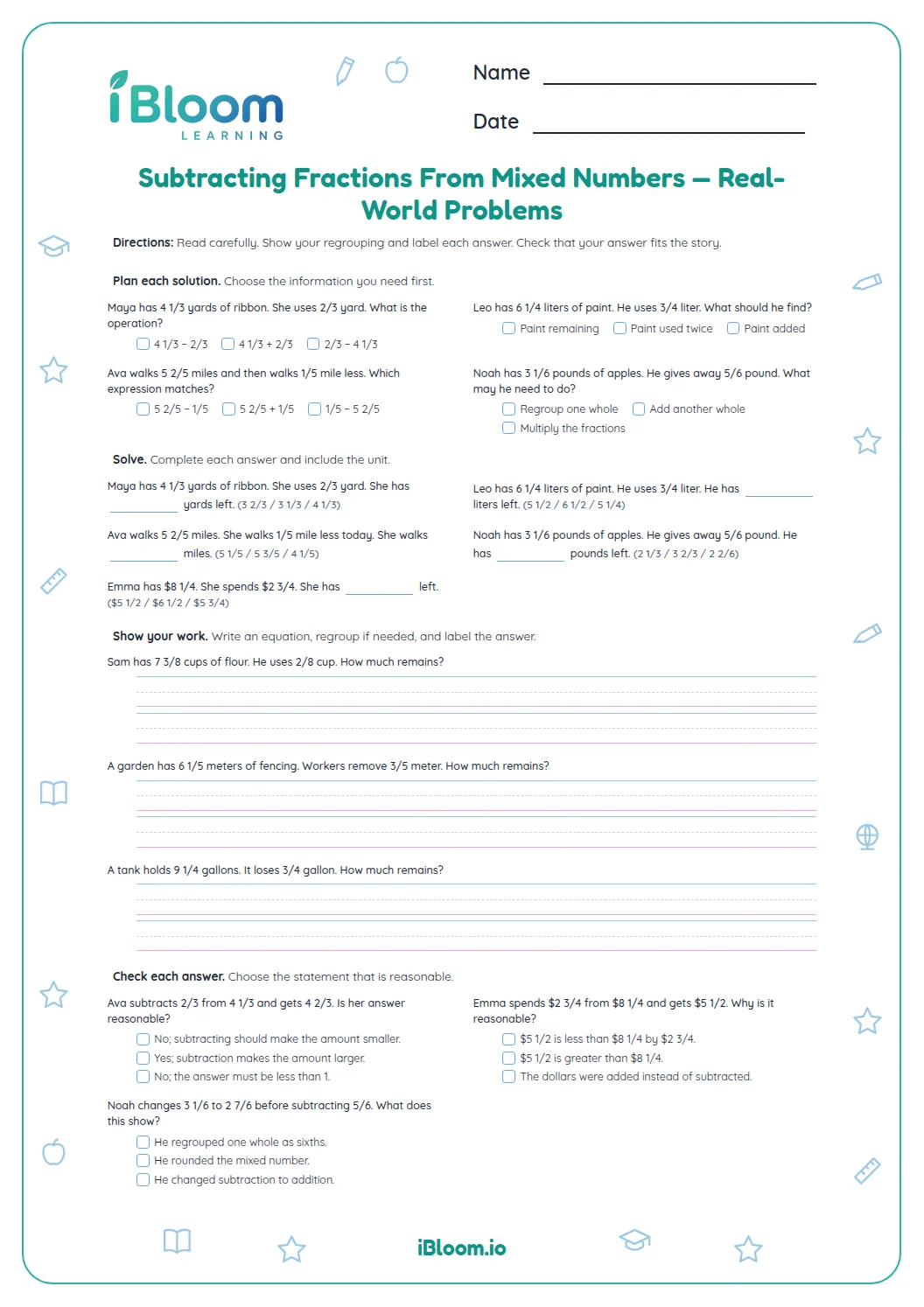
For a story problem, name the operation from the situation, write an equation, and include the requested unit in the answer.
What is on the printable?
Part A has six model questions, Part B has six focused problems, and Part C has four applications. The answer key follows the worksheet.
- Read six visual models
- Solve six direct problems
- Apply the skill in four short situations
- Use the key to check each result
How can students use this worksheet?
- 1Read the entire prompt before calculating.
- 2For a model, count its equal parts and identify the shaded amount.
- 3Choose the operation that matches the expression or story.
- 4If the first fraction is too small, trade one whole for equal parts.
- 5Check that the answer matches the model and includes the right unit.
Common mistakes and quick fixes
The mistake
Subtracting fractional parts without regrouping when needed.
The fix
Rename one whole using the denominator, then subtract equal-size parts.
The mistake
Changing the denominator while subtracting like fractions.
The fix
Keep the denominator because each part keeps its size.
The mistake
Forgetting that trading one whole reduces the whole-number part by one.
The fix
Subtract one from the whole number, then add the denominator’s number of parts.
Common Core alignment
This worksheet practices subtracting fractions from mixed numbers through models and written problems.
Subtract fractions from mixed numbers, regrouping one whole when needed.
On this sheet: Subtract fractions from mixed numbers, regrouping one whole when needed.
Show the official wordingHide the official wording
Add and subtract mixed numbers with like denominators, e.g., by replacing each mixed number with an equivalent fraction, and/or by using properties of operations and the relationship between addition and subtraction.
What to practice next
Make more practice
Further reading
Questions parents and teachers ask
How many questions are on the printable?
There are 16 questions across three parts: six model questions, six focused problems, and four applications. The worksheet and answer key take four pages in all. About 20 minutes gives time to work, compare answers with the models, and review any calculation that needs another look.
How should students use the models?
Have students name the whole and count the equal parts before reading the shaded amount. They can then connect that amount to the expression in the prompt. This sequence helps them check whether the drawing and calculation represent the same quantity.
Does the answer key include units?
The answer key gives a result for every question. When a story asks for a measurement, students should include the unit in their own answer. If a unit is printed after the answer blank, the key gives only the number so the unit is not repeated.
What should students do when they get stuck?
Return to the specific model or expression in that question. Ask what one equal part represents, then identify how many parts the situation combines or removes. For a story, a quick equation can help connect the words to the operation.
Can students show their work?
Yes. The focused problems and applications provide space for written work, and students can write a short equation before giving each result. Encourage them to keep the units with measurement answers and to check their calculations against any model.