



About this worksheet
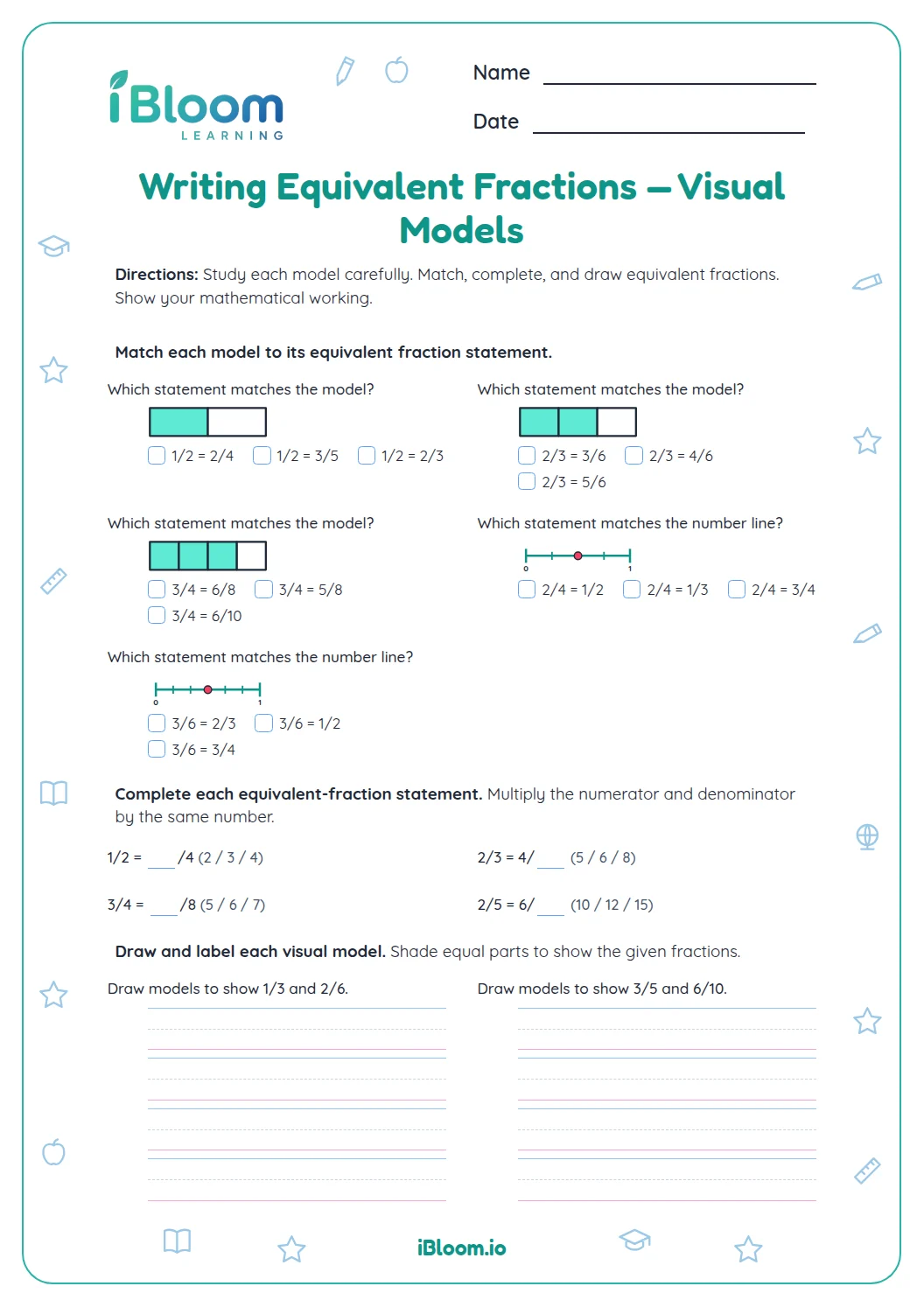
This Grade 4 printable asks students to build equivalent fractions by multiplying or dividing the numerator and denominator by the same factor. Eight missing-term equations lead into six multiple-choice reasoning checks. The corrected examples distinguish a true equivalence from a tempting but incorrect one, including 3/7 = 9/21. An answer key is included. The practice aligns with CCSS 4.NF.A.1.
Aligned to 4.NF.A.1
How do you make an equivalent fraction?
Multiply the numerator and denominator by the same number. For 5/6 = ___/18, the denominator changes from 6 to 18 by a factor of 3. Apply that same factor to the numerator: 5 × 3 = 15, so the missing numerator is 15.
The fraction names the same amount because each sixth is divided into three smaller equal parts.
How can you test a fraction claim?
Check whether the same factor changes both terms. Maya’s statement 2/3 = 6/9 is correct: both 2 and 3 were multiplied by 3. For Ava’s 3/7 = 12/21, the denominator was multiplied by 3, so the numerator should be 9; 9/21 is equivalent to 3/7.
What kinds of reasoning are on the sheet?
The 14 questions move from missing numerator or denominator values to evaluating claims and selecting corrections. The key lists the correct values and choices.
A simple method for each fraction
- 1Compare the known denominator or numerator with its target.
- 2Find the multiplication or division factor.
- 3Apply that same factor to the other term.
- 4Check that the new fraction names the same amount.
- 5For a claim, verify both terms changed consistently.
Common mistakes and quick fixes
The mistake
Changing only the numerator or only the denominator.
The fix
Use the same factor on both terms.
The mistake
Using different factors for the two terms.
The fix
Write the factor beside each multiplication or division.
The mistake
Calling 12/21 equivalent to 3/7 because 7 × 3 = 21.
The fix
Check the numerator too: 3 × 3 = 9.
Common Core alignment
The questions use visual reasoning about equal fraction values and the same scaling factor.
Explain and generate equivalent fractions by multiplying numerator and denominator by the same factor.
On this sheet: Students generate equivalent fractions and judge claims by checking the factor applied to both terms.
Show the official wordingHide the official wording
Explain why a fraction a/b is equivalent to a fraction (n × a)/(n × b) by using visual fraction models, with attention to how the number and size of the parts differ even though the two fractions themselves are the same size. Use this principle to recognize and generate equivalent fractions.
What to practice next
Make more practice
Further reading
Questions parents and teachers ask
Why does 5/6 = 15/18?
Both terms are multiplied by 3. Since 6 × 3 = 18, multiply the numerator by 3 too: 5 × 3 = 15. The fraction still describes the same amount, now divided into more, smaller equal parts. This example shows how a common factor preserves the fraction value.
Is Maya’s 2/3 = 6/9 claim correct?
Yes. Both terms were multiplied by 3: 2 × 3 = 6 and 3 × 3 = 9. This is the correct way to generate an equivalent fraction, so the claim is an example of sound reasoning. Students can also multiply both terms by the same number to check.
Why is 3/7 not equal to 12/21?
The denominator was multiplied by 3, but the numerator was multiplied by 4. To keep the value equal, multiply both terms by the same factor. With denominator 21, the equivalent fraction is 9/21 because 3 × 3 = 9. Check the numerator and denominator independently before choosing.
Can students divide to make equivalent fractions?
Yes, when both terms can be divided evenly by the same factor. For example, divide 4 and 6 by 2 to get 2/3. This is called simplifying, and it preserves the fraction’s value. This is a useful way to verify an equivalent fraction.
What does the answer key include?
The key lists each missing numerator or denominator and the correct option for all six reasoning questions. Students can compare their factor checks with the keyed choices, including why Maya’s fraction is equivalent and why Ava’s stated fraction is not.
How many questions are included?
There are 14 questions across two worksheet pages: eight missing-term equations and six multiple-choice reasoning checks. The separate key gives a response for every blank and identifies the correct choice for each claim or comparison. Students can use it after trying the same-factor check on their own.