



About this worksheet
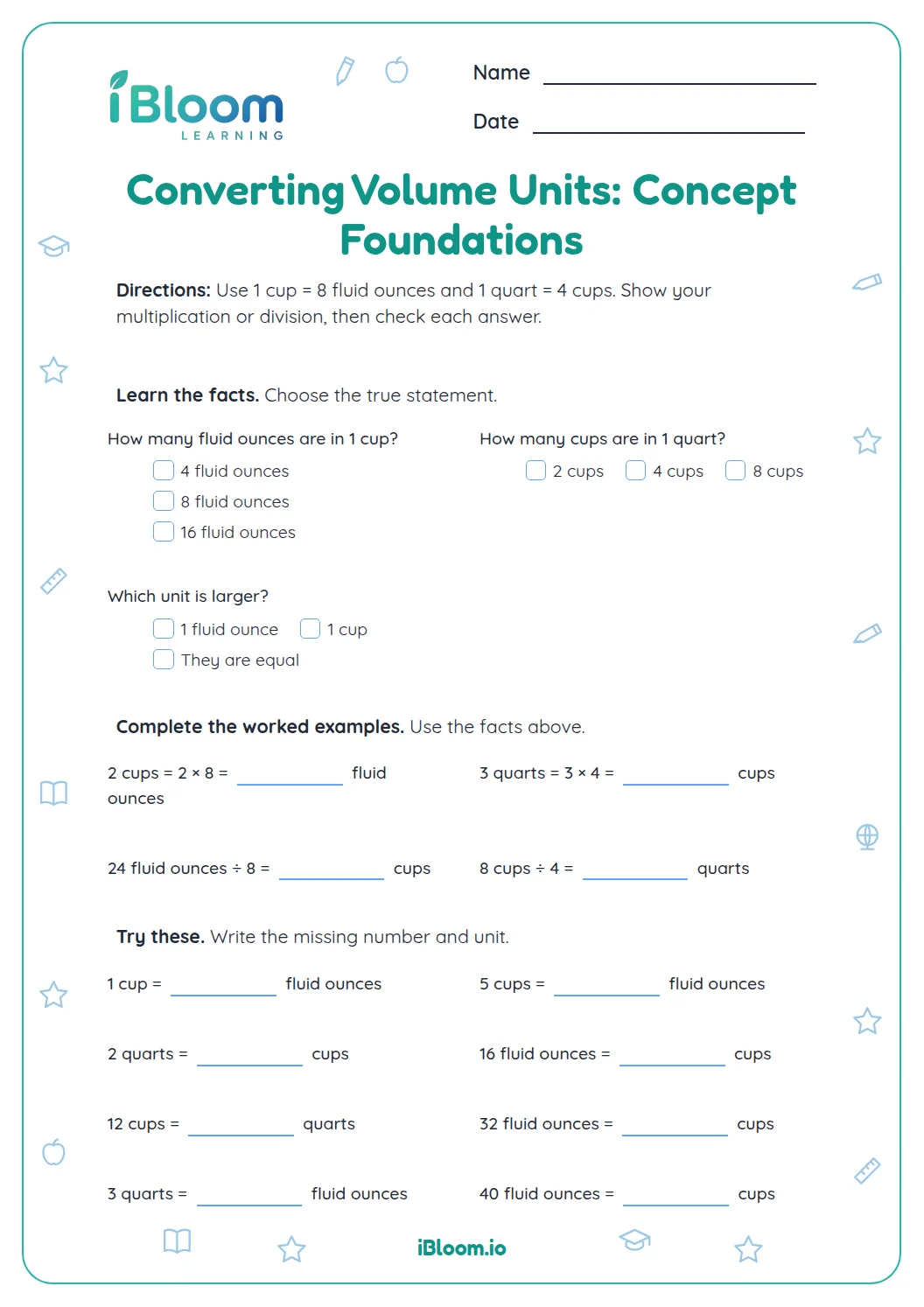
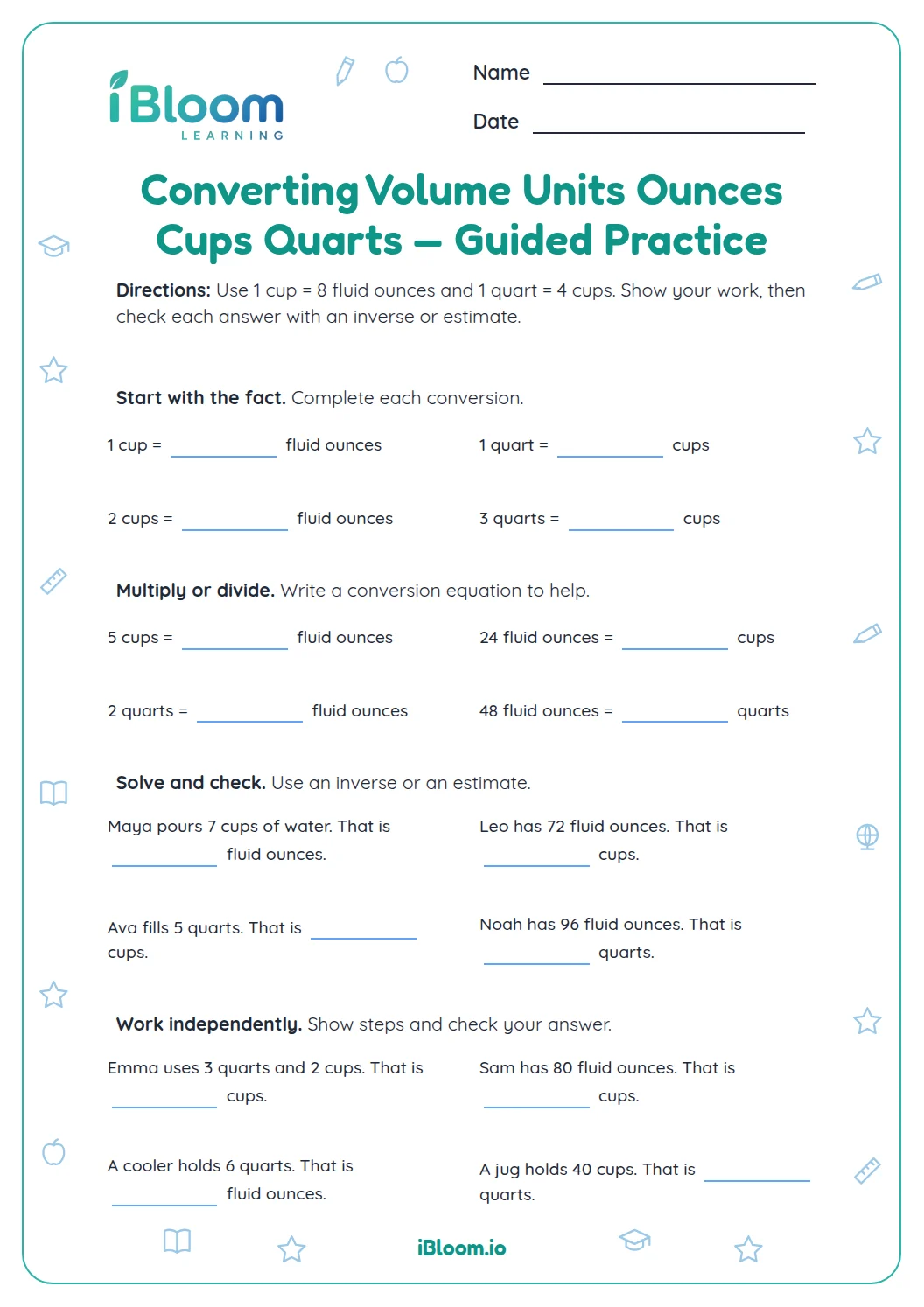
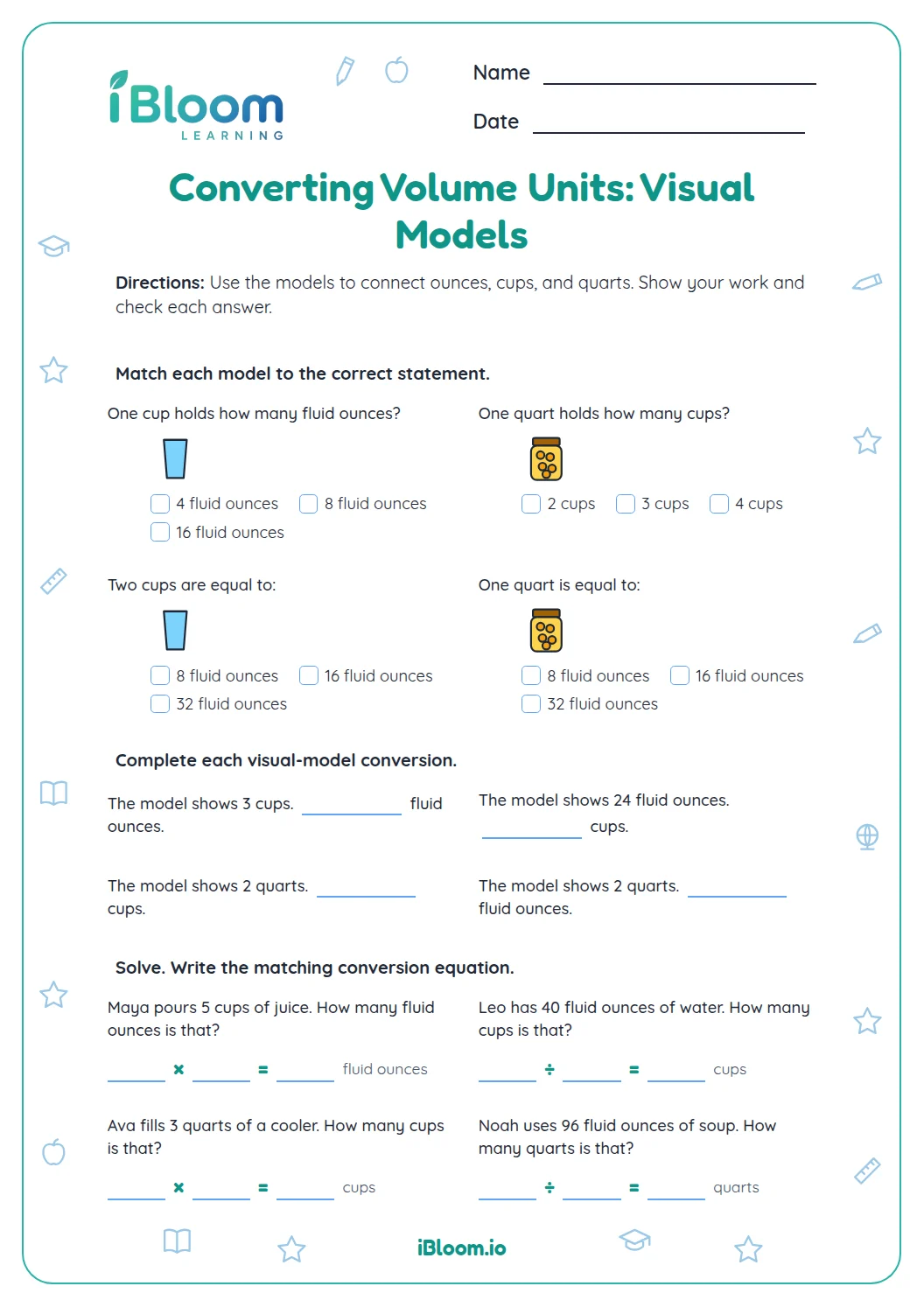
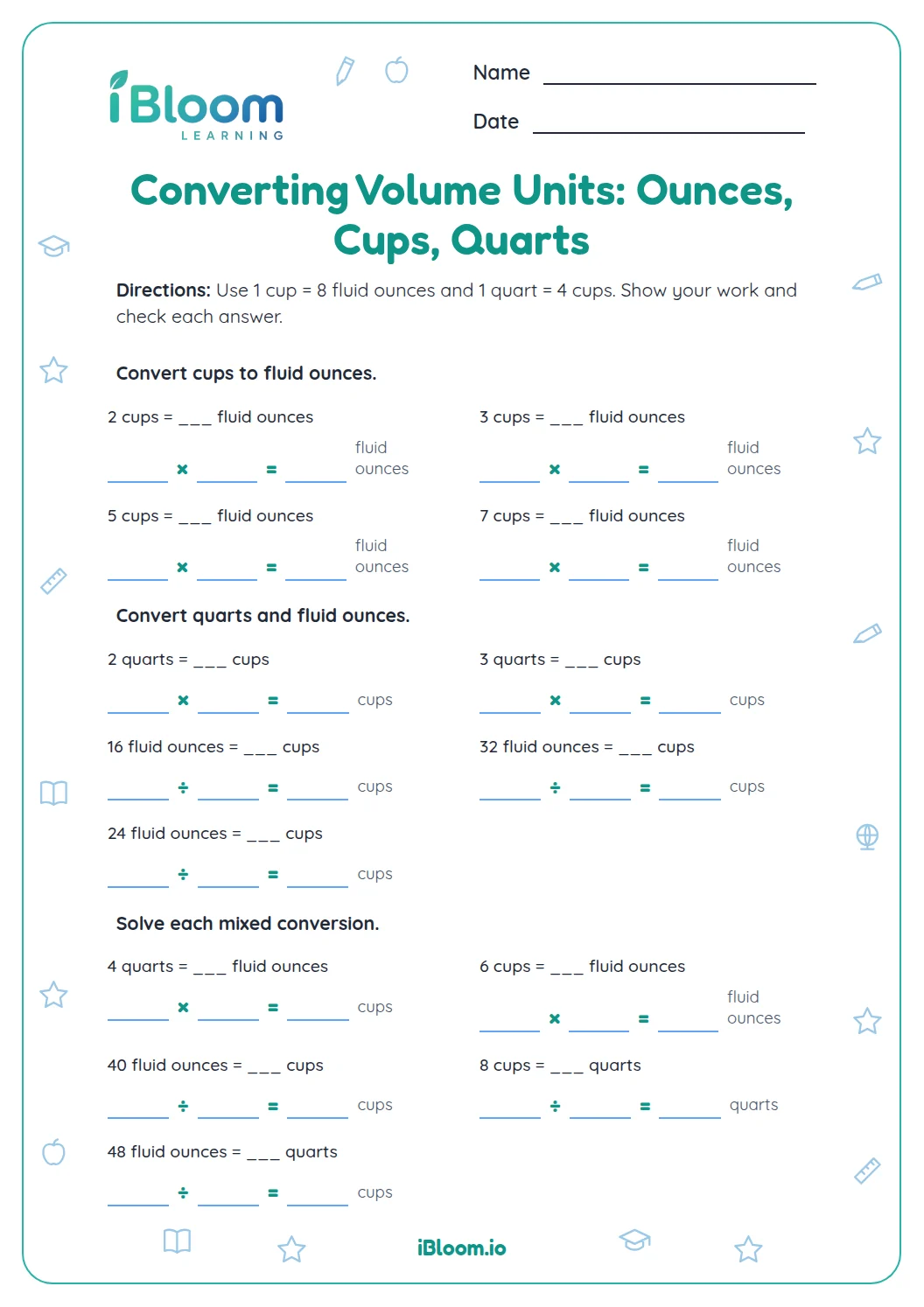
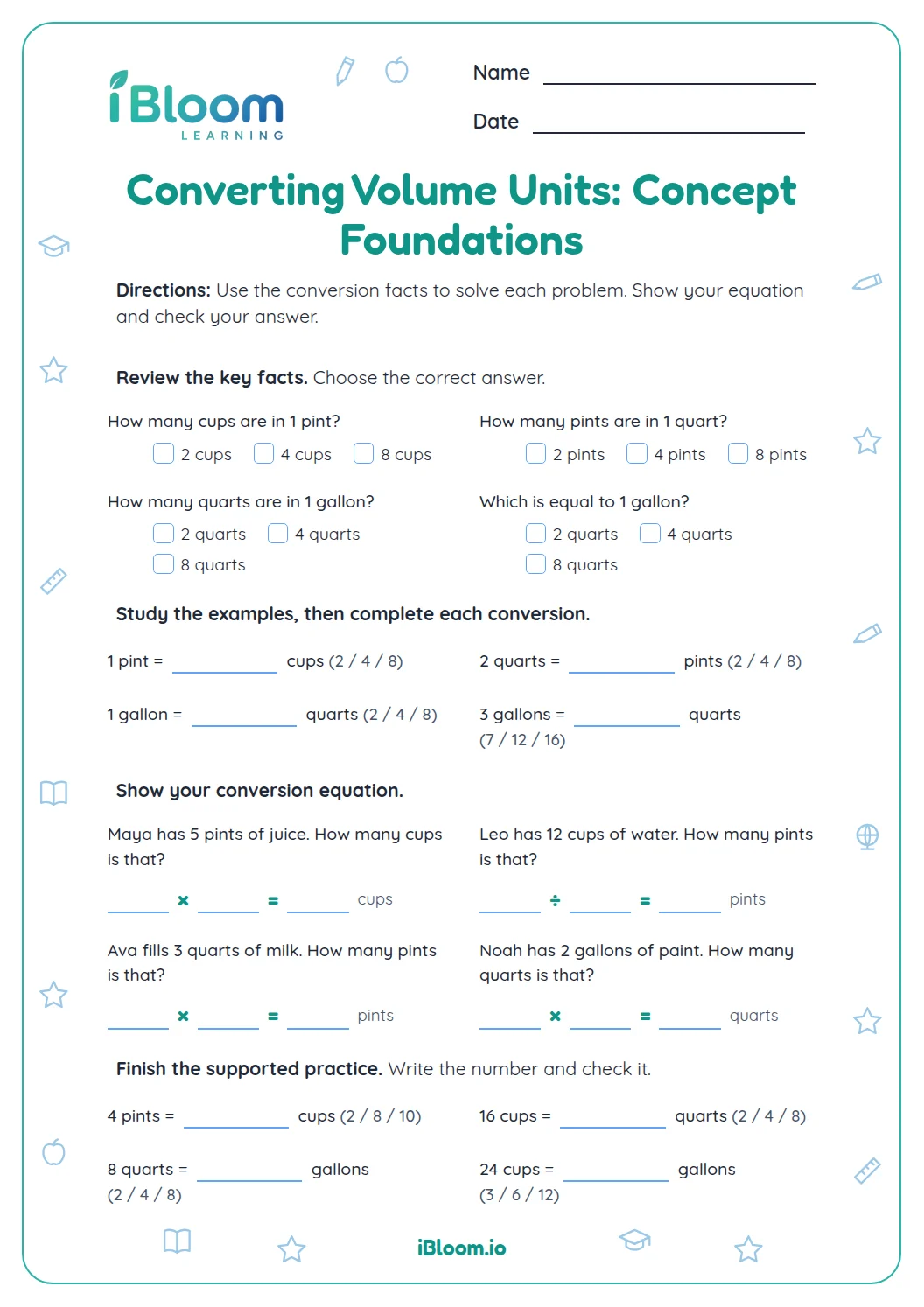
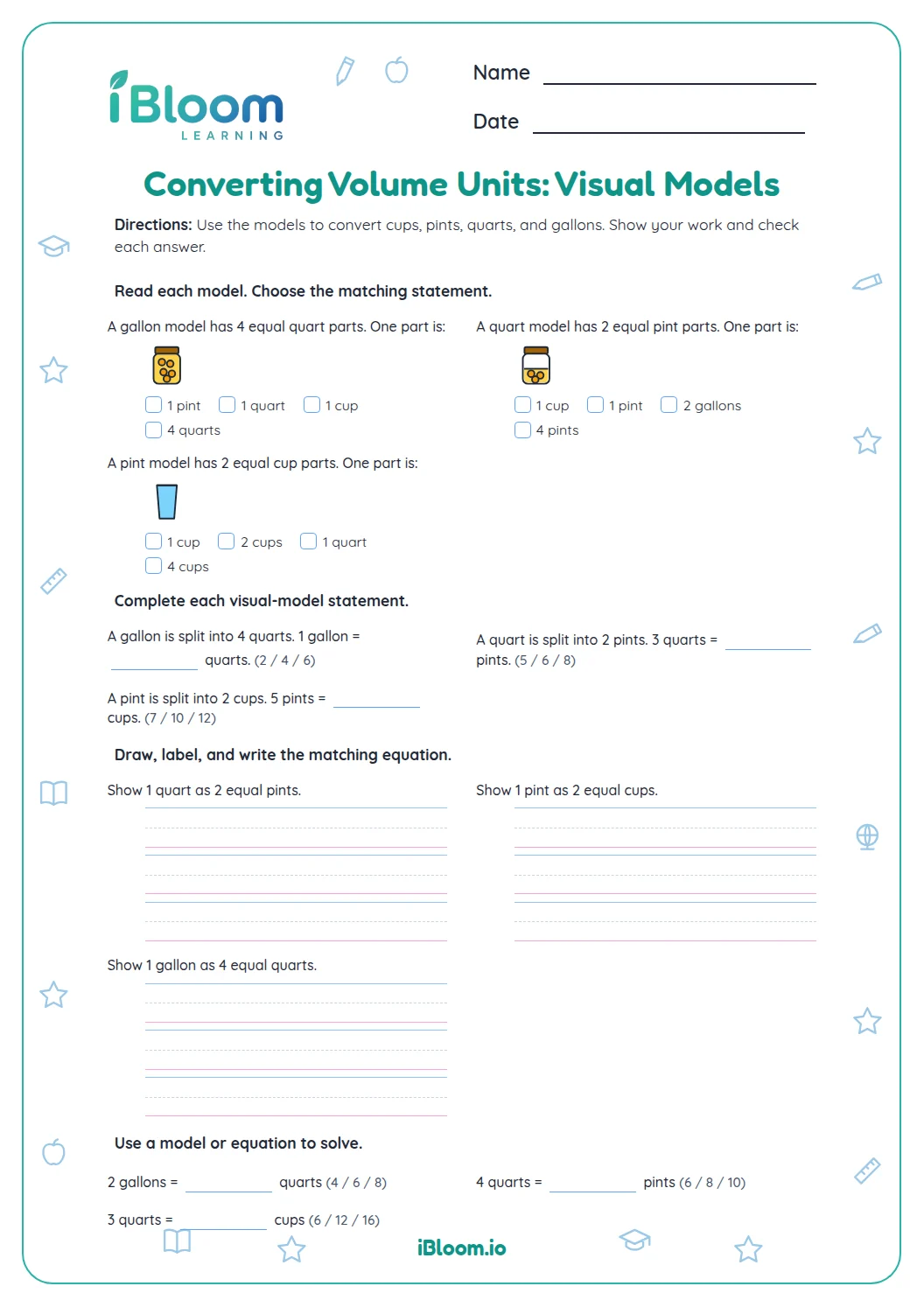
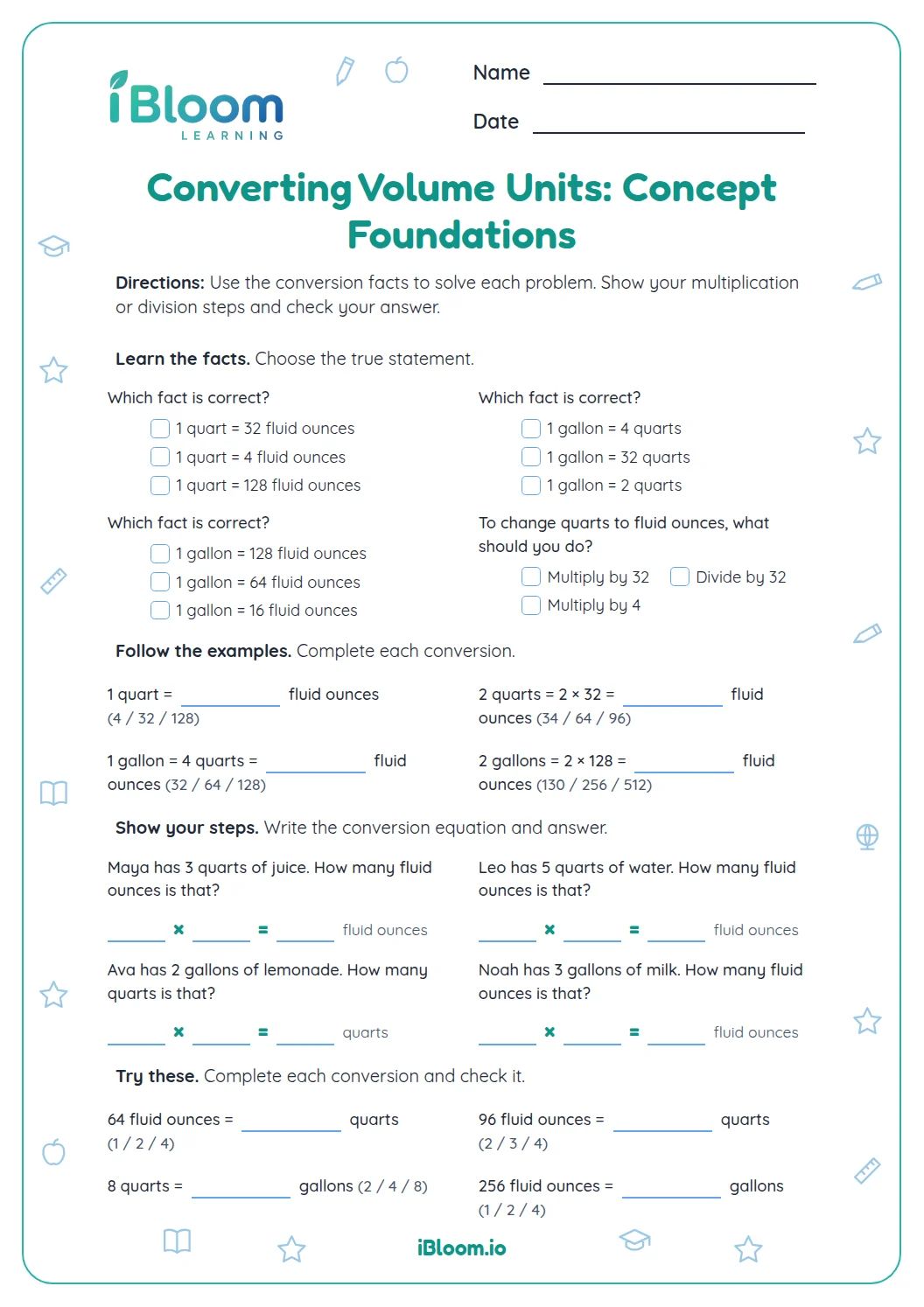
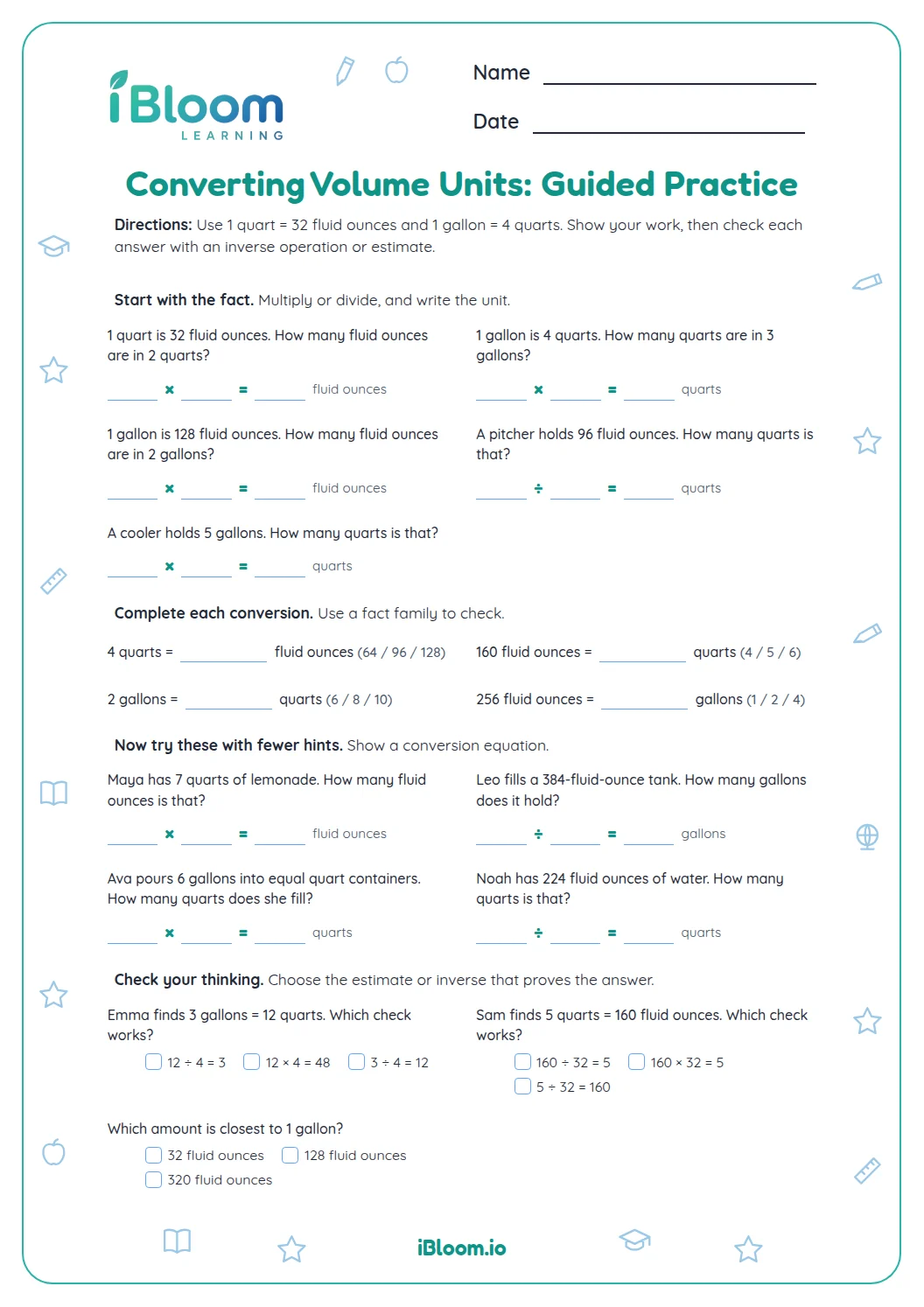
This free printable Grade 4 worksheet gives students 16 questions to convert and combine fluid ounces, cups, and quarts.. The practice uses three parts and a separate answer key, with examples that move from direct work to practical applications. It practices 4.MD.A.1. Students can check each response and revisit the conversion or place-value step that supports it.
Aligned to 4.MD.A.1
What will students practice?
The worksheet has 16 questions in three parts. The groups move from direct practice to using the same skill in practical problems.
Question 1 begins Part A. In later parts, students use the same core idea with slightly more steps. Each question has a concise response, and the key follows the same numbering.
- Four parts progress from direct to applied practice
- A separate answer key gives each response
- All numbers and units are printed in the question when needed
How can a student check the work?
Read the requested unit or place carefully, then choose the matching fact or step. After calculating, reverse the operation or compare the digits to see whether the answer fits.
- 1A cooler holds 2 quarts. How many cups is that?
- 2Use the relevant conversion or place-value fact.
- 3Use the relevant conversion or place-value fact.
- 4Check that the answer uses the requested unit or place.
How should families use the answer key?
Have the student complete one part at a time, then check those responses before moving on. If an answer differs, ask the student to point to the fact or place-value detail that supports the answer.
The key is set up to avoid repeating a unit printed after a blank. Responses to word problems include their requested units when appropriate.
How to use this worksheet
- 1Read the part direction and notice the unit or place requested.
- 2Use the conversion fact, ruler mark, or place value named by the problem.
- 3Write a calculation in the work grid when one is provided.
- 4Record the final answer in the requested unit or form.
- 5Check the result against the separate answer key.
Common mistakes and quick fixes
The mistake
Using a conversion in the wrong direction.
The fix
Check whether the answer needs a larger or smaller unit before calculating.
The mistake
Reading the ruler from a mark other than zero.
The fix
Compare the object endpoint to the ruler scale that begins at zero.
The mistake
Looking only at the thousands digit when rounding.
The fix
Use the hundreds digit to decide whether the thousands digit changes.
Common Core alignment
This Grade 4 worksheet practices the following Common Core mathematics standards.
Use the relationships among fluid ounces, cups, and quarts.
On this sheet: Use the relationships among fluid ounces, cups, and quarts.
Show the official wordingHide the official wording
Know relative sizes of measurement units within one system of units including km, m, cm; kg, g; lb, oz; l, ml; hr, min, sec. Within a single system of measurement, express measurements in a larger unit in terms of a smaller unit. Record measurement equivalents in a two-column table.
What to practice next
Make more practice
Further reading
Questions parents and teachers ask
What does this worksheet help students practice?
This worksheet gives students 16 questions on fluid ounces, cups, and quarts. The three parts start with direct practice and move into practical applications, while the separate answer key follows the same question numbers for easy checking. Students can point to the ruler marks or conversion facts as they explain a result.
How many pages should I print?
The student worksheet uses 4 pages, and the separate answer key uses 4 pages. Print the student pages for practice, then keep the answer-key pages nearby to check responses after the work is finished. This keeps the key separate while the student works through the problems.
What is a useful way to check an answer?
Ask the student to name the conversion or place-value fact used, then check that the result matches the requested unit or place. The answer key provides a quick comparison, and a mismatched answer is a chance to review the calculation.
How should students use the work spaces?
For problems with a work grid, students can write the conversion or calculation there before recording the final response. For ruler reading, they can compare the object endpoint with the ruler marks and then record the measured length.
How long does this practice take?
Plan for about 20 to 25 minutes, including time to show work and check the answer key. Students can complete one part at a time, then return to a missed item and review the conversion or place-value step.
Can I use this at home or in class?
Yes. The worksheet works for independent, partner, or small-group practice. Students can complete the questions first, then use the separate answer key to review their work and explain a conversion or rounding choice. The clear part headings make it easy to assign a short section during class.