



About this worksheet
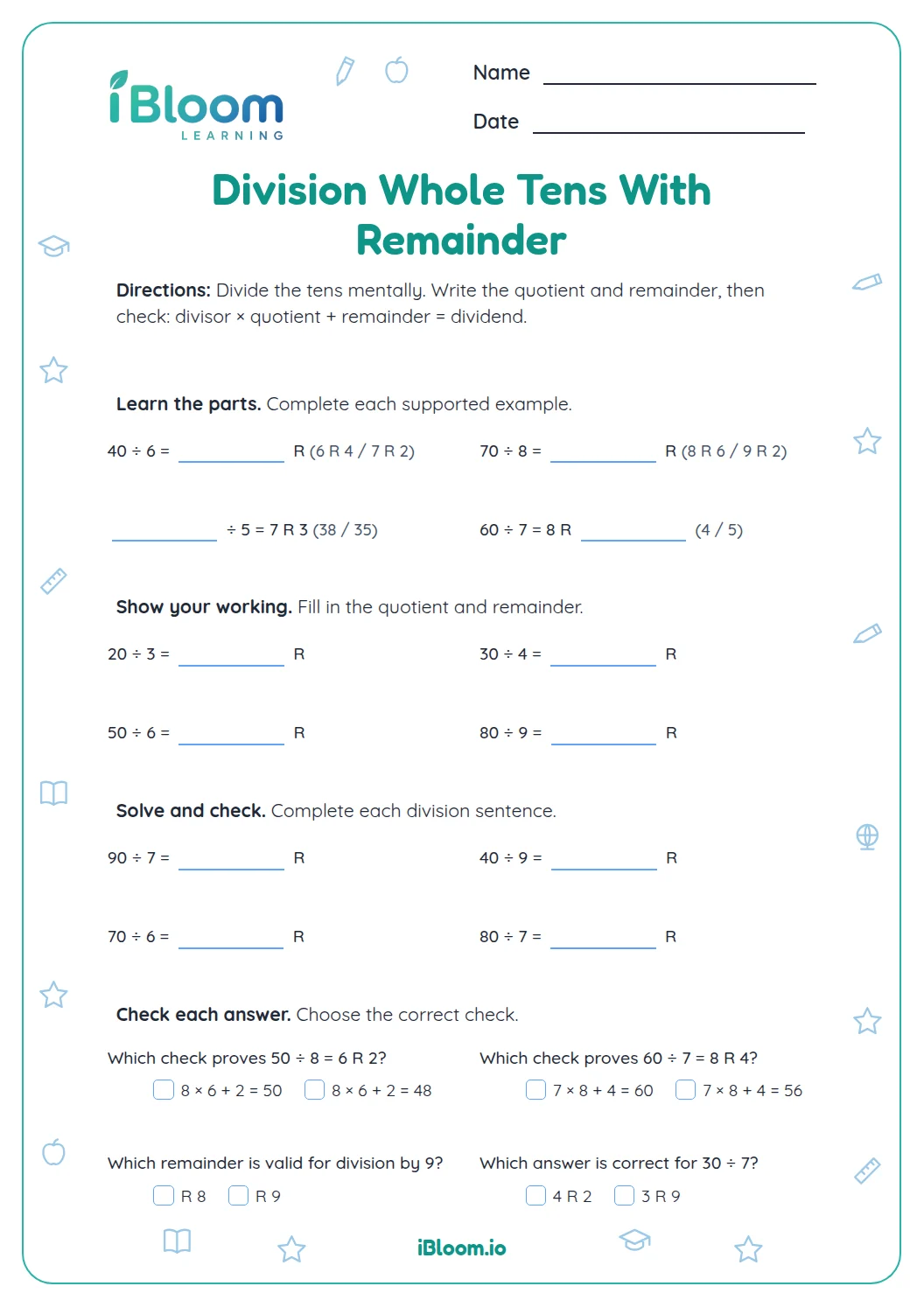
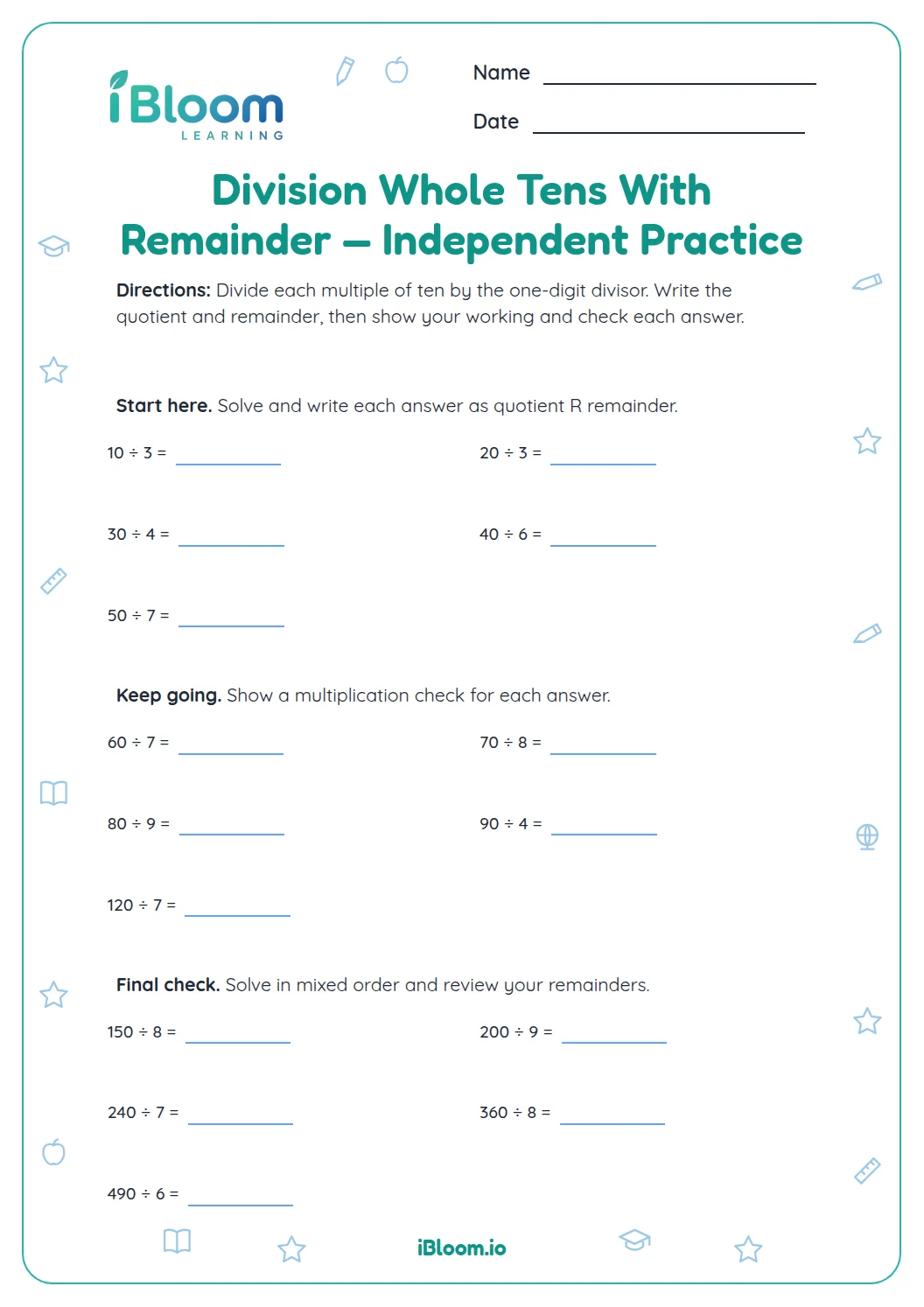
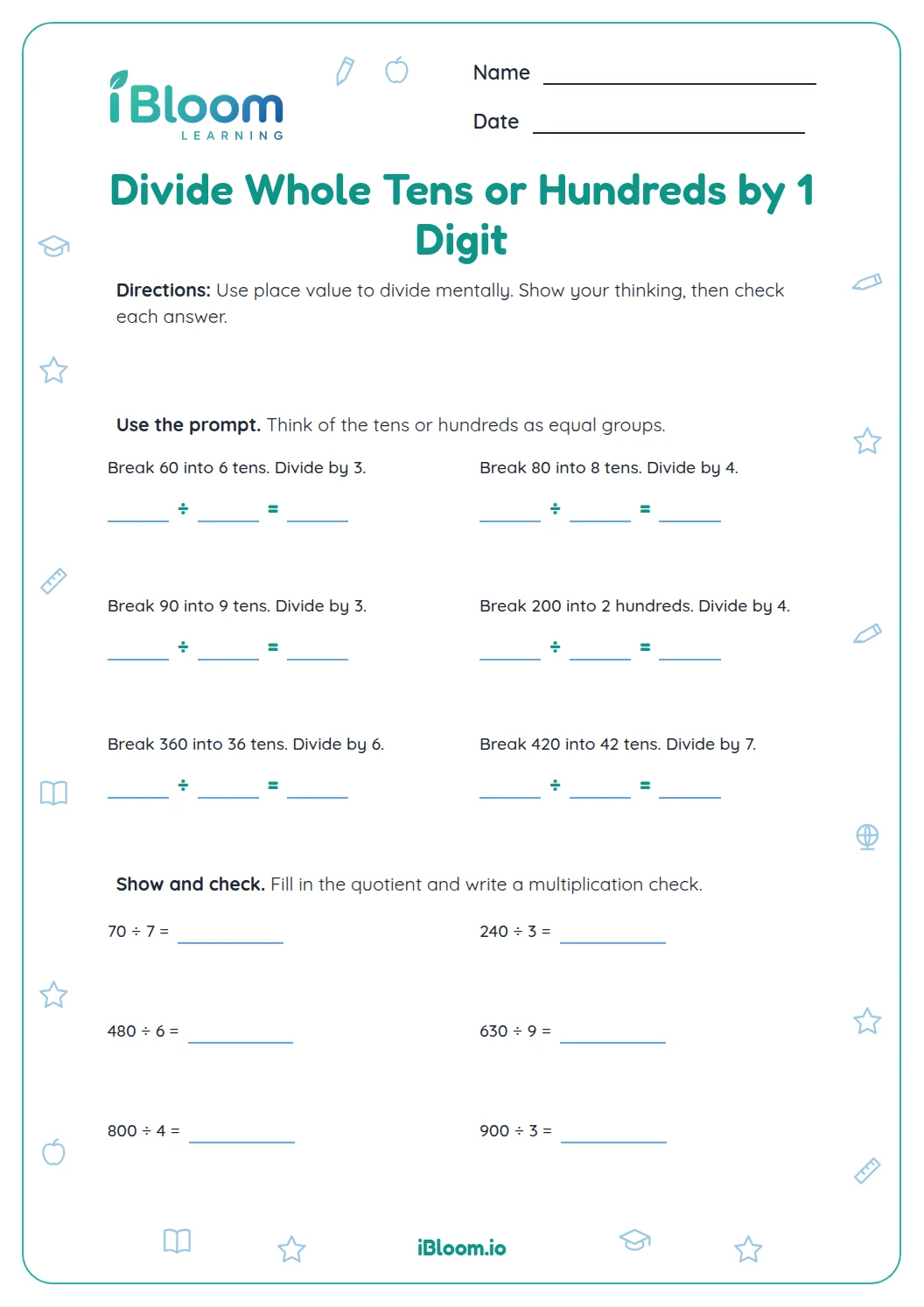
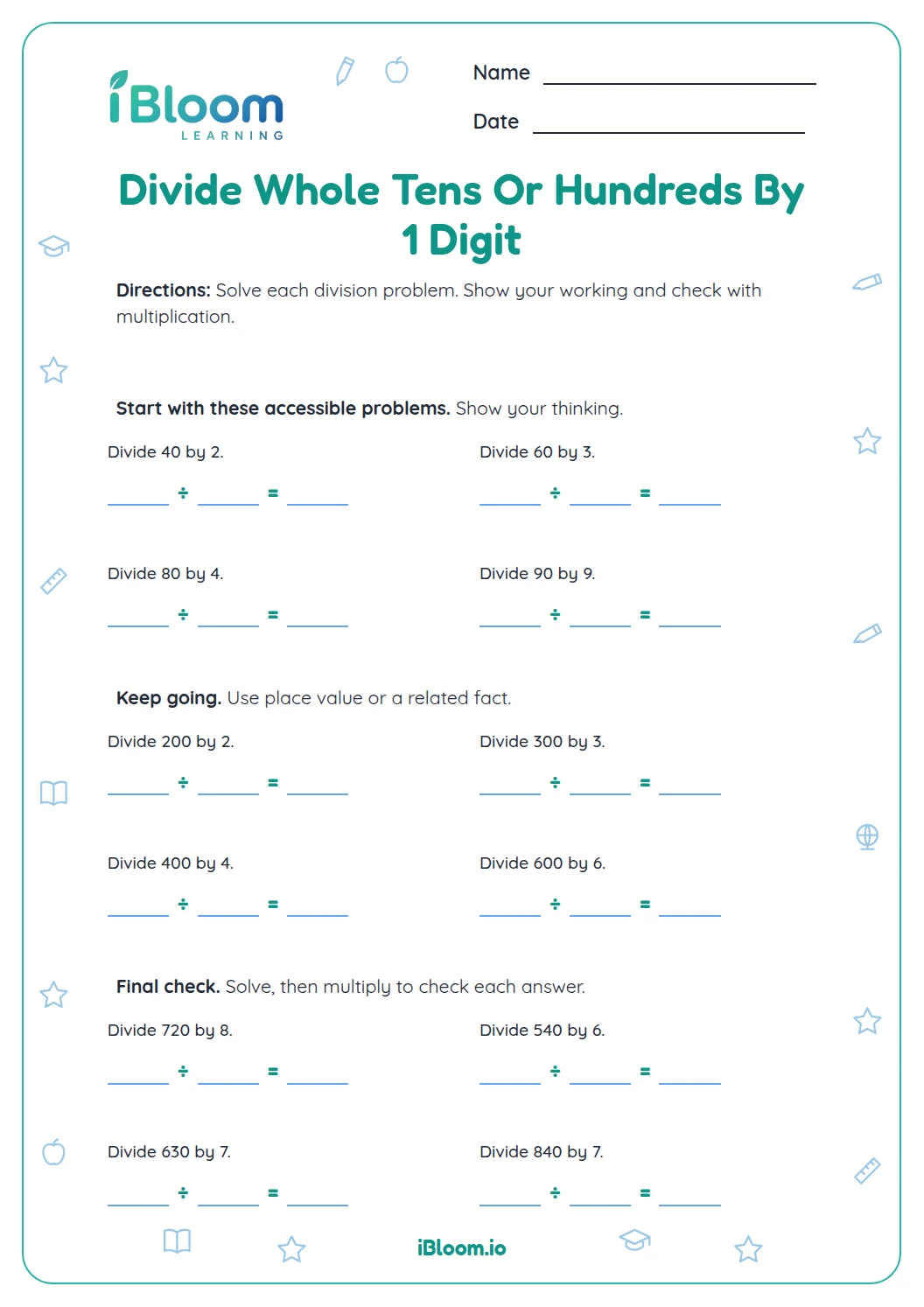
This printable Grade 4 worksheet uses base-ten block drawings to make three-digit division visible. Each item asks students to share the pictured hundreds, tens and ones equally among a one-digit number of groups, then record one quotient and one remainder. All remainders are smaller than the divisor. The key includes the checked quotient-remainder pairs. It practices CCSS 4.NBT.B.6.
Aligned to 4.NBT.B.6
How do blocks show a division problem?
A number bond can split the dividend into a multiple of the divisor and a leftover. For 315 ÷ 3, the bond separates 315 into 312 and 3. Since 312 is 104 groups of 3, the answer is 104 R3.
Check: 3 × 10⁴ + 3 = 315. The remainder is smaller than the divisor, so no additional group can be made.
What makes a remainder valid?
A remainder is the amount left after making as many equal groups as possible. It must be less than the number of groups. For example, 905 ÷ 3 is 301 R2; 300 R5 is invalid because five leftovers could make another group.
What does the worksheet include?
Three questions use number bonds to show the dividend as equal groups plus a leftover. Eleven more give direct three-digit division practice. Each asks for one quotient and remainder, and the separate key lists all 14 results.
Share the blocks and check
- 1Read the dividend and number of groups.
- 2Share hundreds equally among the groups.
- 3Regroup any leftover hundred as ten tens.
- 4Share tens, then regroup leftovers as ones.
- 5Record the quotient and remainder.
- 6Check divisor × quotient + remainder = dividend.
Common mistakes and quick fixes
The mistake
Leaving a remainder as large as the divisor.
The fix
Make another group and lower the remainder.
The mistake
Ignoring a place-value trade.
The fix
Trade one hundred for ten tens or one ten for ten ones.
The mistake
Writing only the remainder or only the quotient.
The fix
Record both in q R r form and check the dividend.
Common Core alignment
The models connect place value with whole-number quotients and remainders.
Find quotients and remainders using place value, equations or models.
On this sheet: Each item uses a base-ten drawing and asks for a quotient and remainder with a one-digit divisor.
Show the official wordingHide the official wording
Find whole-number quotients and remainders with up to four-digit dividends and one-digit divisors, using strategies based on place value, the properties of operations, and/or the relationship between multiplication and division. Illustrate and explain the calculation by using equations, rectangular arrays, and/or area models.
What to practice next
Make more practice
Further reading
Questions parents and teachers ask
How do you check a quotient with a remainder?
Multiply the divisor by the quotient, then add the remainder. For 905 ÷ 3 = 301 R2, calculate 3 × 301 + 2 = 905. Also confirm that the remainder, 2, is less than the divisor, 3. This verifies both the total and that no extra group can be made.
Why can’t 905 ÷ 3 be 300 R5?
A remainder must be smaller than the divisor. Since five is greater than three, five leftovers can make another group. The correct result is 301 R2, because 3 × 301 + 2 = 905. A valid remainder cannot make another complete group.
What do the block drawings represent?
The number bonds split each dividend into a multiple of the divisor and a leftover amount. For 315 ÷ 3, the bond shows 315 and 0; 315 ÷ 3 = 105 with no remainder. For 326 ÷ 4, 324 is divisible by 4 and 2 is left over, giving 81 R2.
Are the remainders always smaller than the divisor?
Yes. Each answer on this sheet has a valid remainder from zero up to one less than the divisor. This condition confirms that no additional full group can be made from what is left. Zero remainder means the dividend divides into equal groups exactly.
How many division questions are there?
There are 14 questions across two worksheet pages: eight number-bond models and six direct quotient-and-remainder calculations. Each has two blanks, quotient first and remainder second. The separate answer key lists both values for every item. Check multiplication to verify the dividend.
Is there an answer key?
Yes. The separate key lists the quotient and remainder for all 14 models. It can be checked by multiplying the quotient by the divisor and adding the remainder to get the original dividend. The drawing represents the dividend in hundreds, tens and ones.