

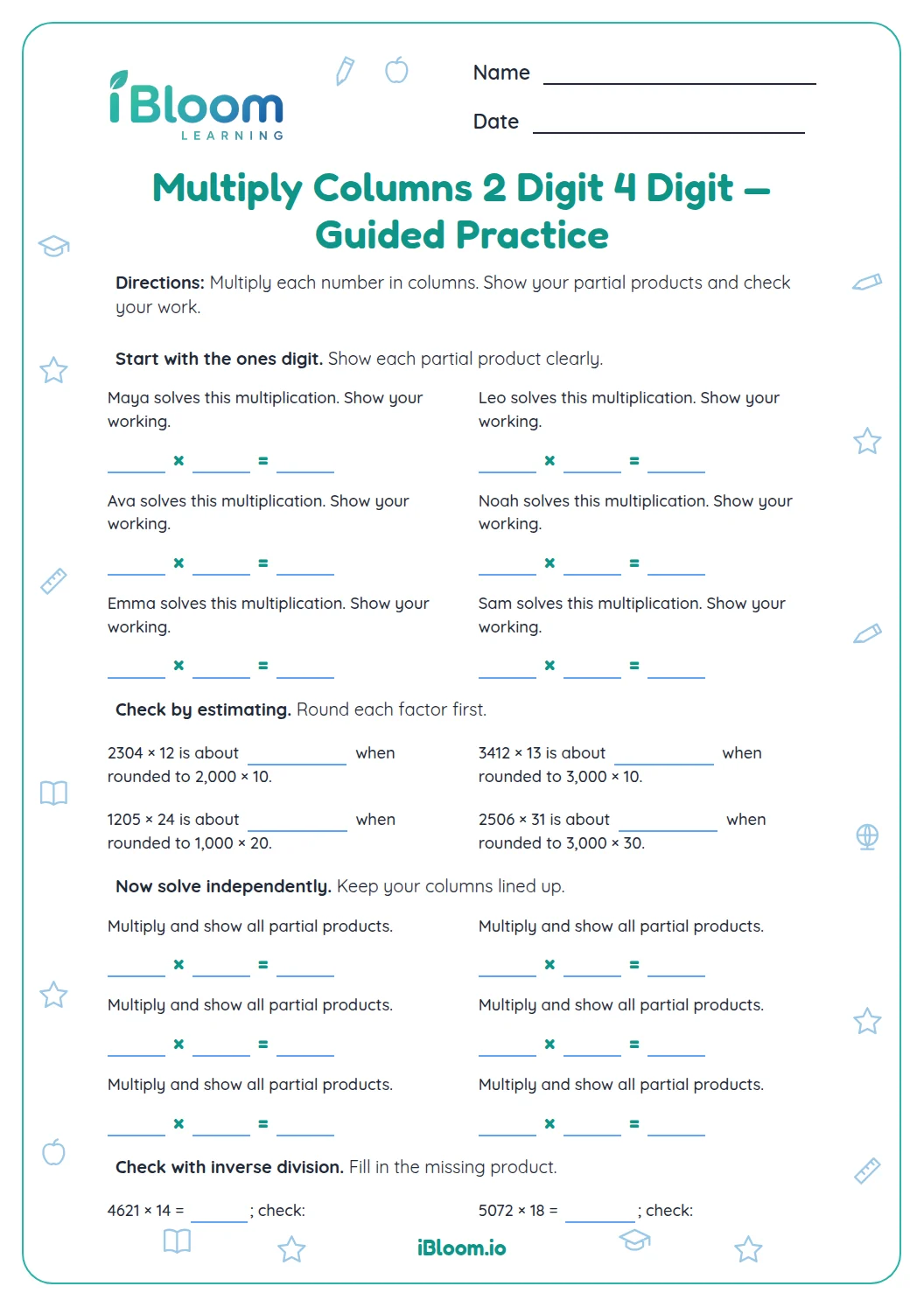
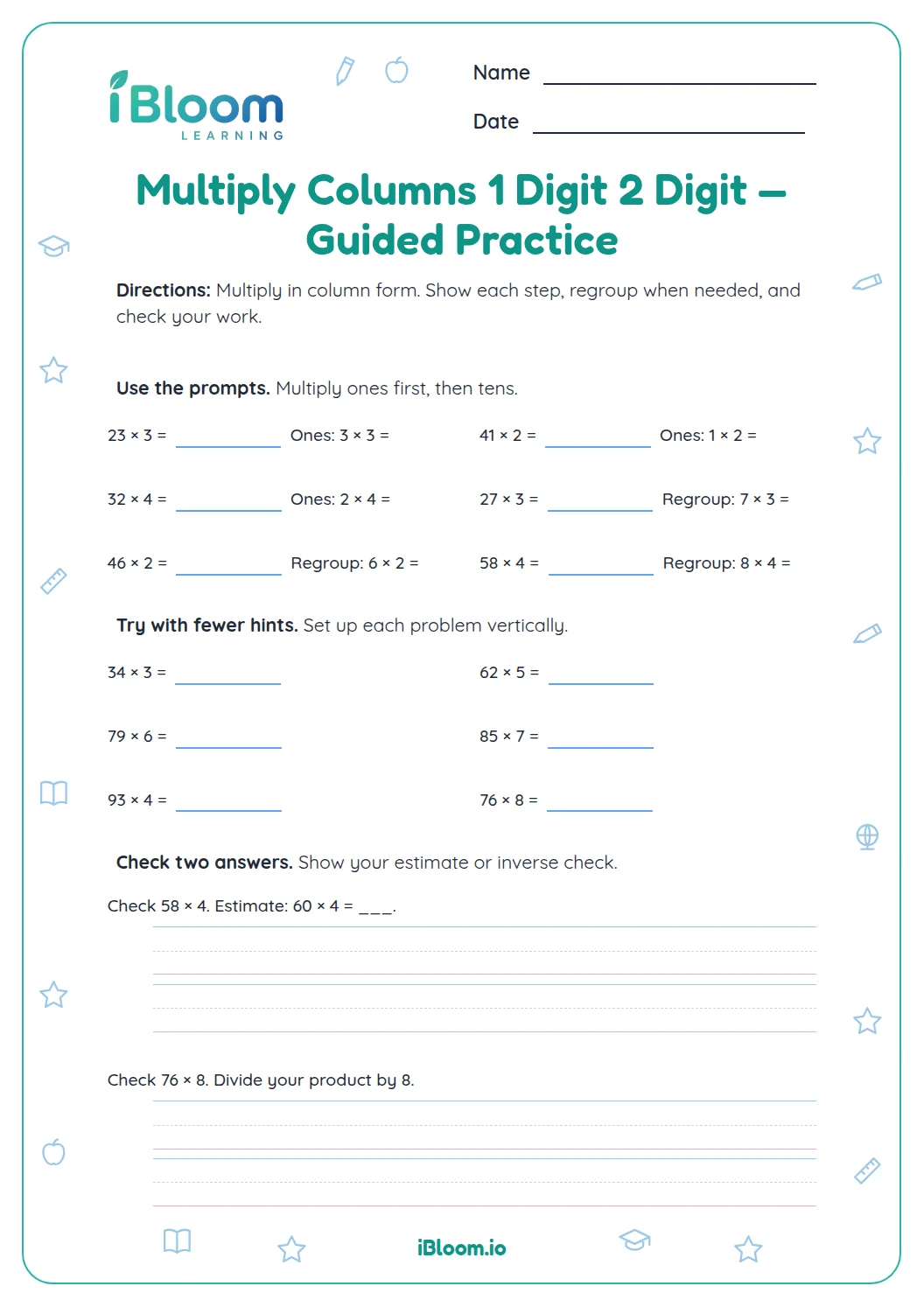


About this worksheet
This free printable Grade 4 worksheet gives students 16 multi-digit multiplication problems. Each prompt prints the factors or a complete missing-factor equation, and the final part includes work grids for recording a method. The separate answer key lists the results. Students use place value to organize each product.
How should students set up each problem?
Line up digits by place value before you multiply. For example, 24 × 1,306; work across the columns and check the result.
- 124 × 1,306
- 2Answer: 31,344
What changes across the four parts?
Part A gives direct computations. Part B asks for a missing factor or number. Part C gives more computations, and Part D provides work grids for recording a method.
How many problems are included?
There are 16 questions across 3 worksheet pages, followed by 3 answer-key pages. Each student prompt includes the numbers needed to solve.
How to work through the page
- 1Read the full number sentence and identify the operation.
- 2Align digits by place value before you multiply.
- 3Work one place at a time and record regrouping or partial products.
- 4Use an estimate or inverse operation to check the result.
- 5Compare with the separate answer key after solving.
Common mistakes and quick fixes
The mistake
Digits drift into the wrong place-value column.
The fix
Write ones under ones, tens under tens, and so on before computing.
The mistake
A regrouped value is not reduced in the column it came from.
The fix
After regrouping, update both affected digits before continuing.
The mistake
A place value is skipped during the calculation.
The fix
Check each column or partial product before combining the results.
What to practice next
Make more practice
Questions parents and teachers ask
Are the numbers printed on the student page?
Yes. Every calculation shows its operands, and every missing-number item shows the full equation with its known values. Students can solve from the worksheet without referring to the key. The answer key is printed separately for checking after the work is complete.
How many problems are on the worksheet?
The worksheet has 16 questions in four parts across 3 student pages. The answer key follows on 3 pages. The parts move from direct computations to missing-number equations and a final set with work space. Students can complete one part at a time and use the separate key only after solving.
What should students do in the first part?
Students solve the printed products in Part A. They should align digits by place value and work carefully through each place. For multiplication, partial products keep the values organized; for subtraction, regroup when needed. Estimating first helps check whether the result is reasonable.
How does the missing-number part work?
Each Part B item shows an equation with one unknown. Students can use the known values and the inverse operation to find the missing number, then substitute it back to check. The printed operands and result make each equation solvable without the answer key.
What does the answer key include?
The key lists the answer for each of the 16 questions on separate pages. The written computation items include their final result so an adult can compare the student’s work with the correct answer. Check the operations and the place values before reviewing speed.
How can students check an answer?
Students can estimate the product and check each partial product before combining them. The factors are printed on the student sheet, so the check can focus on place value and the size of the result. The separate key lets an adult compare answers after the student finishes.