


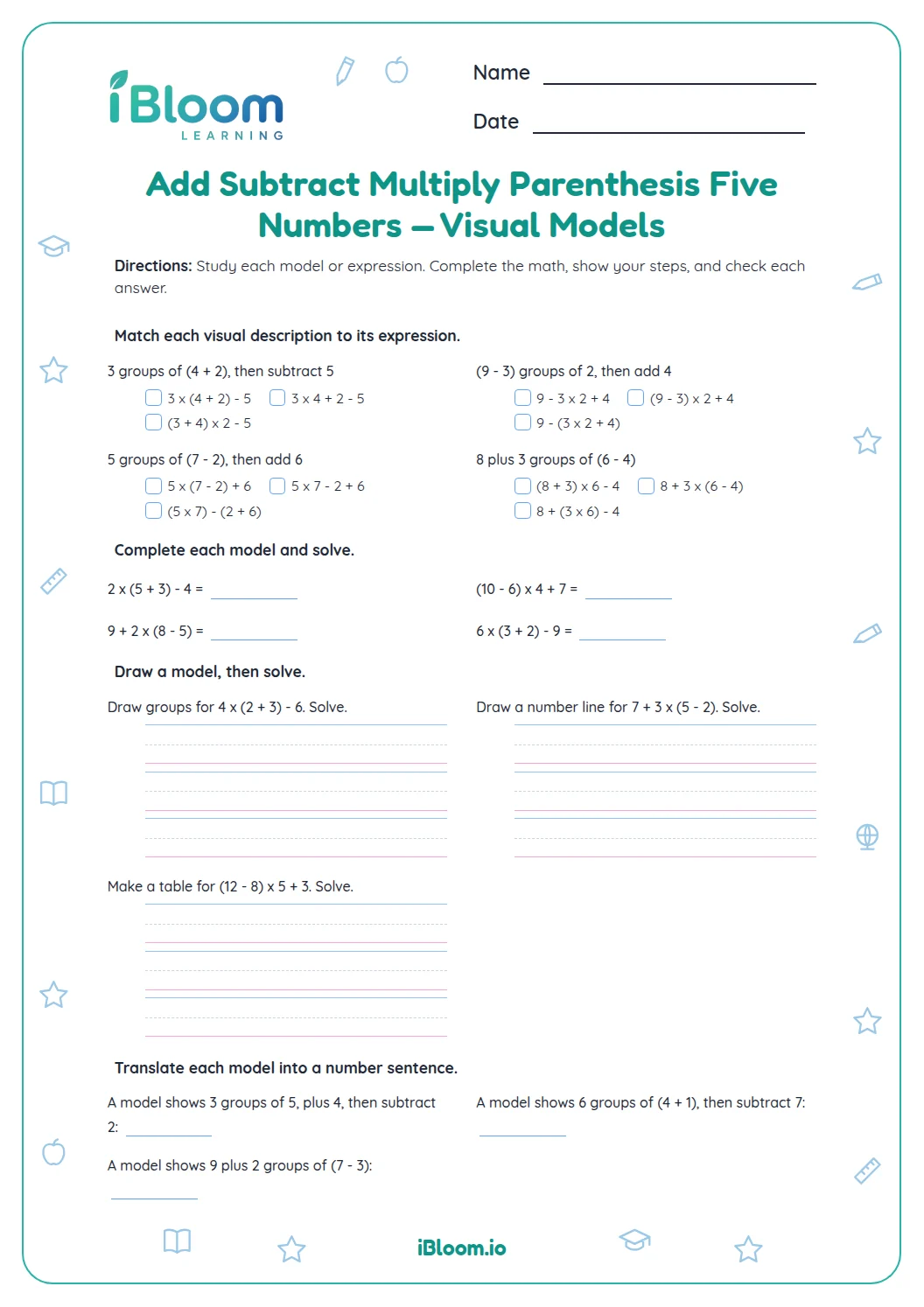

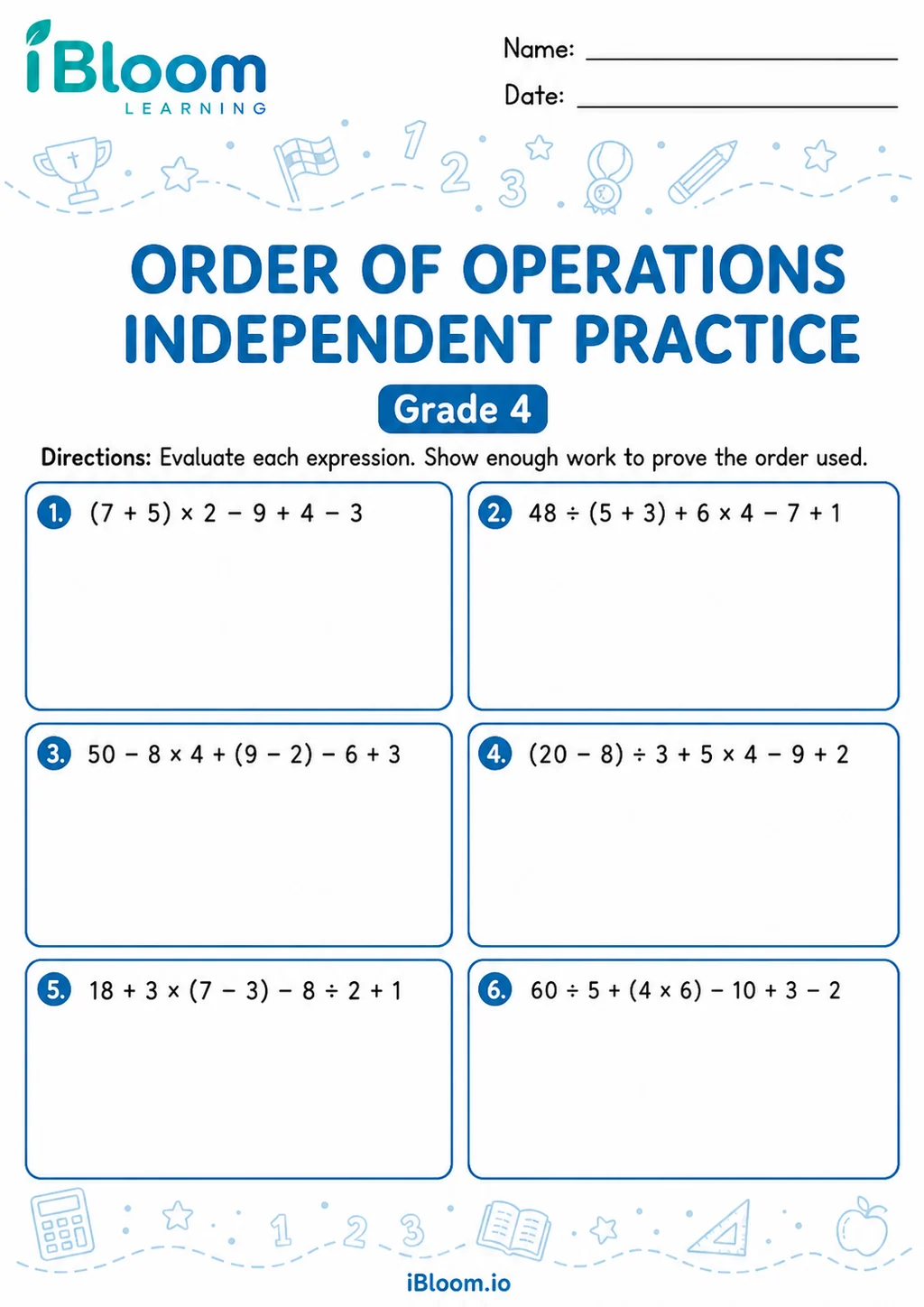
About this worksheet
This Grade 4 printable provides 14 independent expressions with five numbers, parentheses, and addition, subtraction, multiplication and division. Each expression evaluates to a whole number, and the answer key shows its checked value. Students apply parentheses first, then multiplication and division from left to right, followed by addition and subtraction. The expressions align with CCSS 5.OA.A.1.
Aligned to 5.OA.A.1
What do parentheses tell you to do?
Parentheses mark a group to evaluate before the rest of the expression. In 24 ÷ (2 + 4) + 7 × 3 − 5, add inside the parentheses to get 6. Then calculate 24 ÷ 6 = 4 and 7 × 3 = 21, leaving 4 + 21 − 5 = 20.
The operations inside parentheses still follow their own order rules if there is more than one operation.
What happens after the parentheses?
Multiply and divide have equal priority, so work them from left to right. Addition and subtraction also share a priority and are worked from left to right after multiplication and division. Do not assume multiplication always comes before division.
How is this set organized?
Fourteen five-number expressions fill two worksheet pages. Each includes parentheses and the four operations. The separate answer key gives one whole-number value for each expression.
Evaluate each expression in sequence
- 1Copy or notice the group inside parentheses.
- 2Evaluate that group first.
- 3Find multiplication and division and work left to right.
- 4Find addition and subtraction and work left to right.
- 5Check the final value against the answer key.
Common mistakes and quick fixes
The mistake
Adding from left to right before multiplying.
The fix
Finish multiplication and division first.
The mistake
Always multiplying before dividing.
The fix
Use left-to-right order for both operations.
The mistake
Ignoring the parentheses.
The fix
Circle the grouped numbers and calculate them first.
Common Core alignment
The expressions practice using parentheses and evaluating numerical expressions.
Use parentheses in numerical expressions and evaluate the expressions.
On this sheet: Every expression uses parentheses and operation precedence to determine its value.
Show the official wordingHide the official wording
Use parentheses, brackets, or braces in numerical expressions, and evaluate expressions with these symbols.
What to practice next
Make more practice
Further reading
Questions parents and teachers ask
What is the first step in 24 ÷ (2 + 4) + 7 × 3 − 5?
Add inside the parentheses first: 2 + 4 = 6. Then divide 24 by 6 to get 4 and multiply 7 by 3 to get 21. Finish with 4 + 21 − 5 = 20. The final value matches the answer key.
Does multiplication always come before division?
No. Multiplication and division have equal priority, so calculate whichever appears first as you move left to right. The same rule applies to addition and subtraction after multiplication and division are complete. Moving left to right keeps equal-priority operations in the right order.
Why are parentheses used?
Parentheses show which numbers are grouped and must be evaluated first. In 24 ÷ (4 + 2) + 3 × 5 − 1, the group equals 6 before the division and multiplication are carried out. The grouped calculation sets the value used in the rest of the expression.
How many numbers are in each expression?
Each expression uses five number values, along with parentheses and all four operations across the set. The sequence of steps stays consistent, while the numbers and grouping vary. This avoids adding or subtracting before higher-priority operations are done. This avoids adding or subtracting before higher-priority operations are done.
What is the answer to 24 ÷ (2 + 4) + 7 × 3 − 5?
The value is 20. First 2 + 4 = 6, then 24 ÷ 6 = 4 and 7 × 3 = 21. Finish with 4 + 21 − 5 = 20. This is the first expression on the student page and a useful worked check.
Is an answer key included?
Yes. A separate key lists the value for each of the 14 expressions. Students can compare only after finishing and use any mismatch to revisit the order of operations. The answer key helps identify which step needs a second look.