



About this worksheet
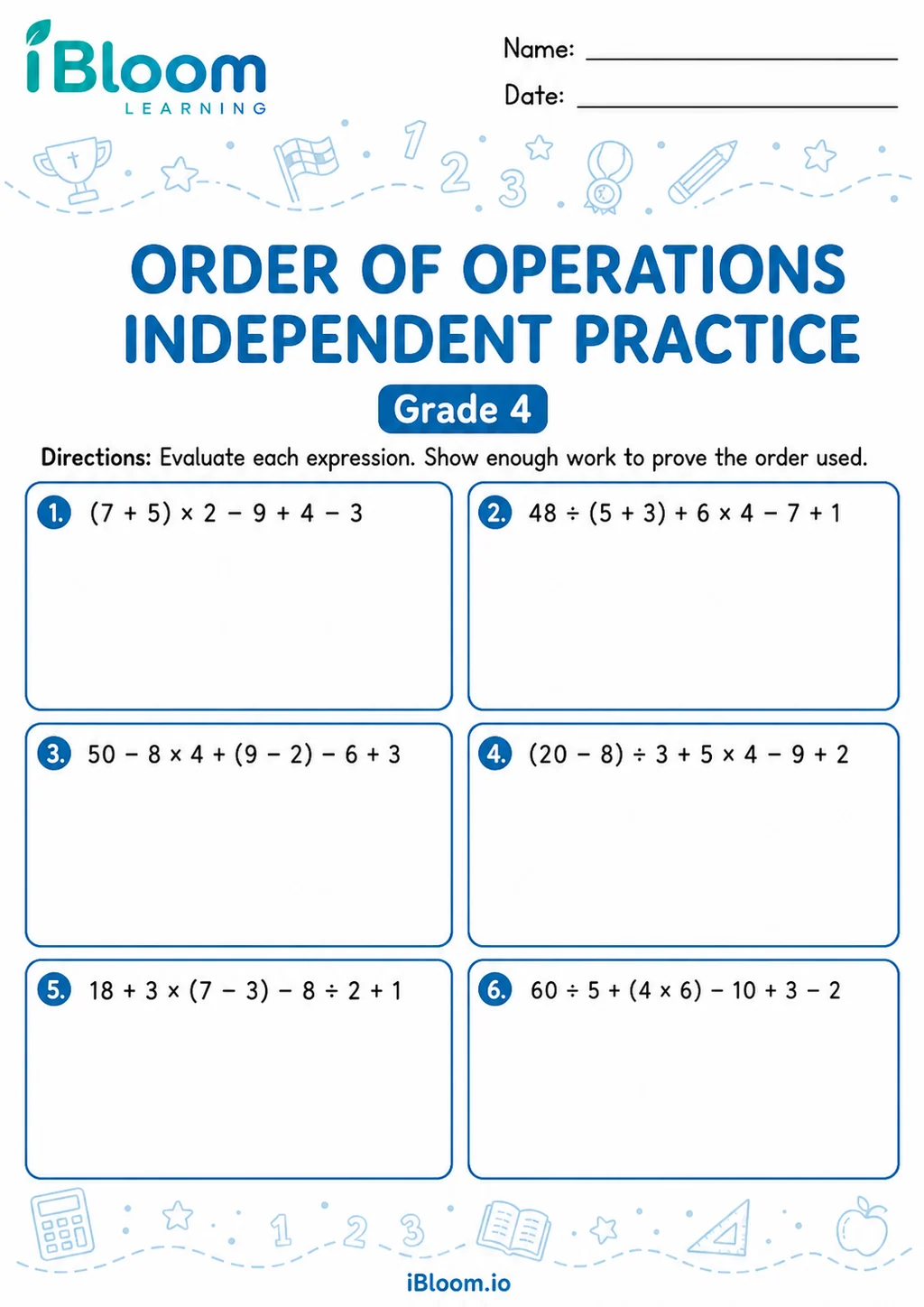
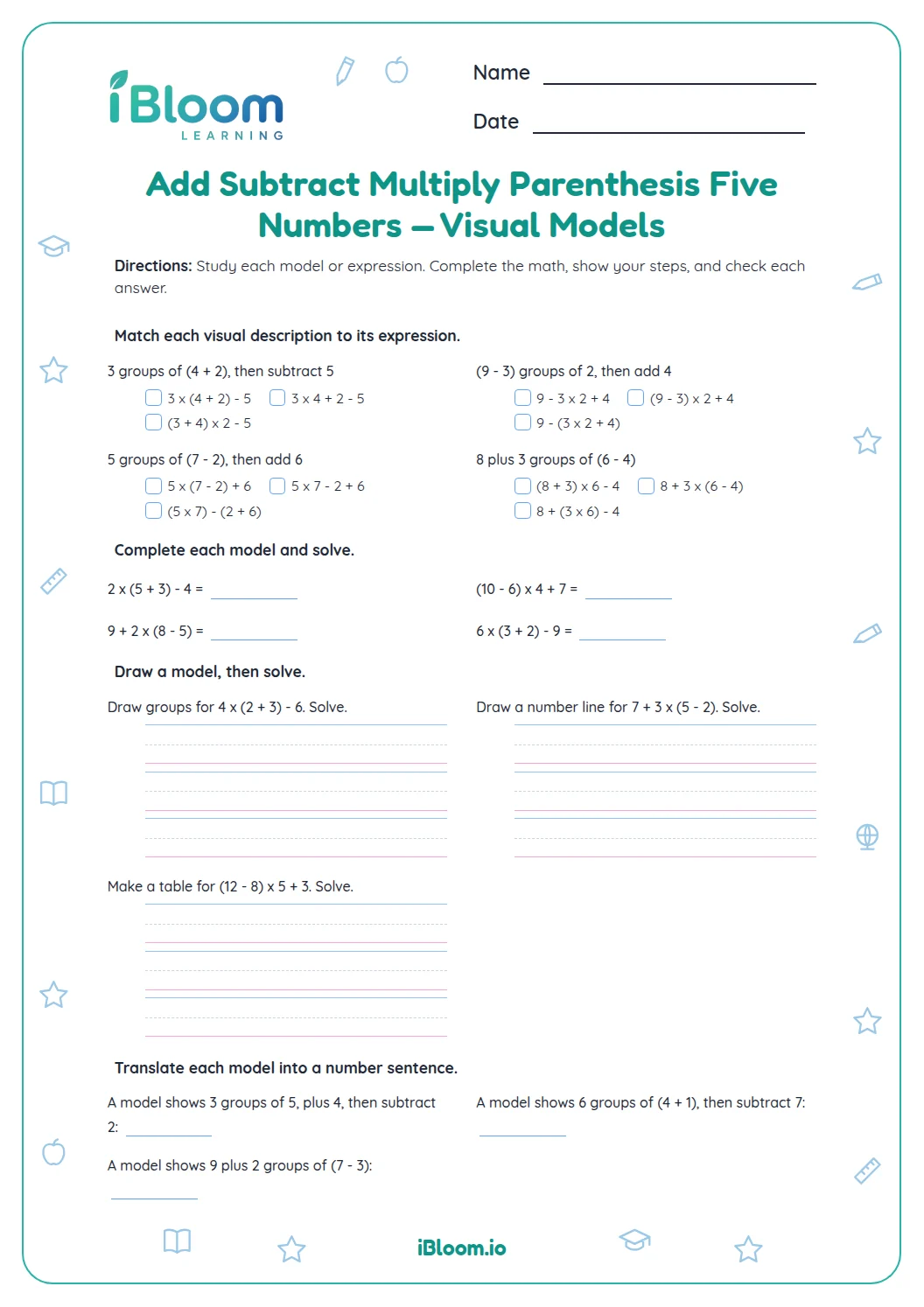
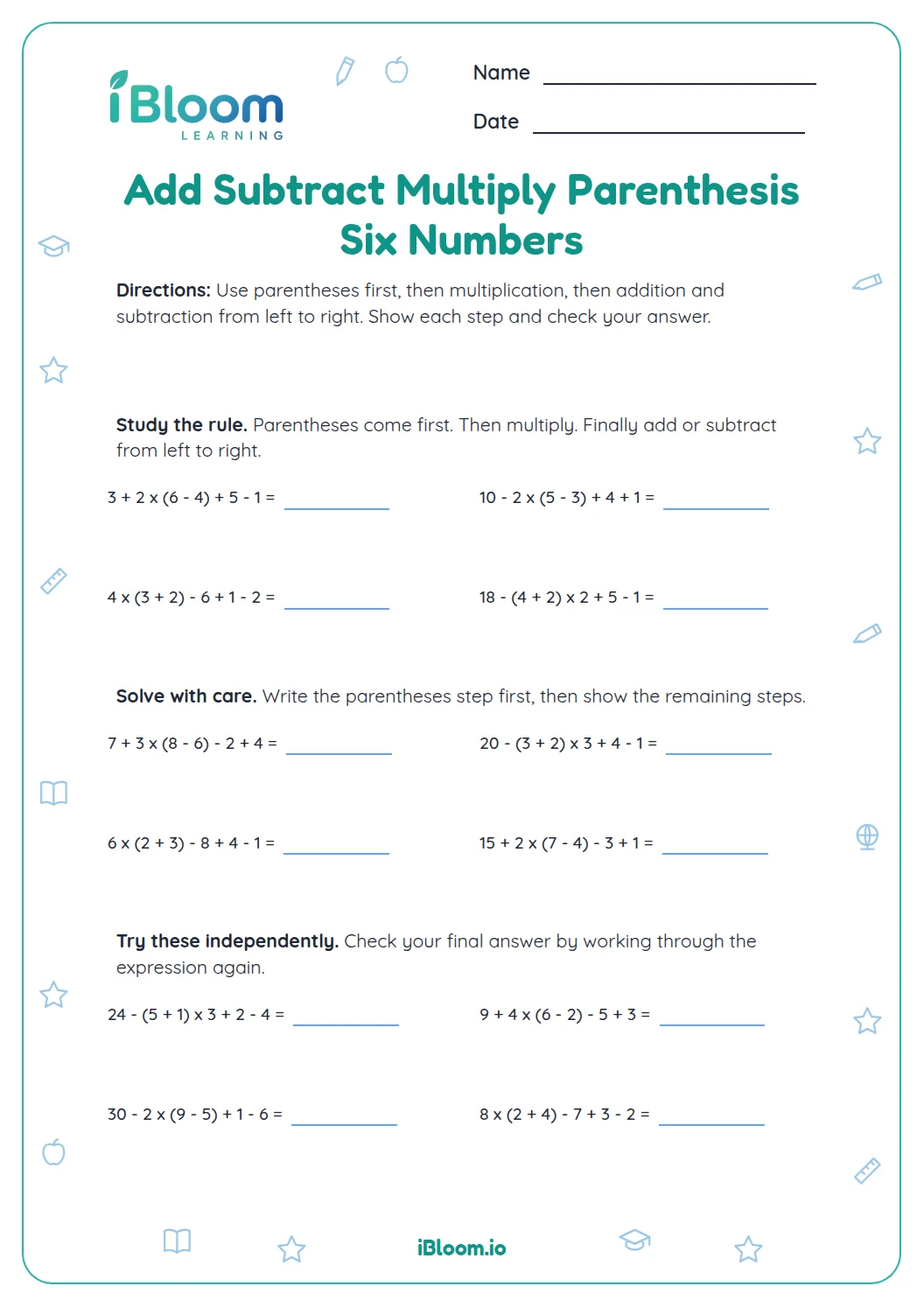
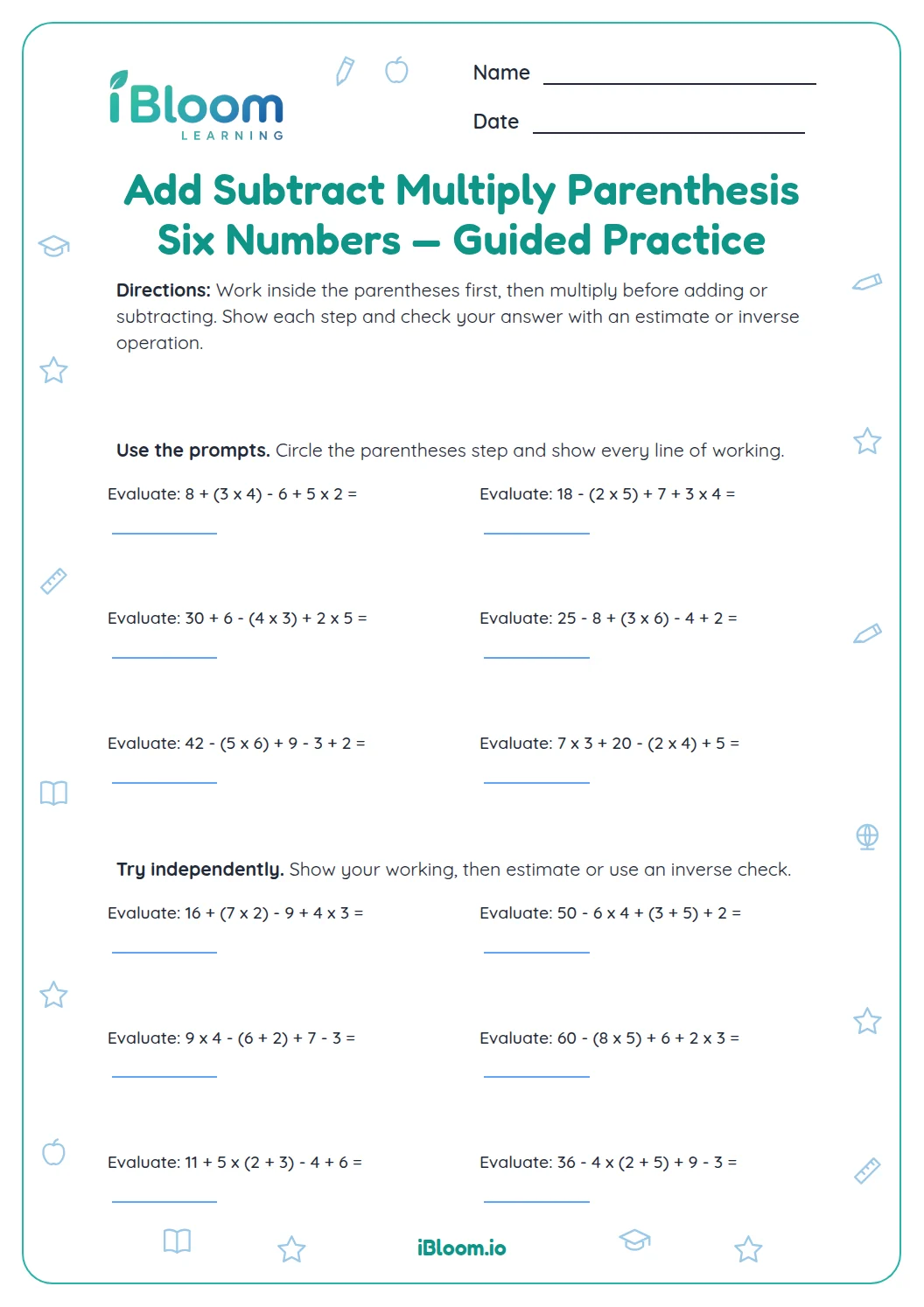
This free printable Grade 4 worksheet gives students 14 order of operations problems: four short stories and ten numerical expressions. Students translate situations about pancakes, pencils, apples, and muffins into expressions, then evaluate number sentences with parentheses and mixed operations. The two-page worksheet includes a separate answer key.
Aligned to 5.OA.A.1
How do parentheses guide each calculation?
Parentheses group numbers that belong together. After evaluating that group, complete multiplication and division from left to right, then addition and subtraction from left to right. In a story, use the wording to decide which values belong in the group.
- 1(18 + 6) ÷ 4 + 7 − 1
- 218 + 6 = 24; 24 ÷ 4 = 6
- 36 + 7 − 1 = 12 flowers per bunch
How do the stories become expressions?
Part A has four situations about pancakes, pencils, apples, and muffins. Students use the order described in each story to write an expression before calculating. Part B asks them to evaluate ten number sentences.
How can an adult support the practice?
Invite the student to underline the quantities and circle the words that signal grouping or equal sharing. Ask them to write one expression, calculate one step at a time, and label the result with the unit named in the story.
How to use this worksheet
- 1Read the full expression before calculating.
- 2Work inside parentheses first.
- 3Multiply or divide from left to right.
- 4Add or subtract from left to right.
- 5Compare each final answer with the key.
Mistakes to watch for
The mistake
Adding before multiplying.
The fix
Circle multiplication and division, then complete them before addition or subtraction.
The mistake
Ignoring a minus sign after parentheses.
The fix
Copy each sign with its number before combining terms.
The mistake
Changing a grouped sum into separate operations.
The fix
Calculate the entire parenthesis first and replace it with its value.
Common Core alignment
Use parentheses to show which calculations are grouped first.
On this sheet: Each problem evaluates numerical expressions with parentheses and operation order.
Show the official wordingHide the official wording
Use parentheses, brackets, or braces in numerical expressions, and evaluate expressions with these symbols.
What to practice next
Make more practice
Further reading
Questions parents and teachers ask
Why do the parentheses come first?
Parentheses mark a group that should be evaluated before the rest of an expression. In this real-world order of operations worksheet, students replace that group with its value and then follow the remaining operation signs. Keeping the grouped value visible helps a student avoid changing the expression while working.
What happens when an expression has more than one operation?
After evaluating parentheses, multiplication and division are completed from left to right when they appear. Addition and subtraction are then completed from left to right. Students should not treat addition as always coming before subtraction, or multiplication as always coming before division.
Is an answer key included?
Yes. The separate answer key includes a response for all 14 questions. Students can finish a section before checking, then compare their steps with the keyed value or explanation. If an answer differs, have them recopy the expression and check the first operation before changing later steps.
How can I help a student who gets a different answer?
Ask the student to point to the parentheses and identify the first operation they completed. Then check multiplication and division from left to right, followed by addition and subtraction from left to right. Keeping every plus and minus sign attached to its number can reveal where the work changed.
How long should this worksheet take?
A student can work through the two worksheet pages in about 25 to 30 minutes, depending on how much written explanation is needed. The answer key is separate, so an adult can use it after the student finishes. Short breaks between sections can keep the checking process focused.