



About this worksheet
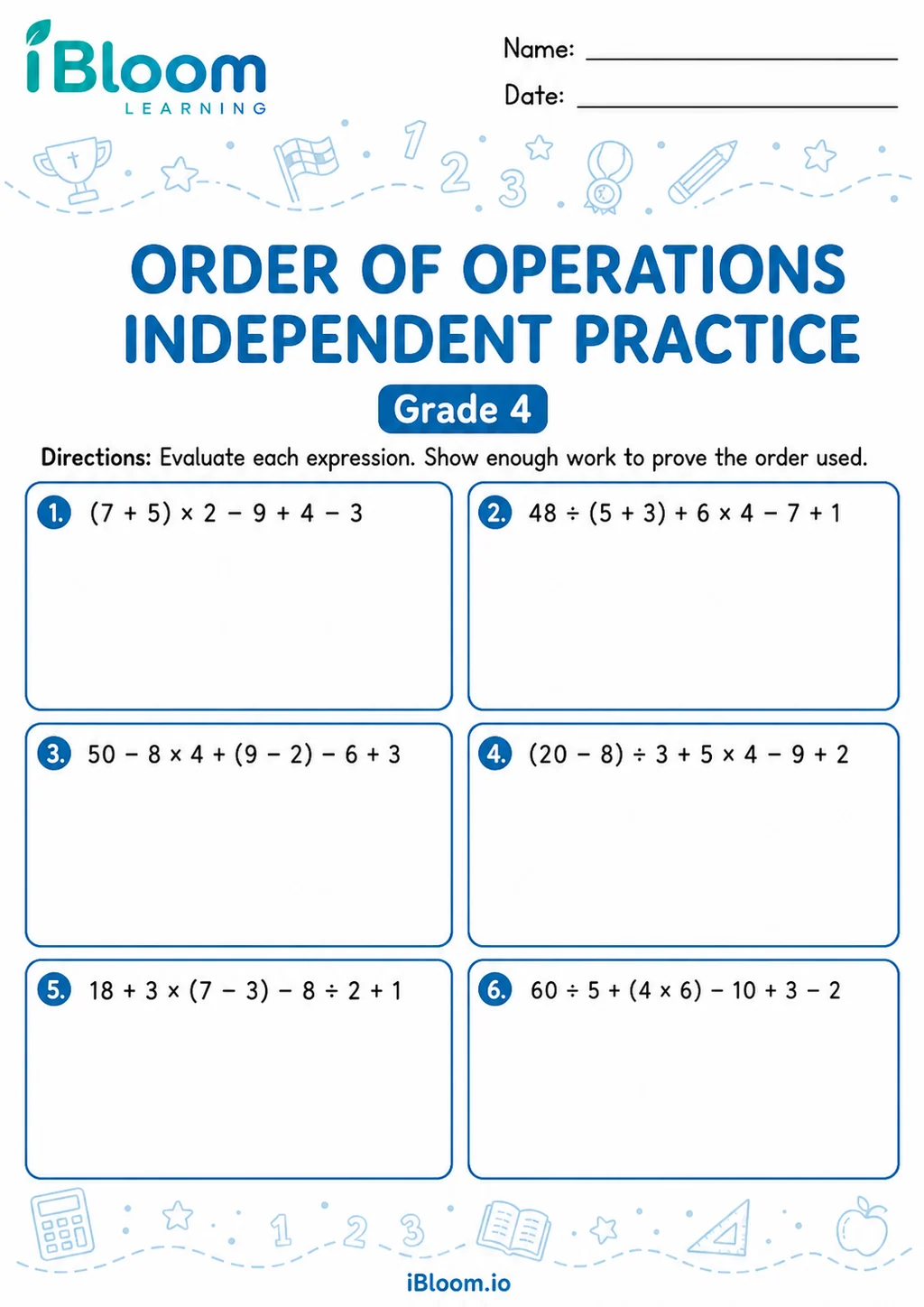
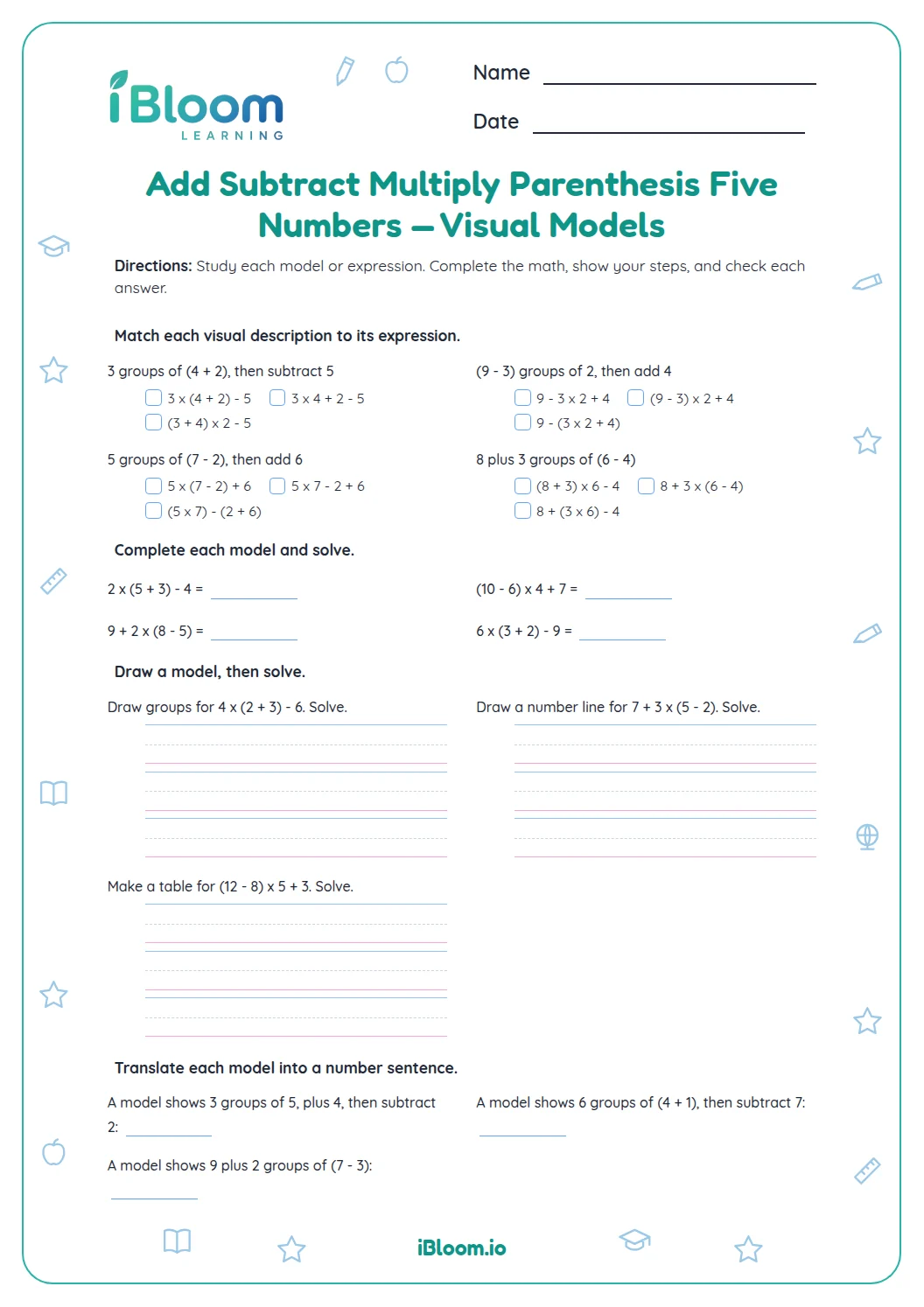
This free Grade 4 worksheet gives students 16 six-number expressions with parentheses and addition or subtraction. Students simplify the grouped numbers first, then work through each remaining sign from left to right. Practice moves from direct evaluation to multiple-choice values and missing-number equations, with a separate answer key for checking results. The page practices CCSS 5.OA.A.1 by asking students to evaluate numerical expressions with grouping symbols.
Aligned to 5.OA.A.1
What do parentheses tell a student to do first?
Parentheses group numbers that belong together. Simplify that group before using its value in the rest of the expression. Keep the new value in the same place, then continue through addition and subtraction from left to right.
Writing one line after each step helps students keep track of which operation comes next.
- 120 − (9 + 2) + 6 − 3 + 4
- 2Parentheses first: 9 + 2 = 11, so 20 − 11 + 6 − 3 + 4
- 3Work left to right: 20 − 11 = 9, then 9 + 6 = 15
- 4Continue: 15 − 3 = 12, then 12 + 4 = 16
How should addition and subtraction be handled?
Addition and subtraction have equal priority. After evaluating parentheses, start at the left and perform each operation in order. Do not add every number first and subtract afterward; that changes the expression.
For a quick check, substitute each intermediate result into the expression and compare the final value with the answer key.
What kinds of questions are included?
This sheet has 16 items in three parts. Students complete six evaluations, five multiple-choice items, and five missing-number equations. The key follows the question IDs and gives one answer for each item.
Every equation prints the numbers students need. The first part introduces the evaluation routine, and later questions ask students to apply it independently.
How to use this worksheet
- 1Read the whole expression before calculating.
- 2Find the numbers inside parentheses.
- 3Evaluate that group first.
- 4Continue addition and subtraction from left to right.
- 5Write the result and check it with the key.
Common mistakes and quick fixes
The mistake
Adding all the numbers before subtracting.
The fix
After parentheses, follow every sign from left to right.
The mistake
Keeping the parentheses but forgetting to simplify the group.
The fix
Write the group’s value in its place before continuing.
The mistake
Changing a subtraction into addition while moving terms.
The fix
Copy each sign carefully on the next line.
Common Core alignment
This sheet practices evaluating numerical expressions with grouping symbols.
Evaluate expressions by simplifying parentheses before completing the remaining operations.
On this sheet: Every question evaluates or uses the value of a grouped expression.
Show the official wordingHide the official wording
Use parentheses, brackets, or braces in numerical expressions, and evaluate expressions with these symbols.
What to practice next
Make more practice
Further reading
Questions parents and teachers ask
What is the first step in each expression?
Evaluate the numbers inside parentheses first. Then replace that group with its value and continue through addition and subtraction from left to right. Each item on this worksheet gives students a complete expression or equation to solve. Writing intermediate steps makes each decision easy to review.
Do addition and subtraction have different priority?
No. Addition and subtraction have equal priority, so students complete them from left to right after simplifying parentheses. The signs stay attached to the operations as students rewrite each step. Keeping the original signs visible prevents a common calculation slip.
What is included in the answer key?
The key gives answers for all 16 questions in their printed order. It supports quick checking after students have completed the worksheet and leaves the work itself for the student to show on the page. Compare each final value with the steps, especially at the parentheses.
How can a student check a missing-number answer?
Substitute the proposed number into the blank and evaluate both sides. If the two sides have the same value, the missing number works. Students can also use the inverse relationship between subtraction and addition. Rechecking both sides confirms the equation balances.
Is this worksheet suitable for classroom or home practice?
Yes. The printable page and separate answer key can support a short lesson, independent practice, or review at home. Students should write intermediate steps so they can spot where an operation or sign may have changed. Teachers and families can review one item together before independent work begins.