
About this worksheet
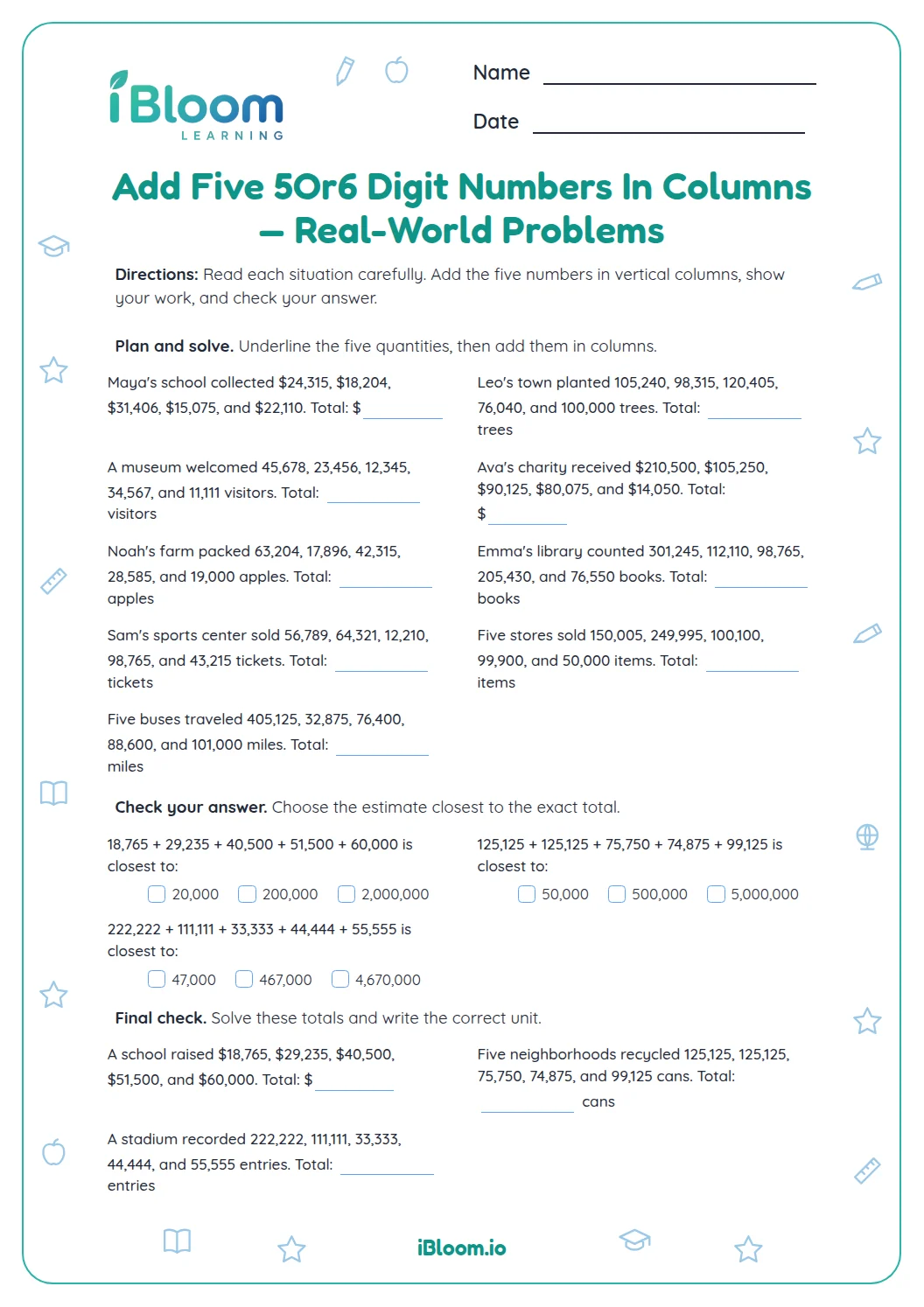
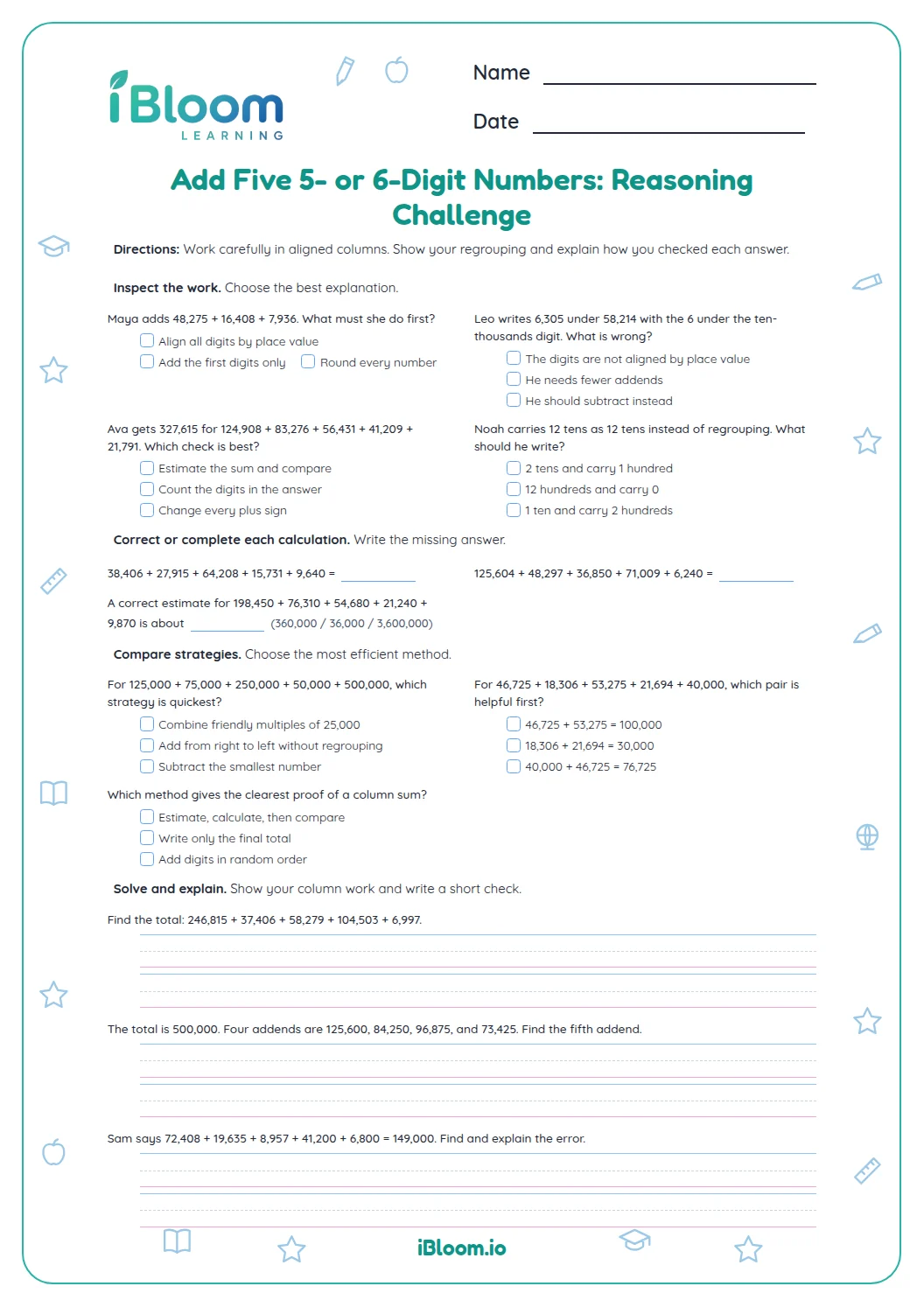
This Grade 5 worksheet gives students 15 column-addition problems with five addends, using five- and six-digit whole numbers. Every prompt prints each plus sign so the full expression is clear before students line up the place values. Three parts move from accessible totals to larger sums and a final mixed set. A separate answer key supports checking each result. The practice connects written addition to place-value reasoning and the relationship between addition and subtraction.
Aligned to 5.NBT.B.7
How should a student line up five addends?
Write one number on each row, lining up the ones digits in one column. Keep tens, hundreds, and every larger place directly above one another. This makes regrouping visible and prevents a digit from drifting into the wrong column.
- 1124,305 + 236,417 + 105,208 + 312,146 + 14,300
- 2Add ones first, then tens and continue from right to left.
- 3Record each regrouped ten above the next place-value column.
Why add from right to left?
The ones column is the first place where regrouping may happen. Carry its groups of ten into the tens column, then continue across the number. Moving left one place at a time keeps each regrouped amount attached to the correct value.
What does regrouping mean in these problems?
Ten ones have the same value as one ten, and ten tens have the same value as one hundred. When a column total reaches ten or more, write the ones digit in that column and regroup the tens into the next column.
How can students check a large sum?
Estimate each addend to a nearby ten-thousand or hundred-thousand, then add those rounded values. The estimate should be close to the exact total. Students can also subtract one addend from the total and see whether the other four addends remain.
How to use this worksheet
- 1Write every addend in a separate row, with place values aligned.
- 2Start in the ones column and add all five digits in that column.
- 3Write the ones digit of the column total and regroup any tens.
- 4Repeat through the hundred-thousands place.
- 5Estimate the addends and compare the estimate with the exact total.
Common addition mistakes
The mistake
Leaving out one addend while adding a crowded column.
The fix
Mark each digit after adding its column, then move one column left.
The mistake
Writing the whole column total in the answer row.
The fix
Keep only the ones digit in that column and regroup the tens.
The mistake
Misaligning a number with fewer digits.
The fix
Line up the ones digits first; the leftmost digit may begin farther right.
Common Core alignment
This worksheet practices multi-digit addition with place-value strategies.
Use place-value strategies and written methods for operations with multi-digit numbers.
On this sheet: Students add multi-digit whole numbers using the column method and check their totals.
Show the official wordingHide the official wording
Add, subtract, multiply, and divide decimals to hundredths, using concrete models or drawings and strategies based on place value, properties of operations, and/or the relationship between addition and subtraction; relate the strategy to a written method and explain the reasoning used.
What to practice next
Make more practice
Further reading
Questions parents and teachers ask
Do all five addends need their own row?
Yes. Put one addend on each row and align the ones digits vertically. Then the tens and larger place values line up automatically, so each column contains digits with the same value. Students can pause after each column to check that the regrouped value moved one place left
How many questions are on this page?
There are 15 five-addend sums in three parts. The first five build fluency, the next five include larger regrouping totals, and the last five provide a final mixed set. Before comparing with the key, ask the student to estimate the total
What does the answer key include?
The separate answer key gives the sum for every question. Students can compare totals after finishing a part and revisit the columns where their result differs. A useful routine is to point to every addend while copying it into a separate row
What is a quick way to estimate?
Round each addend to a nearby ten-thousand or hundred-thousand, depending on its size, and add the rounded values. The estimate gives a useful check on the size of the exact total. Students can explain each regrouping aloud: ten ones make one ten, and ten tens make one hundred. Naming the exchange links the written mark to the value it represents.
Which Common Core skill does the sheet practice?
The work connects to 5.NBT.B.7, which asks students to use place-value strategies and written methods for operations with decimals. This worksheet uses whole-number addition and focuses on organizing and regrouping multi-digit values. Use the answer key after completing a section, then return to the written columns for any incorrect total