
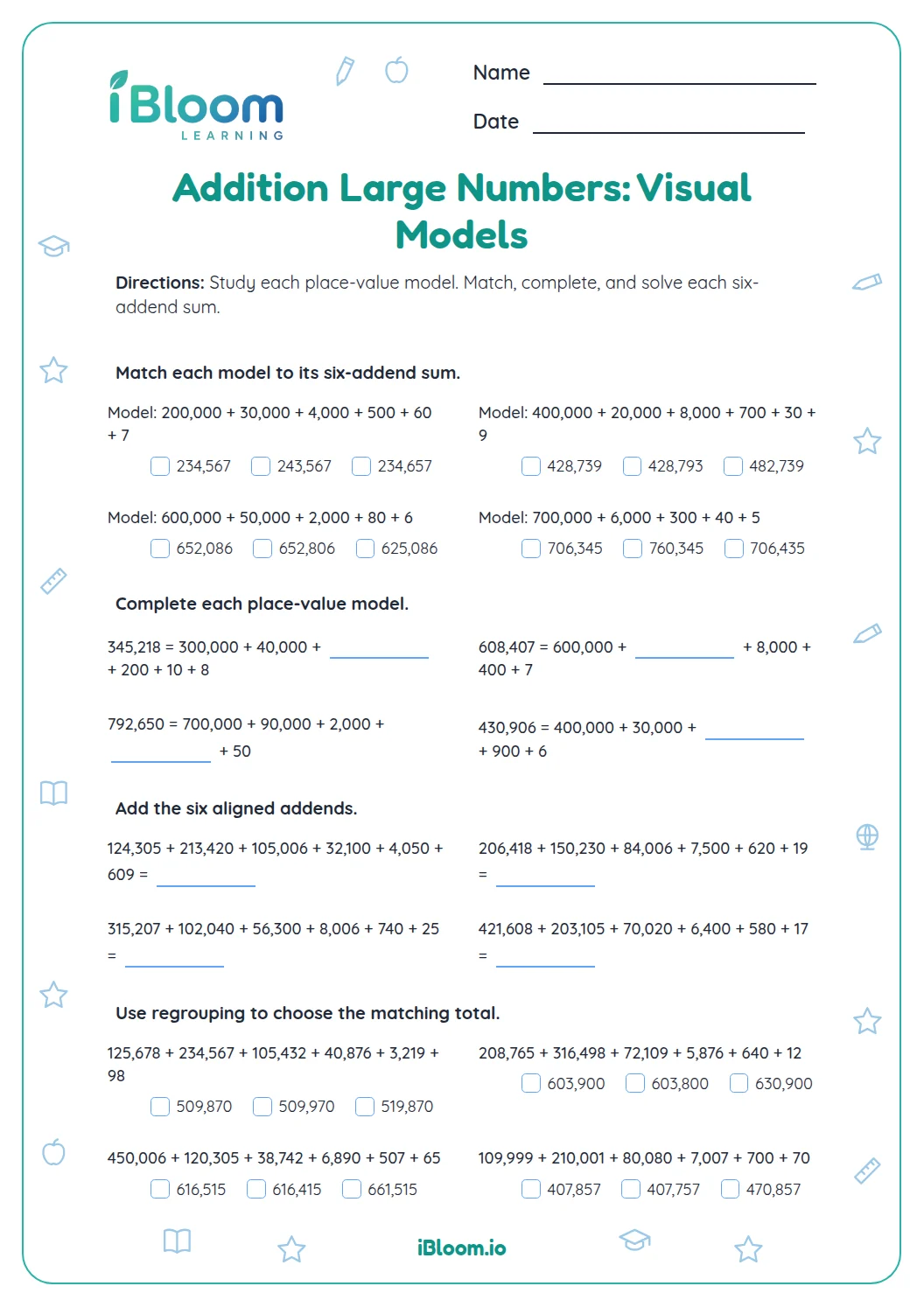
About this worksheet
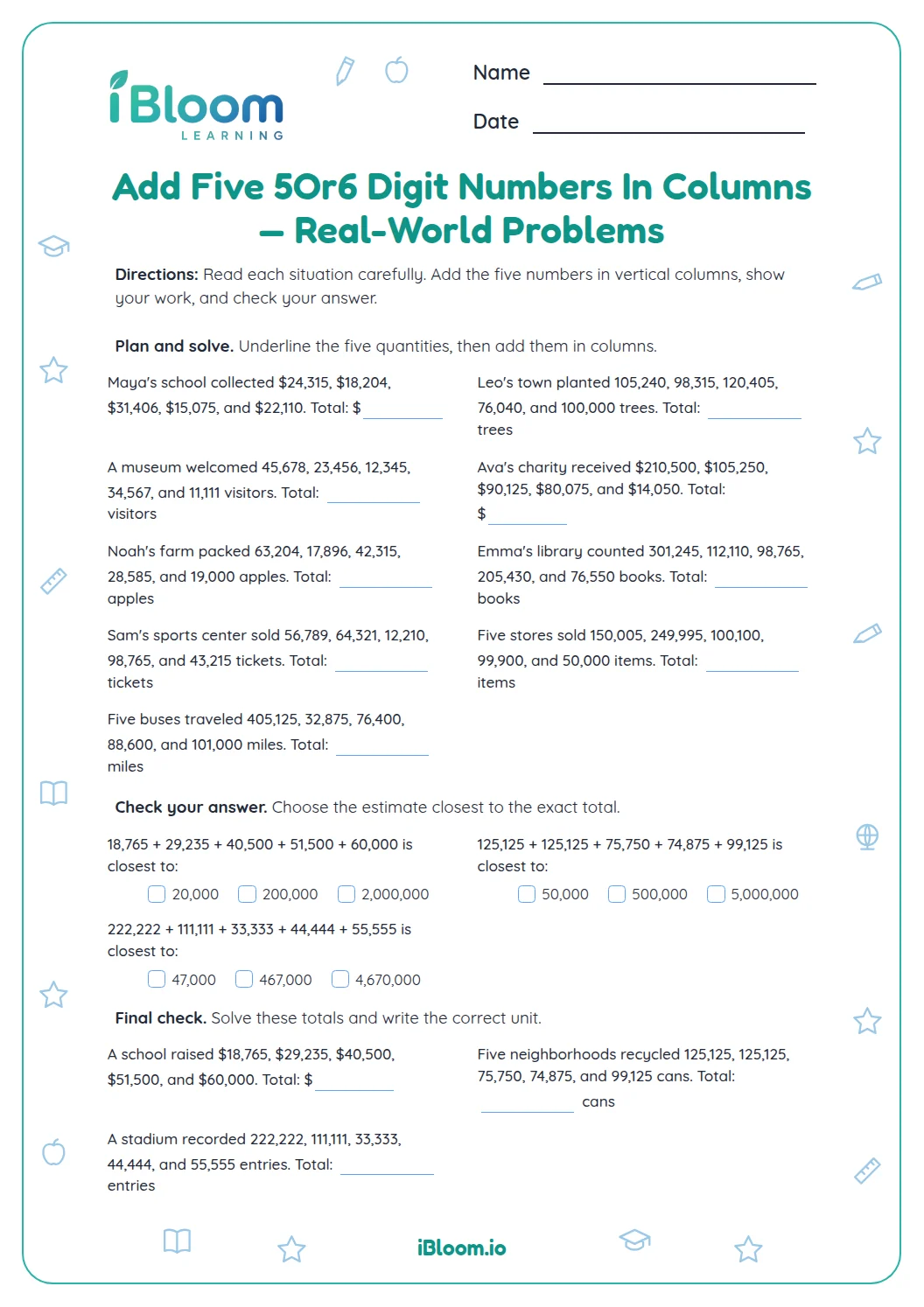
This free Grade 5 worksheet gives students focused practice with adding five multi-digit numbers. They work through short place-value reminders followed by five-addend sums that grow in size. The sheet builds accuracy with clear steps, followed by a separate answer key for checking each response. It practices Common Core 4.NBT.B.4 through grade-level work with whole numbers and place value.
Aligned to 4.NBT.B.4
How do students work through adding five multi-digit numbers?
For 24,315 + 13,204 + 10,006 + 2,450 + 1,025, align the ones, tens, hundreds, thousands, and ten-thousands. Adding the columns gives 51,000.
The opening questions recall how to align addends and regroup. The remaining questions provide workspace for five-addend sums, first with prompts and then independently.
What is included on the worksheet?
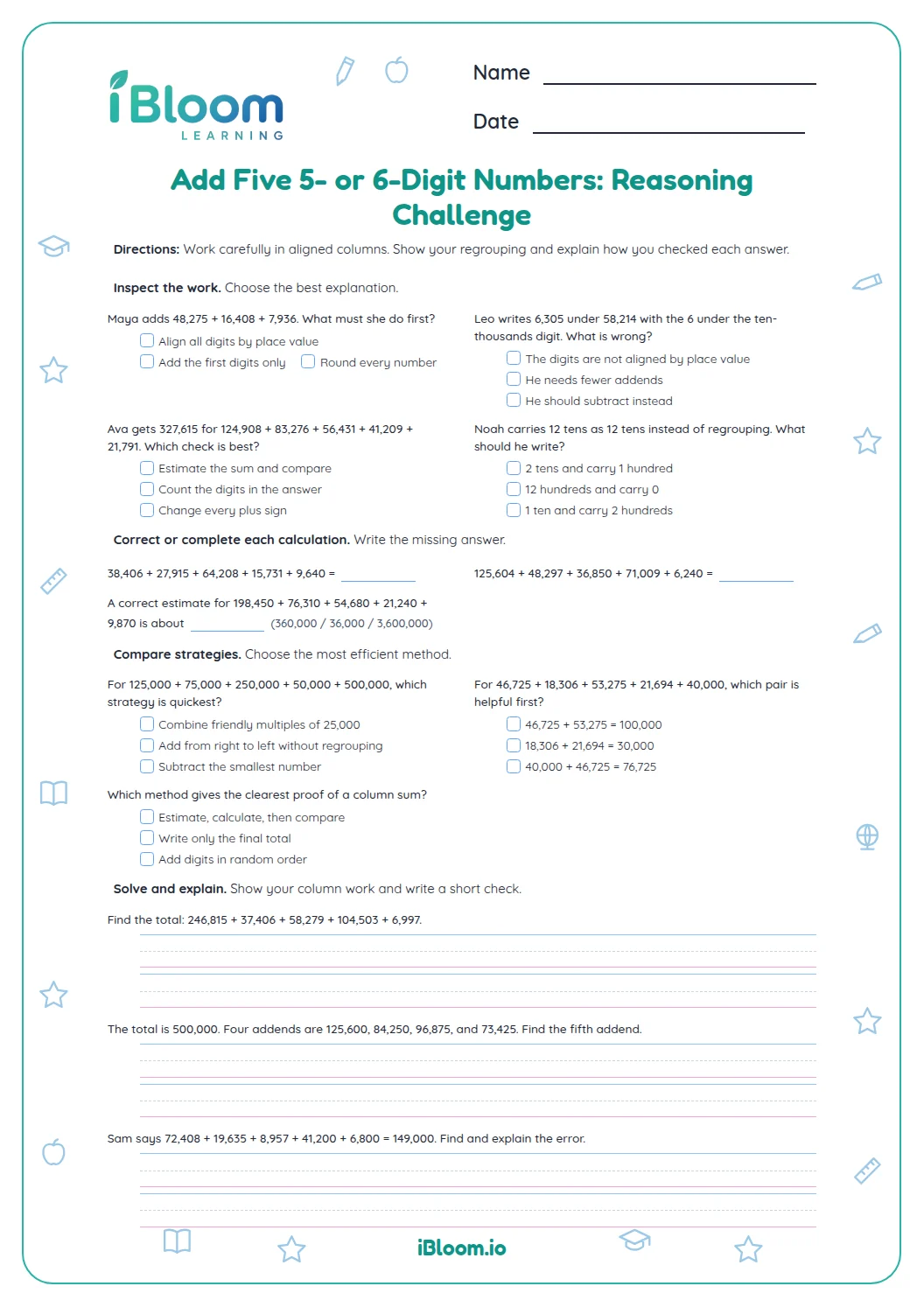
The 15 questions are arranged in four parts across two worksheet pages, followed by a two-page answer key. Part A reviews the setup, Parts B and C build fluency, and Part D asks students to estimate before adding exactly.
- Part A: recall addends and regrouping
- Part B: add five numbers with initial guidance
- Part C: practice with support
- Part D: estimate, then check exact totals
How can an adult support practice?
Ask the student to name the place value being worked on before calculating. A quick estimate or inverse operation can help catch a misaligned digit or missed regrouping.
How to use this worksheet
- 1Read the addends and line up digits by place value in your workspace.
- 2Add the ones column, then move left through each place.
- 3Regroup each time a column total reaches ten or more.
- 4Estimate the total to see whether the exact sum is reasonable.
- 5Compare the exact total with the key and recheck any column that differs.
Common mistakes and quick fixes
The mistake
Starting a number in the wrong column.
The fix
Align the ones digits first, then check each place before adding.
The mistake
Forgetting to include a carried value in the next column.
The fix
Add the carried value to that column before writing its digit.
The mistake
Stopping at the largest addend instead of adding all five.
The fix
Mark each addend as it is included, then total every column.
Common Core alignment
Students align whole-number addends, regroup, and find exact sums.
Add multi-digit whole numbers using place value and the standard algorithm.
On this sheet: Students align whole-number addends, regroup, and find exact sums.
Show the official wordingHide the official wording
Fluently add and subtract multi-digit whole numbers using the standard algorithm.
What to practice next
Make more practice
Further reading
Questions parents and teachers ask
What skill does this worksheet practice?
This worksheet practices adding five multi-digit numbers with whole numbers. Its 15 questions move from the core setup into independent practice, and a separate answer key gives a response for every item. Students should write the intermediate steps so place value and regrouping remain clear.
How many questions are included?
There are 15 questions arranged in four parts. Students review addends and regrouping, work through guided five-number sums, then estimate and check exact totals. The worksheet takes two pages, and the matching answer key takes two pages for checking each response.
How should students show their work?
Students can show work by writing each rounded value or regrouped place value before computing. Keeping those intermediate values visible makes it easier to catch an error and explain why the final result is reasonable. For column work, line up every digit by its place.
When should students use the answer key?
Use the answer key after completing a section or the full worksheet. If a result differs, compare the setup first, then redo the column or rounding step where the work changed. The key includes exact values so students can check both computation and reasoning.
Can this worksheet be used for independent practice?
Yes. The directions apply to the whole sheet, and the parts progress from a reminder to independent computation. An adult can review one example before students continue alone, then use the key to discuss any answer that does not match.