

About this worksheet
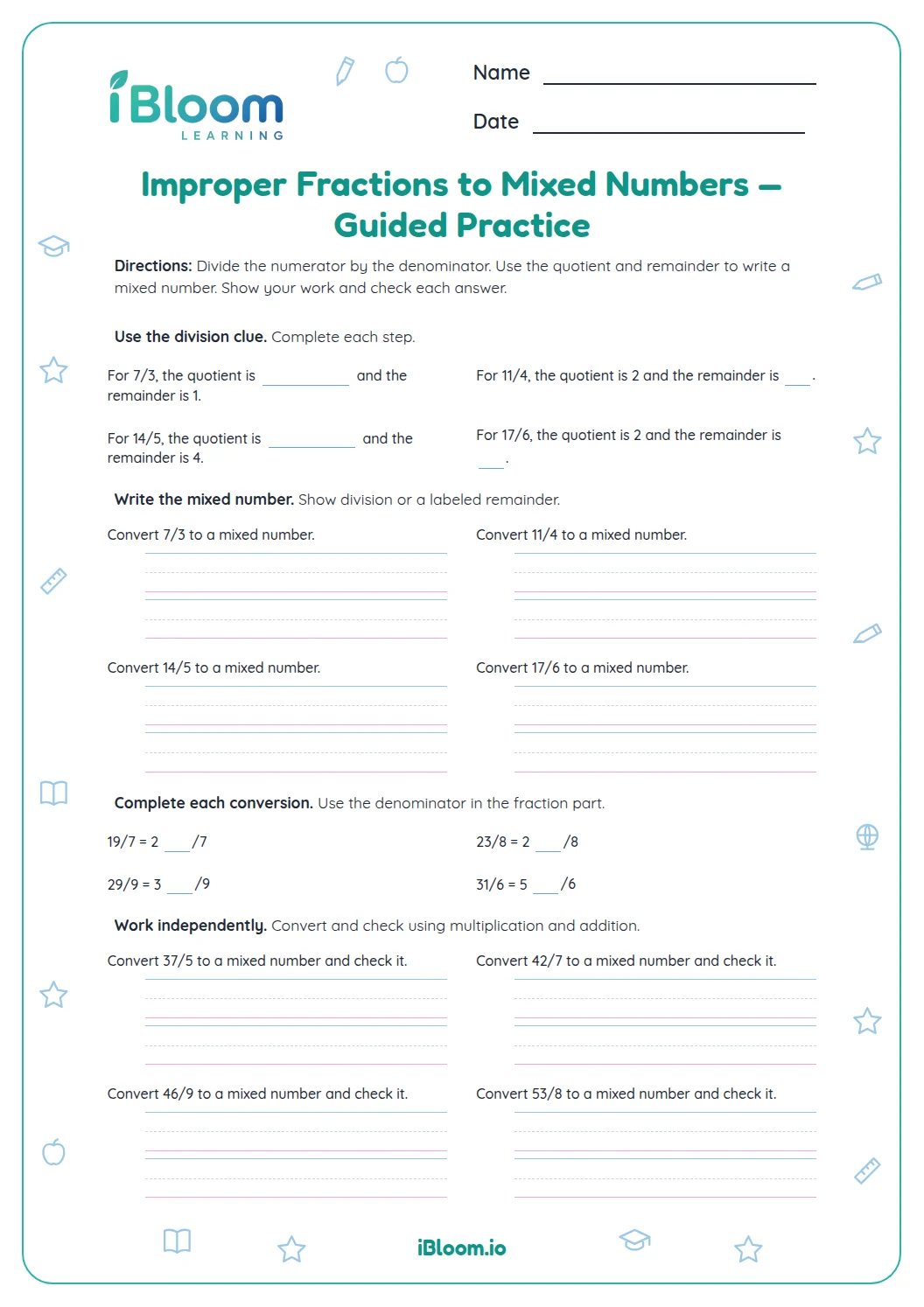
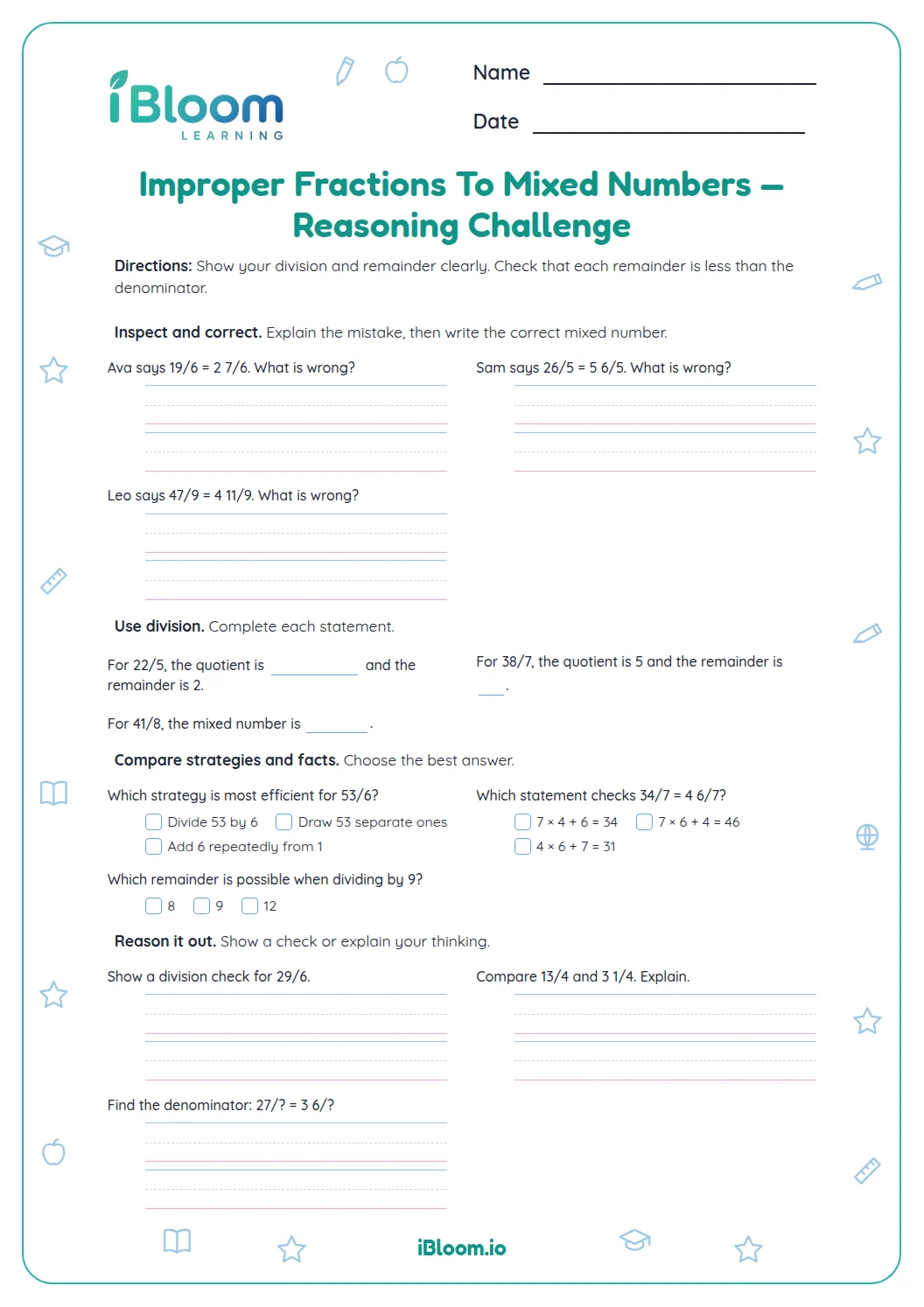
Fourteen items connect division remainders with the fractional part of a mixed number. The printable provides work space and an answer key for checking each result.
How can you work through the sheet?
For 7/3, 7 ÷ 3 gives 2 remainder 1. The quotient is the whole number and the remainder stays over the original divisor: 2 1/3.
What should learners check?
Use the place-value columns and directions printed on the worksheet. Work one item at a time, then use the key to locate and correct any calculation error. Use the answer key after completing the student pages to check each response.
How to use this worksheet
- 1Divide the numerator by the denominator.
- 2Use the quotient as the whole-number part.
- 3Write the remainder over the original denominator.
- 4Keep the denominator unchanged and simplify only if the remainder fraction can reduce.
- 5Check by multiplying the whole number by the denominator and adding the numerator of the fractional part.
Common mistakes and quick fixes
The mistake
Writing only the quotient: include the leftover fraction.
The fix
include the leftover fraction.
The mistake
Using the numerator as the new denominator: the denominator stays the same.
The fix
the denominator stays the same.
The mistake
Changing the denominator to the remainder: place the remainder in the numerator.
The fix
place the remainder in the numerator.
What to practice next
Make more practice
Questions parents and teachers ask
How many problems are included?
The worksheet contains 14 items in two parts. Early questions connect division with the whole-number and remainder parts; later questions ask for mixed-number conversions. Encourage the learner to write each step clearly and review the relevant columns or fraction parts when checking.
How does division help convert an improper fraction?
Divide the numerator by the denominator. The quotient gives the whole number, and the remainder becomes the numerator of a fraction over the original denominator. Encourage the learner to write each step clearly and review the relevant columns or fraction parts when checking.
What should I do if the division has no remainder?
A zero remainder means the fraction equals a whole number. Write that whole number without a fractional part. Encourage the learner to write each step clearly and review the relevant columns or fraction parts when checking. Have learners compare every written step with the place-value or fraction relationship shown by the problem, then correct the work before moving on.
Does the denominator change during conversion?
No. Keep the original denominator for the fractional part. The remainder becomes its numerator. Encourage the learner to write each step clearly and review the relevant columns or fraction parts when checking. Have learners compare every written step with the place-value or fraction relationship shown by the problem, then correct the work before moving on.
What is one way to check a mixed number?
Multiply the whole-number part by the denominator and add the fractional numerator. The result should equal the original numerator. Encourage the learner to write each step clearly and review the relevant columns or fraction parts when checking. Have learners compare every written step with the place-value or fraction relationship shown by the problem, then correct the work before moving on.