





About this worksheet
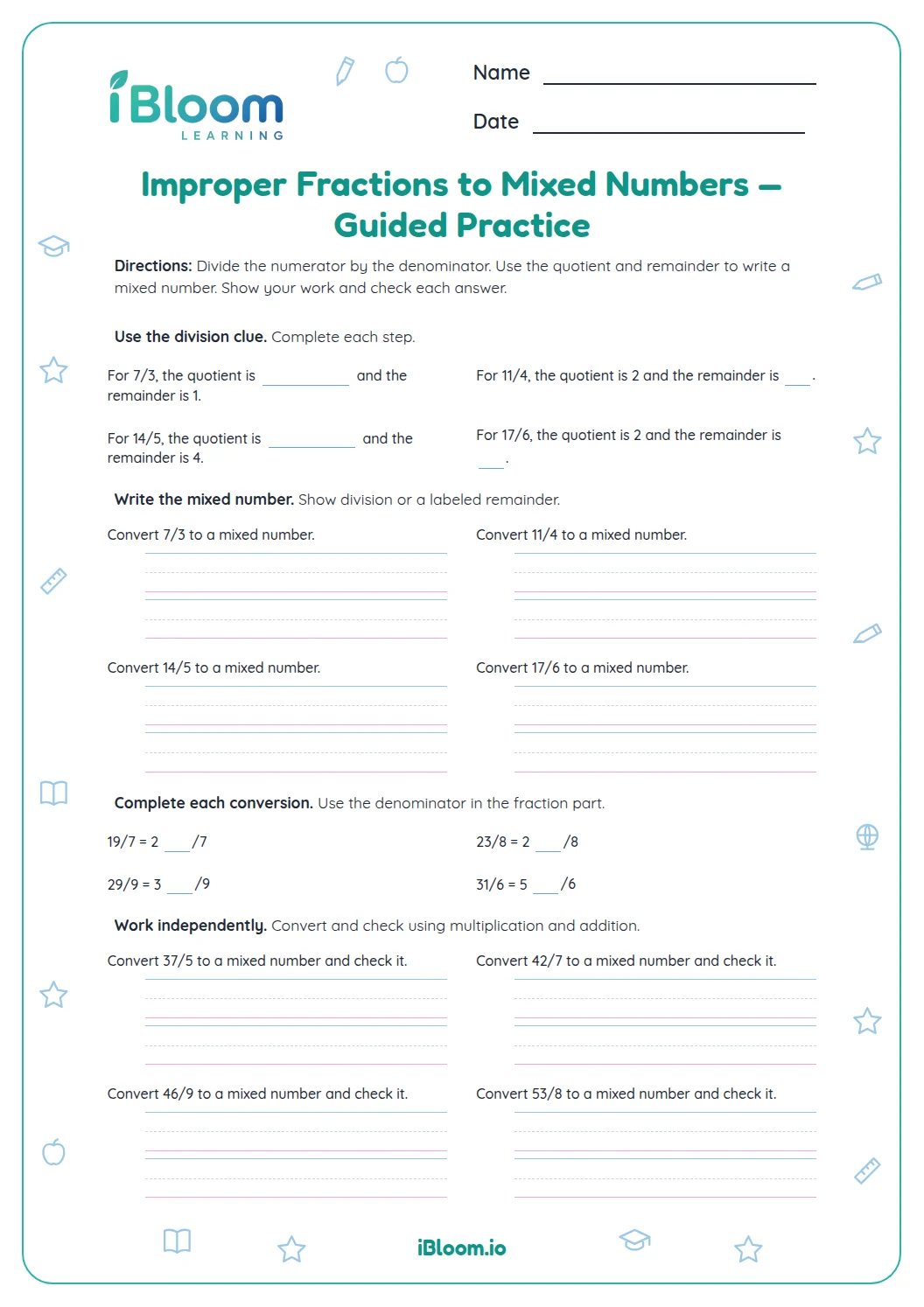
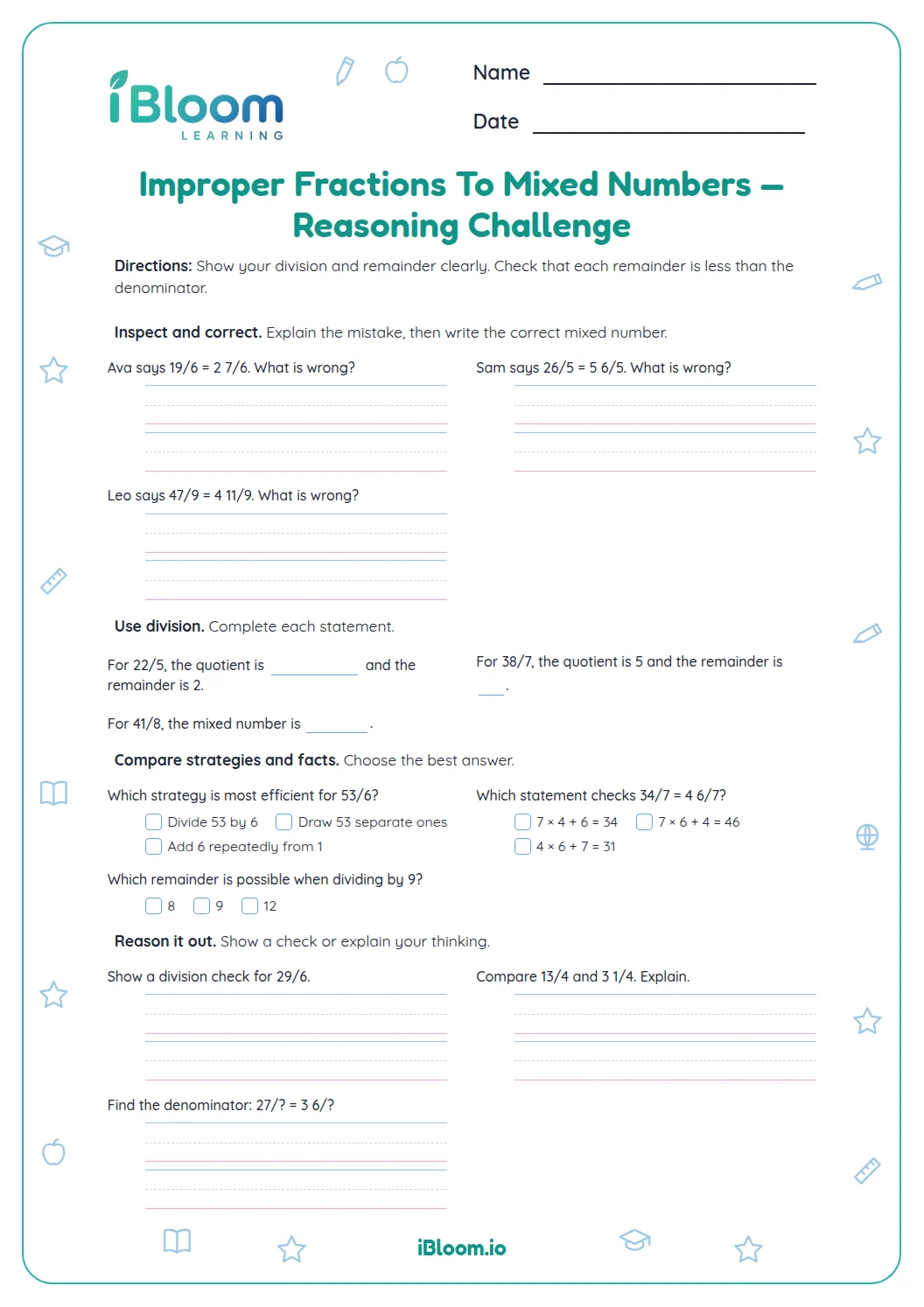
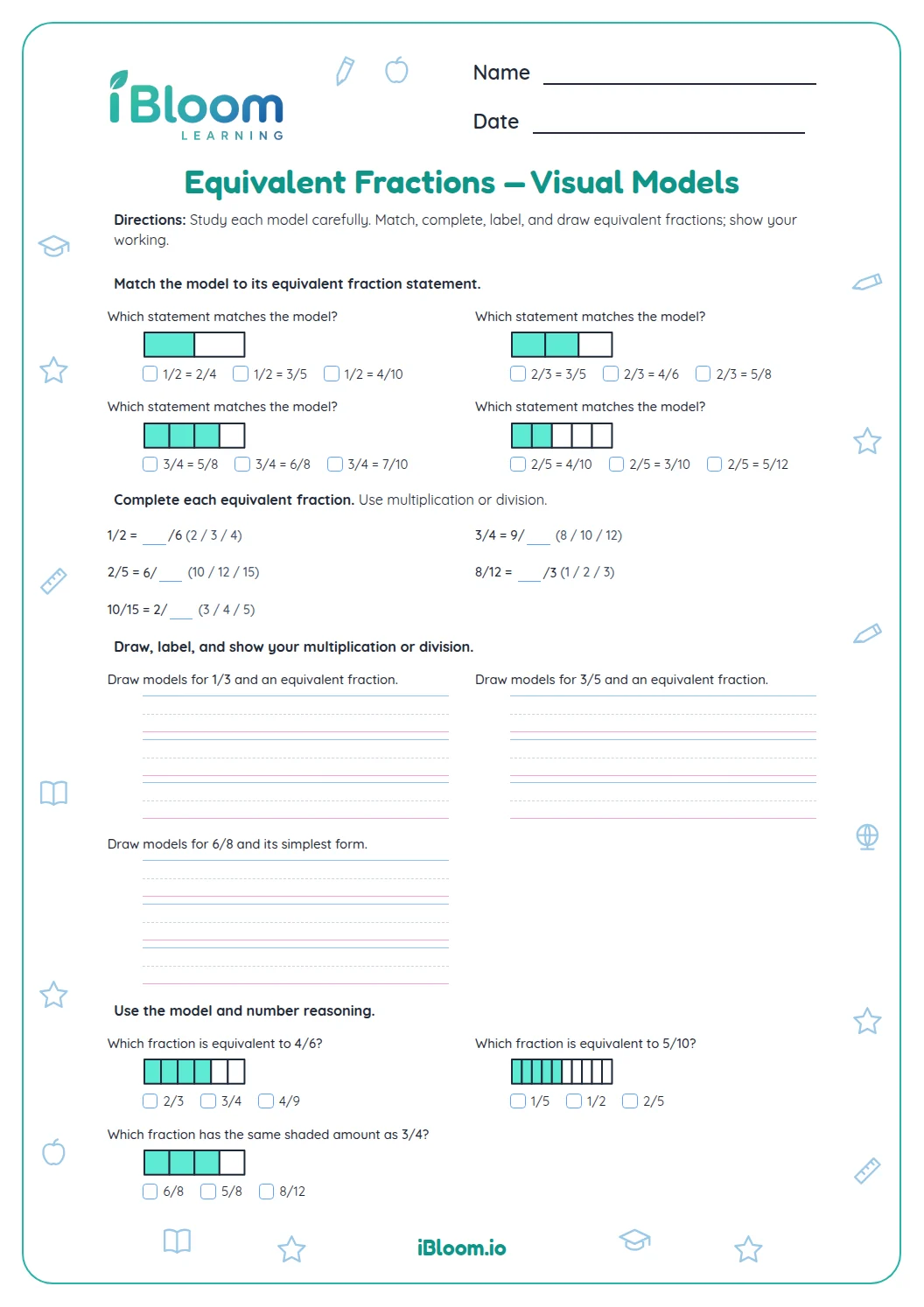
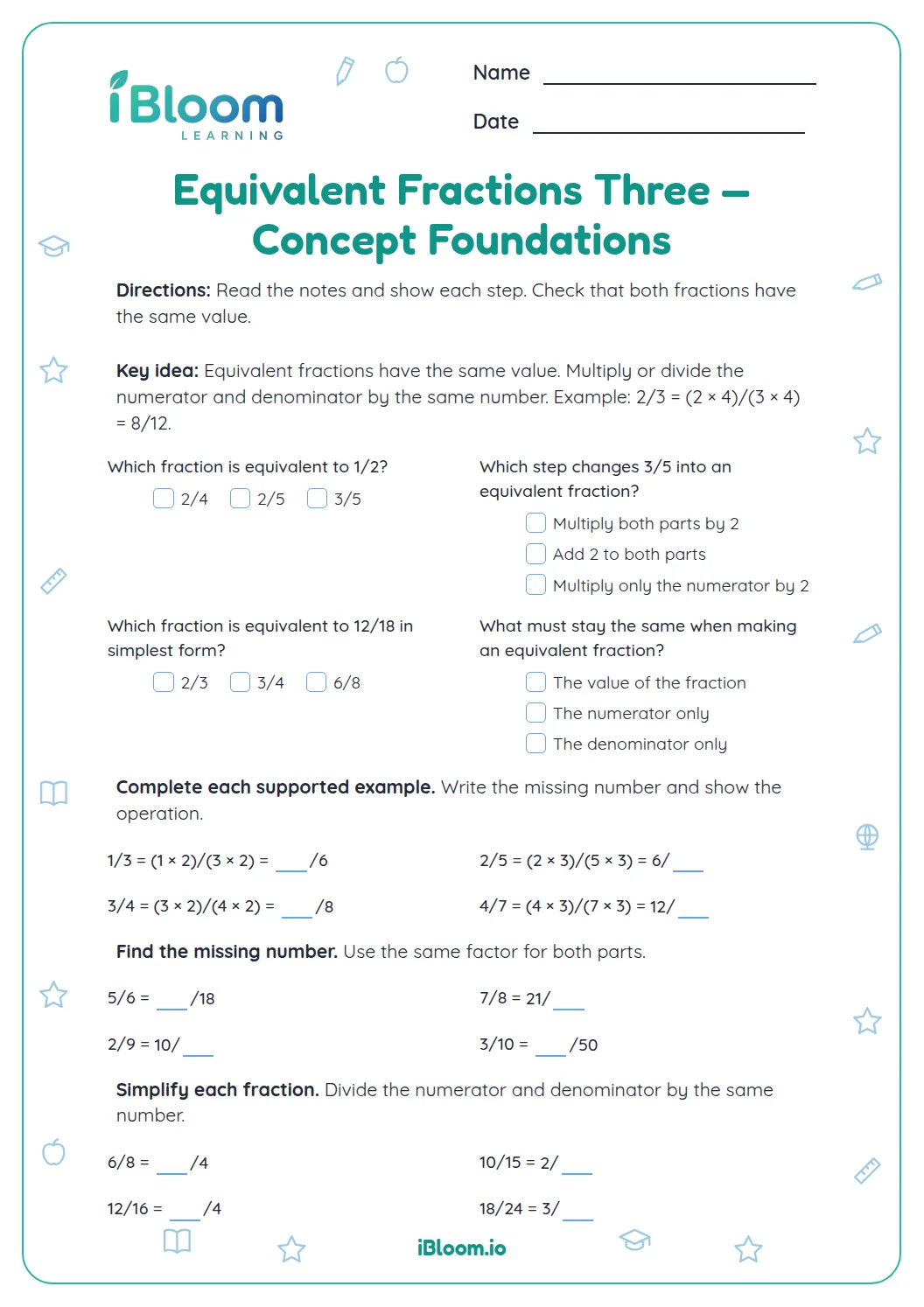
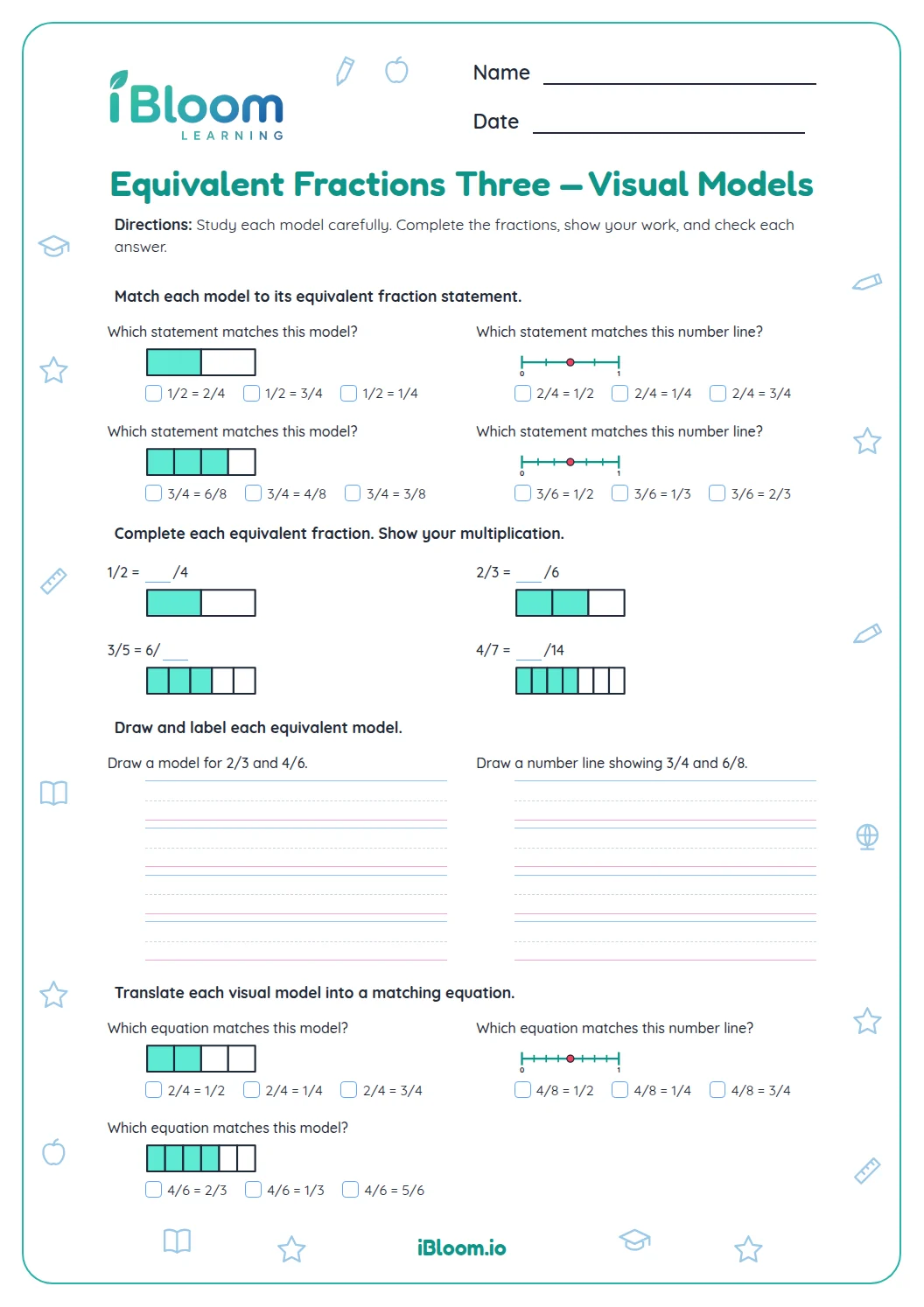
This Grade 5 worksheet connects improper fractions to mixed numbers in three ways: students read shaded fraction models, divide the numerator by the denominator, and check equivalence by converting back. Six drawn models show real shaded values; the remaining questions use specific fractions and answer choices. A separate key gives the matching mixed number or improper fraction for all 14 items.
Aligned to 5.NF.B.3
How do models show an improper fraction?
Each full shape represents one whole. Count its equal parts, then count the additional shaded parts.
- 1The model has 1 whole and 4 of 5 parts shaded.
- 2Answer: 1 4/5
How does division make a mixed number?
Divide the numerator by the denominator. The quotient gives the whole number, and the remainder becomes the numerator over the same denominator.
How can you check a conversion?
Multiply the whole number by the denominator and add the numerator. The result should be the original numerator, with the denominator unchanged.
Convert an improper fraction
- 1Divide the numerator by the denominator.
- 2Write the quotient as the whole number.
- 3Write the remainder over the original denominator.
- 4Read a model by counting full shapes and remaining shaded parts.
- 5Check by multiplying and adding to recover the numerator.
Fraction conversion mistakes
The mistake
Changing the denominator when writing the remainder.
The fix
Keep the original denominator because the part size stays the same.
The mistake
Using the remainder as the whole number.
The fix
The quotient is the number of wholes; the remainder is the extra part.
The mistake
Forgetting fully shaded wholes in a model.
The fix
Count every complete shape before the leftover shaded parts.
Common Core alignment
This worksheet practices 5.NF.B.3 through its calculation and reasoning tasks.
Interpret an improper fraction as division and represent its value with a visual fraction model.
On this sheet: Interpret an improper fraction as division and represent its value with a visual fraction model.
Show the official wordingHide the official wording
Interpret a fraction as division of the numerator by the denominator (a/b = a ÷ b). Solve word problems involving division of whole numbers leading to answers in the form of fractions or mixed numbers, e.g., by using visual fraction models or equations to represent the problem.
What to practice next
Make more practice
Further reading
Questions parents and teachers ask
How do you turn an improper fraction into a mixed number?
Divide the numerator by the denominator. The quotient is the whole-number part, and the remainder is written over the original denominator. For 9/5, the quotient is 1 and the remainder is 4, so the mixed number is 1 4/5. This is the division method used in Part B.
What should students count in a fraction model?
Count every fully shaded shape as one whole, then count the shaded parts of the next shape. The parts in each shape are equal, so the number of parts in one whole gives the denominator. This lets students read both the whole and fractional part. This lets students read both the whole and fractional part.
Does the denominator change during conversion?
No. The denominator names the size of the fractional parts, and those parts stay the same during conversion. The numerator changes into a whole-number quotient and a leftover remainder over that same denominator. Keep the part size unchanged.
How can students check a mixed number?
Multiply the whole-number part by the denominator, then add the fractional numerator. For 1 4/5, calculate 1 × 5 + 4 = 9, which returns the numerator in 9/5. The denominator remains 5. This check works for every item.
What does the answer key include?
The separate two-page key gives an answer for each model, division conversion, and equivalence question. For model items, students can compare both the whole number and the leftover fraction with the shaded shapes. The key also supports checking each step.