




About this worksheet
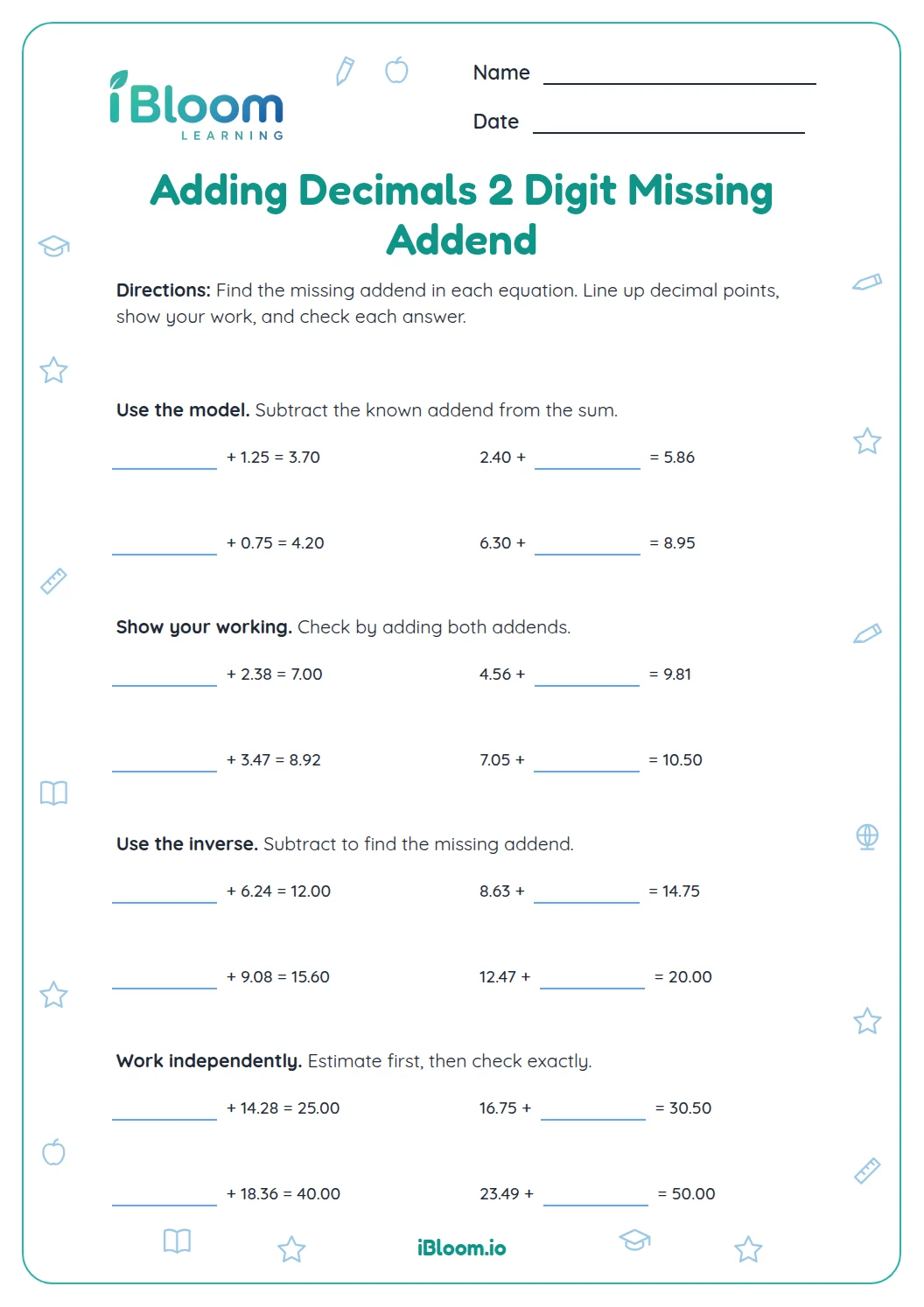
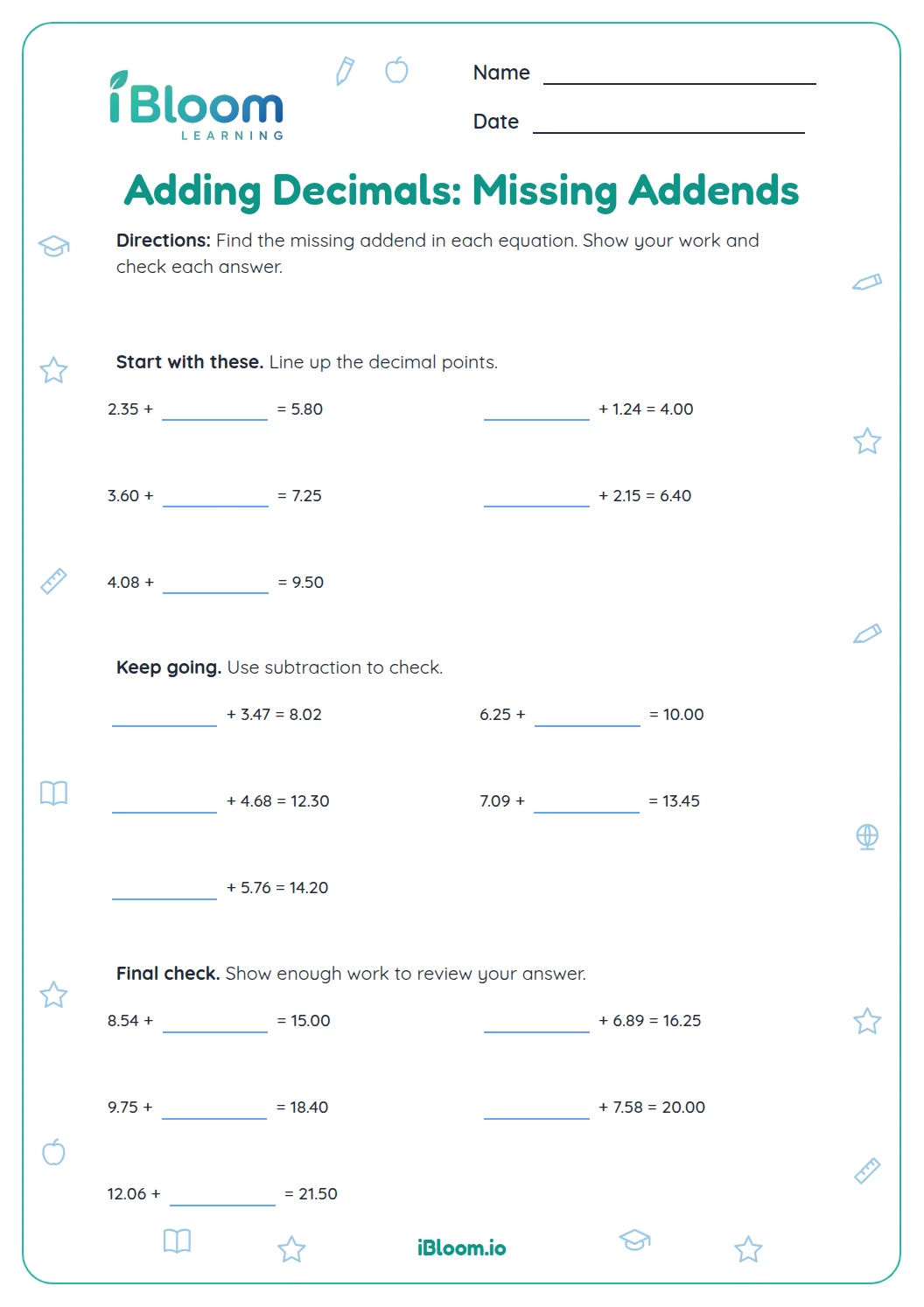
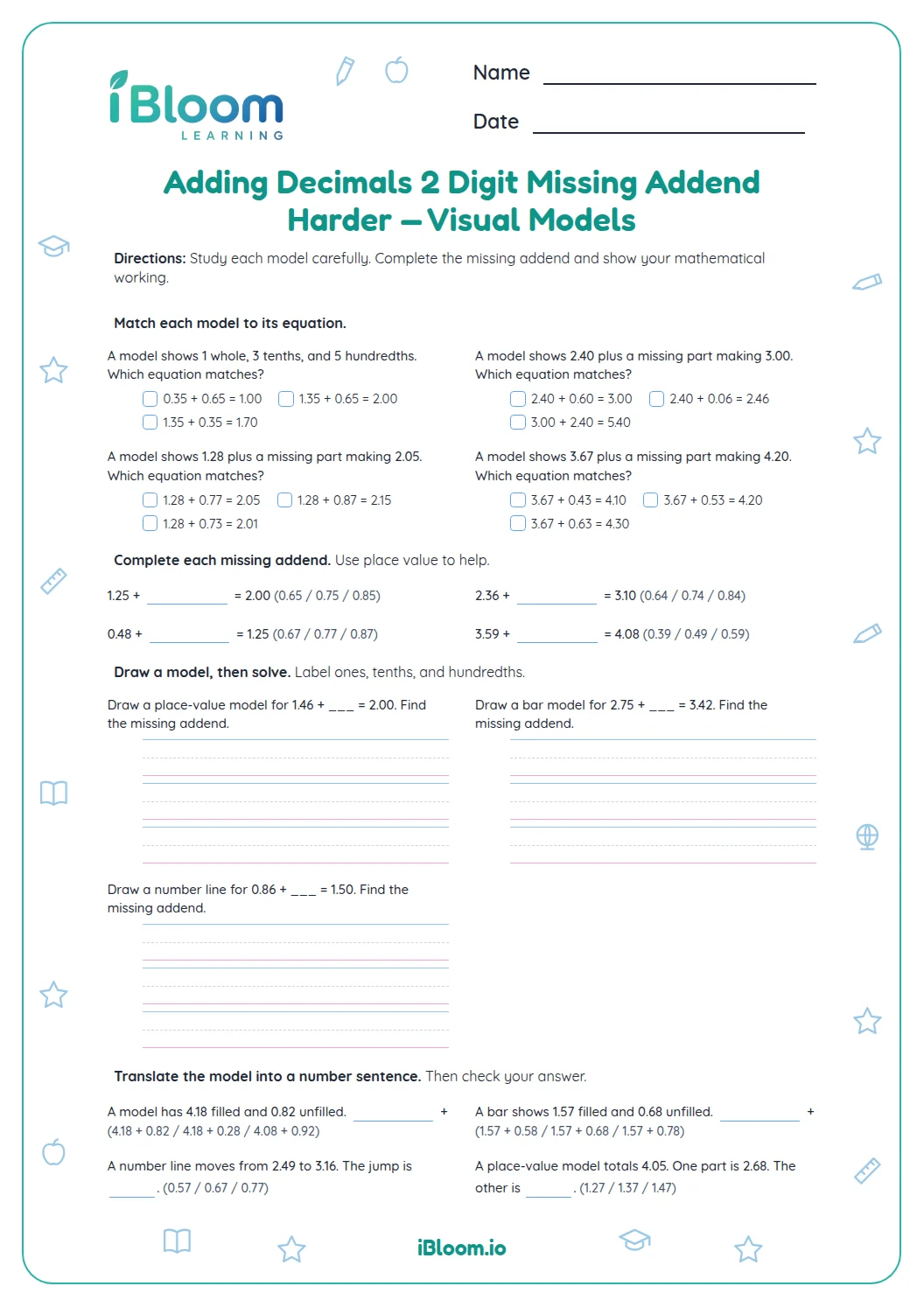
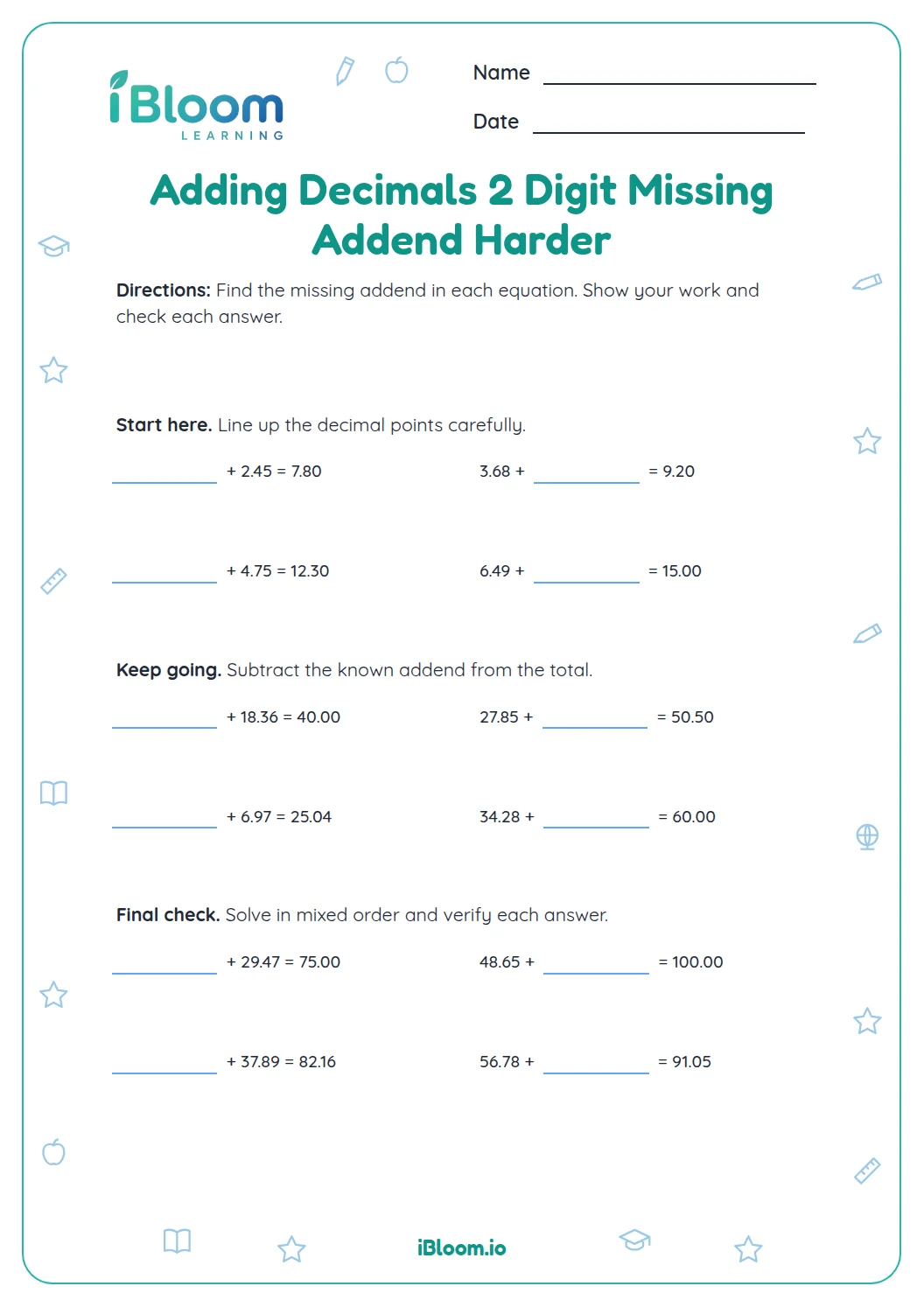
This Grade 5 worksheet has 16 real-world problems with decimal amounts to the hundredths place. Each story gives a total and one known part; students write or use the displayed missing-addend equation, subtract to find the unknown, then check by addition. Contexts include lengths, prices, liquid amounts, and distances. Answers show only the missing number because each prompt already supplies any unit. The work practices CCSS 5.NBT.B.7.
Aligned to 5.NBT.B.7
How does subtraction find the missing addend?
For q3, the total is $4.85 and one item costs $2.39. Subtract 4.85 − 2.39 to get 2.46; then 2.39 + 2.46 = 4.85.
How should decimal places line up?
Place decimal points in one column before subtracting. Add a zero to a shorter decimal when useful, such as 2.5 written as 2.50.
How can you check the unknown?
Add the known amount and the missing amount. The sum should equal the total in the story.
How to use this worksheet
- 1Identify the total and the known amount in the story.
- 2Write the known addend and a blank for the missing addend.
- 3Subtract the known amount from the total.
- 4Add your answer back to the known amount to check.
Common mistakes and quick fixes
The mistake
Subtracting the total from the known amount.
The fix
The total is larger; calculate total minus the known part.
The mistake
Ignoring the hundredths place.
The fix
Line up decimal points and include a zero when a place is empty.
The mistake
Giving the full total instead of the missing part.
The fix
Check by adding the known amount and your answer together.
Common Core alignment
The questions practice this standard through the specific calculations and models on the sheet.
Use addition and subtraction to solve decimal word problems to hundredths.
On this sheet: Each story requires finding a missing decimal addend or part using addition and subtraction.
Show the official wordingHide the official wording
Add, subtract, multiply, and divide decimals to hundredths, using concrete models or drawings and strategies based on place value, properties of operations, and/or the relationship between addition and subtraction; relate the strategy to a written method and explain the reasoning used.
What to practice next
Make more practice
Further reading
Questions parents and teachers ask
How do you find a missing decimal addend?
Subtract the known addend from the total. In q3, calculate $4.85 − $2.39 to find $2.46. Add that result to $2.39 to check that the sum returns to $4.85. The answer key records only the missing number, since the prompt names the amount and its unit.
Why does subtraction help find an addend?
Addition and subtraction undo one another. If the total and one addend are known, subtract the known amount to find what is missing. For q6, subtract 4.85 gallons from 7.50 gallons to find 2.65 gallons needed to fill the tank.
How should decimal points be lined up?
Write each decimal point directly beneath the other. If one amount has fewer digits, add a zero to keep place values aligned; for example, 2.5 can be written as 2.50. Then subtract tenths from tenths and hundredths from hundredths. This keeps each place value in its proper column.
What is a good way to check an answer?
Add the missing amount to the known addend. The sum should equal the total in the story. If it does not, check the subtraction and line up the decimal points again. The separate answer key can help identify an arithmetic slip.
Are the answers money amounts only?
No. The prompts include prices and measurements such as meters, miles, cups, and liters. Use the story to identify the unit, and write the missing numeric amount in the blank. The key lists only that number because the unit is already stated in the prompt.