



About this worksheet
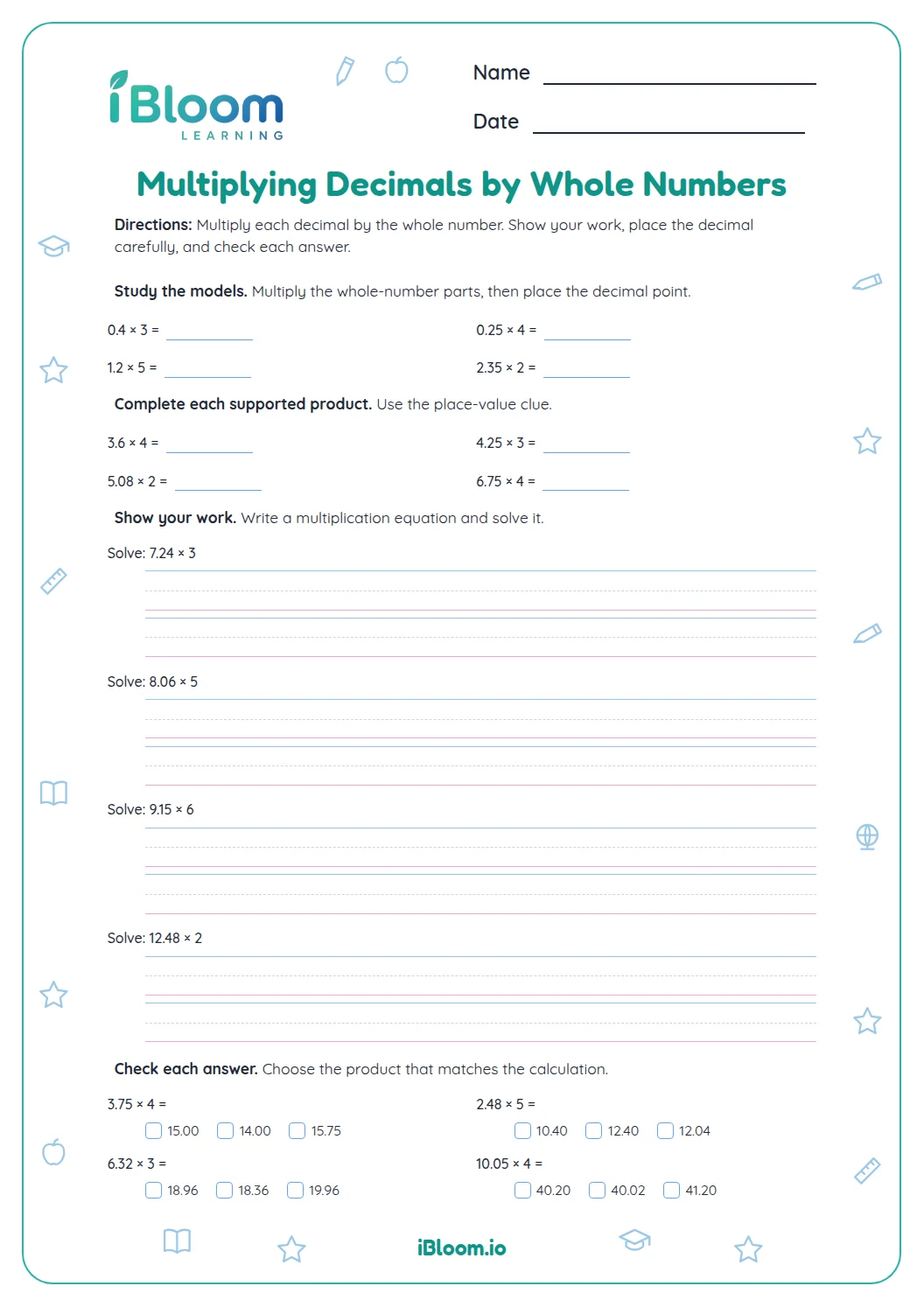
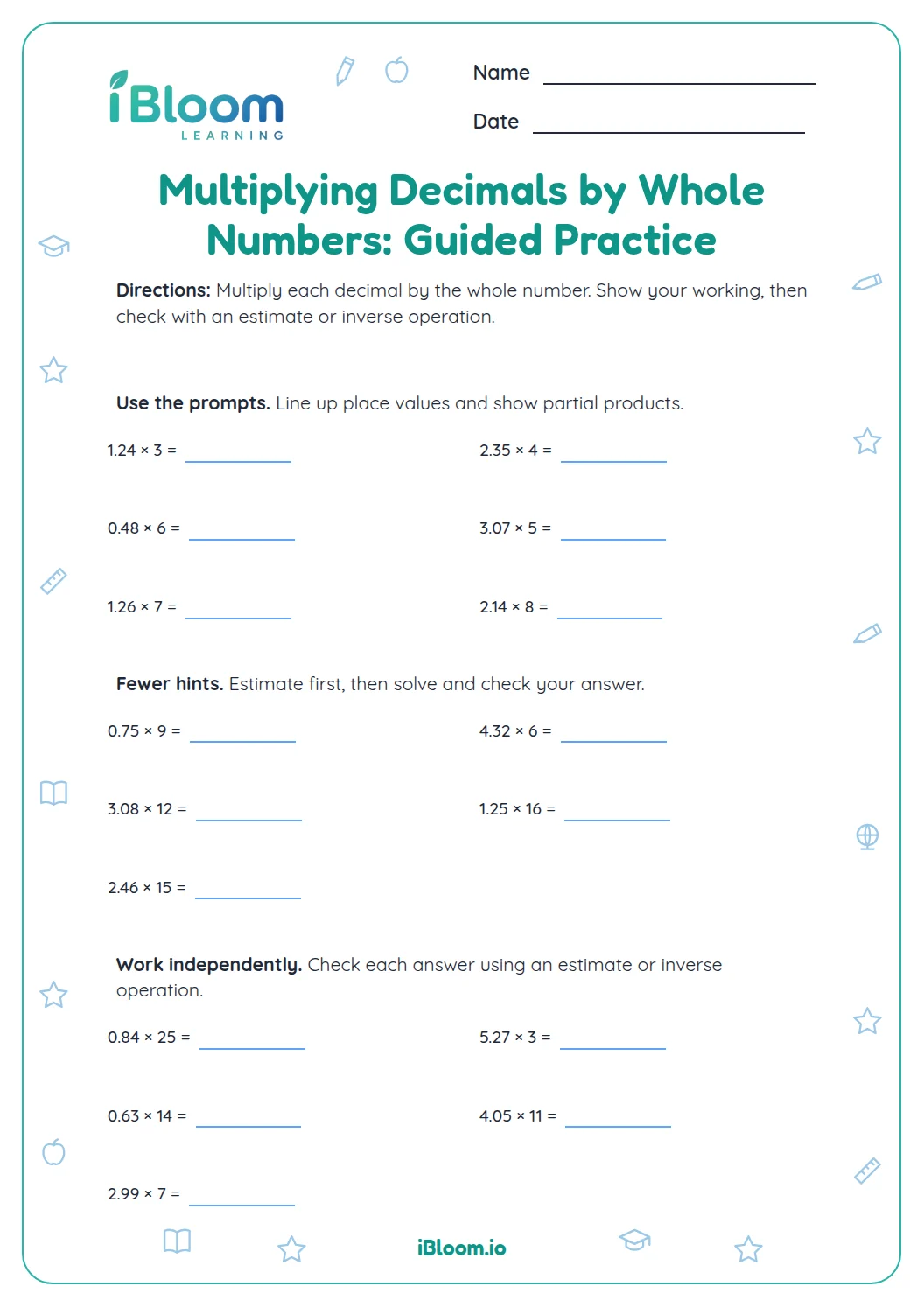
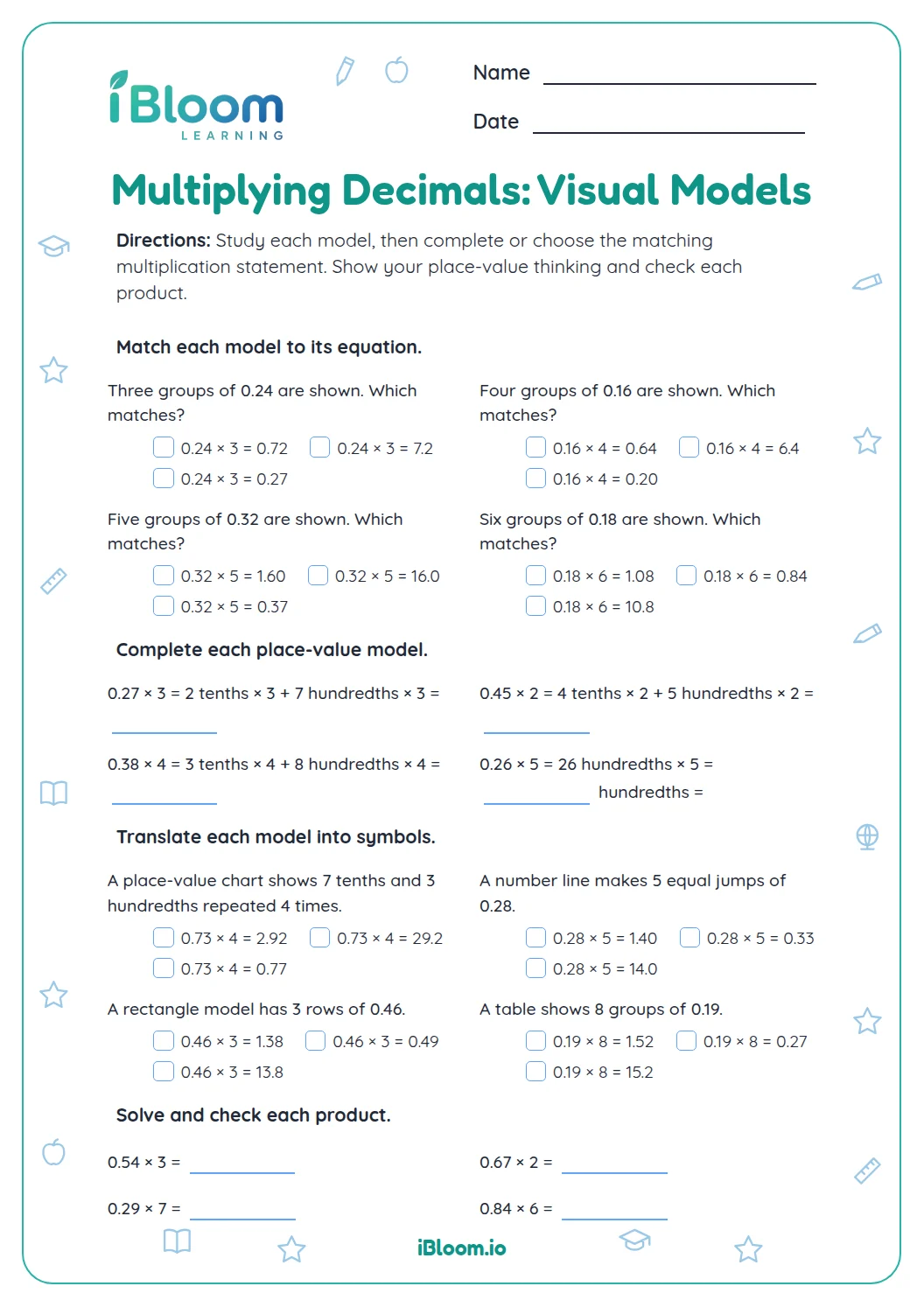
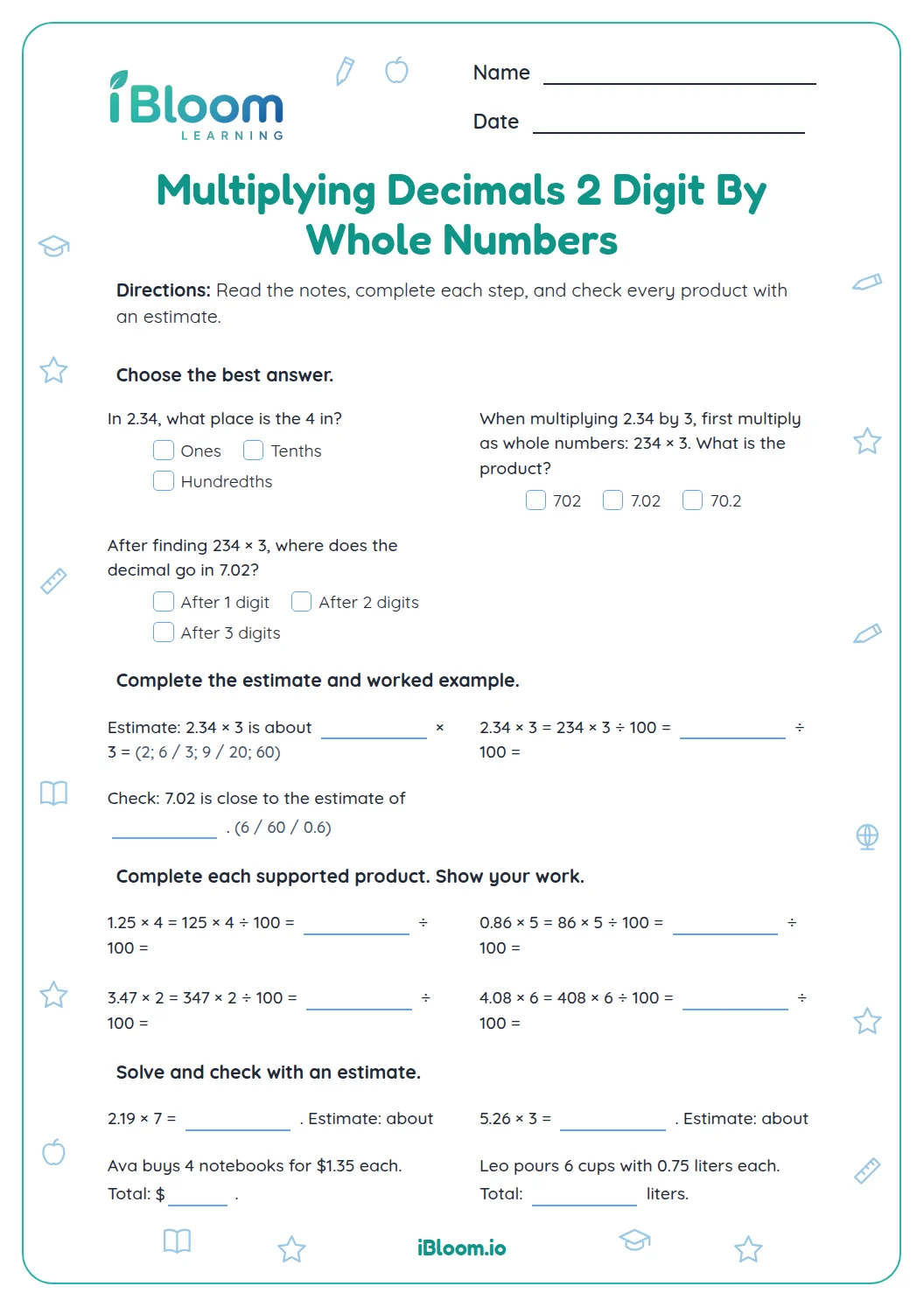
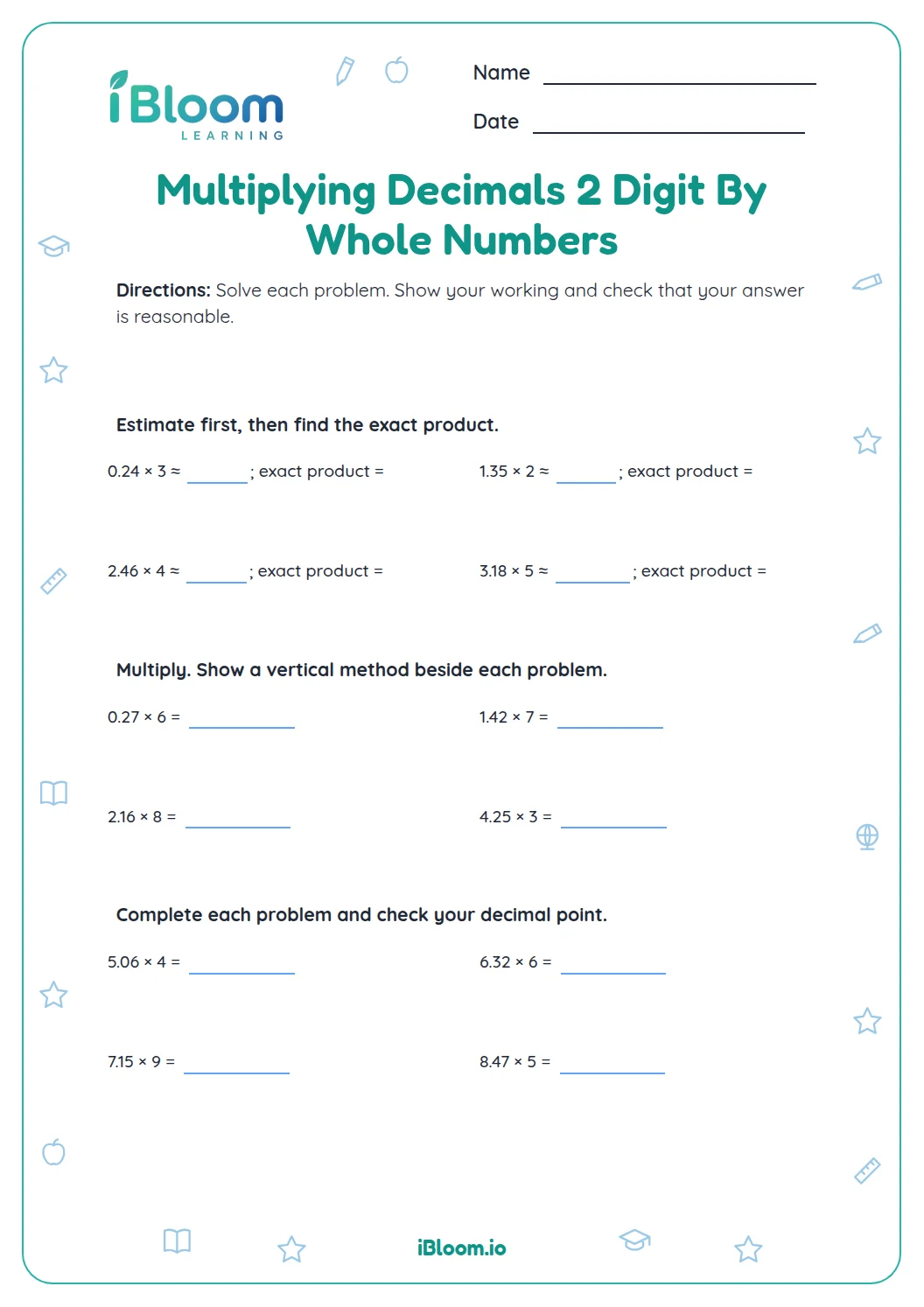
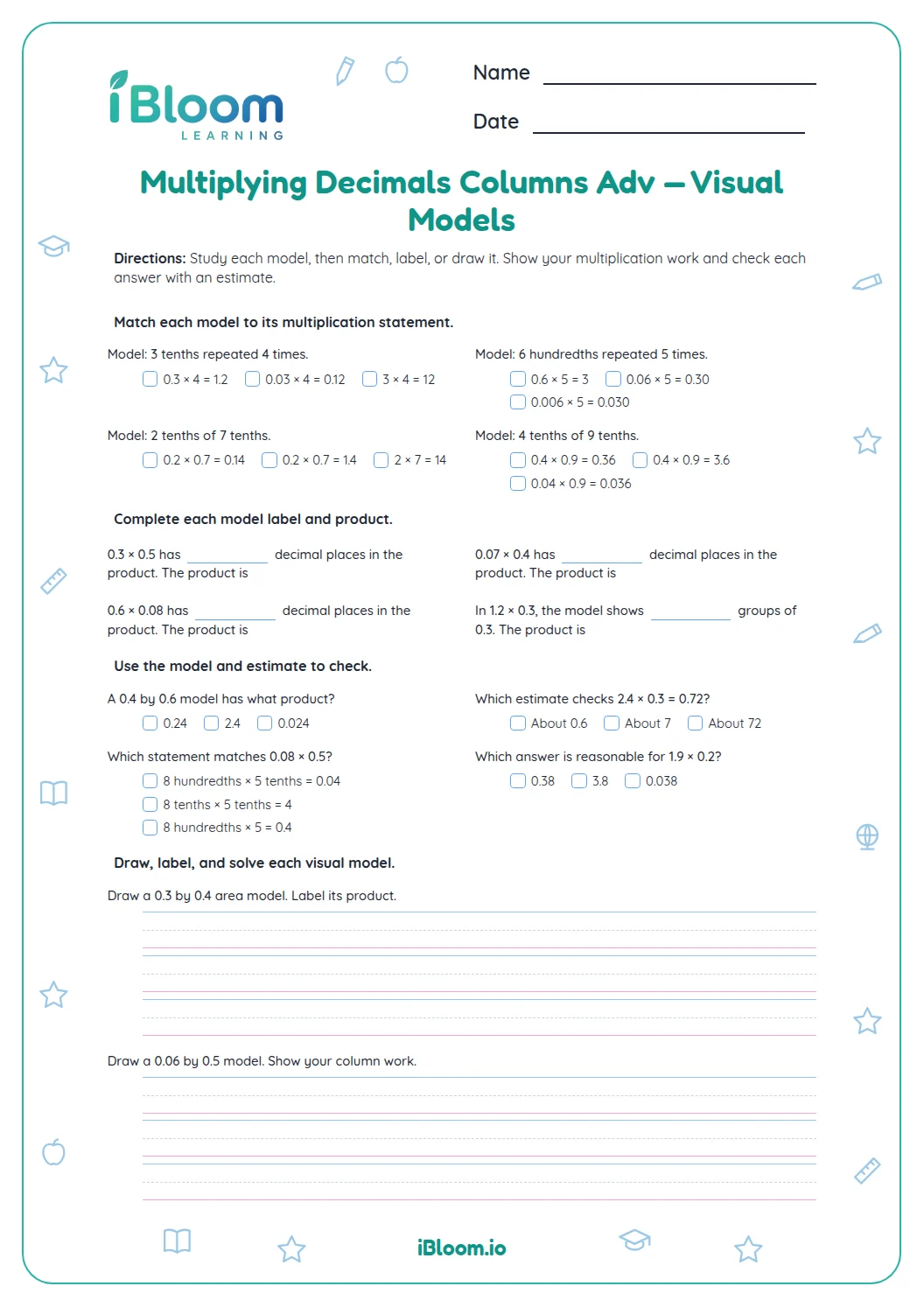
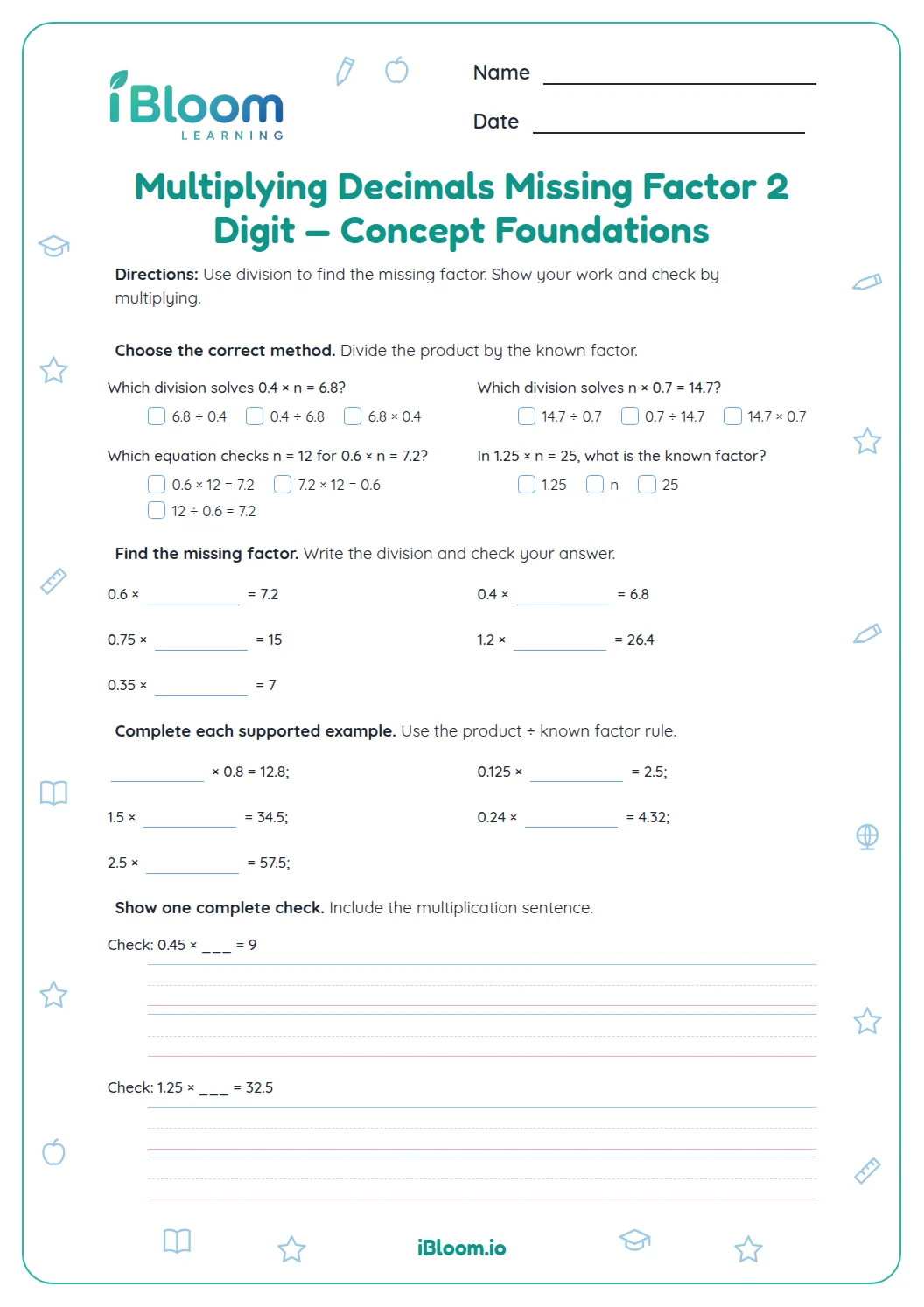
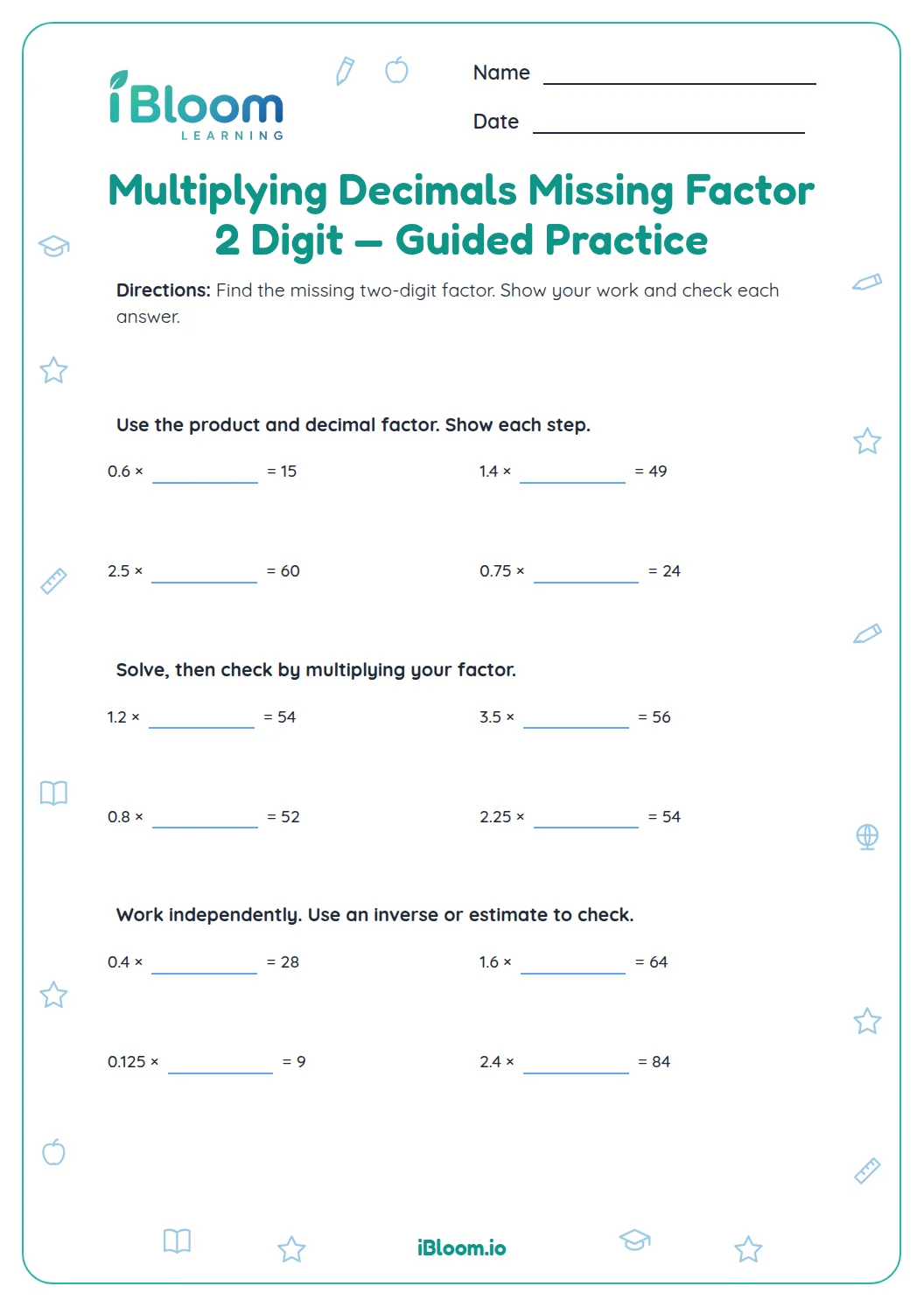
This Grade 5 reasoning challenge gives students practice multiplying decimals by two-digit whole numbers. Twelve questions move from products to estimates, equivalent expressions and explanations, with two short real-world problems and a separate answer key. Students use place value to predict and check products such as 24 × 0.6. The work supports CCSS 5.NBT.B.7.
Aligned to 5.NBT.B.7
How can you solve one example?
For 24 × 0.6, first find 24 × 6 = 144. Since 0.6 is one tenth of 6, the product is one tenth of 144: 14.4.
- 124 × 0.6 = 14.4
What will the practice ask you to do?
Estimate, multiply, and explain how place value changes products such as 24 × 0.6. Includes error analysis and real-world problems.
How can you check an answer?
Check that the result fits the size of the factors and that each answer matches the requested unit, fraction form or repeating cycle. Use the separate key after completing the page.
How can I use this worksheet?
- 1Read the direction at the start of each part.
- 2Write one answer for each prompt and keep its units or notation clear.
- 3Use a model, estimate or inverse operation to check the result.
- 4Compare completed work with the separate answer key.
What mistakes should students watch for?
The mistake
Treating a decimal factor as a whole number.
The fix
Estimate the product first; a factor below 1 makes the product smaller.
The mistake
Placing the decimal without checking the factors.
The fix
Use place value and compare the product with a reasonable estimate.
The mistake
Choosing an estimate that is far from the exact product.
The fix
Round the decimal to a nearby tenth or whole number before multiplying.
Common Core alignment
Students multiply decimals to hundredths with place-value strategies and explain their reasoning.
Multiply decimals to hundredths using place value and explain the reasoning.
On this sheet: Students multiply decimals by whole numbers and use place-value reasoning to estimate and explain.
Show the official wordingHide the official wording
Add, subtract, multiply, and divide decimals to hundredths, using concrete models or drawings and strategies based on place value, properties of operations, and/or the relationship between addition and subtraction; relate the strategy to a written method and explain the reasoning used.
What to practice next
Make more practice
Further reading
Questions parents and teachers ask
How many questions are on this reasoning challenge?
There are 14 questions in three parts. Students calculate four products, reason through four estimates or claims, then solve or explain four applications. The worksheet and its key each use pages so the products, reasoning prompts and explanations have room. Estimating first helps catch misplaced decimals before checking with exact multiplication.
What does 24 × 0.6 equal?
The product is 14.4. Since 0.6 is six tenths, 24 × 0.6 is six tenths of 24, or 14.4. Students can also calculate 24 × 6 = 144 and then divide by 10 to check the decimal place. Since seven tenths is less than one whole, the product must stay below 36; 25.2 fits that check.
Why does 36 × 0.7 equal 25.2 rather than 252?
Because 0.7 is less than 1, multiplying 36 by 0.7 must give a result smaller than 36. The whole-number product 36 × 7 is 252, and seven tenths of that value is 25.2. The items mix computation, estimation, equivalent expressions and a word problem so students can use several ways to reason.
What strategies appear on the worksheet?
Students calculate products, estimate a product’s size, match an equivalent expression, and inspect a decimal-place error. The last part asks for a repeated-addition connection, two multiplication situations, and an explanation, so students use both computation and reasoning. Students practice multiplying decimals to hundredths with place-value strategies and explaining the reasoning they used.
Which Common Core standard does this sheet practice?
This worksheet practices multiplying decimals to hundredths using place-value strategies and explaining the reasoning. It emphasizes two-digit whole-number factors, estimates for checking, and a word problem where students apply the product to a measured length in context. Students also compare estimated and exact products.