


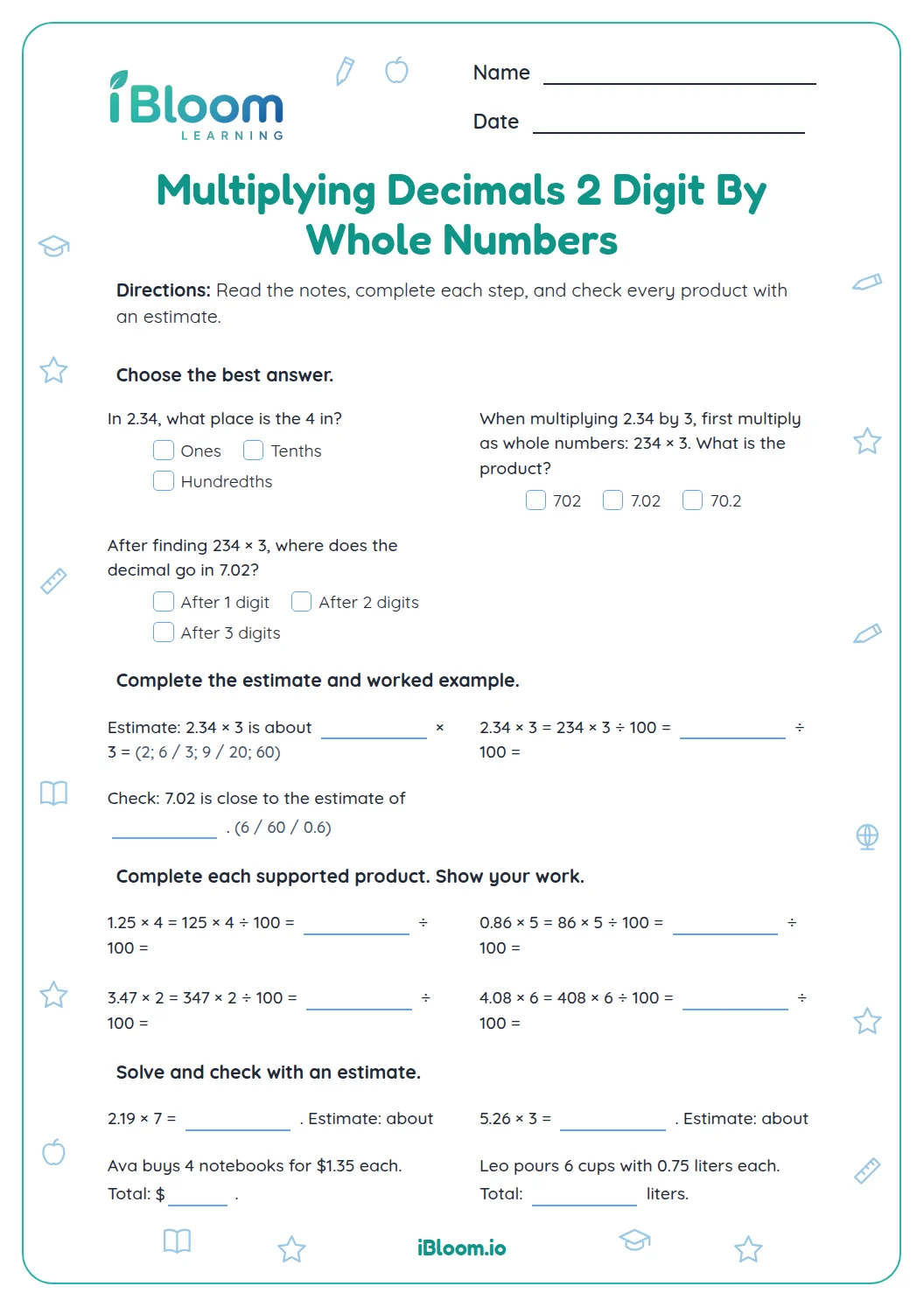

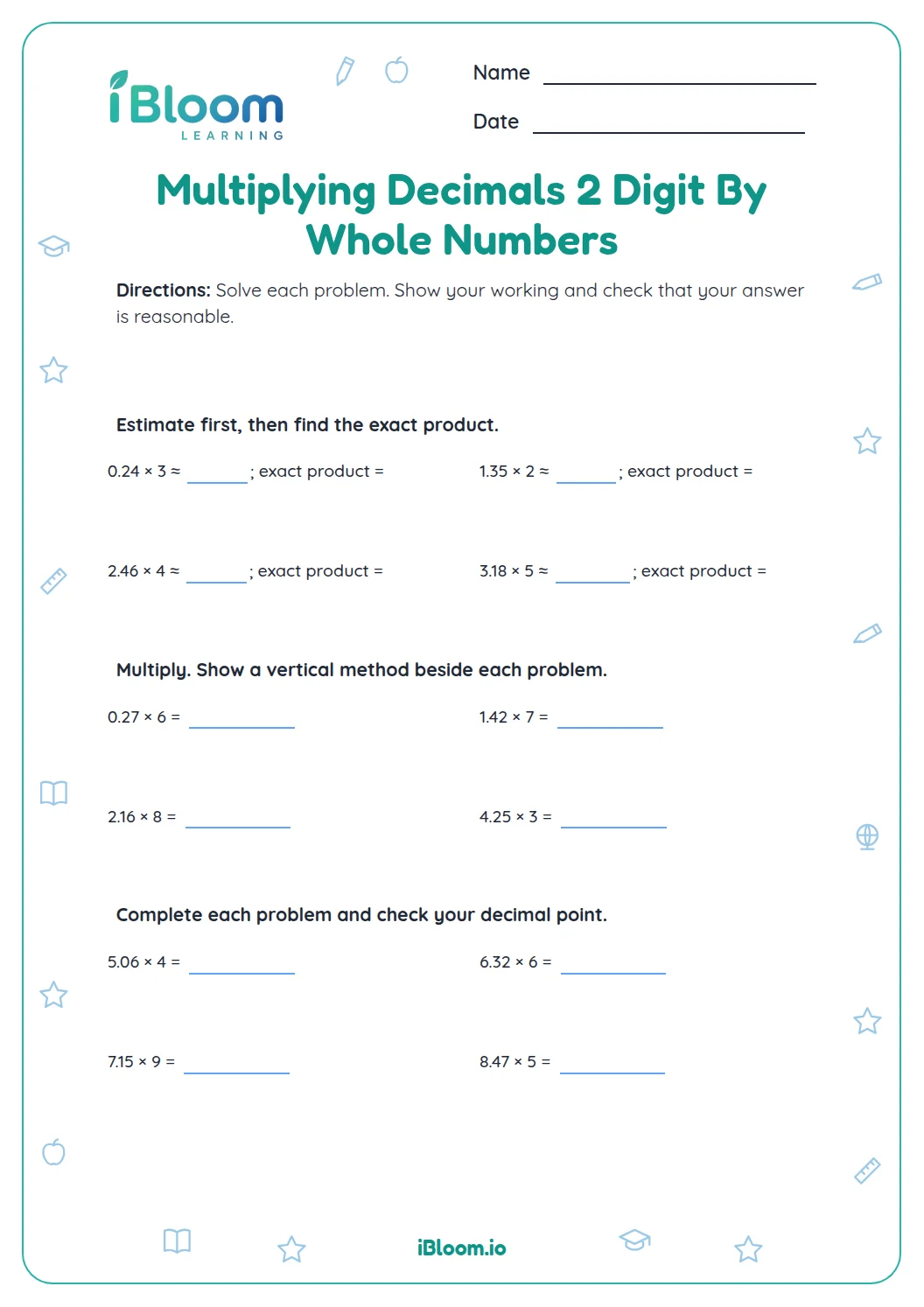
About this worksheet
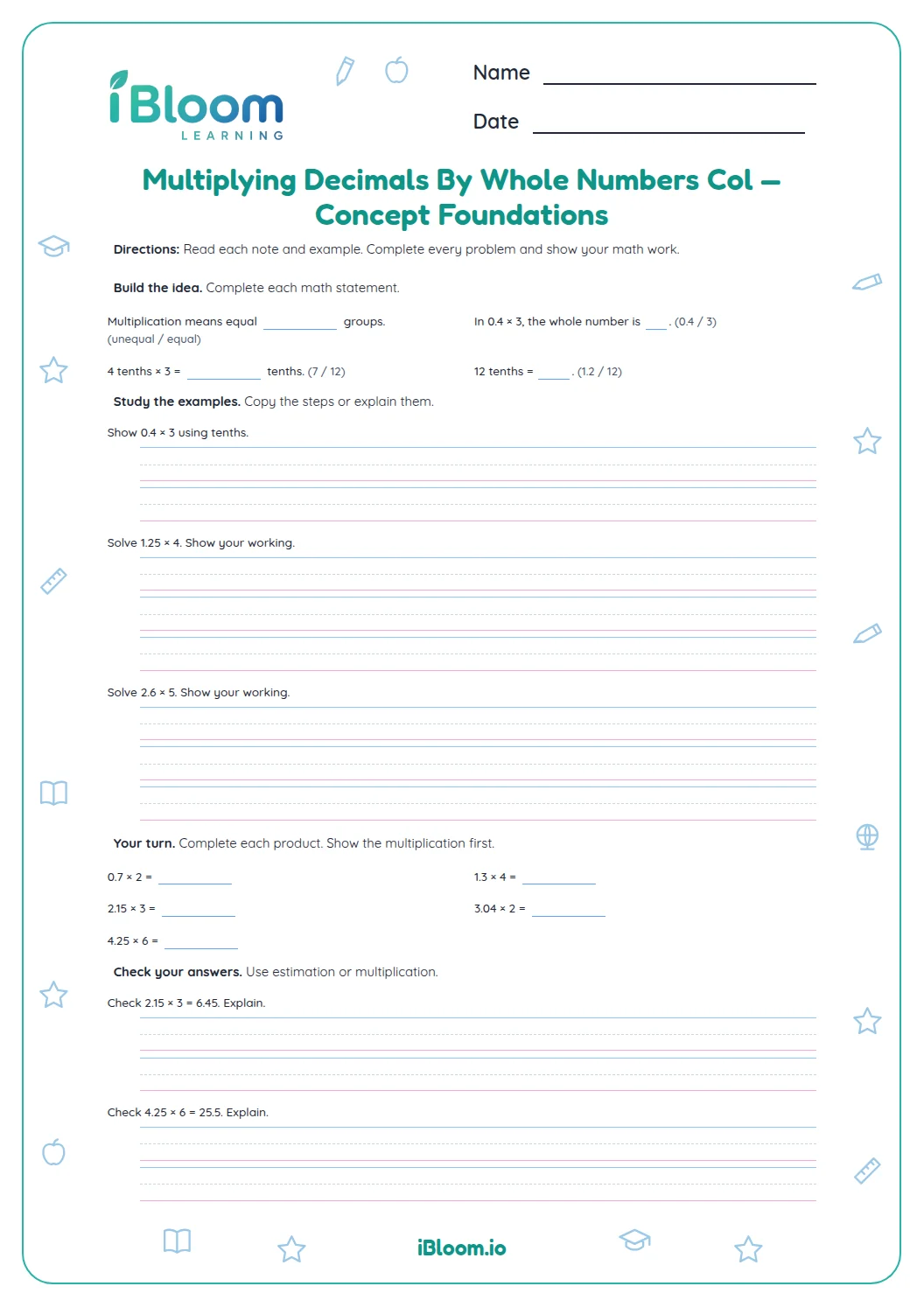
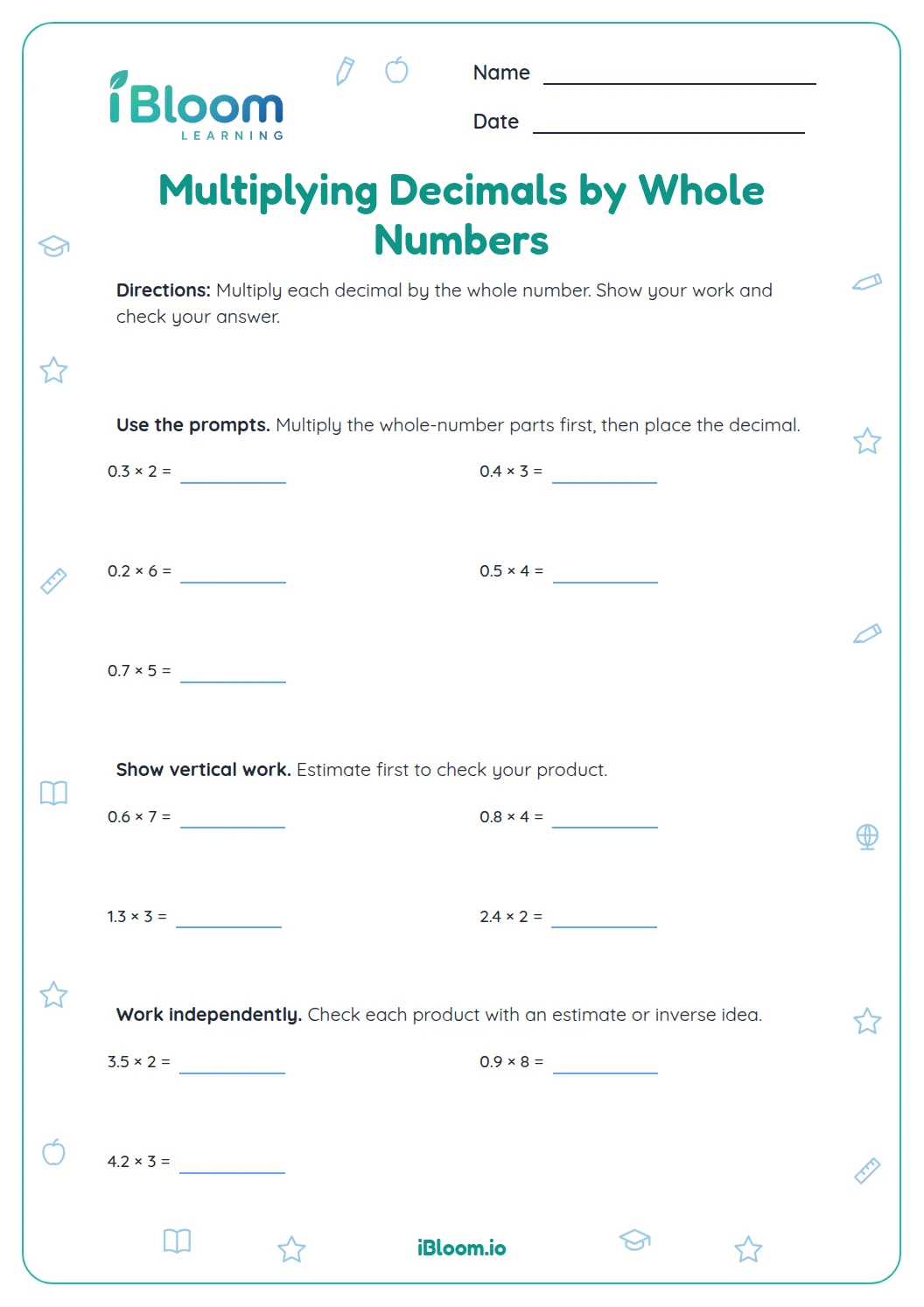
This guided Grade 5 worksheet practices multiplying decimals by whole numbers using column methods. The first four items separate an estimate from the exact product with two distinct blanks; later items build to two-digit whole-number factors and short applications. The answer key includes each product and its units.
Aligned to 5.NBT.B.7
How should an estimate and exact answer differ?
Round or use a nearby whole-number factor to estimate the product. Then multiply the original factors exactly. For 2.4 × 3, an estimate is about 6 and the exact product is 7.2.
- 1Estimate 2.4 × 3 as about 6; exact: 2.4 × 3 = 7.2
How do you multiply by a whole number?
Multiply the decimal digits by the whole number as in whole-number multiplication. Then use the decimal places in the decimal factor to place the product point.
How can a child check the work?
Finish each item before using the separate answer key. Compare the steps as well as the final number; a correct check should return to the original total, factor, or data set.
How to use this worksheet
- 1Estimate the product when the prompt asks.
- 2Multiply the digits as with whole numbers.
- 3Place the decimal using the decimal factor’s places.
- 4Write the exact product in its own blank.
- 5Include the unit in an applied answer and check it.
Common mistakes and quick fixes
The mistake
Writing the exact product in the estimate blank.
The fix
Use a nearby value for the estimate and the second blank for the exact product.
The mistake
Treating 0.9 as 9 when multiplying by 8.
The fix
Compute 9 × 8, then place one decimal place: 7.2.
The mistake
Leaving off a unit in a story problem.
The fix
Label mass in kilograms and length in meters.
This worksheet practices the following Common Core skill.
Use place-value understanding to solve decimal computation problems.
On this sheet:
Show the official wordingHide the official wording
Add, subtract, multiply, and divide decimals to hundredths, using concrete models or drawings and strategies based on place value, properties of operations, and/or the relationship between addition and subtraction; relate the strategy to a written method and explain the reasoning used.
What to practice next
Make more practice
Further reading
Questions parents and teachers ask
Why estimate before calculating?
An estimate gives a quick size check. Since 2.4 is close to 2, 2.4 × 3 should be near 6, which helps catch a product such as 72. Complete the calculation first, then check the printed key. Explain any correction using the numbers in the problem to make each step clear.
What unit belongs in the applied answers?
Use the same kind of unit the situation gives: kilograms for mass and meters for length. Units make clear what the product measures. Complete the calculation first, then check the printed key. Explain any correction using the numbers in the problem to make each step clear.
How can you fix 0.6 × 9 = 54?
Compute 6 × 9 = 54, then place one decimal place because 0.6 has one. The product is 5.4. Complete the calculation first, then check the printed key. Explain any correction using the numbers in the problem to make each step clear.
How many questions are on this worksheet?
There are 15 questions: 12 products and 3 applied problems. The first four ask for separate estimates and exact products, followed by column multiplication and short situations involving mass and length. The answer key includes the products and units.
How can an adult support practice?
Ask the child to estimate before multiplying and explain where the decimal point belongs. For the applied items, have them write the multiplication equation and include the unit. Then compare the work with the separate answer key and discuss whether the exact answer is close to the estimate.