
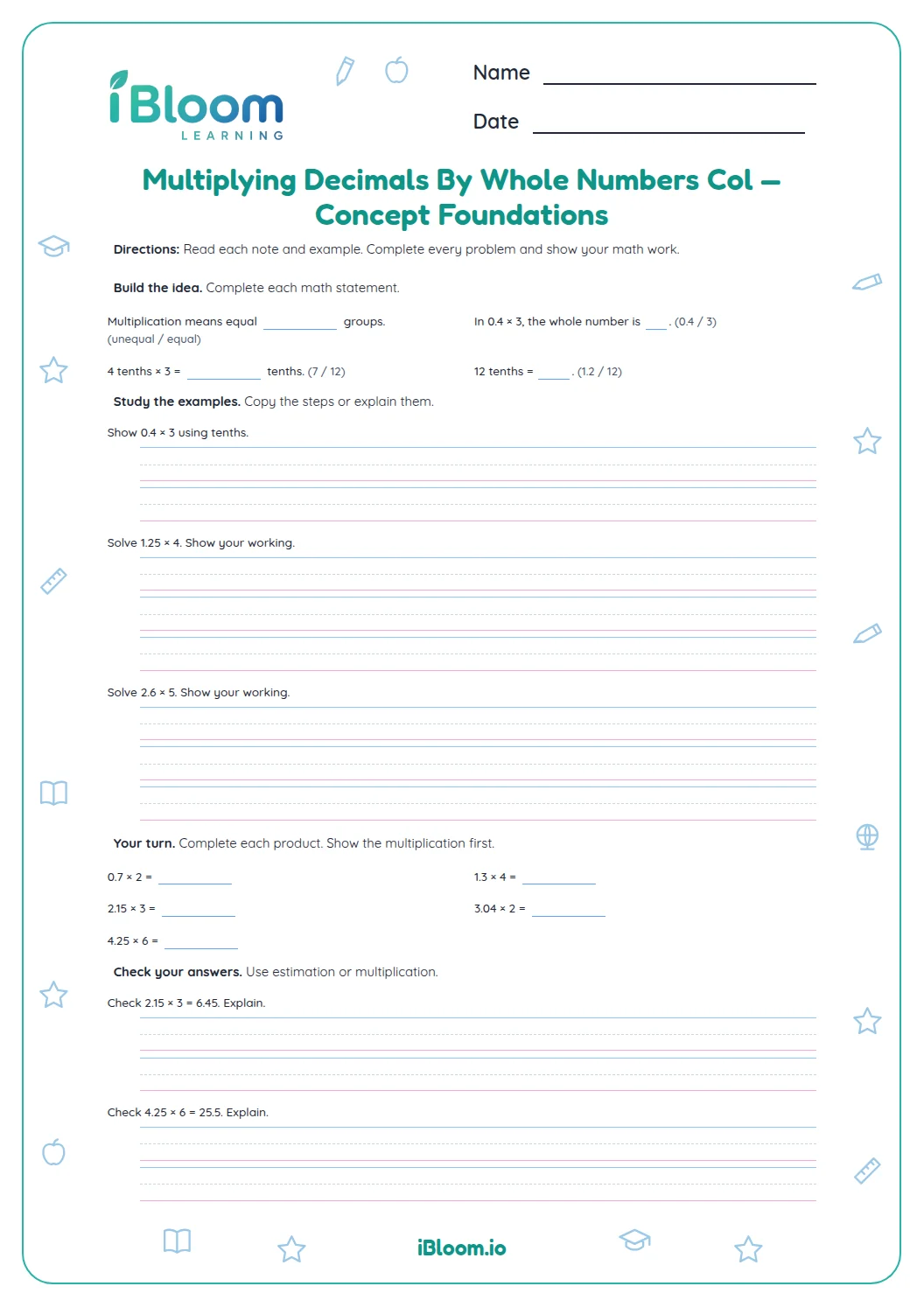


About this worksheet
This printable decimal products worksheet is for grade 5 students. It provides 14 questions with room to work and a separate answer key. The problems build practice with the exact skill named on the sheet, using familiar quantities and contexts. Students can record an equation, calculate, and check that the result answers the question.
How can students solve each problem?
Read the quantities and decide what operation the story describes. For example, A baker packs 6 boxes with 1.25 pounds of flour in each. How many pounds are packed?
Write an equation, calculate carefully, and label the result with the unit asked for.
- 1Identify the quantities and their relationship.
- 2Write the matching number sentence.
- 3Calculate and reread the question.
What is on the worksheet?
The sheet has 14 questions arranged in parts, followed by a separate answer key. Each prompt names the quantities needed for its calculation.
How can an adult help?
Ask the student to explain why the operation fits before checking the arithmetic. For story problems, compare the final unit with the unit in the question.
How can students check their work?
- 1Read for the quantities and units.
- 2Decide which operation matches the story.
- 3Write the equation before calculating.
- 4Check the arithmetic with a second method.
- 5Label the answer with the requested unit.
What should students watch for?
The mistake
Using the right numbers with the wrong operation.
The fix
State what the question asks you to find, then choose the operation.
The mistake
Making an arithmetic error while working with fractions or decimals.
The fix
Show each step and check the result with an estimate or inverse operation.
The mistake
Leaving off or duplicating the unit.
The fix
Write the unit once, as requested in the question.
What to practice next
Make more practice
Questions parents and teachers ask
Can students use the answer key independently?
Yes. The separate key lets students compare their results after attempting each problem. Encourage them to show their work first, then use any mismatch as a chance to revisit the equation and arithmetic. This keeps the check focused on the reasoning as well as the final number. The pages are ready to print and use.
How should students show their work?
Students can write an equation in the space provided and show the calculation steps that lead to the result. For a story problem, a brief label or unit helps connect the number back to the situation. The key gives a concise result for each item.
What if an answer does not match the key?
Reread the question and compare its quantities with the equation. Check the operation, then recompute one step at a time. A reverse operation or estimate can help locate the error. The answer key is a check, while the student’s written work shows where a correction may be needed.
Can this worksheet be used for small-group practice?
Yes. A teacher or caregiver can solve the first item with a group, then ask students to explain their setup before working independently. Comparing different solution steps after completion can reinforce how the target operation represents each situation.
How long does the worksheet take?
Plan for about 25 minutes, though pace depends on how much work the student writes. The 14 questions give time to set up equations, calculate, and check the answers. A student can revisit a missed item by comparing the equation with the story quantities.