Free printable practice
Divisibility Rules Practice Activities
Grade 5 students practise using divisibility rules to identify factors quickly and make smarter factoring decisions.
Free printable worksheet PDFs
Preview every available page, then download the free worksheet PDF for home, homeschool, tutoring, or classroom practice.
Preview the exact activity before downloading it.
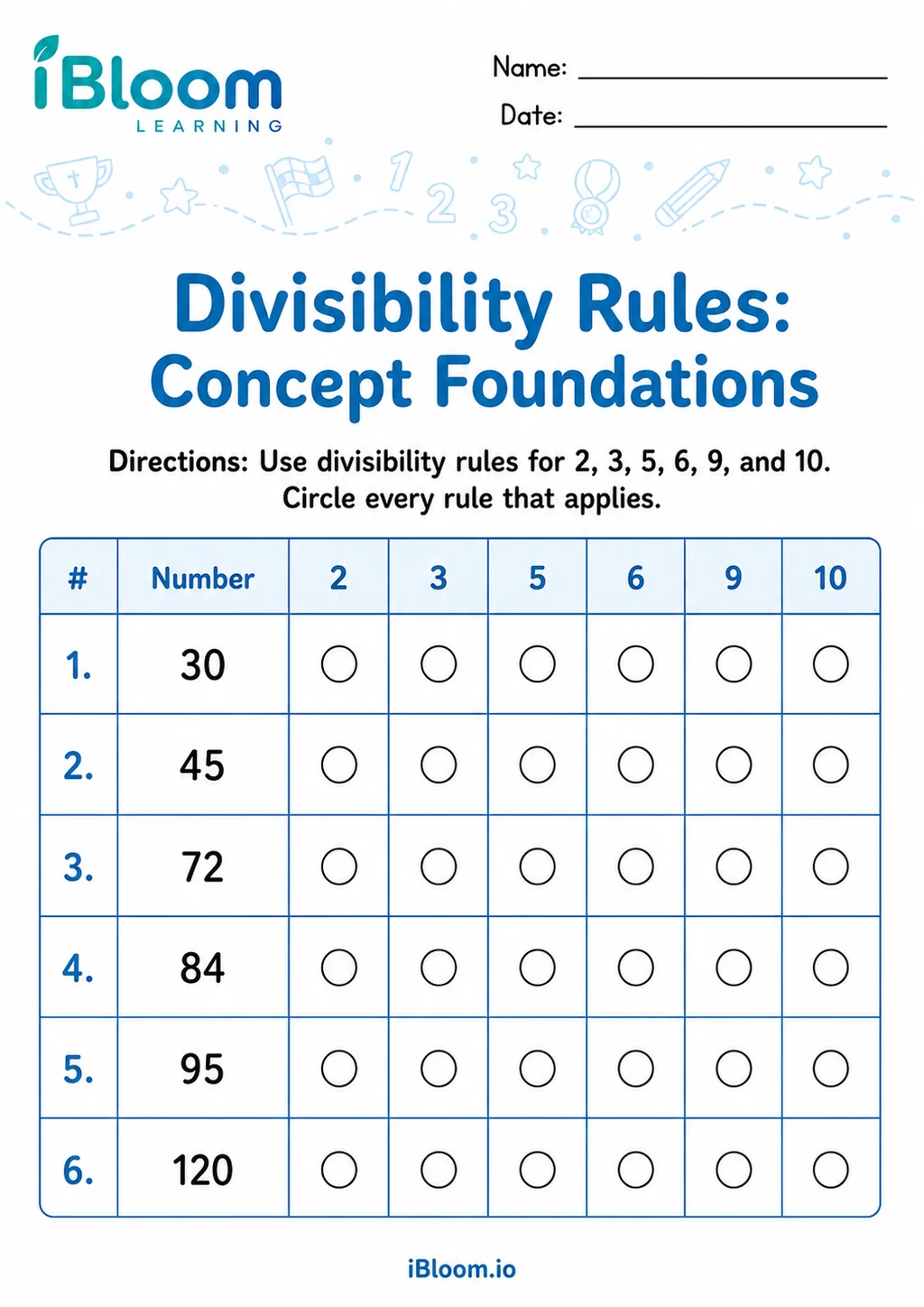 Divisibility Rules — Concept FoundationsGrade 5 students practise using divisibility rules to identify factors quickly and make smarter factoring decisions. This Grade 5 foundations worksheet adds concise teaching notes, worked examples, and supported first attempts.Grade 5Free PDF preview
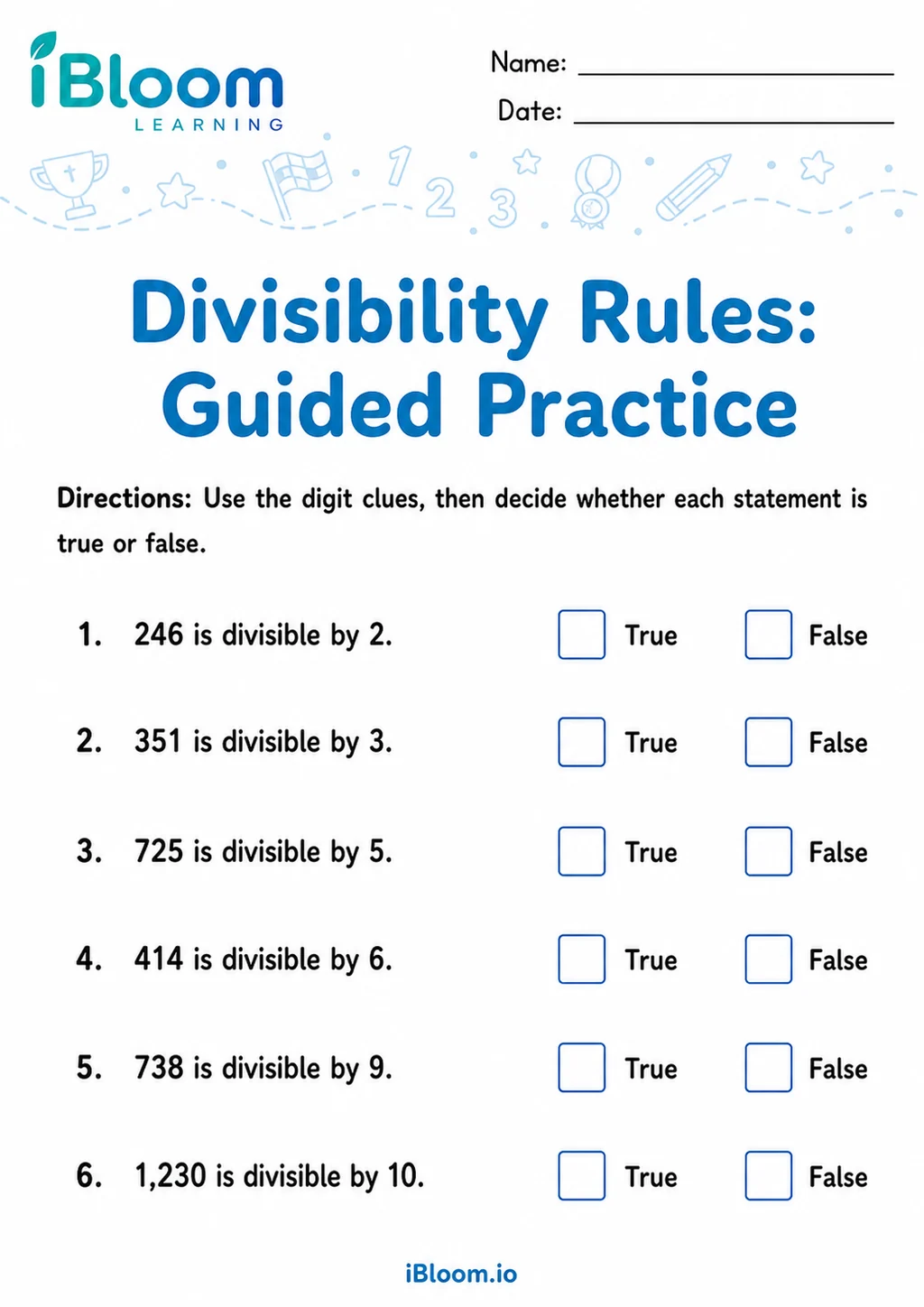 Divisibility Rules — Guided PracticeGrade 5 students practise using divisibility rules to identify factors quickly and make smarter factoring decisions. This Grade 5 guided-practice worksheet progresses from prompts and checkpoints to independent questions.Grade 5Free PDF preview
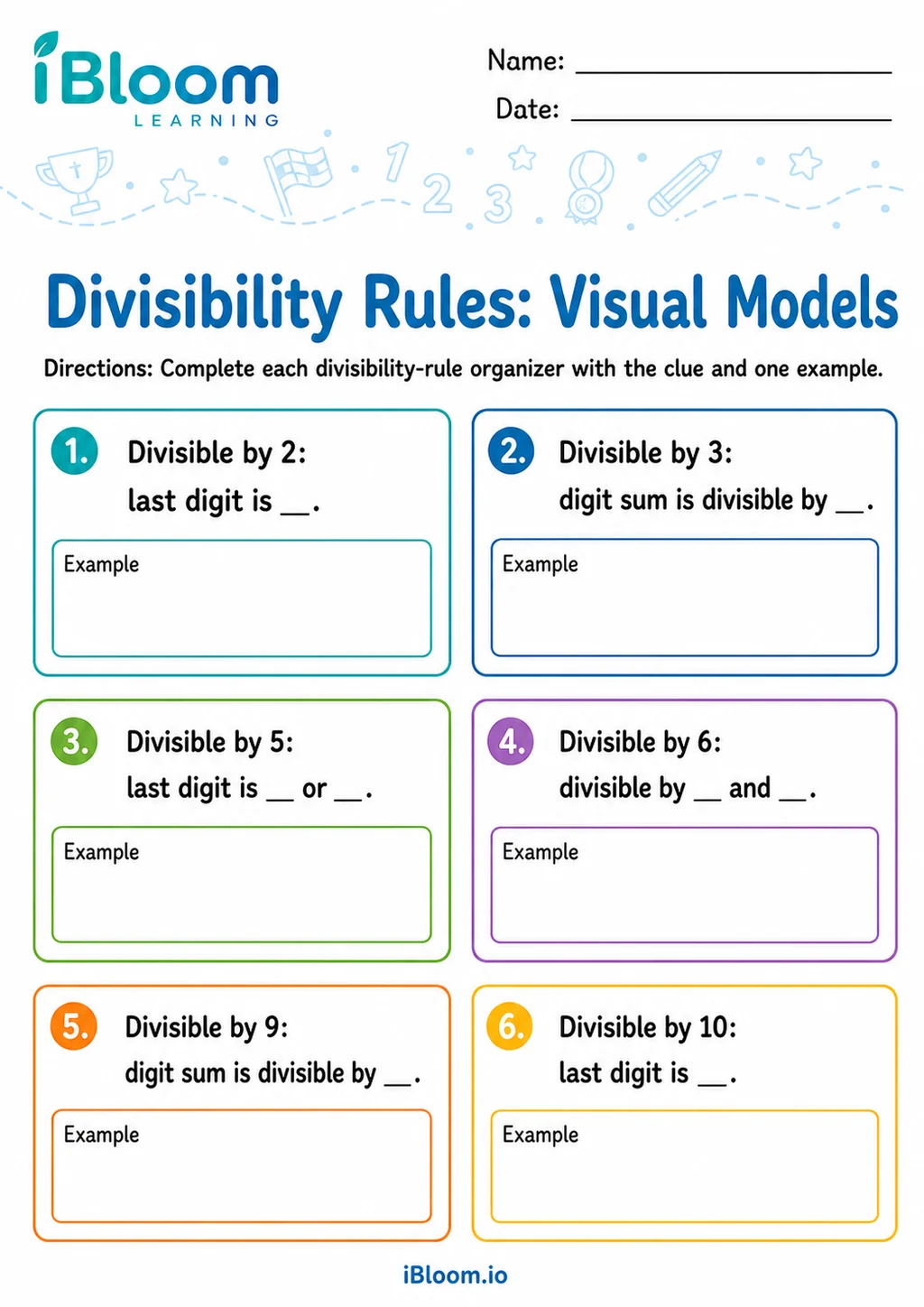 Divisibility Rules — Visual ModelsGrade 5 students practise using divisibility rules to identify factors quickly and make smarter factoring decisions. This Grade 5 visual-model worksheet connects suitable diagrams, tables, number lines, or place-value models to mathematical notation.Grade 5Free PDF preview
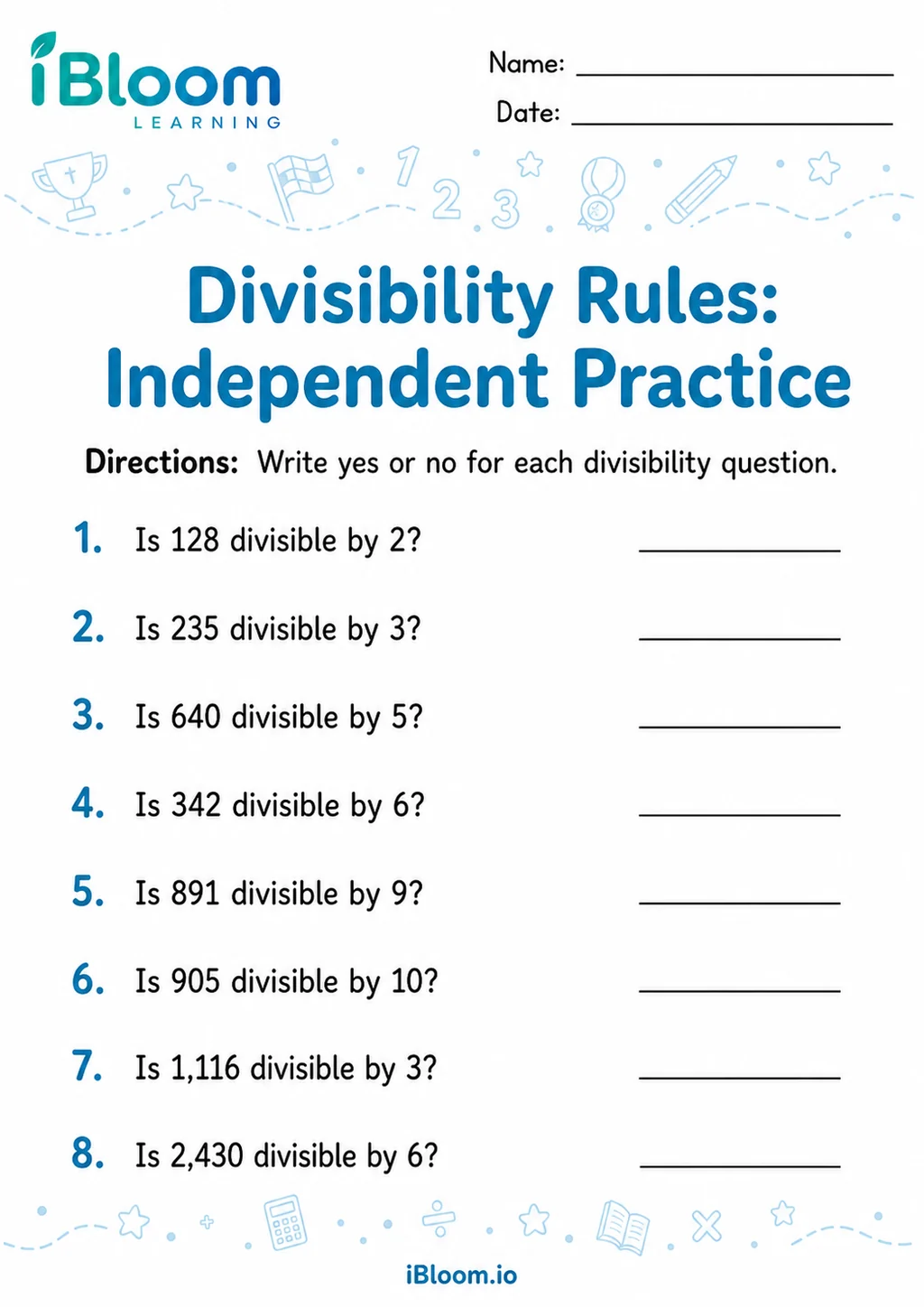 Divisibility Rules — Independent PracticeGrade 5 students practise using divisibility rules to identify factors quickly and make smarter factoring decisions. This Grade 5 independent-practice worksheet provides a balanced sequence of accurate, grade-level exercises.Grade 5Free PDF preview
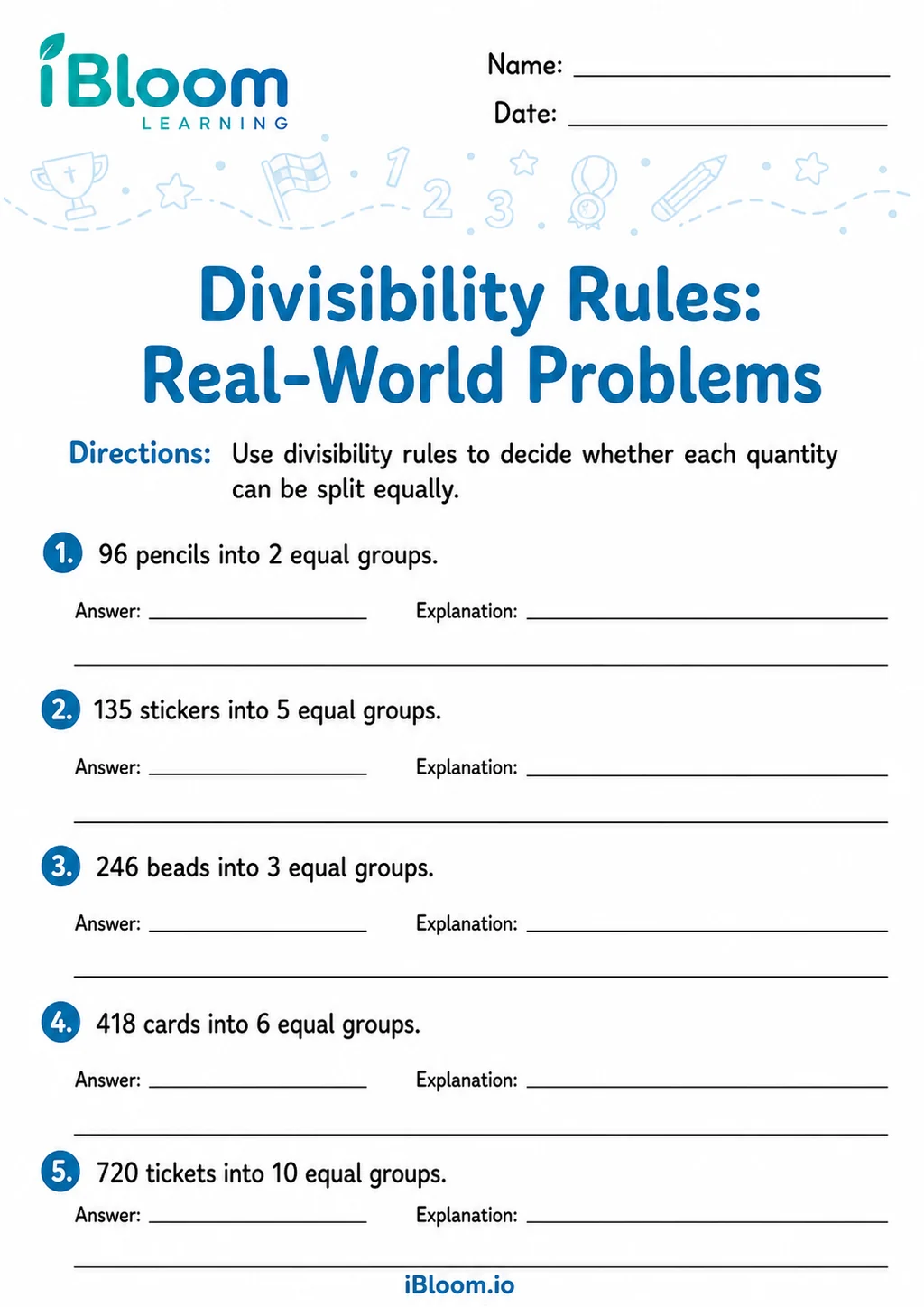 Divisibility Rules — Real-World ProblemsGrade 5 students practise using divisibility rules to identify factors quickly and make smarter factoring decisions. This Grade 5 application worksheet uses realistic one-step and multi-step situations with room to model and solve.Grade 5Free PDF preview
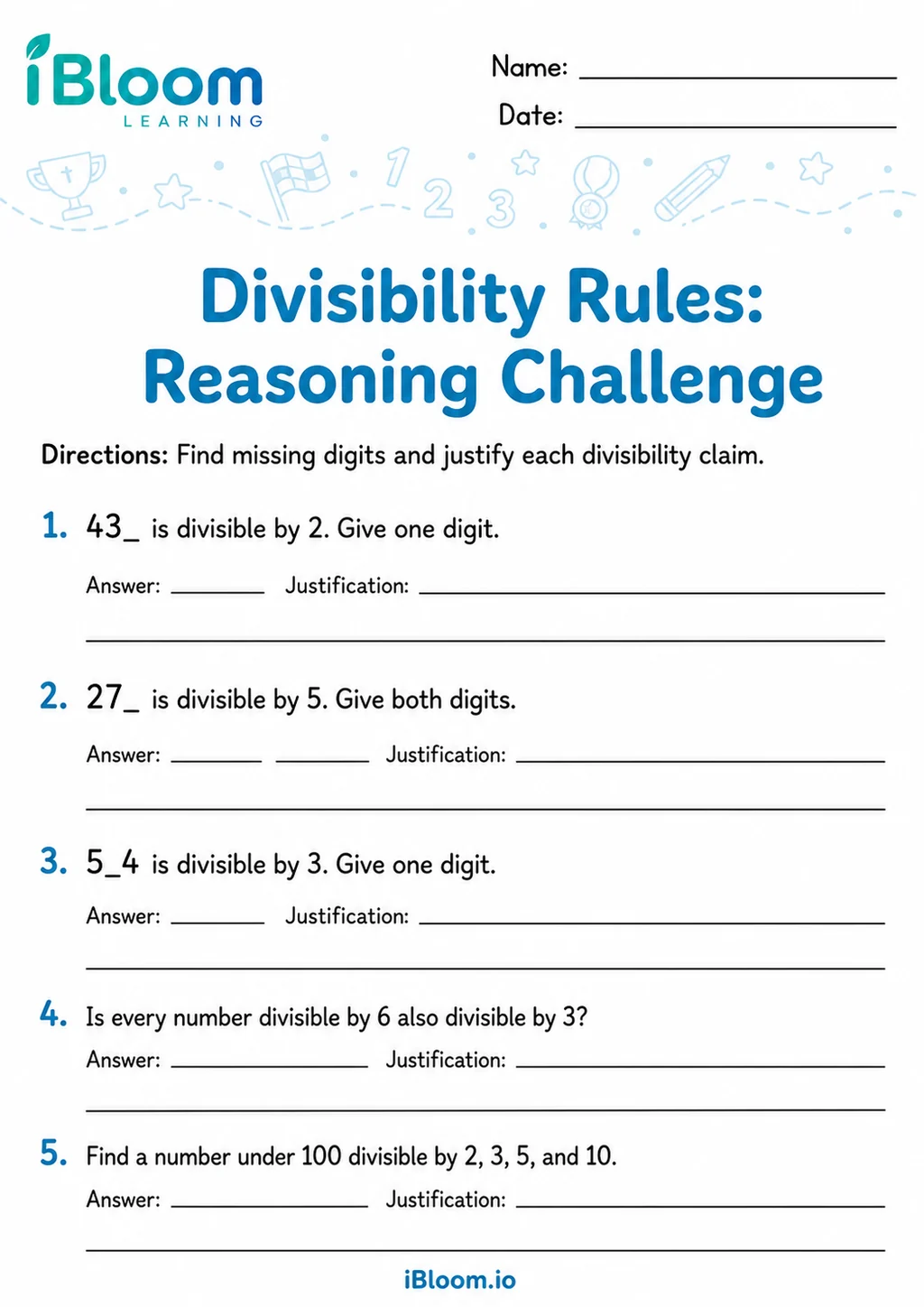 Divisibility Rules — Reasoning ChallengeGrade 5 students practise using divisibility rules to identify factors quickly and make smarter factoring decisions. This Grade 5 reasoning worksheet combines error analysis, strategy comparison, missing information, and a gentle extension.Grade 5Free PDF preview
Practice that builds confidence
From Quick Checks to Factoring Decisions
These Grade 5 divisibility rules worksheets help children decide whether a number can be divided evenly without doing long division every time. Students practise checking numbers using familiar clues such as the last digit, digit sums, and combinations of rules.
The printable activities connect directly to factoring work. Children sort numbers, test divisibility, find possible factors, and explain why a number is or is not divisible by another number.
Divisibility rules give Grade 5 students a practical way to test factors before they divide. Instead of guessing, children learn to look for evidence: an even last digit for 2, a 0 or 5 for 5, digit sums for 3 and 9, and combined tests such as checking 2 and 3 before deciding a number is divisible by 6. These clues build speed, but they also support deeper factoring because students begin to see how numbers are structured.

A Simple Home Routine
Choose one number from a worksheet and ask your child, “Which factors can we rule out quickly?” Have them check one rule at a time and say the reason aloud: “It is not divisible by 5 because it does not end in 0 or 5.” Then let them confirm one answer with division. This routine keeps the focus on reasoning rather than memorizing a list.

Classroom Practice Ideas
Teachers can use these pages for warm-ups, math centers, partner checks, or quick review before factor trees, greatest common factor, or prime and composite number lessons. One useful activity is to have pairs mark all numbers divisible by a given divisor, then compare the evidence they used. Another is to ask students to sort numbers into “divisible,” “not divisible,” and “not sure yet” before discussing strategies.

Common Mistakes to Notice
Many students mix up digit-sum rules with last-digit rules, especially for 3, 5, and 9. Others assume that if a number is divisible by 2 and 5, it must be divisible by every nearby number. Watch for children who use a rule correctly but answer the wrong question, such as finding divisibility by 3 when the task asks for 9. Encourage them to name the divisor first, then choose the matching rule.
Child-Friendly Strategy
Try the phrase: “Look, add, combine, confirm.” Look at the last digit for rules like 2, 5, and 10. Add the digits for 3 and 9. Combine rules when needed, such as 2 and 3 for 6. Confirm with division only when the rule points to a likely factor.
Free printable PDF download
Use this grade 5 divisibility rules worksheet page to preview the activity, print it, or download it as a PDF for quick practice. It works well for homework, homeschool lessons, tutoring, morning work, revision, and classroom centers.
Answers and answer key support
After the child completes the worksheet independently, parents and teachers can use the answer support or answer key information to check the work, review mistakes, and choose the next practice step.
Why iBloom Worksheets Help
The activities move from single-rule practice to mixed decisions, so students do not rely on one shortcut in every problem. Clear number choices, repeated reasoning prompts, and varied formats help children connect divisibility rules to the larger Grade 5 factoring unit.
Helpful answers
Frequently asked questions
What divisibility rules should a Grade 5 student know?
Most Grade 5 learners practise common rules for numbers such as 2, 3, 4, 5, 6, 8, 9, and 10, depending on the lesson sequence. The focus is on using each rule to test whether a number has a given factor.
How do divisibility rules support factoring?
They help students test possible factors quickly. For example, before dividing, a child can use a digit-sum rule to see whether 3 or 9 is a likely factor, making factor lists and factor trees more efficient.
Should children still practise division if they know the rules?
Yes. Divisibility rules are shortcuts for deciding whether division will come out evenly, but students should still understand division and use it to confirm answers when needed.
What is a common error with divisibility by 6?
Students often check only whether a number is even. A number is divisible by 6 only if it is divisible by both 2 and 3, so children must also check the digit sum for divisibility by 3.
How can I help my child remember the rules without rote memorization?
Ask your child to explain the reason for each decision in a sentence. Saying “I checked the digit sum because the divisor is 3” helps connect the rule to the number being tested.
Is this grade 5 divisibility rules worksheet free?
Yes. You can preview it for free and use the printable worksheet for home or classroom practice.
Can I download this grade 5 divisibility rules worksheet as a PDF?
Yes. Use the worksheet download option to save a printable PDF, or print the worksheet directly from the page.
Does this grade 5 divisibility rules worksheet include answers or an answer key?
When the activity has fixed answers, iBloom includes answer support so parents and teachers can check the completed worksheet.