Free printable practice
Prime Factors 2 100 Practice Activities
Grade 5 students practise finding prime factors of numbers from 2 to 100 using factor trees, division steps, and clear prime factor lists.
Free printable worksheet PDFs
Preview every available page, then download the free worksheet PDF for home, homeschool, tutoring, or classroom practice.
Preview the exact activity before downloading it.
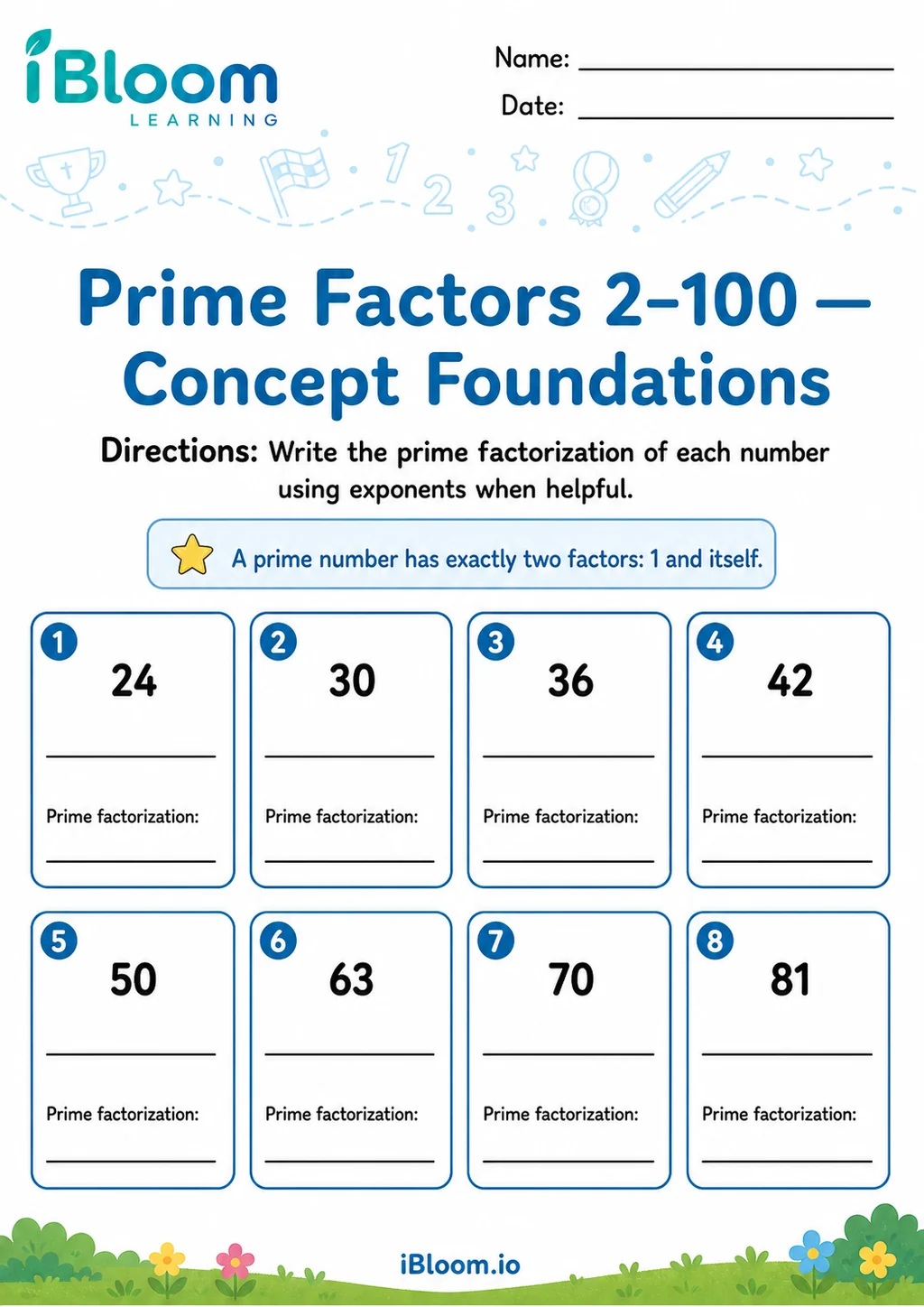 Prime Factors 2–100 — Concept FoundationsGrade 5 students practise finding prime factors of numbers from 2 to 100 using factor trees, division steps, and clear prime factor lists. This Grade 5 foundations worksheet adds concise teaching notes, worked examples, and supported first attempts.Grade 5Free PDF preview
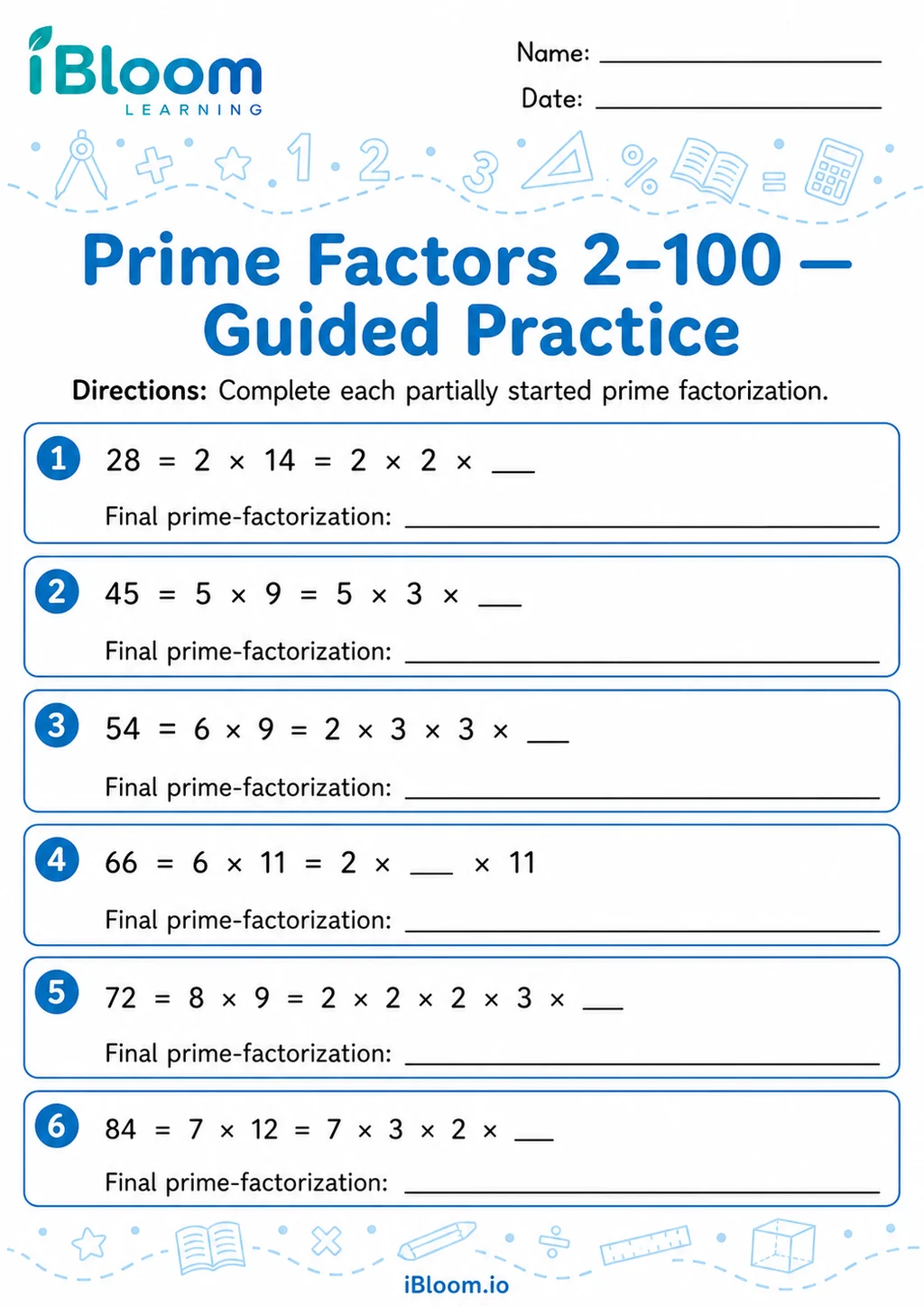 Prime Factors 2–100 — Guided PracticeGrade 5 students practise finding prime factors of numbers from 2 to 100 using factor trees, division steps, and clear prime factor lists. This Grade 5 guided-practice worksheet progresses from prompts and checkpoints to independent questions.Grade 5Free PDF preview
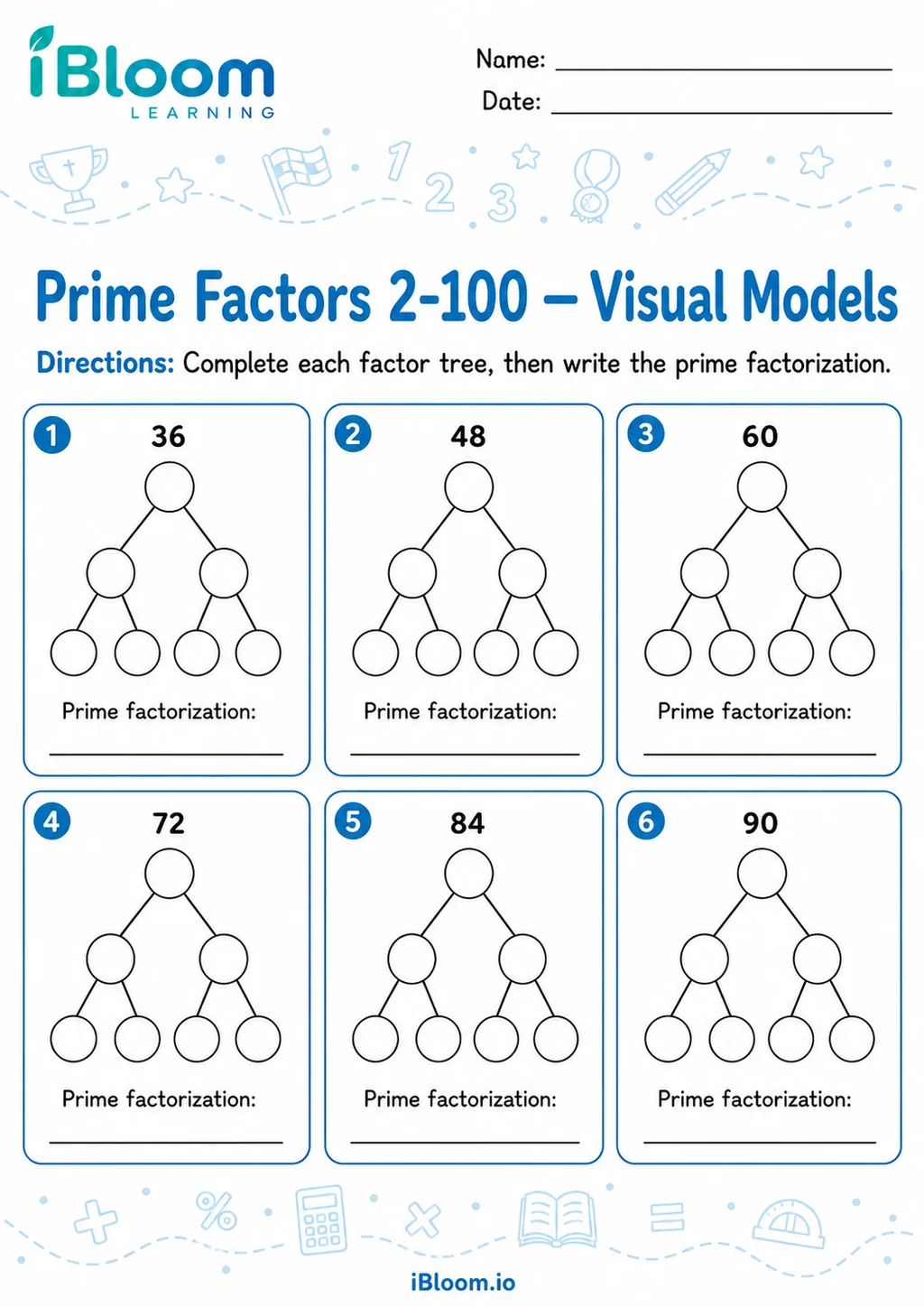 Prime Factors 2–100 — Visual ModelsGrade 5 students practise finding prime factors of numbers from 2 to 100 using factor trees, division steps, and clear prime factor lists. This Grade 5 visual-model worksheet connects suitable diagrams, tables, number lines, or place-value models to mathematical notation.Grade 5Free PDF preview
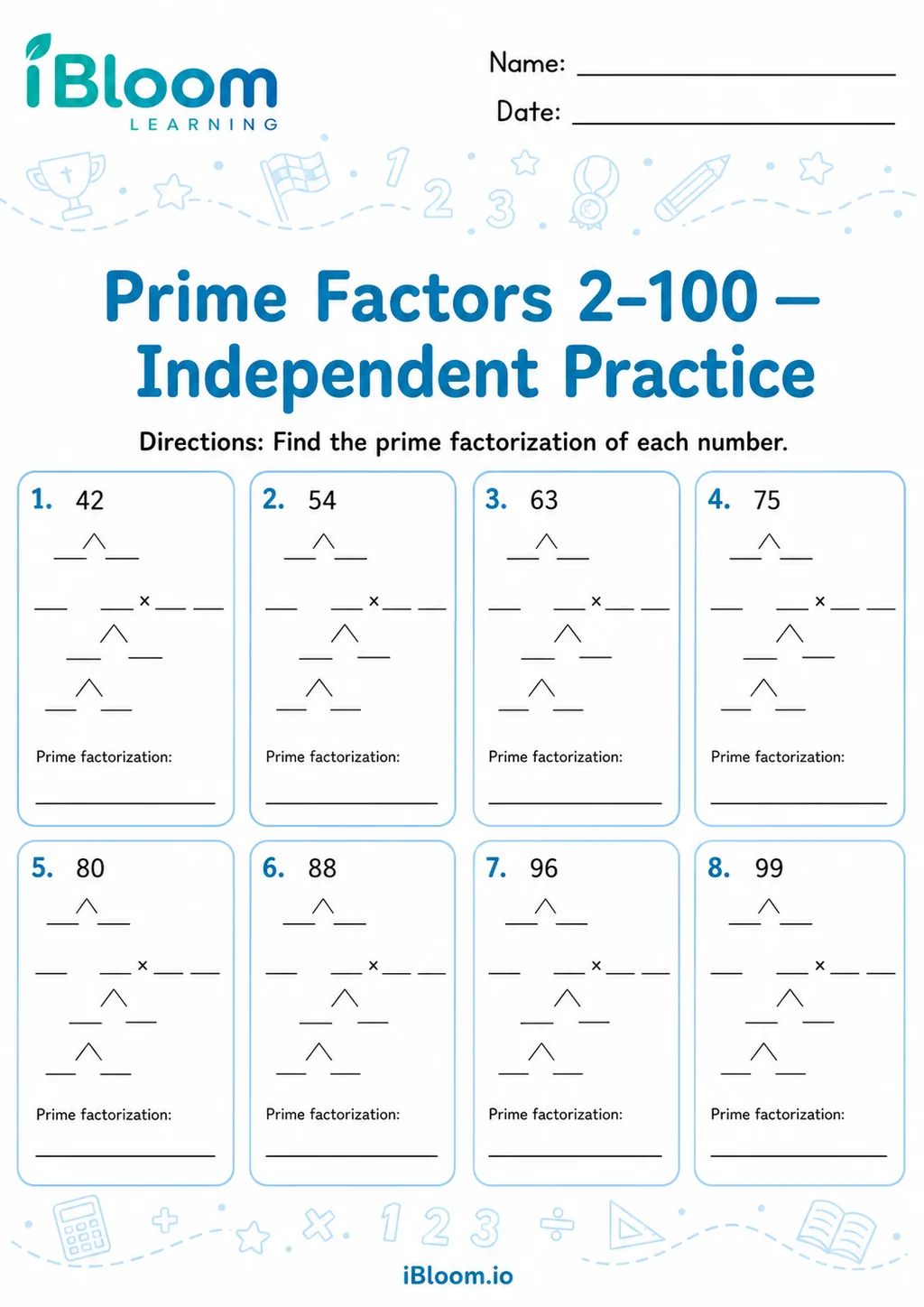 Prime Factors 2–100 — Independent PracticeGrade 5 students practise finding prime factors of numbers from 2 to 100 using factor trees, division steps, and clear prime factor lists. This Grade 5 independent-practice worksheet provides a balanced sequence of accurate, grade-level exercises.Grade 5Free PDF preview
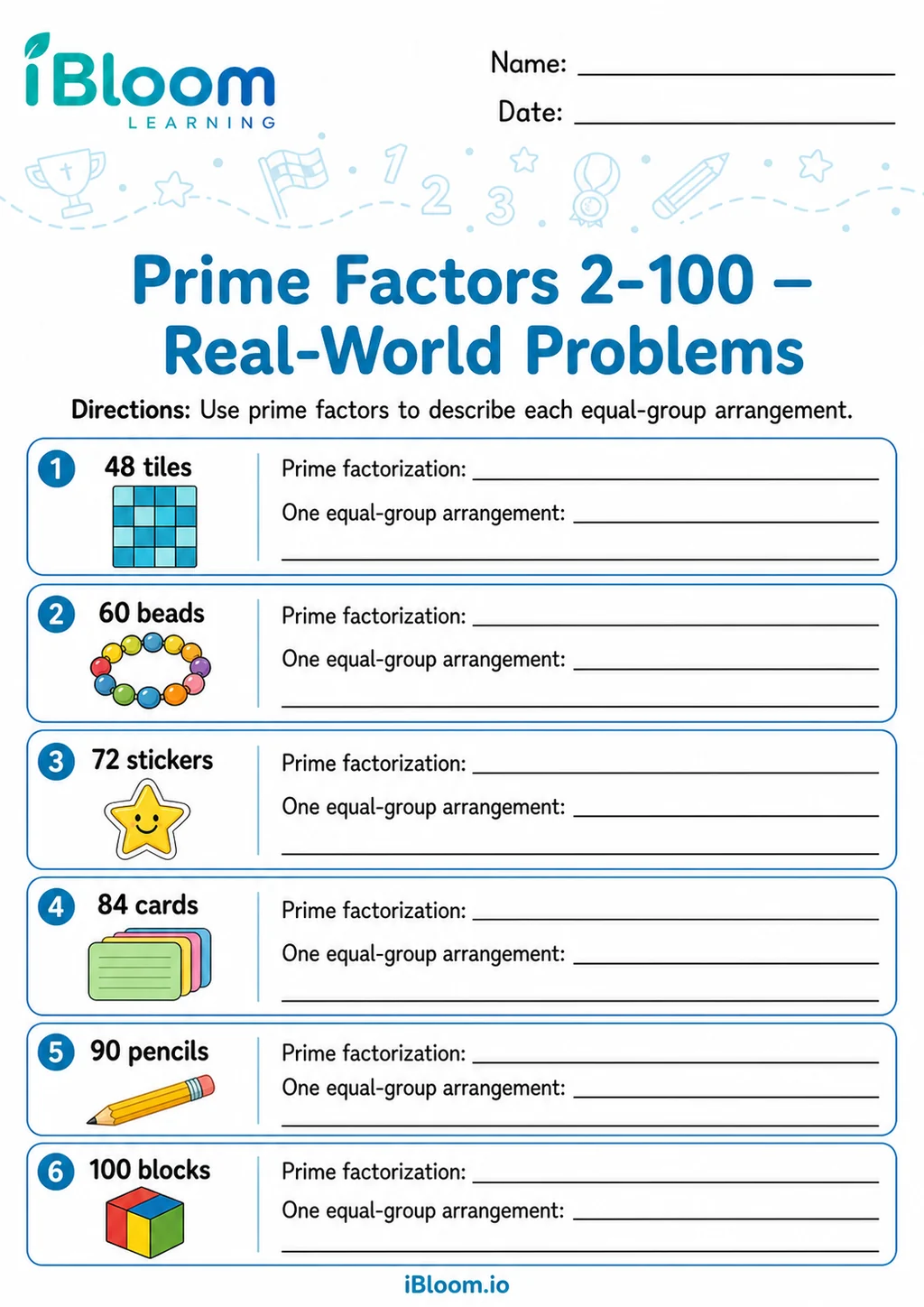 Prime Factors 2–100 — Real-World ProblemsGrade 5 students practise finding prime factors of numbers from 2 to 100 using factor trees, division steps, and clear prime factor lists. This Grade 5 application worksheet uses realistic one-step and multi-step situations with room to model and solve.Grade 5Free PDF preview
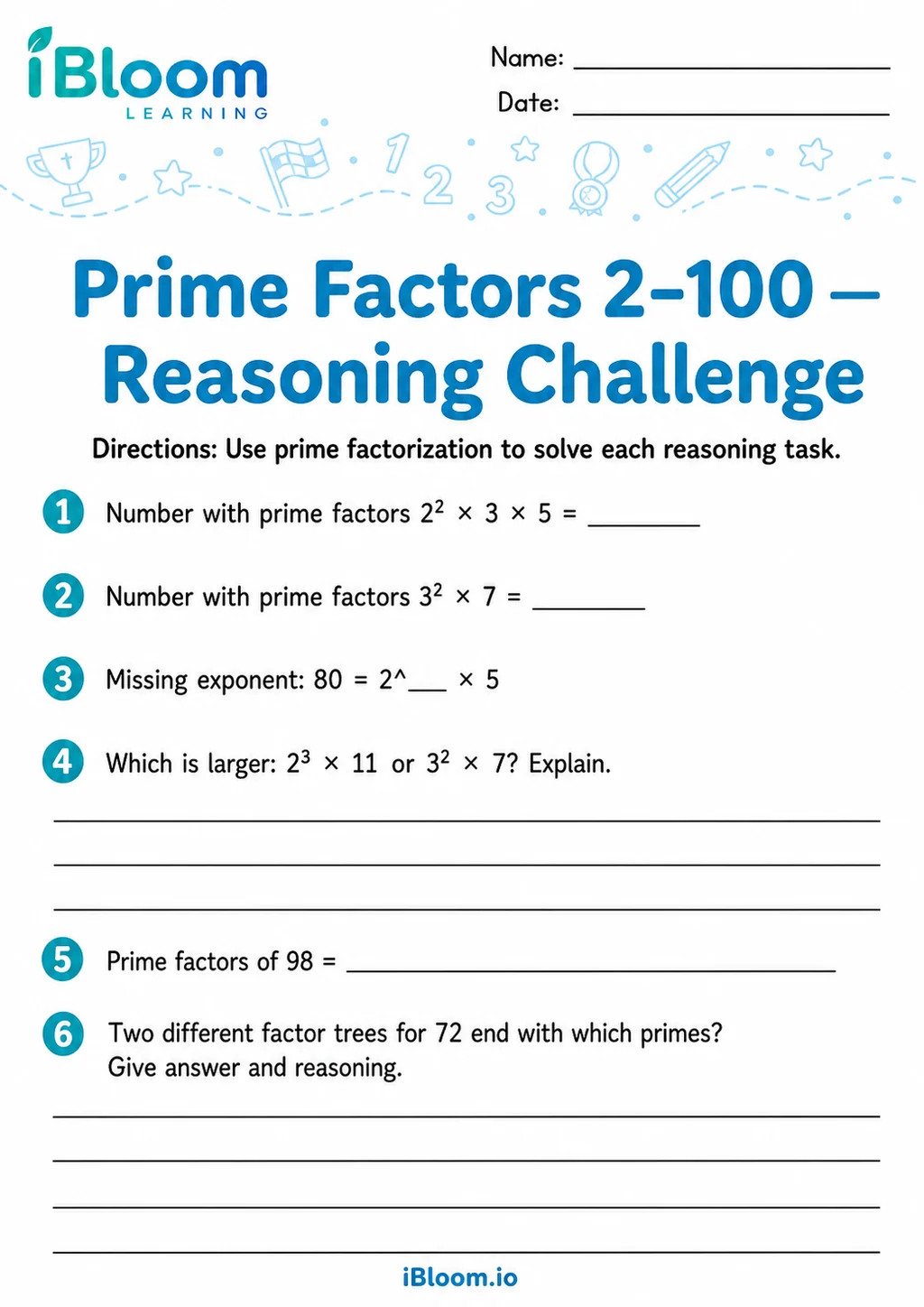 Prime Factors 2–100 — Reasoning ChallengeGrade 5 students practise finding prime factors of numbers from 2 to 100 using factor trees, division steps, and clear prime factor lists. This Grade 5 reasoning worksheet combines error analysis, strategy comparison, missing information, and a gentle extension.Grade 5Free PDF preview
Practice that builds confidence
What students are learning
These Grade 5 math worksheets focus on finding the prime factors of whole numbers from 2 to 100. Children practise breaking a number into prime numbers, recognizing when a factor is composite, and understanding that repeated prime factors must be shown each time.
The printable activities include number-by-number practice, factor tree work, repeated division formats, and mixed review. Students move from familiar numbers such as 12 and 30 to less obvious cases such as 56, 84, and prime numbers like 97.
In Math > Grade 5 > Factoring > Prime Factors 2 100, students learn that every number from 2 to 100 can be written as a product of prime numbers. For example, 60 can be broken into 2 × 2 × 3 × 5. The goal is not just to find any factors, but to keep factoring until only prime numbers remain.

How the practice progresses
The worksheets guide children from simpler even numbers to mixed numbers that require closer thinking. A student might first split 24 into 6 × 4, then continue to 2 × 3 and 2 × 2. Later problems may involve numbers such as 45, 72, or 91, where students must use divisibility facts and check whether the final factors are prime. Prime numbers in the range, such as 53 or 89, help children learn that a number can have itself as its only prime factor.
A simple parent routine
Choose five numbers from the page and ask your child to say one factor pair before writing anything. Then have them circle any composite factors and break those down again. After the work is complete, ask them to multiply the prime factors to check the original number. This quick check builds accuracy and helps children see prime factorization as a reversible process.

Classroom uses for teachers
Teachers can use these printables for factoring centers, small-group reteaching, warm-ups before fraction work, or exit tickets after a lesson on prime and composite numbers. They also work well for partner checking: one student builds a factor tree while the other verifies that every branch ends in a prime number.

Common errors to watch for
Students often stop too soon, writing 36 = 4 × 9 instead of continuing to 2 × 2 × 3 × 3. Some include 1 as a prime factor, leave out repeated factors, or list factor pairs instead of prime factors. Encourage them to ask, “Can any factor still be broken down?” If yes, the factorization is not finished.
Free printable PDF download
Use this prime factors 2 to 100 worksheet page to preview the activity, print it, or download it as a PDF for quick practice. It works well for homework, homeschool lessons, tutoring, morning work, revision, and classroom centers.
Answers and answer key support
After the child completes the worksheet independently, parents and teachers can use the answer support or answer key information to check the work, review mistakes, and choose the next practice step.
Why iBloom worksheets help
The iBloom practice set gives repeated, focused work within the exact 2 to 100 range, so students can build confidence without jumping to larger numbers too early. A child-friendly strategy is: try dividing by 2, then 3, then 5, then 7; keep every prime factor you find; multiply at the end to check.
Helpful answers
Frequently asked questions
What numbers are covered in these prime factor worksheets?
The worksheets focus on whole numbers from 2 to 100, giving Grade 5 students practice with both familiar composite numbers and prime numbers within that range.
Should students use factor trees or repeated division?
Both methods are useful. Factor trees help students see how composite factors break apart, while repeated division gives a more organized step-by-step structure.
How should a prime number like 97 be handled?
If a number is prime, its prime factorization is the number itself. Students should learn not to force extra factors or include 1 as a prime factor.
What mistakes are common when finding prime factors?
Common mistakes include stopping at composite factors, forgetting repeated factors, listing all factor pairs instead of only primes, or treating 1 as a prime number.
What skills should children know before using these worksheets?
Students should be comfortable with multiplication facts, basic division, even and odd numbers, and the difference between prime and composite numbers.
Is this prime factors 2 to 100 worksheet free?
Yes. You can preview it for free and use the printable worksheet for home or classroom practice.
Can I download this prime factors 2 to 100 worksheet as a PDF?
Yes. Use the worksheet download option to save a printable PDF, or print the worksheet directly from the page.
Does this prime factors 2 to 100 worksheet include answers or an answer key?
When the activity has fixed answers, iBloom includes answer support so parents and teachers can check the completed worksheet.