



About this worksheet
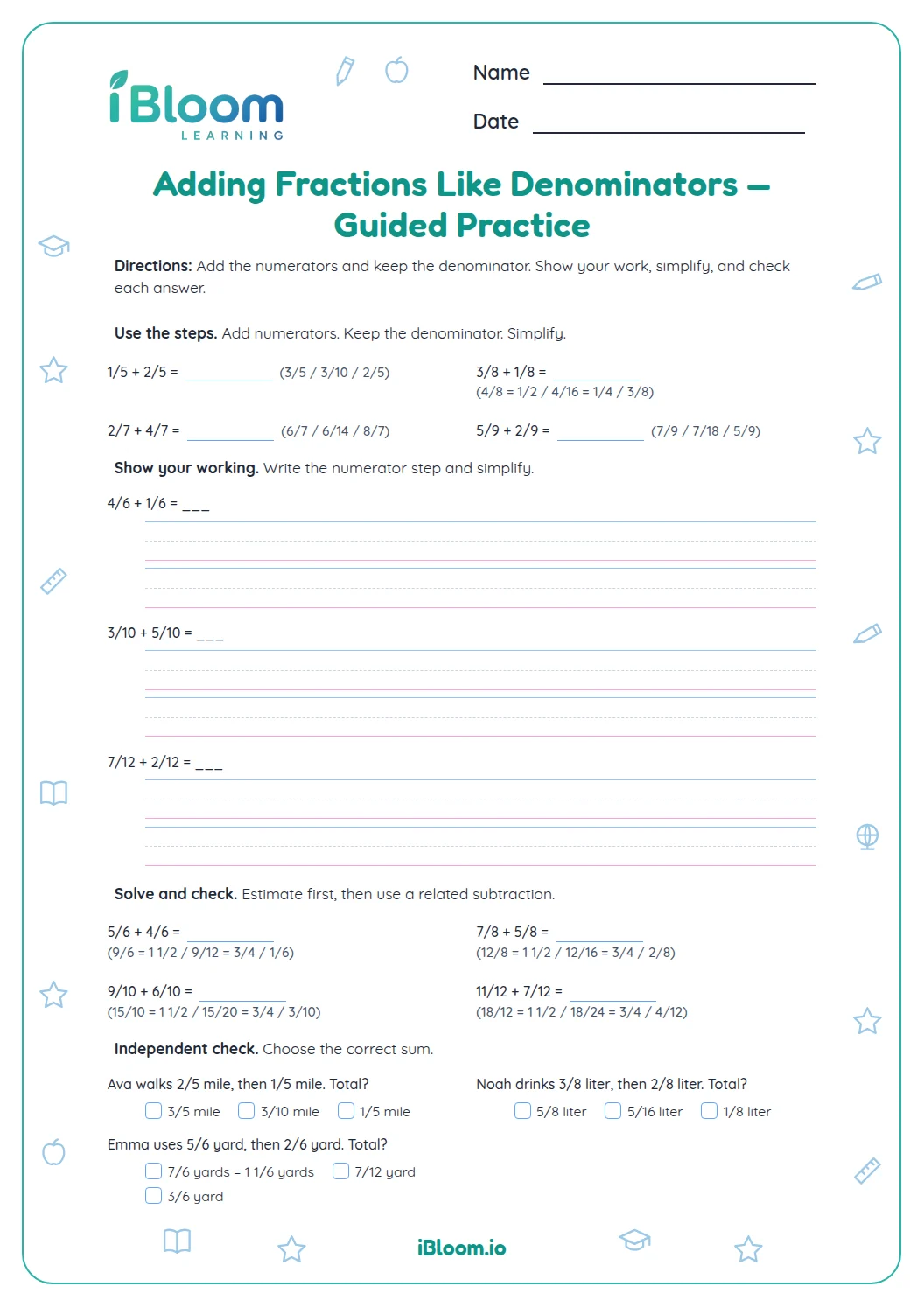
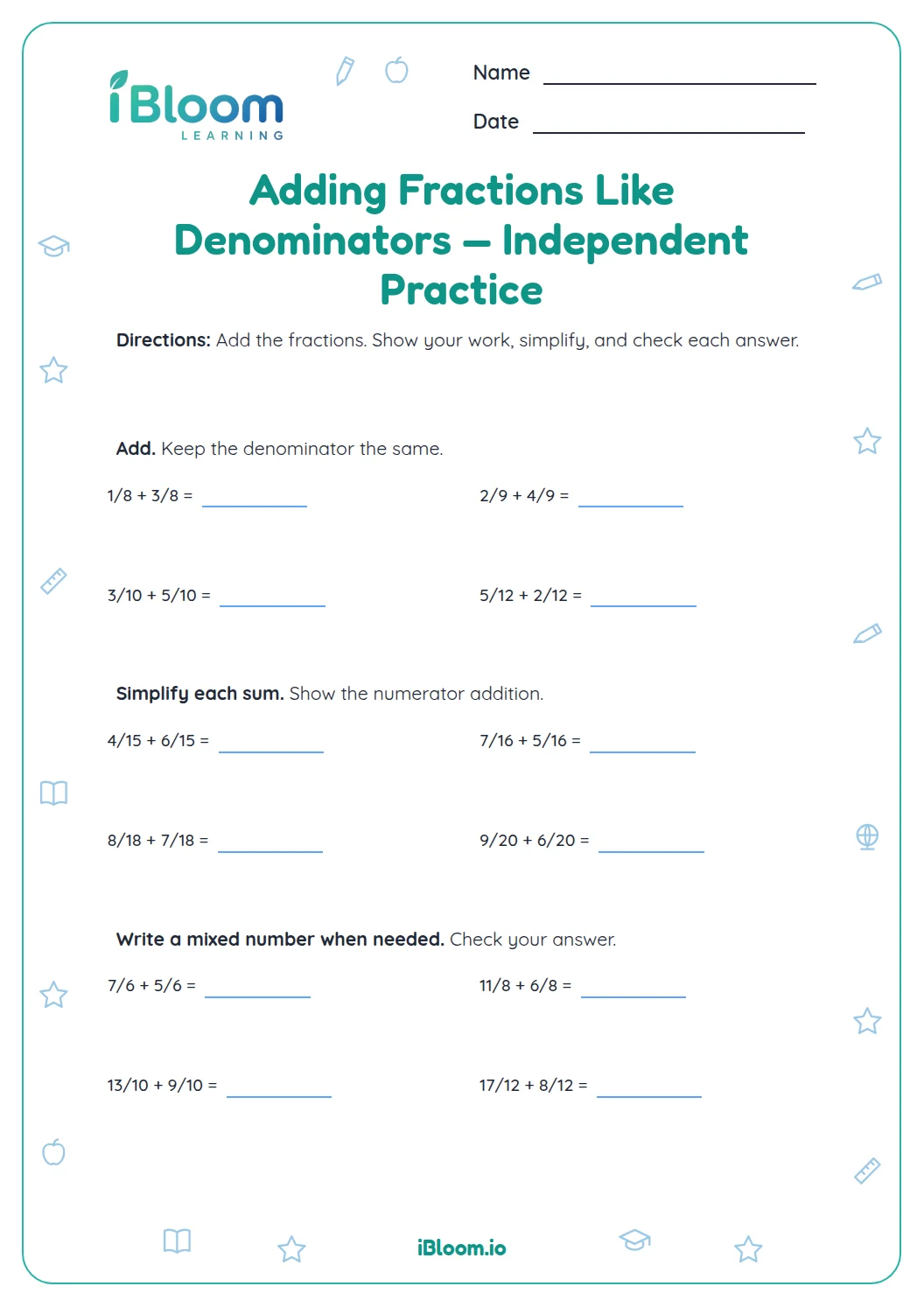
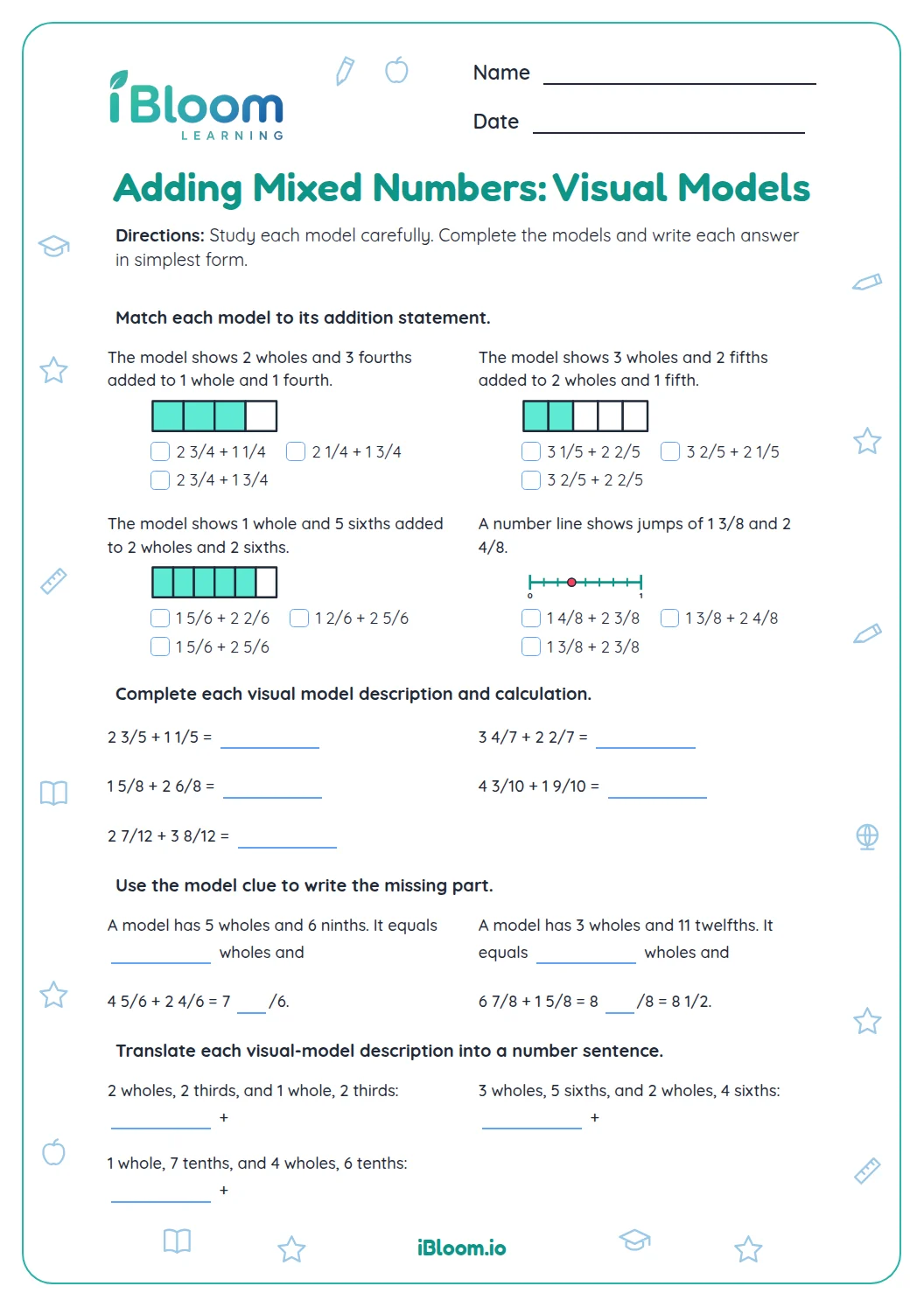
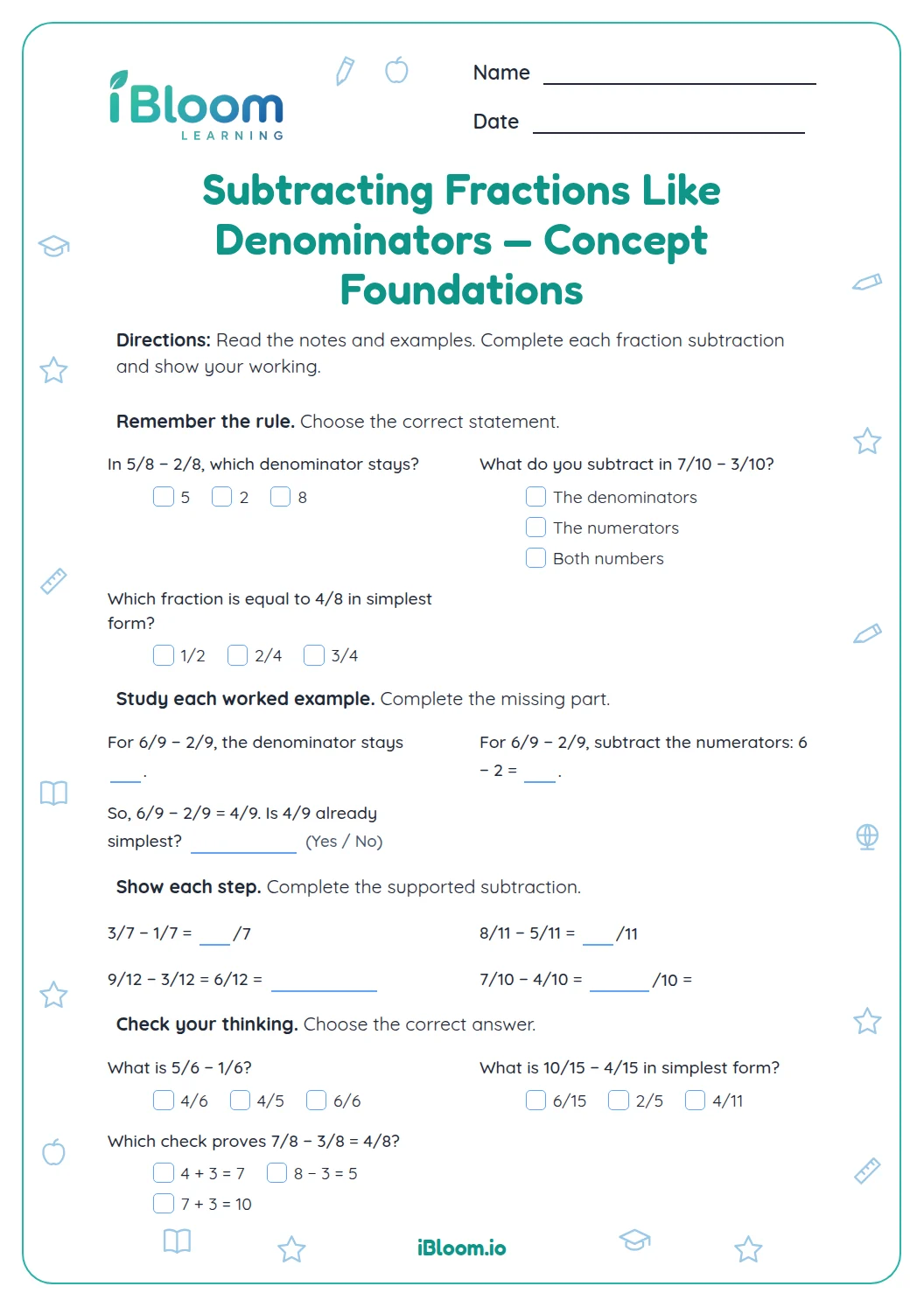
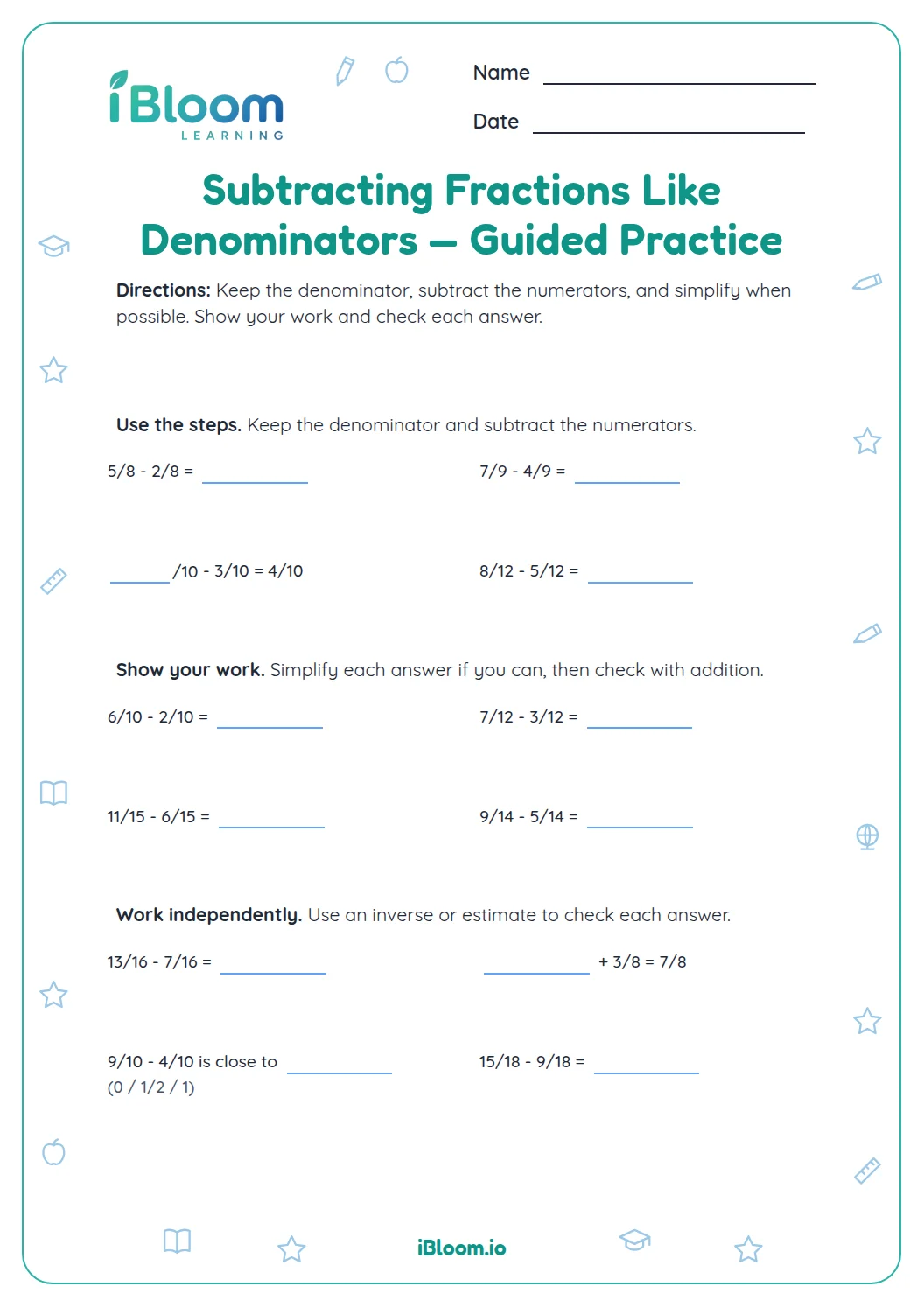
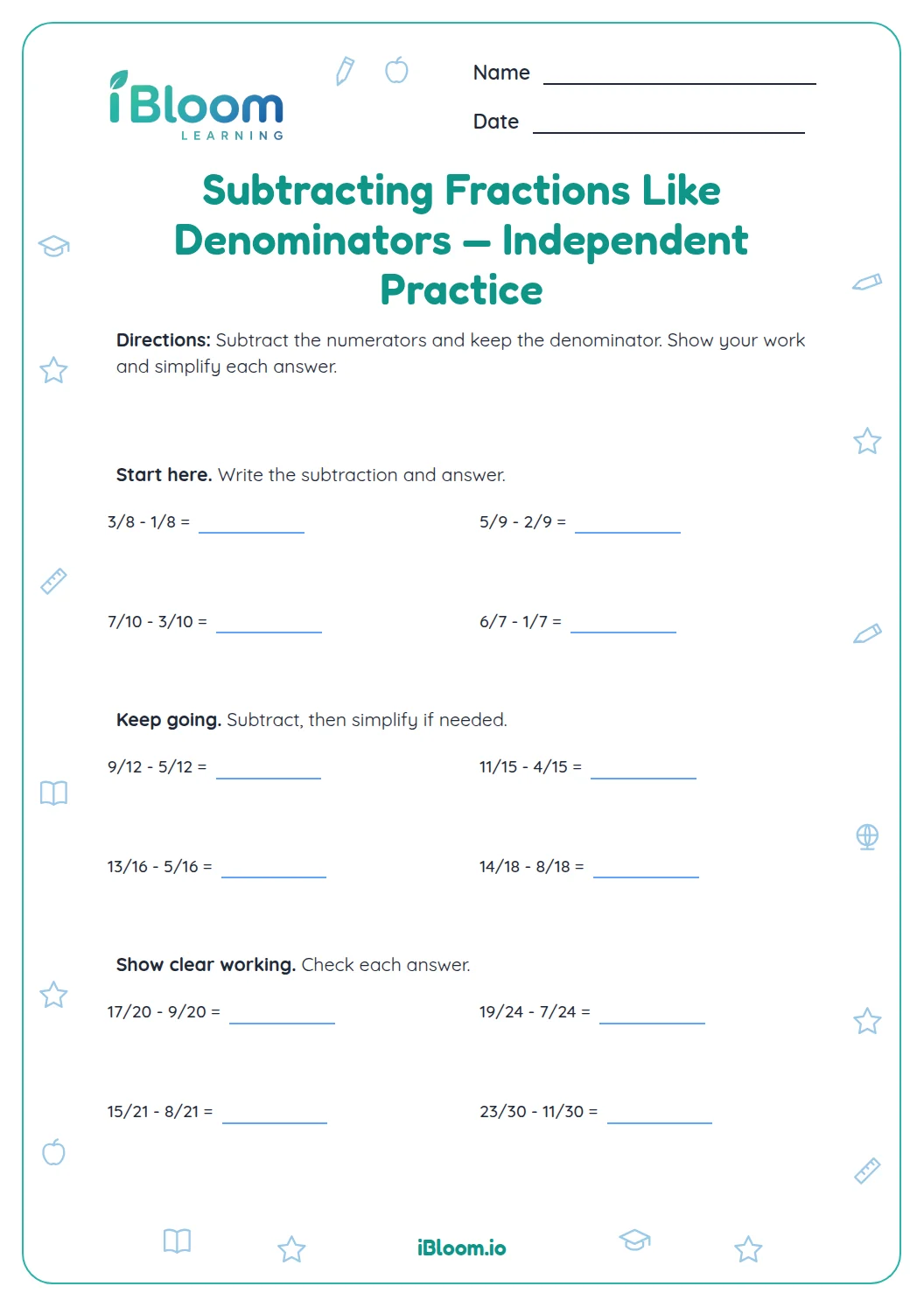
This Grade 5 worksheet uses real situations to practice adding and subtracting fractions with like denominators. 16 problems cover totals, amounts used and amounts left, with working space and a separate answer key.
How can you solve one example?
In Lena’s walk, the two distances use eighths, so the pieces have equal size. Add the numerators, 3 + 2 = 5, and keep the denominator: 3/8 + 2/8 = 5/8 mile.
- 13/8 + 2/8 = 5/8
What will the practice ask you to do?
Use like-denominator fractions to solve practical problems about distance, recipes, crafts, reading and more.
How can you check an answer?
Check that the result fits the size of the factors and that each answer matches the requested unit, fraction form or repeating cycle. Use the separate key after completing the page.
How can I use this worksheet?
- 1Read the direction at the start of each part.
- 2Write one answer for each prompt and keep its units or notation clear.
- 3Use a model, estimate or inverse operation to check the result.
- 4Compare completed work with the separate answer key.
What mistakes should students watch for?
The mistake
Adding or subtracting the denominators.
The fix
Keep the denominator because the fractional pieces are the same size.
The mistake
Using the wrong operation for what remains.
The fix
Subtract the amount used from the starting amount.
The mistake
Leaving an improper fraction unsimplified when a whole-number form is clearer.
The fix
Check whether the numerator contains one or more whole denominators.
What to practice next
Make more practice
Further reading
Questions parents and teachers ask
How many problems are included?
The worksheet has eight real-world problems in three parts, plus a separate answer key. Situations include walking, recipes, a garden, string and water. Each item asks students to find a total or a remaining amount and gives room to show a number sentence.
Why do you keep the denominator when adding like fractions?
The denominator names the size of each piece. In 3/8 + 2/8, both amounts are measured in eighths, so combine the three eighths and two eighths to get five eighths. The sum is 5/8, not 5/16. Students may leave an equivalent fraction unsimplified or reduce it, as long as its value is unchanged.
Can an answer be written in a simplified form?
Yes. When the numerator and denominator share a factor, a simplified equivalent fraction is also correct. For instance, 6/8 equals 3/4 and 6/12 equals 1/2. The key lists equivalent forms where simplifying is useful. Look for whether an amount is being combined or whether some of it is being used or removed; that signals the operation.
How can students tell whether to add or subtract?
Look at what changes in the story. Combining two distances or ingredients calls for addition; using some of an amount or clearing part of a surface calls for subtraction. Writing the equation before calculating helps connect the operation to the situation. The standard describes fraction addition and subtraction through equivalent fractions, and these story problems apply the like-denominator case.