


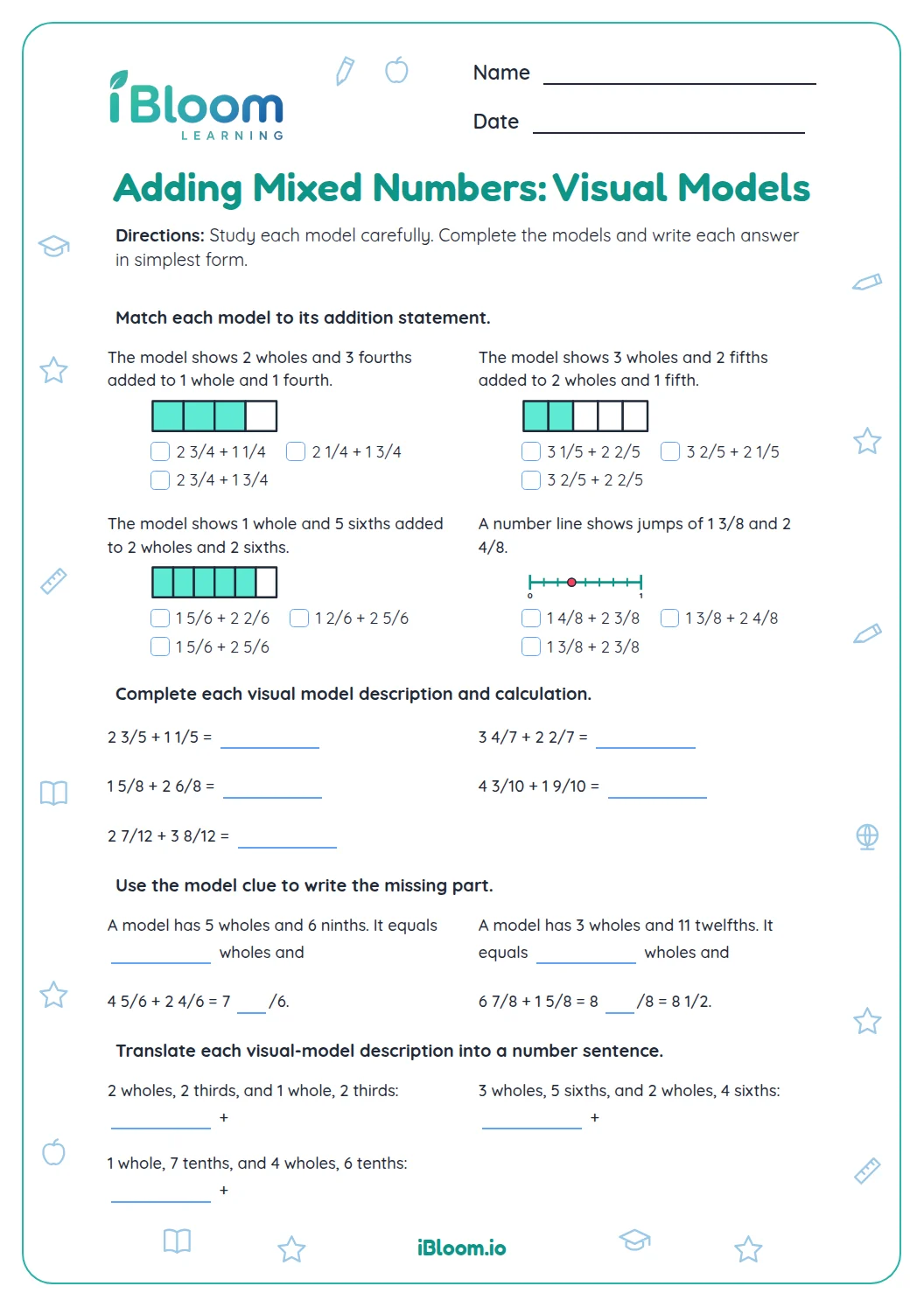
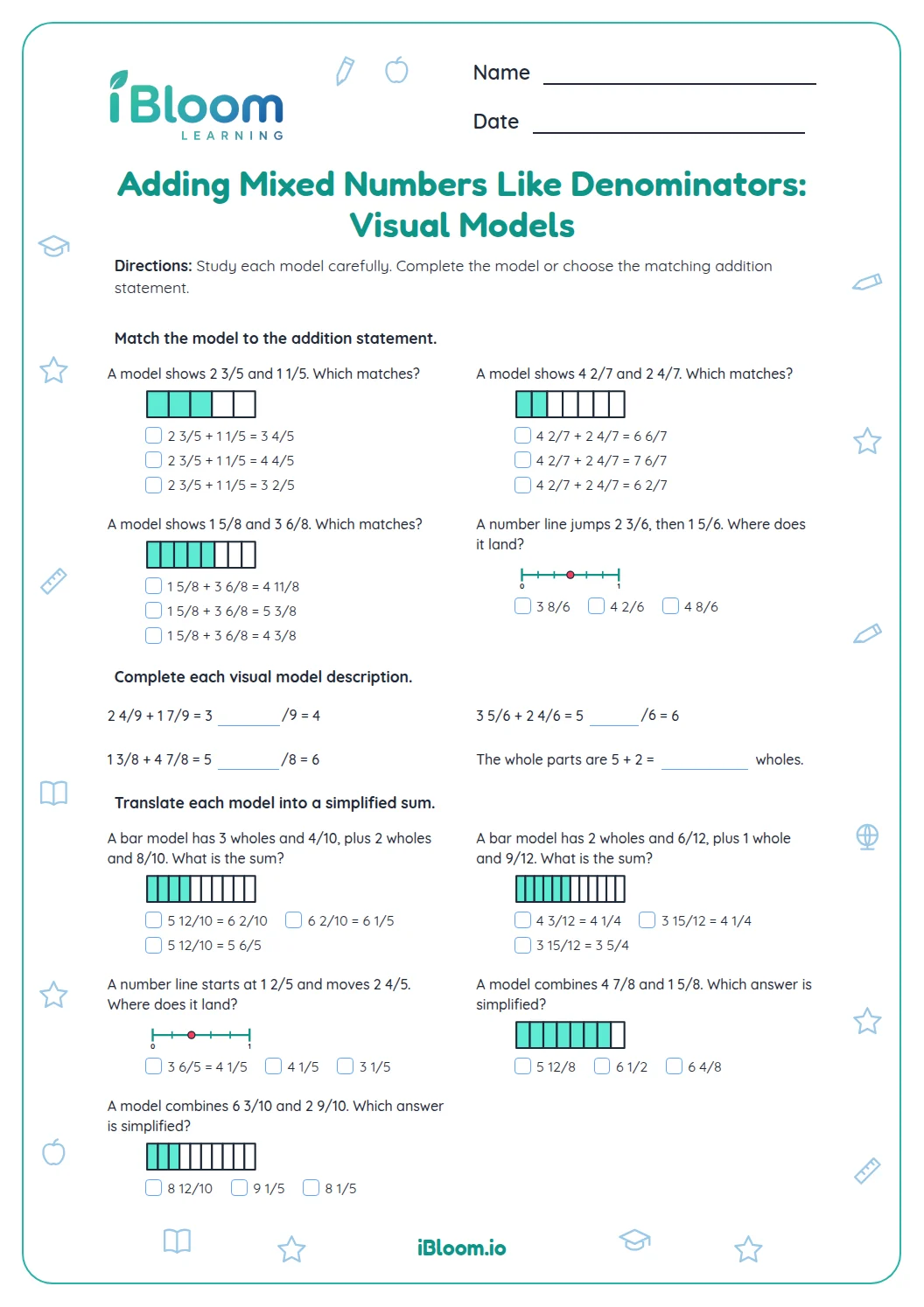

About this worksheet
This free printable Grade 5 worksheet helps students practice adding and subtracting fractions with like denominators. It includes shaded fraction and number-line models, focused problems, and short situations that apply the same idea. Students can use the models to connect equal parts with fraction notation. The sheet has 16 questions in three parts and a separate answer key. It practices CCSS 4.NF.B.3.a.
Aligned to 4.NF.B.3.a
How do the models show the math?
The drawings make like denominators name equal-size parts; combine the numerators and keep the denominator. visible. Count equal parts first, then identify how many are shaded or marked.
For each model question, use only the values printed with the drawing and prompt.
- 1Question 1 joins 2/8 and 3/8, so 2/8 + 3/8 = 5/8.
- 2The bar shows five of eight equal parts shaded.
How do students add or subtract like fractions?
For addition, combine the number of equal-size parts. For subtraction, find how many equal-size parts remain.
Keep the denominator because the size of each part does not change.
What is on the printable?
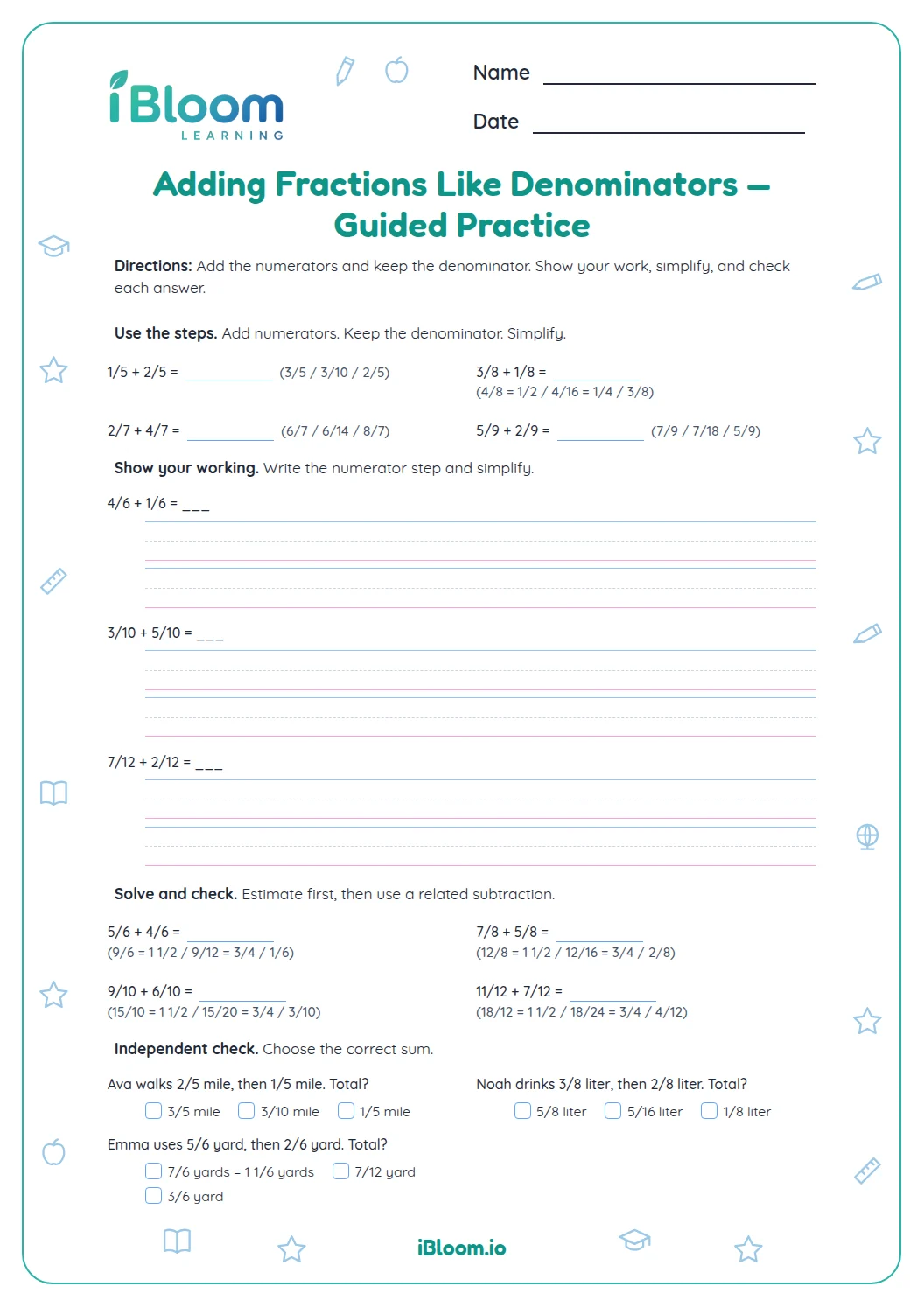
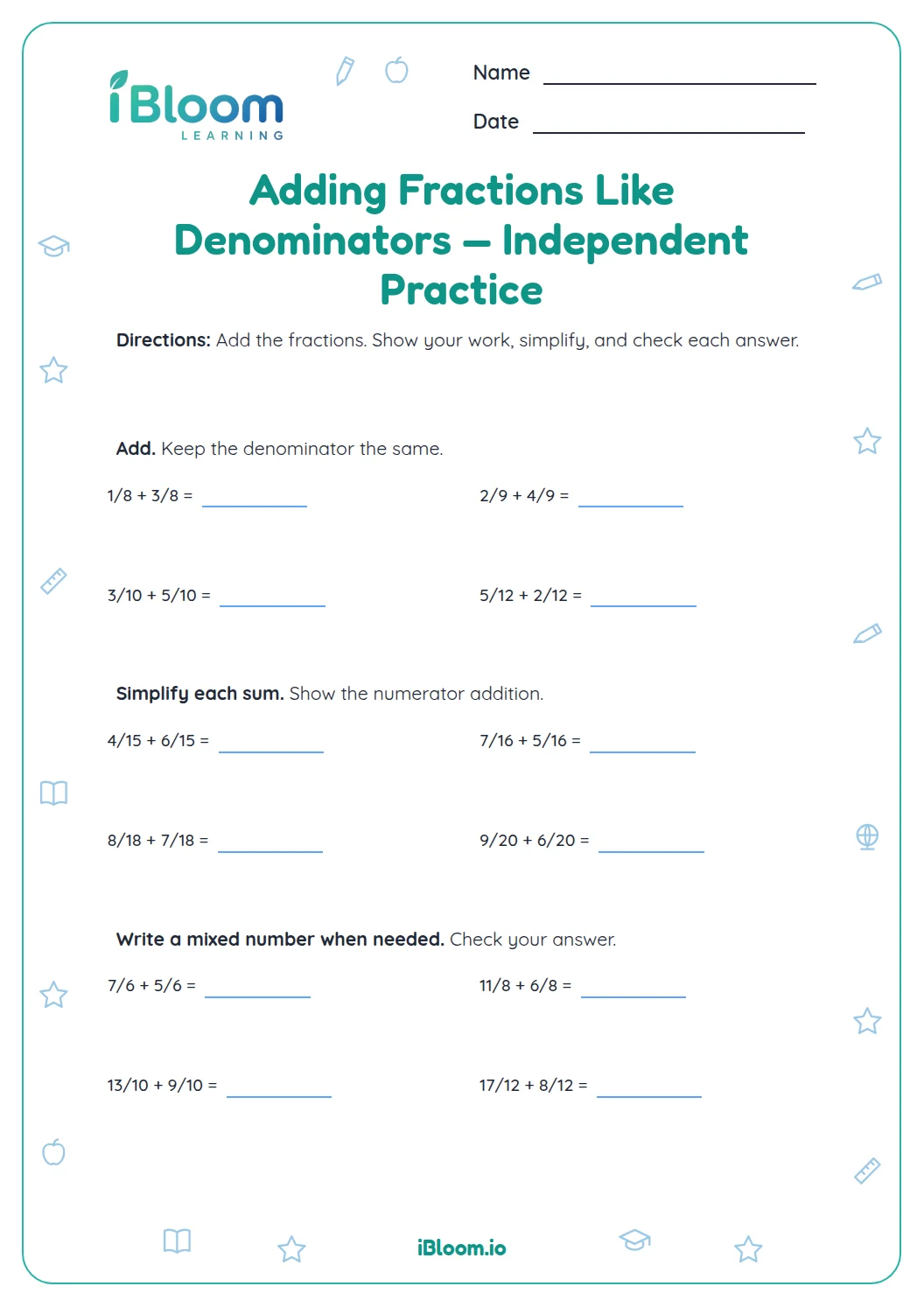
Part A has six model questions, Part B has six focused problems, and Part C has four applications. The answer key follows the worksheet.
- Read six visual models
- Solve six direct problems
- Apply the skill in four short situations
- Use the key to check each result
How can students use this worksheet?
- 1Check that the fractions name the same denominator.
- 2Decide whether the problem joins or separates parts.
- 3Add or subtract the numerators.
- 4Keep the common denominator.
- 5For a story, include the unit and check the result against the quantities.
Common mistakes and quick fixes
The mistake
Adding denominators together.
The fix
The equal parts stay the same size; combine the numerators only.
The mistake
Forgetting to regroup an improper sum as a mixed number when helpful.
The fix
Group one full denominator of parts as a whole.
The mistake
Using addition when the story asks how much remains.
The fix
Look for the amount removed and subtract it from the starting amount.
Common Core alignment
This worksheet practices adding and subtracting fractions with like denominators through models and written problems.
Understand fraction addition and subtraction as joining or separating parts of one whole.
On this sheet: The practice combines and separates fraction parts with like denominators.
Show the official wordingHide the official wording
Understand addition and subtraction of fractions as joining and separating parts referring to the same whole.
What to practice next
Make more practice
Further reading
Questions parents and teachers ask
How many questions are on the printable?
There are 16 questions across three parts: six model questions, six focused problems, and four applications. The worksheet and answer key take four pages in all. About 20 minutes gives time to work, compare answers with the models, and review any calculation that needs another look.
How should students use the models?
Have students name the whole and count the equal parts before reading the shaded amount. They can then connect that amount to the expression in the prompt. This sequence helps them check whether the drawing and calculation represent the same quantity.
Does the answer key include units?
The answer key gives a result for every question. When a story asks for a measurement, students should include the unit in their own answer. If a unit is printed after the answer blank, the key gives only the number so the unit is not repeated.
What should students do when they get stuck?
Return to the specific model or expression in that question. Ask what one equal part represents, then identify how many parts the situation combines or removes. For a story, a quick equation can help connect the words to the operation.
Can students show their work?
Yes. The focused problems and applications provide space for written work, and students can write a short equation before giving each result. Encourage them to keep the units with measurement answers and to check their calculations against any model.