



About this worksheet
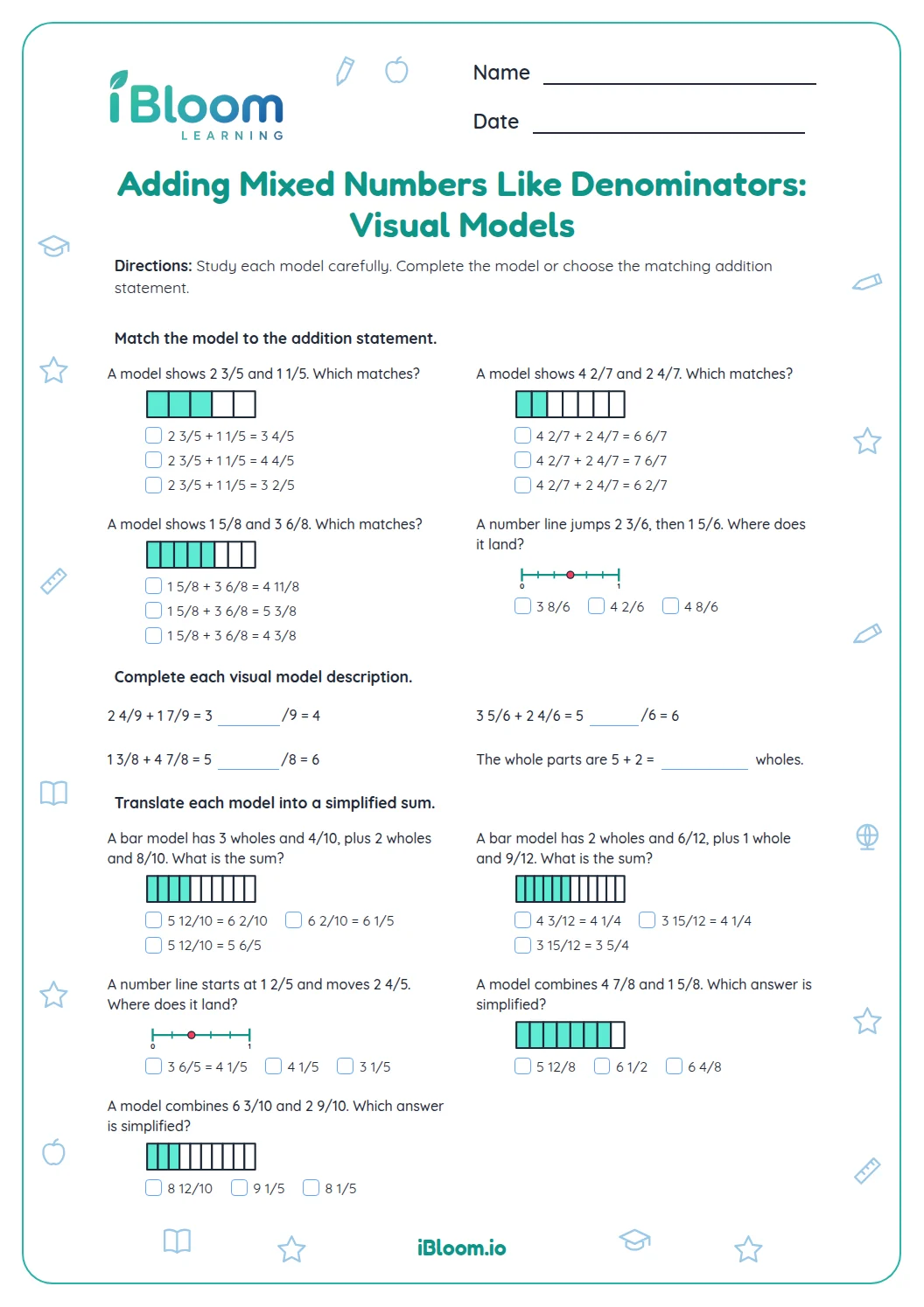
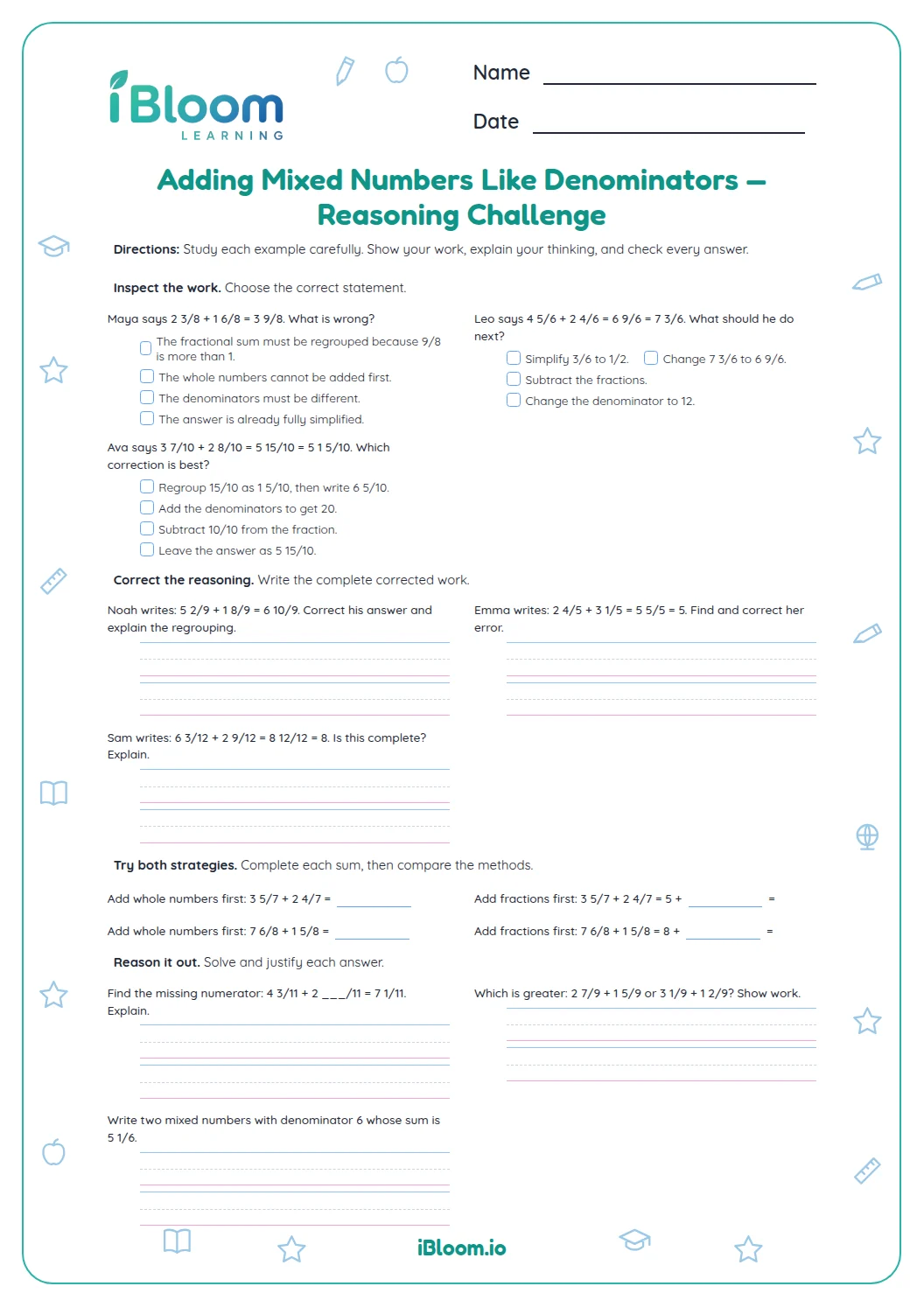
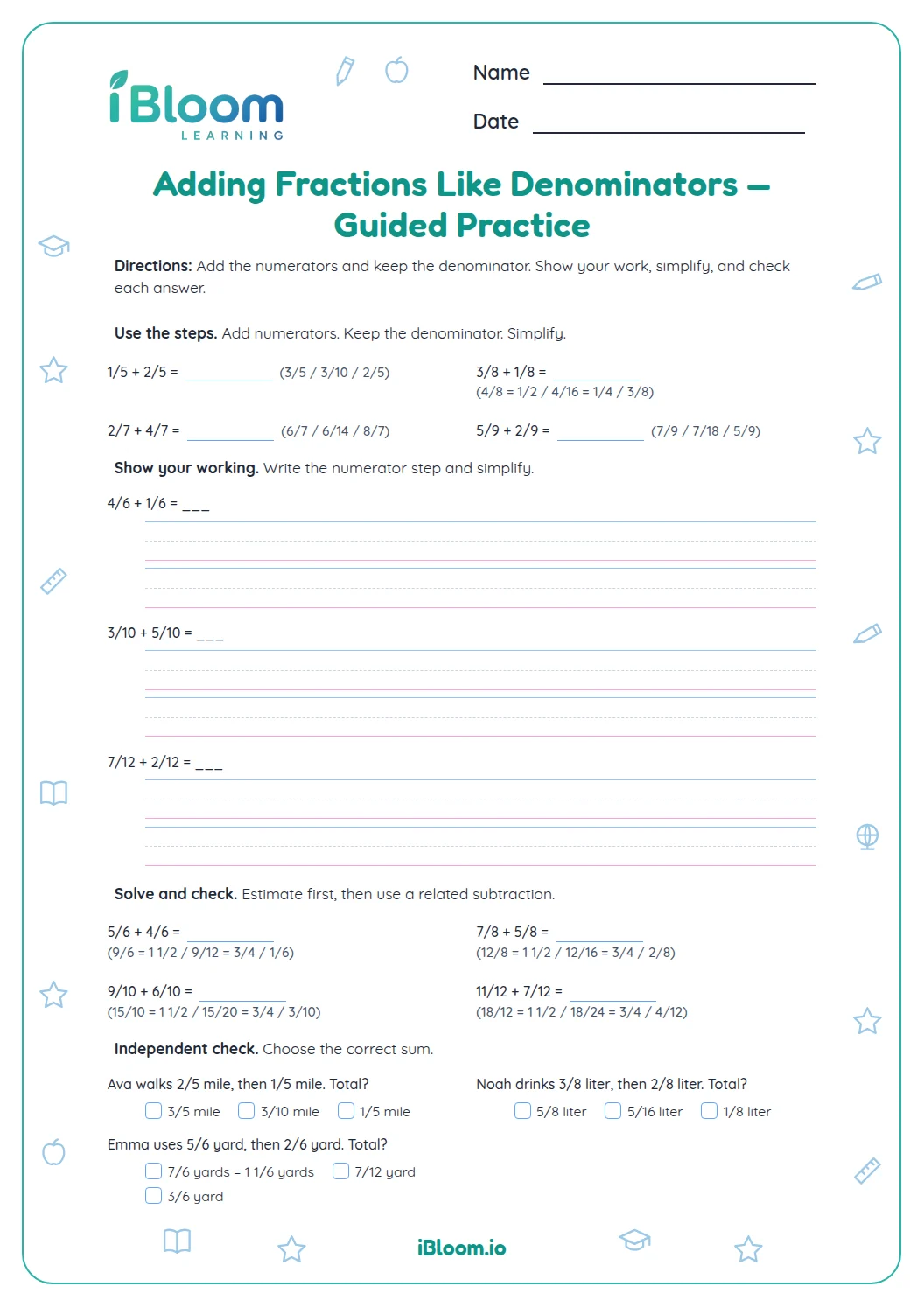
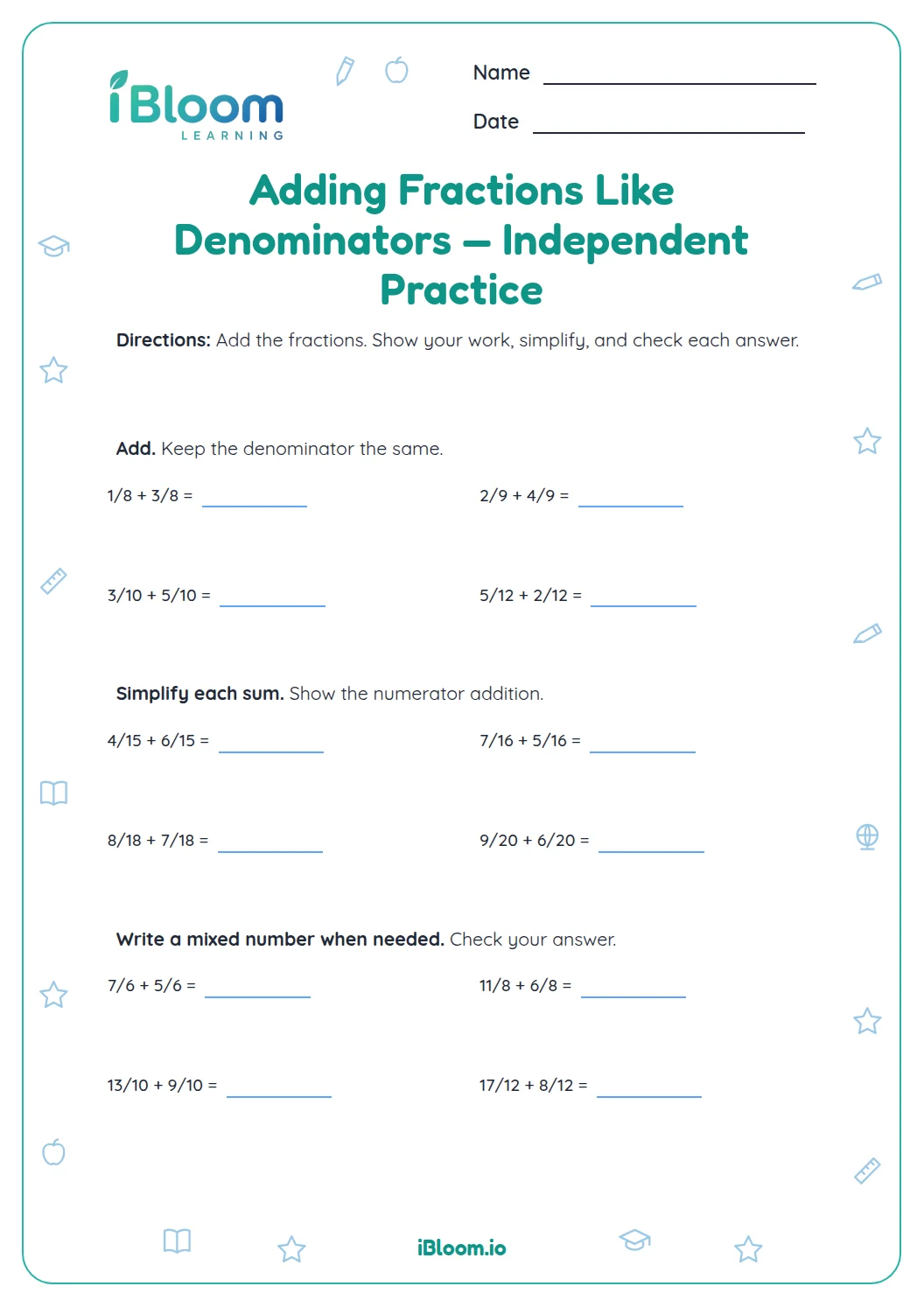
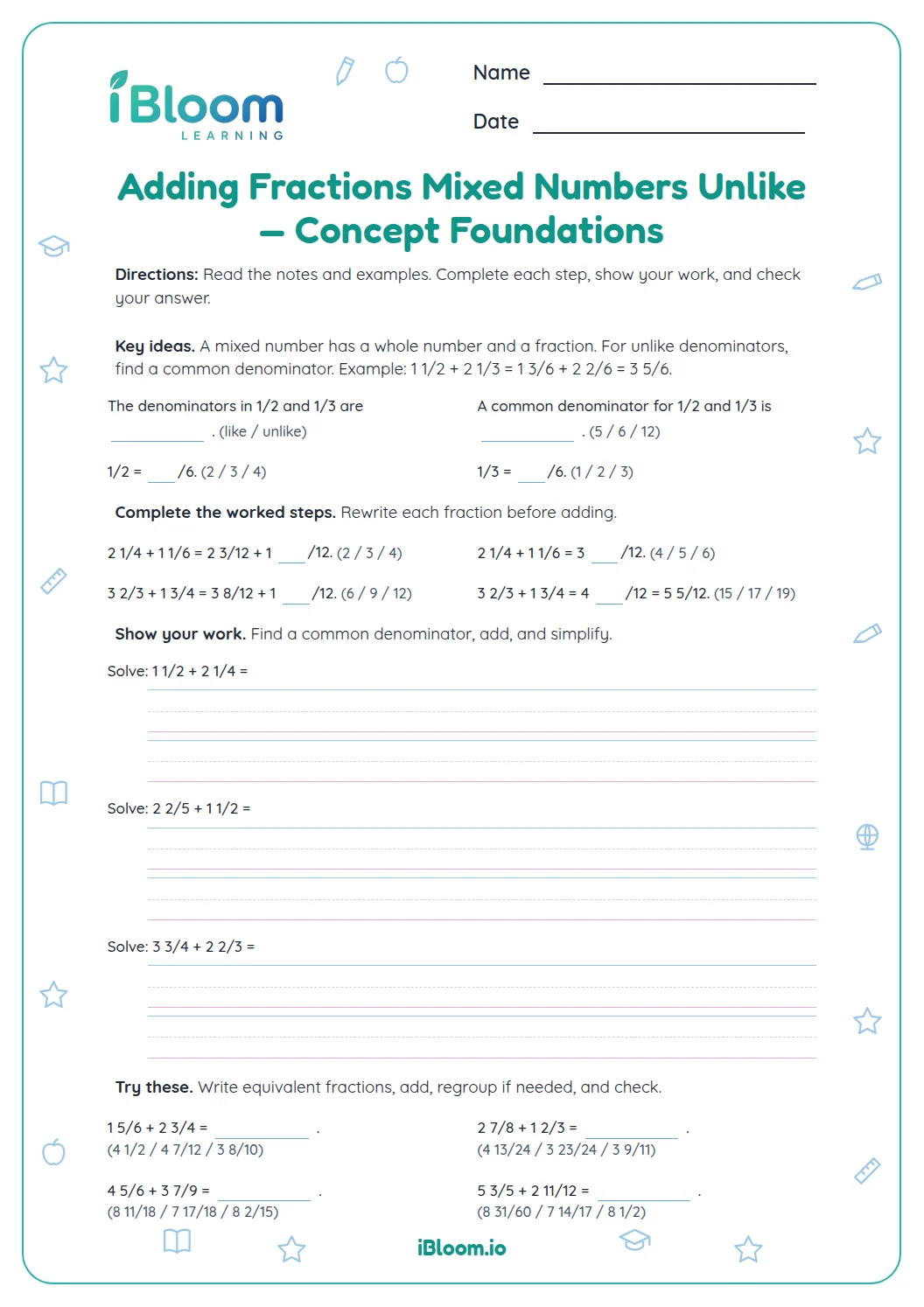
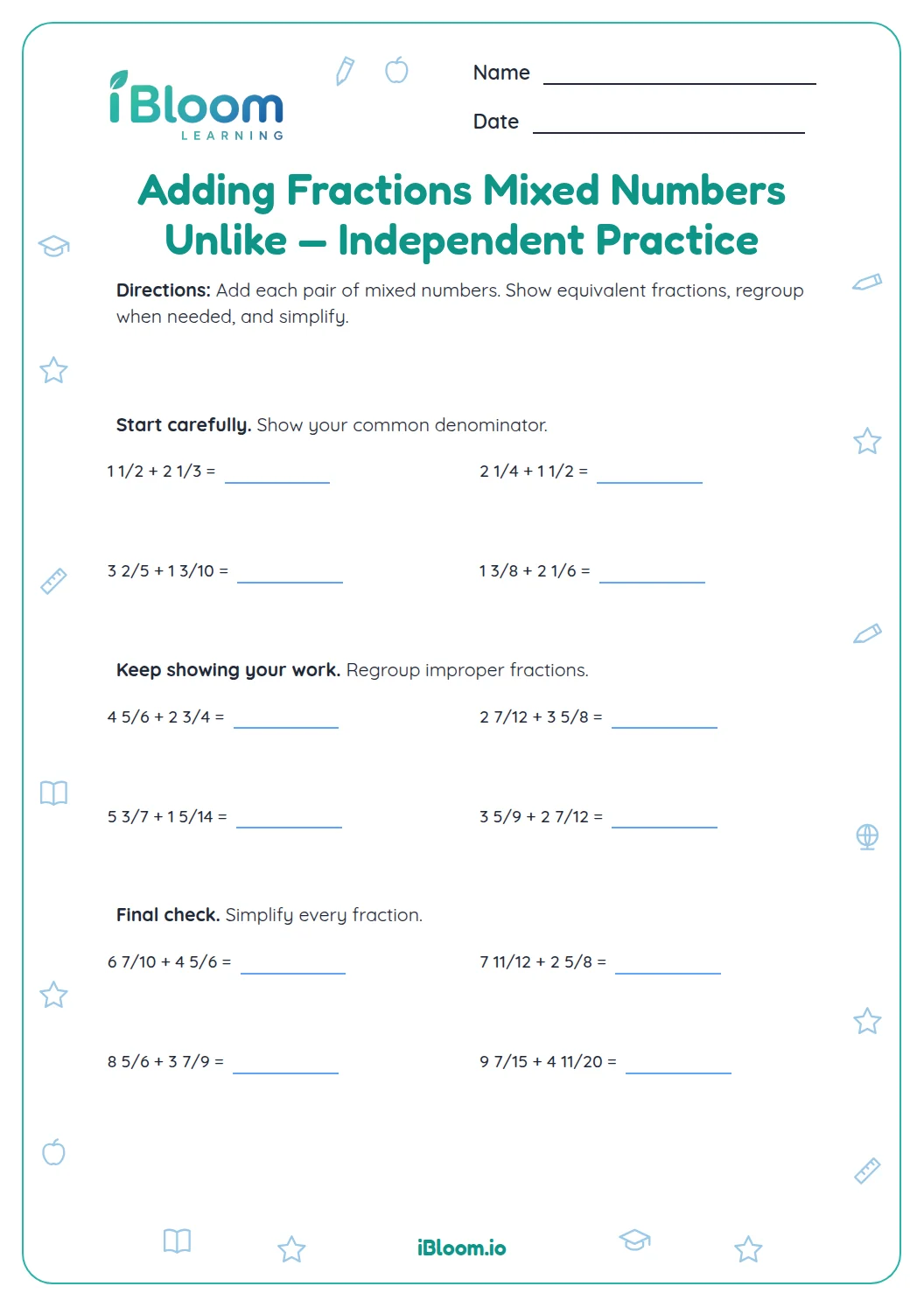
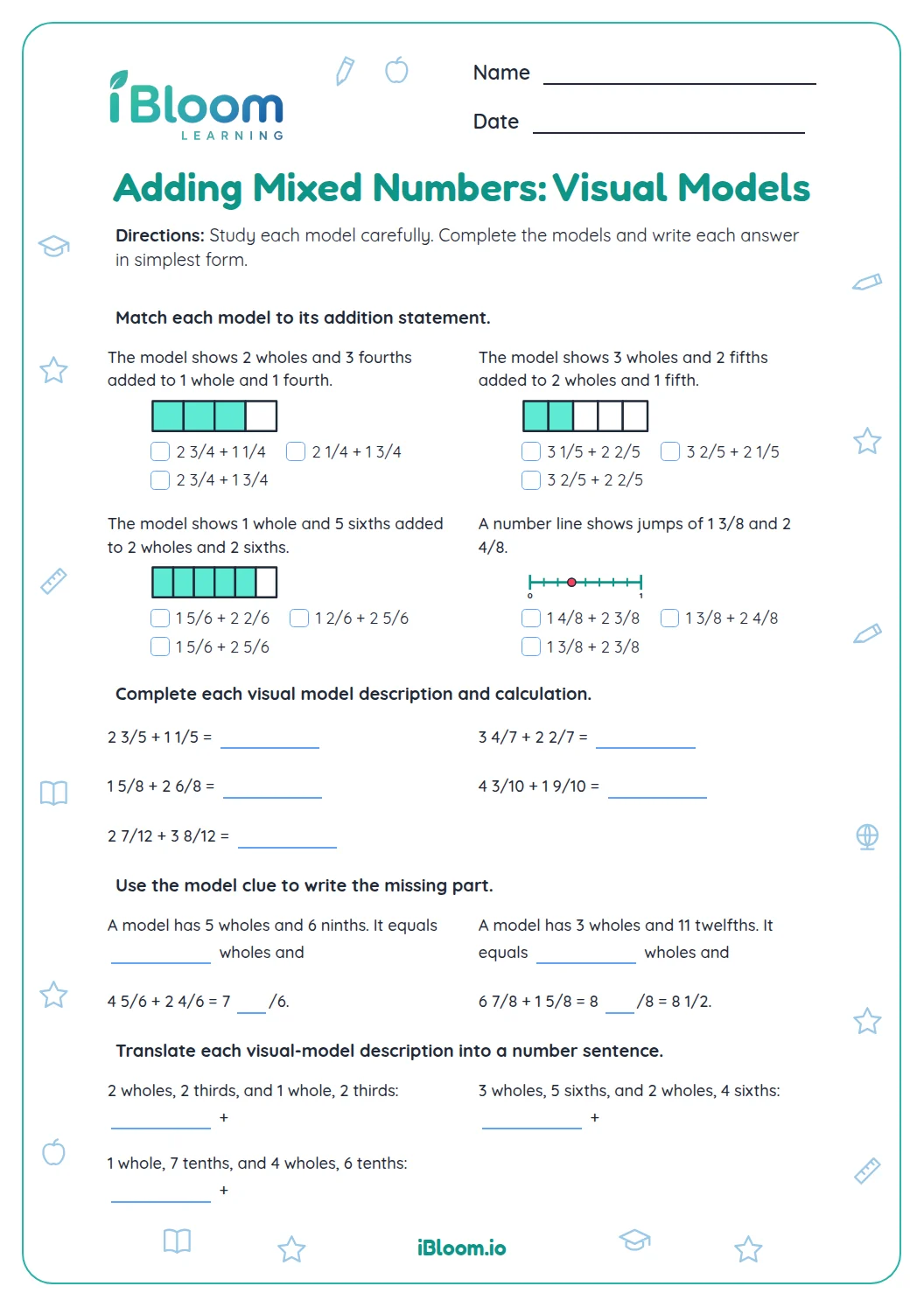
This free printable helps Grade 5 students add mixed numbers with like denominators and estimate. It has 12 questions in two parts: eight exact sums and four sums with a separate estimate blank. Students add the whole numbers and fractional numerators, regroup when needed, and round each addend to the nearest whole for an estimate. A separate answer key follows the two worksheet pages. It aligns with Common Core 5.NF.A.1.
Aligned to 5.NF.A.1
What steps solve these problems?
Add whole numbers and fractional numerators, regroup if needed, and round each addend to the nearest whole for an estimate.
- 17 8/10 + 2 7/10
- 27 + 2 = 9 and 8/10 + 7/10 = 15/10.
- 315/10 = 1 1/2.
- 49 + 1 1/2 = 10 1/2.
- 5Rounded addends: 8 + 3 = about 11.
What is on the printable?
The first eight items ask for exact sums. The final four ask for a sum and an estimate in separate blanks; the answer key follows on two pages.
How can students check their work?
Round each mixed number to the nearest whole, then add those rounded values. Keep that estimate separate from the exact sum.
How to work through the sheet
- 1Read the whole number and fraction parts carefully.
- 2Find a common denominator if the denominators differ.
- 3Rewrite each fraction with an equivalent fraction.
- 4Combine numerators and whole numbers.
- 5Regroup a fraction greater than one into a whole when needed.
- 6Simplify and check the result against an estimate.
Common fraction mistakes and fixes
The mistake
Adding denominators along with numerators.
The fix
Keep the common denominator and add only the numerators.
The mistake
Combining fractional parts before finding equivalent fractions.
The fix
Rename both fractions with the same denominator first.
The mistake
Leaving a fractional sum greater than one unregrouped.
The fix
Trade one whole set of denominator-sized parts for 1 whole.
Common Core alignment
This worksheet practices equivalent fractions and subtraction with unlike denominators.
Rename unlike fractions with equivalent fractions to use a common denominator.
On this sheet: Students rename unlike fractions with equivalent fractions, then subtract using like denominators.
Show the official wordingHide the official wording
Add and subtract fractions with unlike denominators (including mixed numbers) by replacing given fractions with equivalent fractions in such a way as to produce an equivalent sum or difference of fractions with like denominators.
What to practice next
Make more practice
Further reading
Questions parents and teachers ask
What steps does this sheet teach?
Add whole numbers and fractional numerators, regroup if needed, and round each addend to the nearest whole for an estimate. The questions move from initial steps to independent computation, and the separate answer key lets students check each result. Encourage students to write each equivalent-fraction or regrouping step before simplifying.
How should a student check an answer?
Confirm that the renamed fractions keep their value, subtract the numerators only after denominators match, and check that the result is nonnegative and simplified. The answer key provides a quick comparison after the student has completed the work.
What comes with the printable?
The printable has two student worksheet pages followed by two answer-key pages. Each key response is listed in question order, so students can compare a result with the matching item after completing their work. The format keeps the practice and checking steps together.
How many questions are included?
The student sheet contains 12 questions arranged in two parts. The first part builds the main computation steps, while the next set gives students a chance to apply the skill with less support. The key follows the student pages.
How long might the practice take?
About 20 minutes is a reasonable starting point for this practice. Students who write every fraction step may need more time, especially when regrouping or simplifying. Encourage them to finish a section before checking answers so they can spot which step needs review.