





About this worksheet
This free printable Grade 5 worksheet practices finding the missing amount in mixed-number subtraction through 18 questions in 5 parts. It includes direct practice, reasoning or checking, and application items, followed by a separate answer key.
Aligned to 5.NF.A.1 and 5.NF.A.2
How do you find a missing subtrahend?
In a sentence like starting amount − missing amount = result, subtract the result from the starting amount. Addition can also undo subtraction: the missing amount plus the result must equal the starting amount.
Question 1 is 7 2/3 − ___ = 4 1/3. The missing amount is 3 1/3, and substituting it makes the equation true.
- 17 2/3 − ___ = 4 1/3
- 27 2/3 − 4 1/3 = 3 1/3
- 3Check: 7 2/3 − 3 1/3 = 4 1/3
How can you check the unknown?
Put the proposed subtrahend back into the original equation. Subtract and confirm that the result matches exactly, including its fractional part.
What kinds of questions are included?
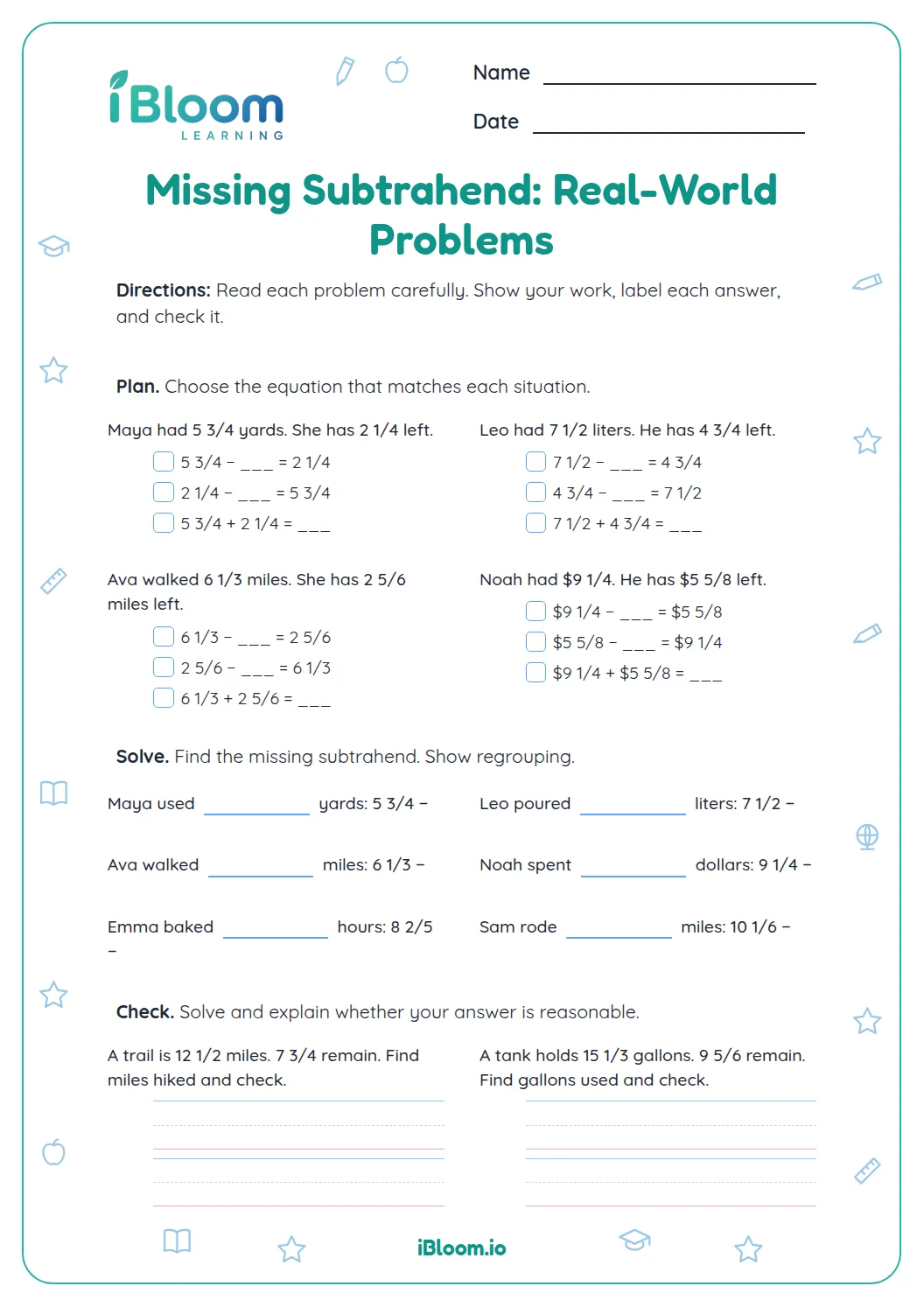
The 18 items include missing-number equations with like and unlike denominators, four amount stories, and a check-a-solution prompt. The key shows the missing amounts in simplified form.
How can you use this worksheet?
- 1Read the equation as starting amount minus amount taken equals amount left.
- 2Subtract the result from the starting amount.
- 3Use equivalent fractions if needed.
- 4Substitute the unknown into the original sentence.
- 5For story problems, include the unit named in the question.
What mistakes should students check?
The mistake
Subtracting the starting value from the result and reversing the order.
The fix
Use starting amount minus result to find what was taken away.
The mistake
Taking only the whole-number difference and ignoring the fractions.
The fix
Rename fractional parts and subtract them as well.
The mistake
Finding a candidate but not checking it in the original equation.
The fix
Substitute the candidate and evaluate both sides.
Common Core alignment
Use equivalent fractions to subtract unlike-denominator fractions and mixed numbers.
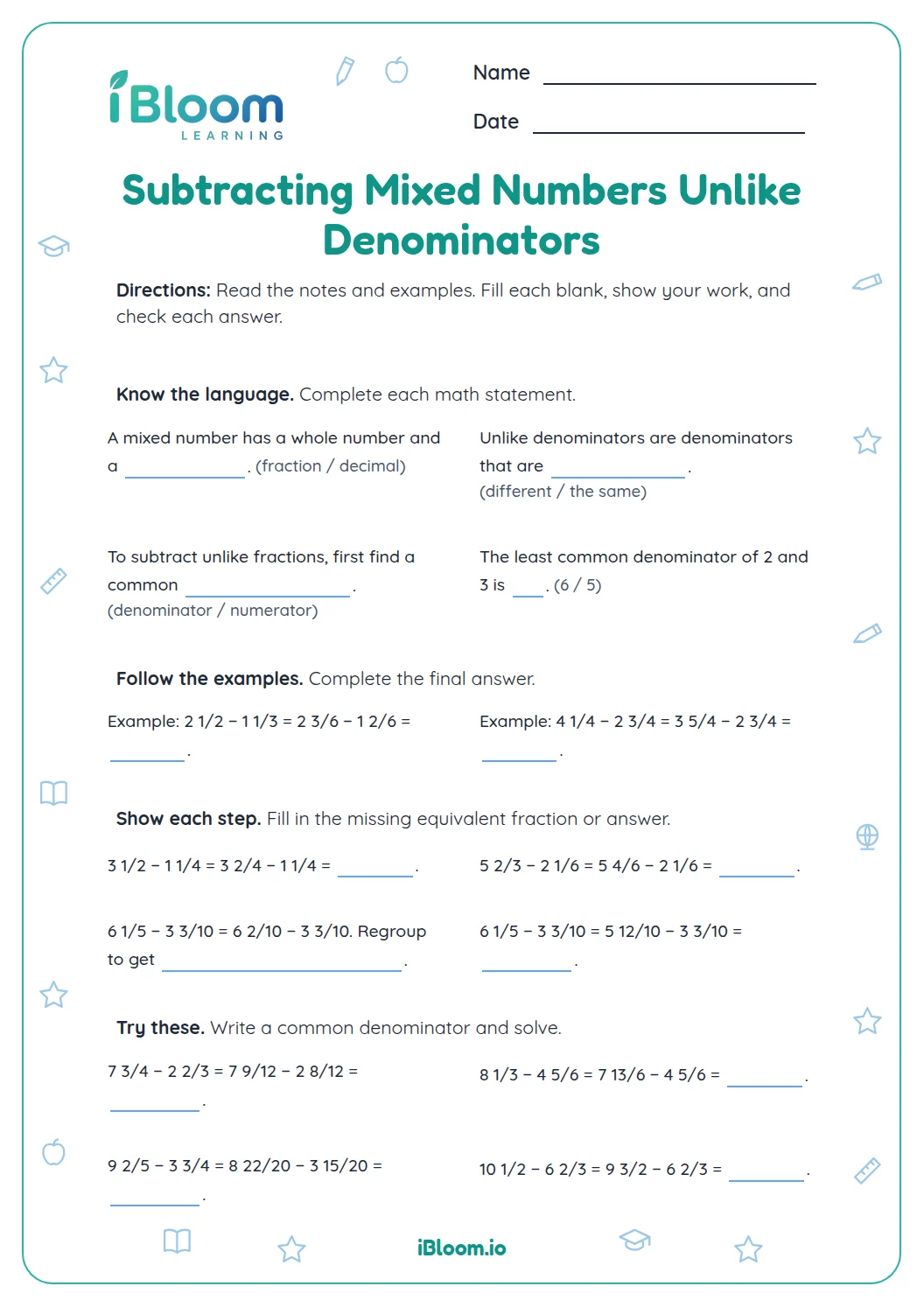
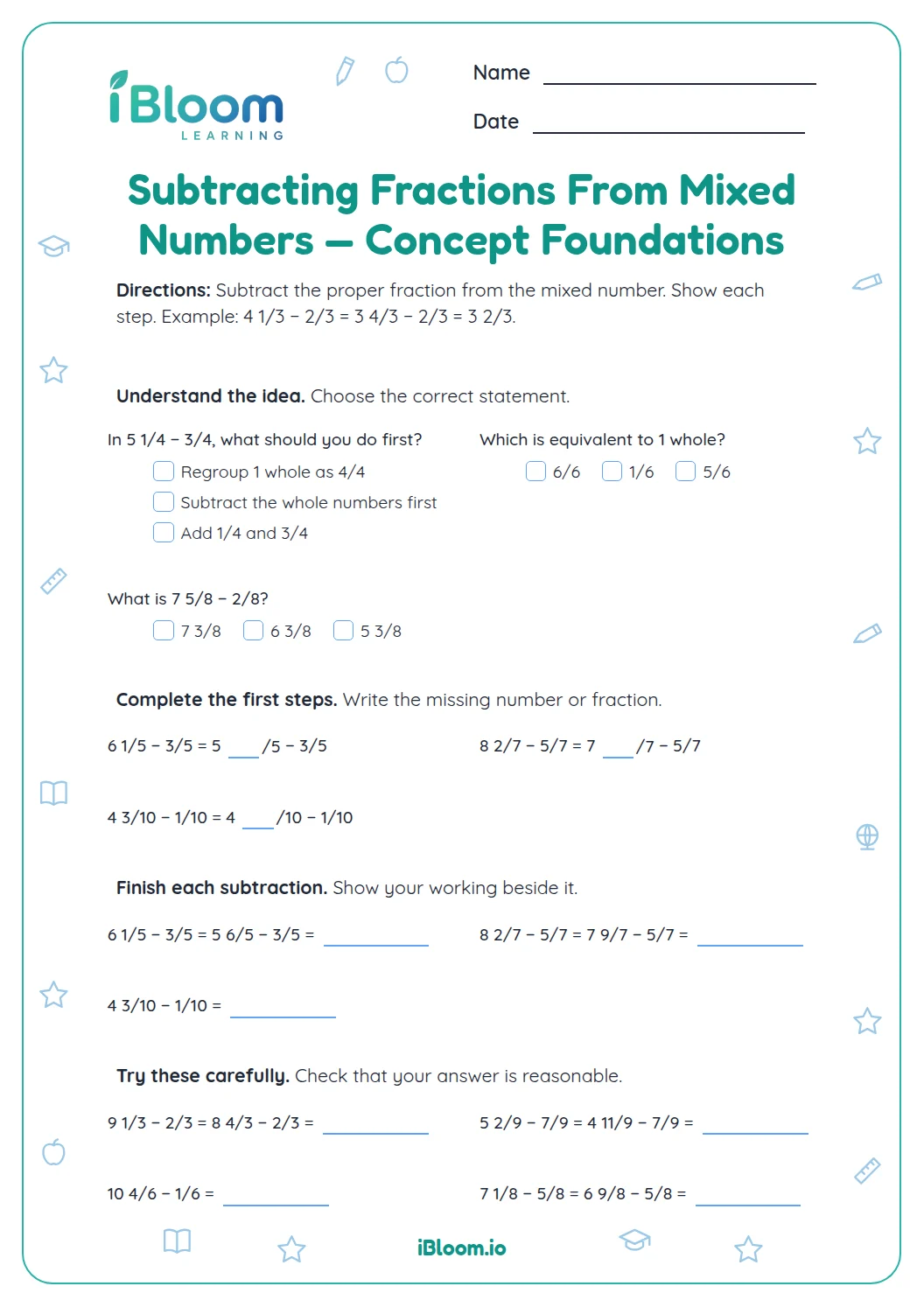
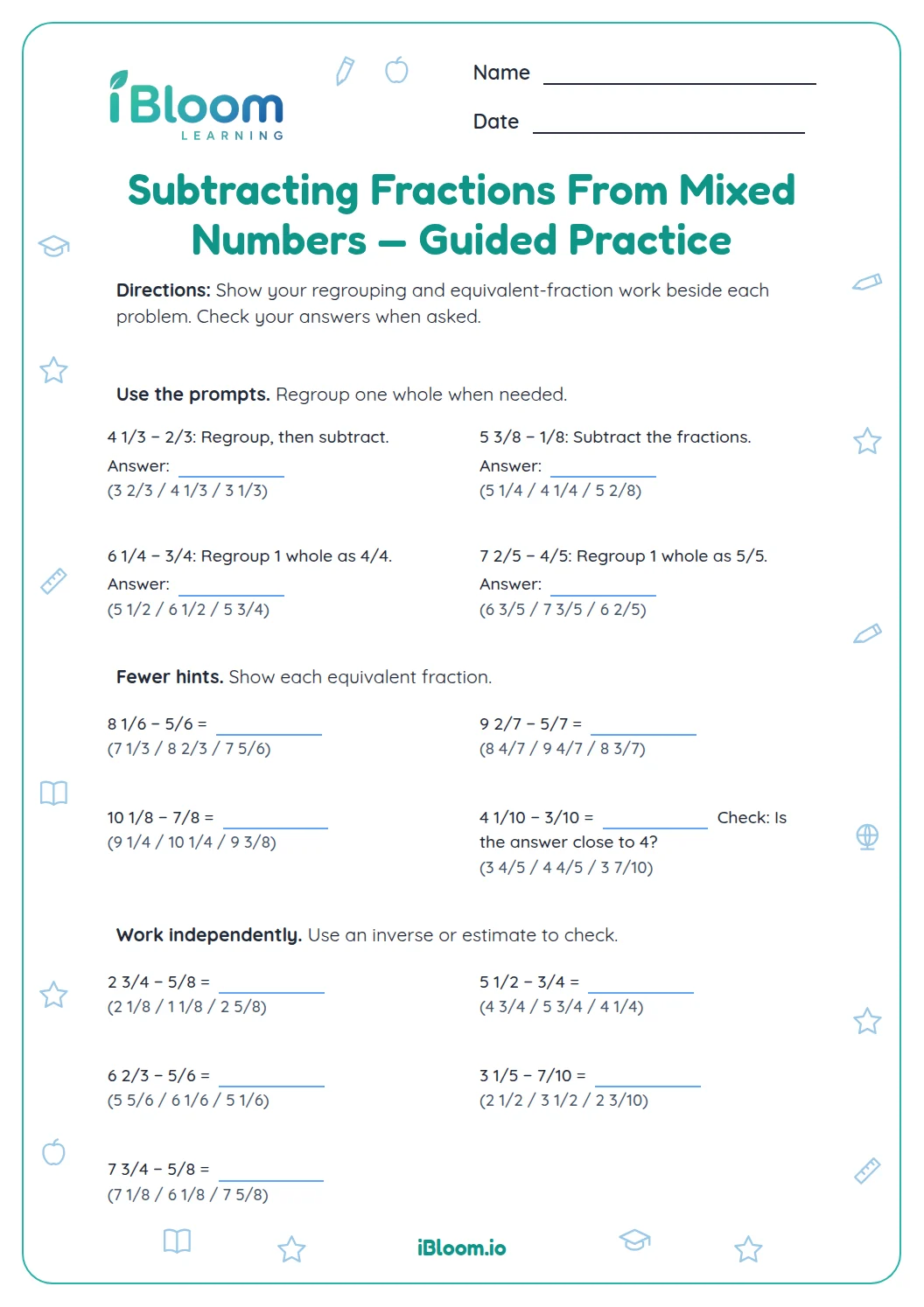
On this sheet: Use equivalent fractions and regrouping to subtract mixed numbers.
Show the official wordingHide the official wording
Add and subtract fractions with unlike denominators (including mixed numbers) by replacing given fractions with equivalent fractions in such a way as to produce an equivalent sum or difference of fractions with like denominators.
Represent and solve fraction subtraction word problems with equations.
On this sheet: Solve the worksheet’s mixed-number subtraction stories with equations.
Show the official wordingHide the official wording
Solve word problems involving addition and subtraction of fractions referring to the same whole, including cases of unlike denominators, e.g., by using visual fraction models or equations to represent the problem.
What to practice next
Make more practice
Further reading
Questions parents and teachers ask
What does a missing subtrahend represent?
It is the amount taken from the starting value. When the start and the result are known, subtract the result from the start to find the missing amount. Add the missing amount to the result to check that it returns to the original start.
What is missing in 7 2/3 − ___ = 4 1/3?
The missing subtrahend is 3 1/3. Subtracting gives 7 2/3 − 3 1/3 = 4 1/3. As a second check, 3 1/3 + 4 1/3 = 7 2/3, so the values fit the original equation. This check confirms both the amount removed and the amount left.
Can addition help find the missing number?
Yes. In start − unknown = result, the unknown plus the result must equal the start. Add the known result back to the unknown, or subtract the result from the start, then substitute your candidate into the original equation.
Why do some missing numbers require regrouping?
The starting fractional part may be smaller than the fraction in the result. Rename one whole as denominator-sized pieces, then make the denominators match. This keeps the quantities equal while making the subtraction possible. The regrouped whole represents the same amount, just in smaller equal pieces.
What contexts are included?
Four stories involve a rope, tank, flour supply, or hike. Each gives a starting and remaining amount and asks how much was used or traveled. The unit is part of the question, so include that unit when stating a story answer.