




About this worksheet
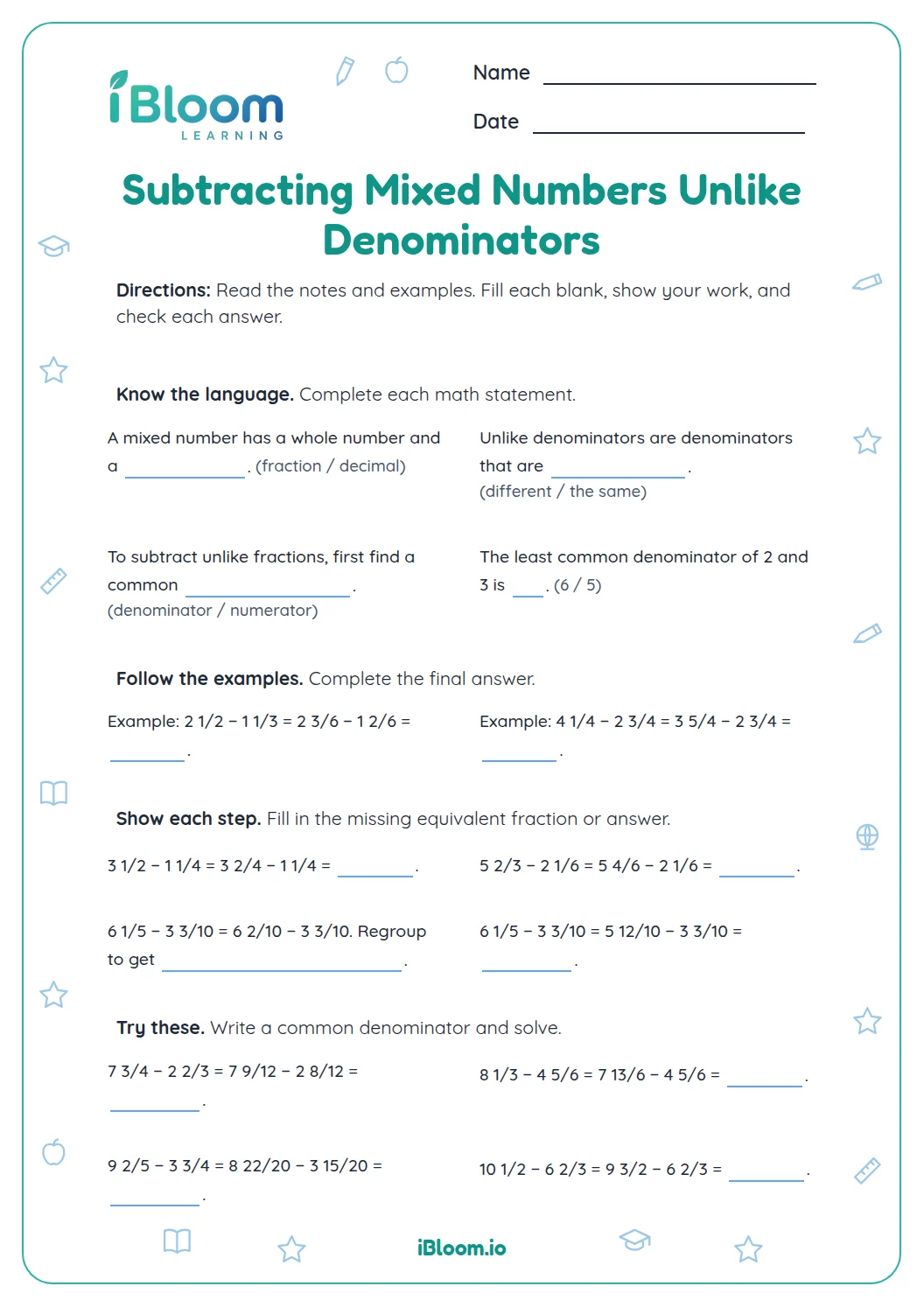
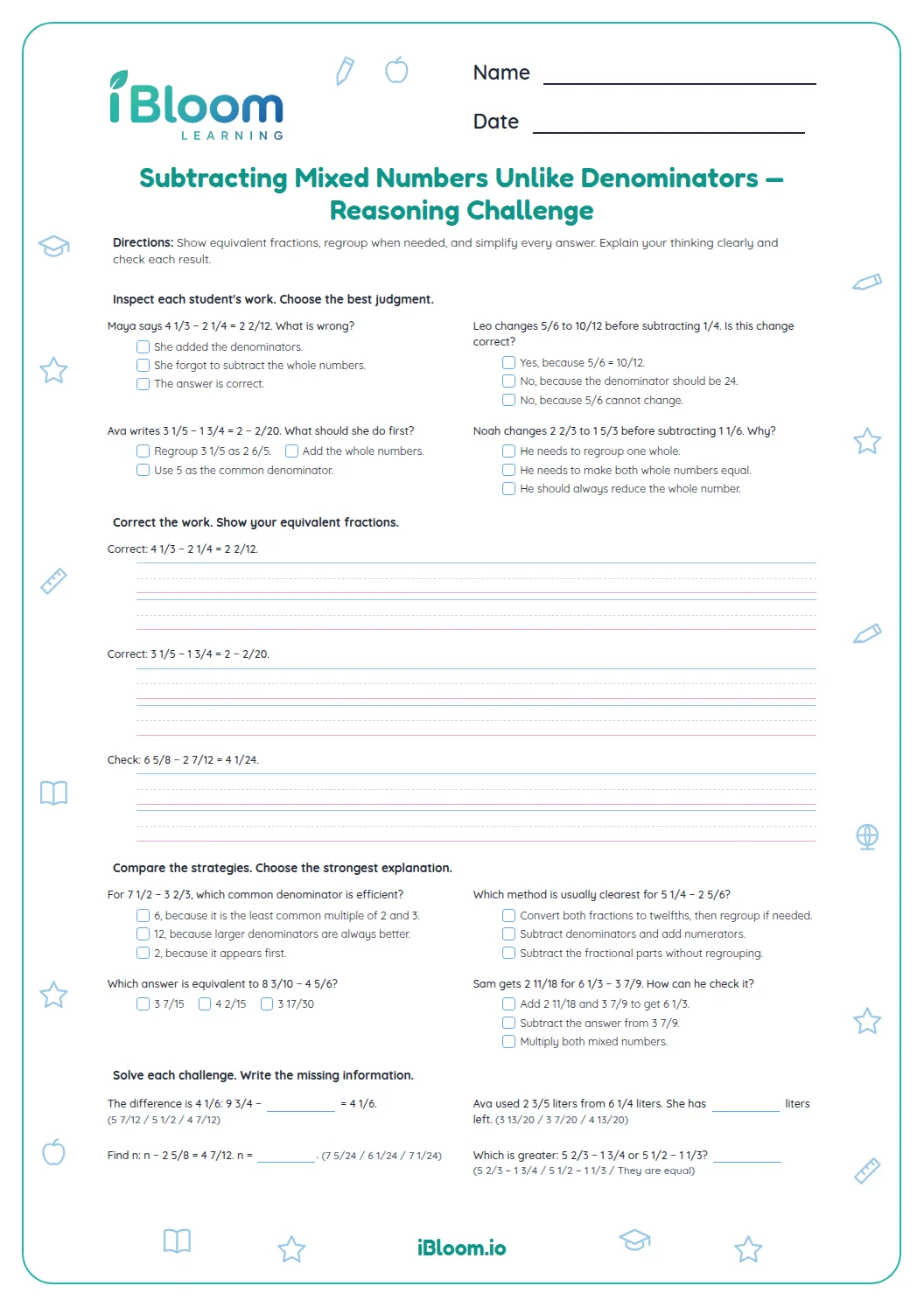
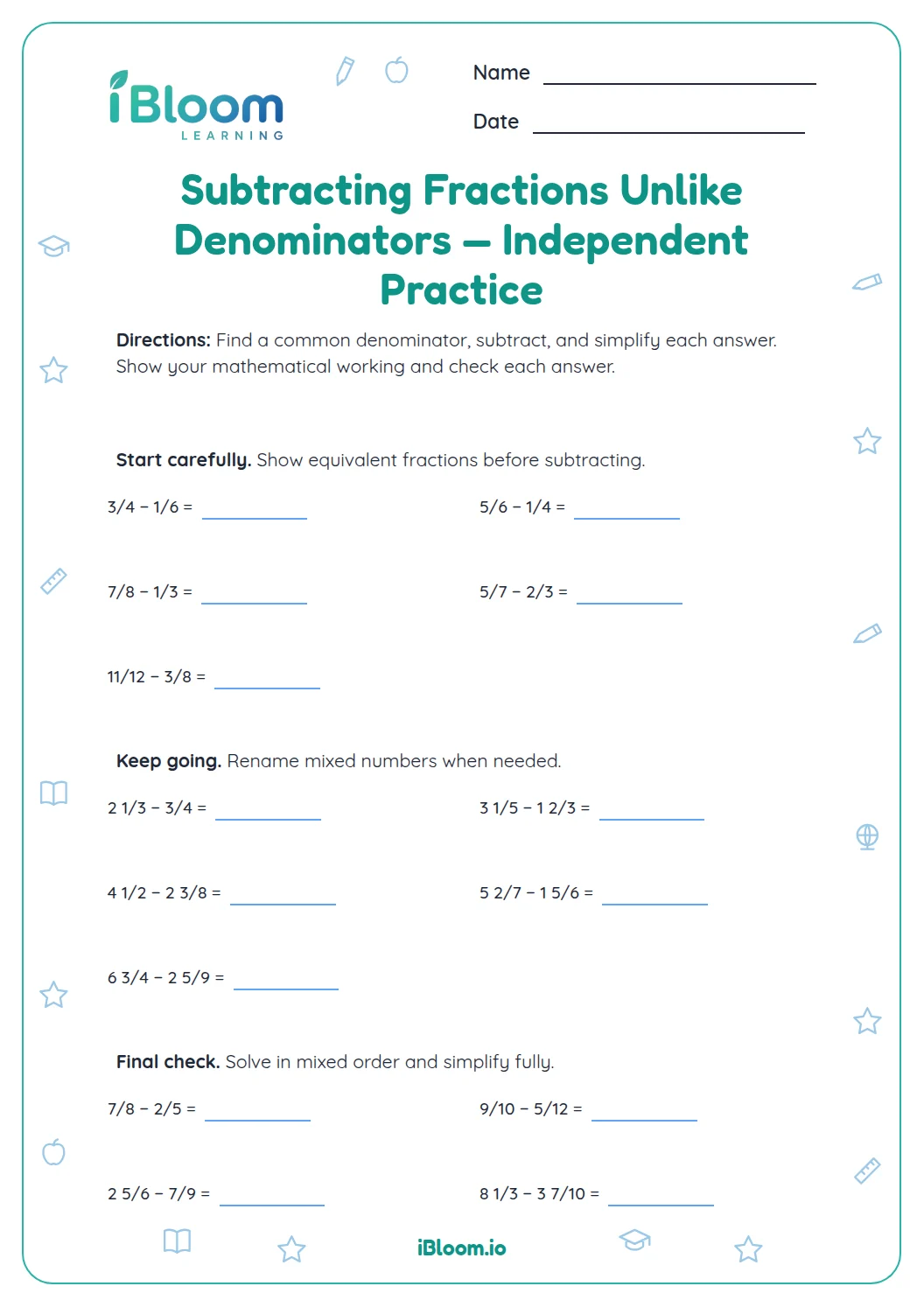
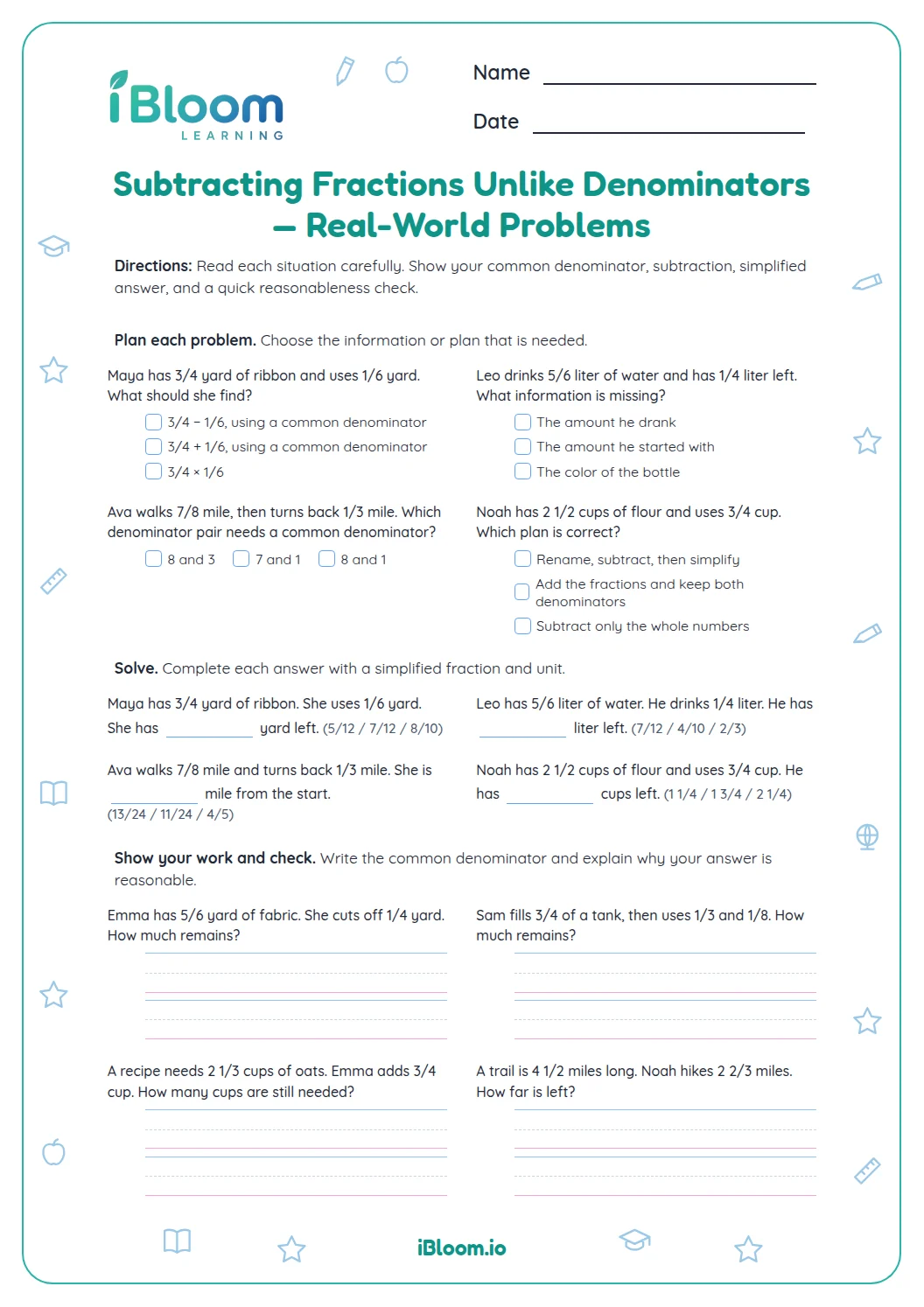
This free printable Grade 5 worksheet practices subtracting mixed numbers with unlike denominators through 14 questions in 3 parts. It includes direct practice, reasoning or checking, and application items, followed by a separate answer key.
Aligned to 5.NF.A.1 and 5.NF.A.2
How do you subtract mixed numbers with unlike denominators?
Find a common denominator so both fractional parts name equal-size pieces. Then subtract the fractions and whole numbers, regrouping a whole when the top fractional part is smaller.
Question 1 uses 3 1/2 − 1 2/7. Rename as 3 7/14 and 1 4/14; subtract to get 2 3/14.
- 13 1/2 − 1 2/7
- 23 7/14 − 1 4/14
- 32 3/14
How can you check a difference?
Add the answer to the subtrahend. The sum should equal the starting mixed number. This check catches borrowing and common-denominator errors.
What does the worksheet include?
Fourteen problems move from direct subtraction to checking and context. Four story problems state the quantities and units directly, and the answer key gives simplified results.
How can you use this worksheet?
- 1Find a common denominator for each pair.
- 2Regroup one whole when the fraction being subtracted is larger.
- 3Reduce each answer when possible.
- 4Check subtraction by adding the subtrahend back.
- 5For story problems, include the requested unit.
What mistakes should students check?
The mistake
Subtracting the whole numbers and leaving unlike fractional parts unchanged.
The fix
Rename both fractions with a common denominator before subtracting.
The mistake
Borrowing a whole but forgetting to convert it into denominator-sized pieces.
The fix
Rewrite one whole as n/n before subtracting the fraction parts.
The mistake
Adding numerators and denominators to make a new fraction.
The fix
Use equivalent fractions; subtract numerators only after denominators match.
Common Core alignment
Use equivalent fractions to subtract unlike-denominator fractions and mixed numbers.
On this sheet: Use equivalent fractions and regrouping to subtract mixed numbers.
Show the official wordingHide the official wording
Add and subtract fractions with unlike denominators (including mixed numbers) by replacing given fractions with equivalent fractions in such a way as to produce an equivalent sum or difference of fractions with like denominators.
Represent and solve fraction subtraction word problems with equations.
On this sheet: Solve the worksheet’s mixed-number subtraction stories with equations.
Show the official wordingHide the official wording
Solve word problems involving addition and subtraction of fractions referring to the same whole, including cases of unlike denominators, e.g., by using visual fraction models or equations to represent the problem.
What to practice next
Make more practice
Further reading
Questions parents and teachers ask
Why do the denominators need to match?
A denominator names the size of the fractional pieces. Rewrite both fractions as equivalent fractions with a common denominator, then subtract the numerators and whole-number parts. If the first fractional part is too small, regroup one whole into pieces of that denominator before subtracting.
What is 3 1/2 − 1 2/7?
The difference is 2 3/14. Rename 1/2 as 7/14 and 2/7 as 4/14, then subtract 3 7/14 − 1 4/14. Add 1 2/7 back to 2 3/14 to check that the sum is 3 1/2. This also confirms the subtraction by undoing it.
How can students check a difference?
Add the subtrahend to the proposed difference. The total should match the starting mixed number. This check can reveal a missed regrouping step or a denominator error; also reduce the fractional part when possible. Keep the common denominator in the fractional parts throughout the subtraction.
Are there word problems on this worksheet?
Yes. Four items describe a trail, ribbon, pitcher, or board. Each gives a starting amount and an amount removed, then asks for the remainder. The key gives the numerical result; use the unit in the question when reporting it.
What happens when regrouping is needed?
Trade one whole for fractional pieces with the common denominator. For example, one whole is 14/14 when working in fourteenths. Add those pieces to the starting fraction, subtract the fractional parts, and then subtract the whole-number parts. Regrouping preserves the starting amount while making equal-sized pieces available.