




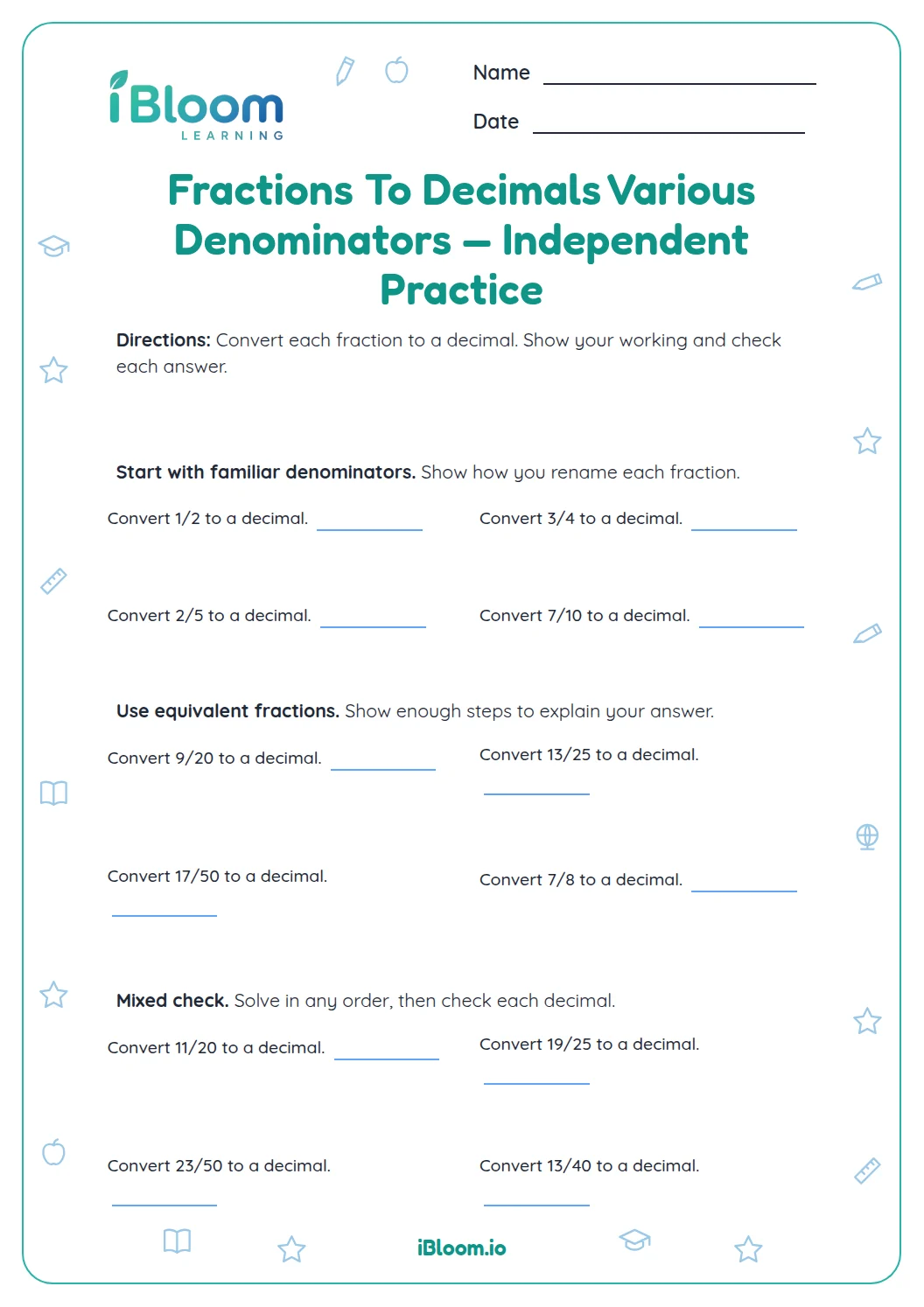
About this worksheet
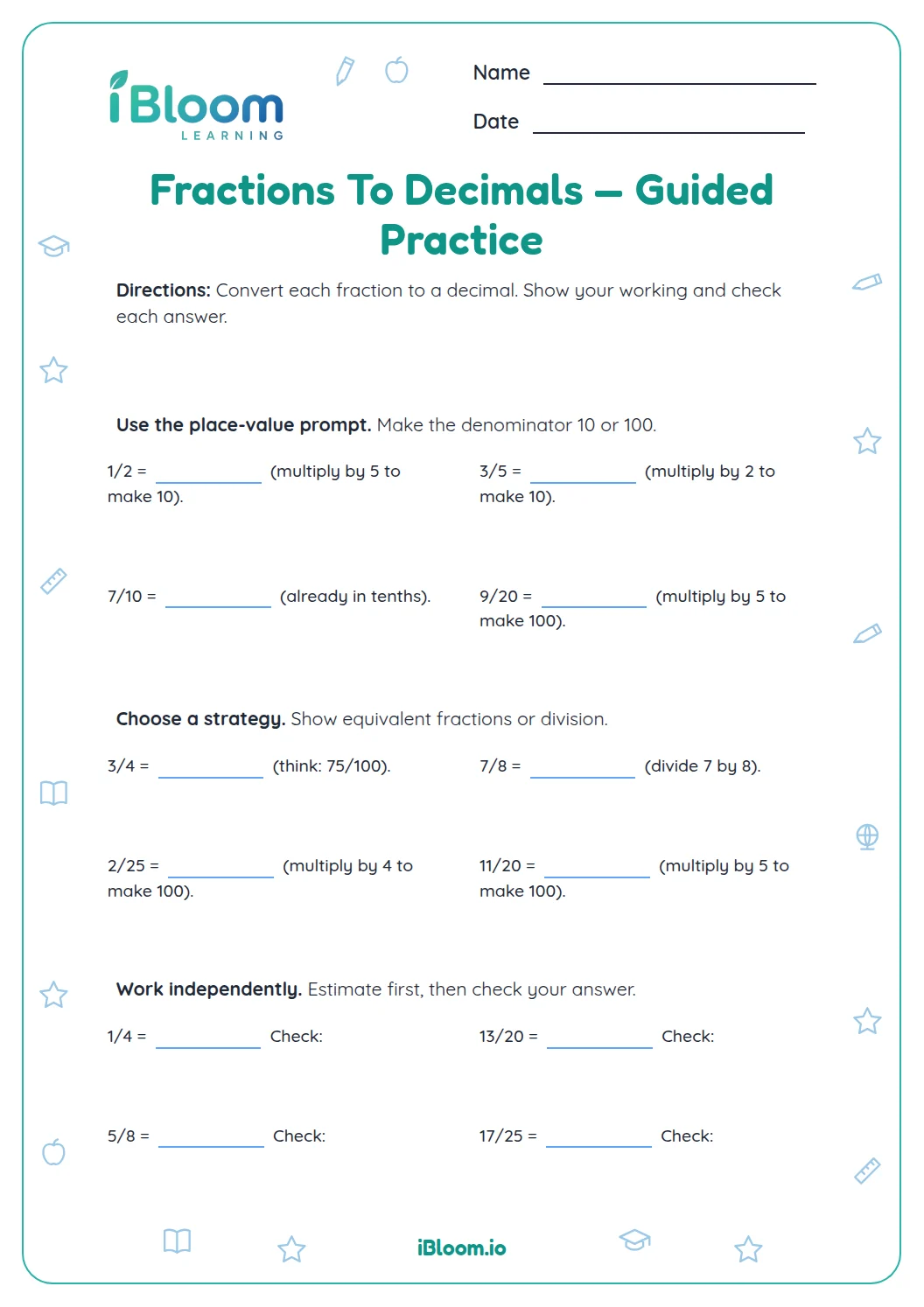
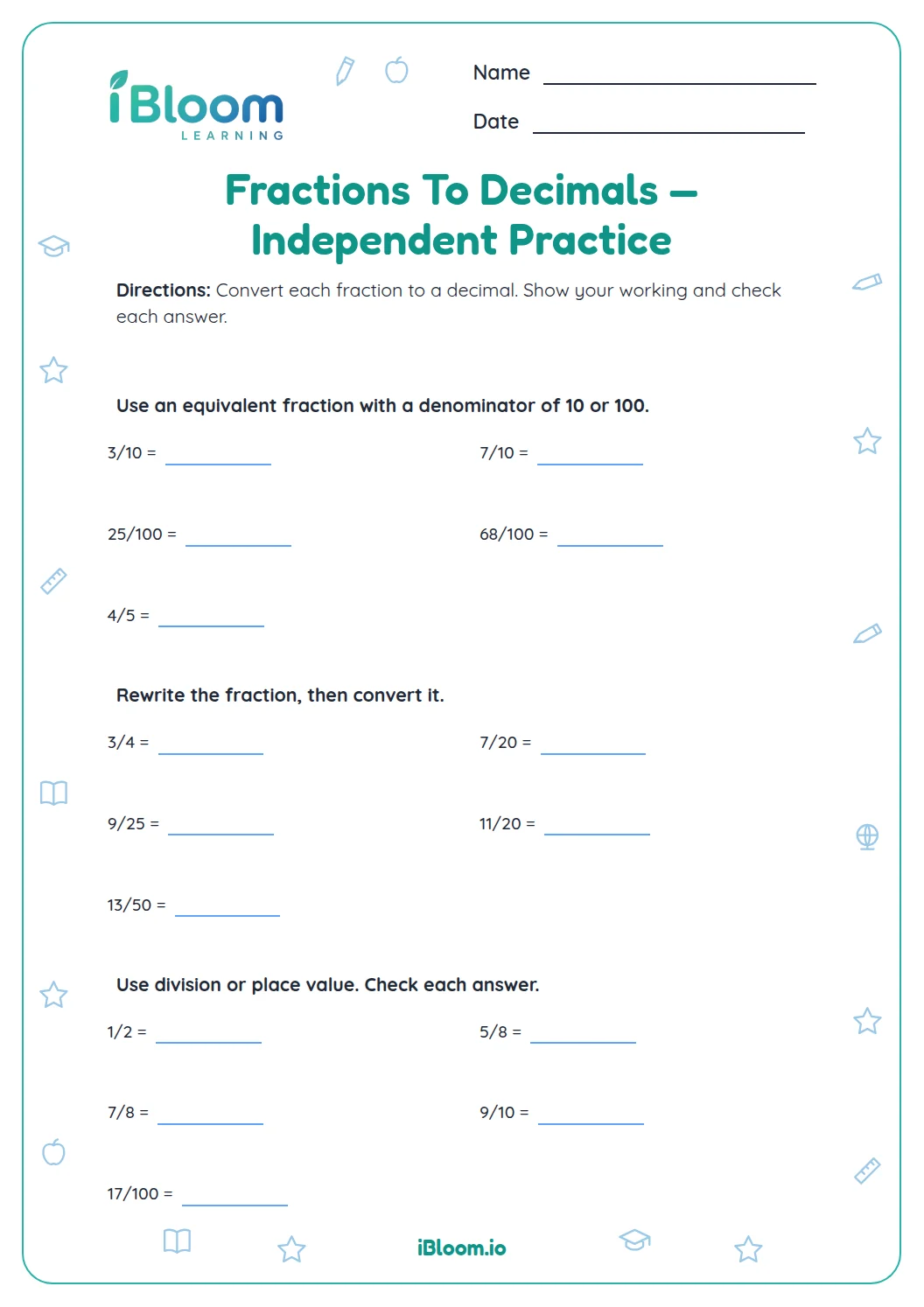
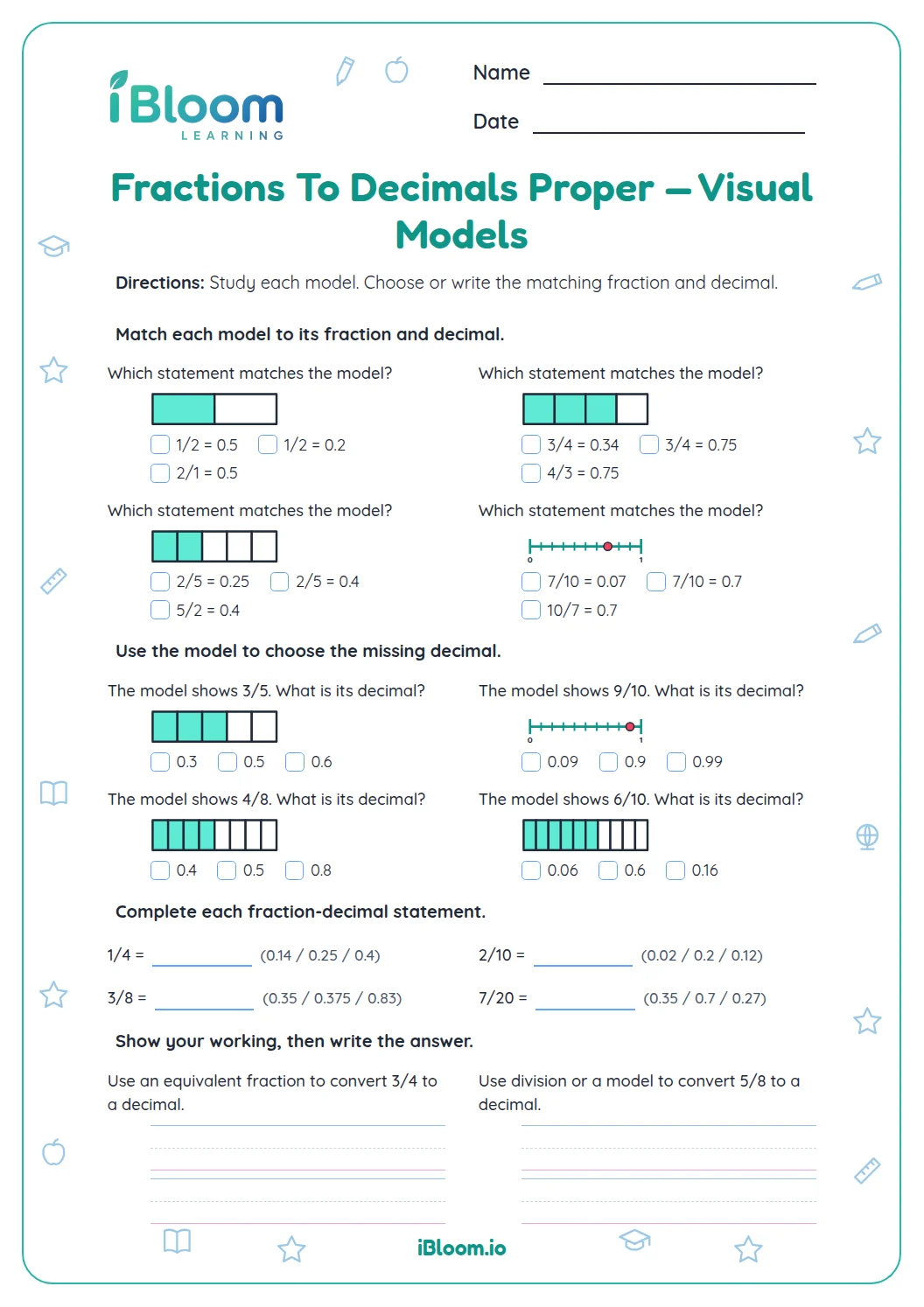
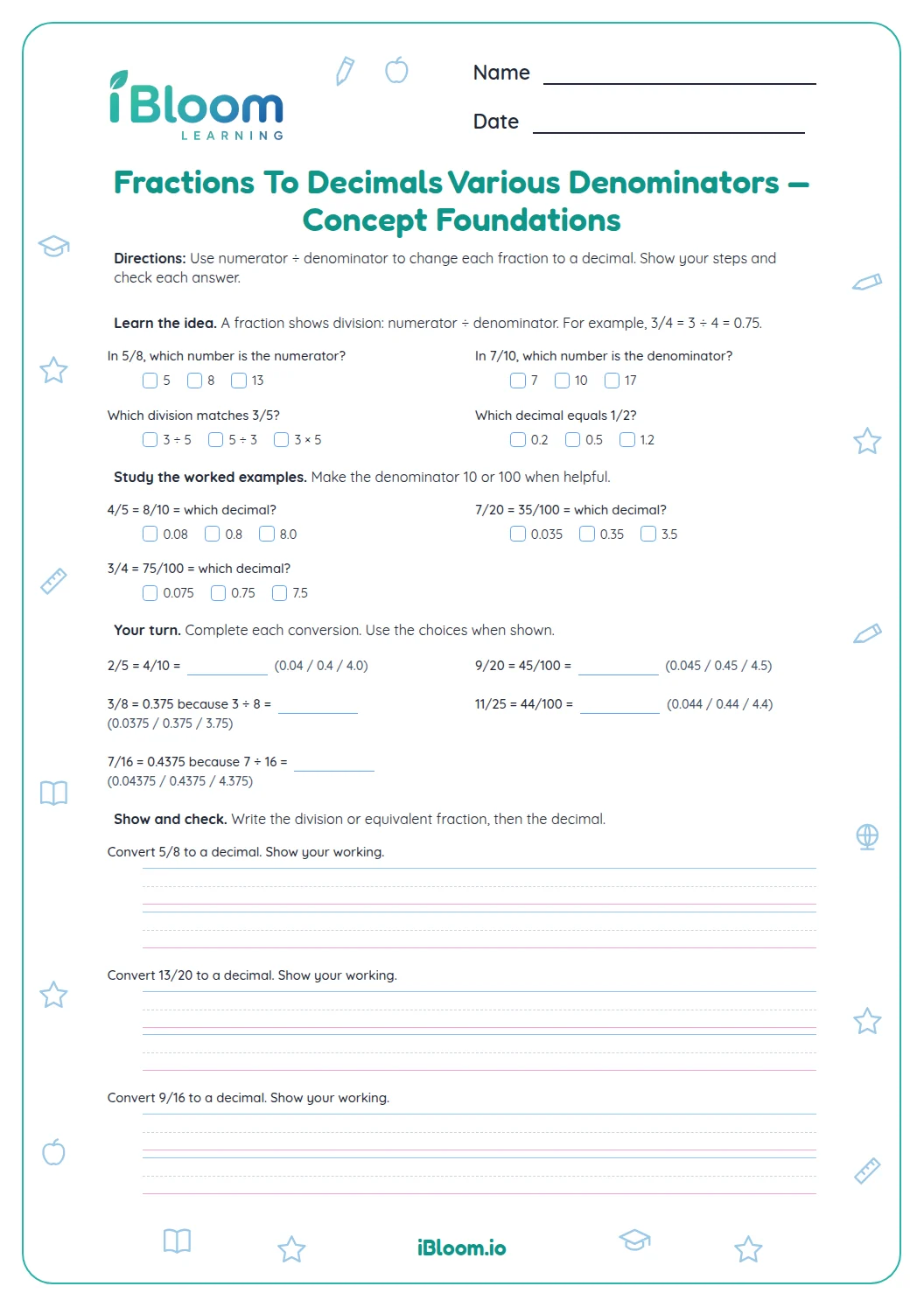
This Grade 5 worksheet practices converting fractions with repeating decimal forms. 14 questions guide students to divide, identify repeating cycles, and write a bar over the repeating digit or block. A separate answer key supports checking.
How can you solve one example?
To convert 1/3, divide 1 by 3. The quotient begins 0.333…, so the digit 3 repeats forever. A bar over the 3 is a compact way to show those continuing digits: 1/3 = 0.3̅.
- 11 ÷ 3 = 0.333… = 0.3̅
What will the practice ask you to do?
Convert fractions such as 1/3 and 5/6, identify repeating blocks, and explain how a repeat bar records the digits.
How can you check an answer?
Check that the result fits the size of the factors and that each answer matches the requested unit, fraction form or repeating cycle. Use the separate key after completing the page.
How can I use this worksheet?
- 1Read the direction at the start of each part.
- 2Write one answer for each prompt and keep its units or notation clear.
- 3Use a model, estimate or inverse operation to check the result.
- 4Compare completed work with the separate answer key.
What mistakes should students watch for?
The mistake
Writing only the first few decimal digits.
The fix
Continue the division until the remainder repeats.
The mistake
Putting the repeat bar over a nonrepeating digit.
The fix
Mark only the digit or group that repeats forever.
The mistake
Confusing a one-digit cycle with a two-digit cycle.
The fix
Track the remainder to see how many digits repeat before it returns.
What to practice next
Make more practice
Further reading
Questions parents and teachers ask
What does a bar over a decimal digit mean?
The bar means that the digit or group of digits repeats without ending. For example, 0.3̅ means 0.333…, while 0.1̅8̅ means 0.181818… with the block 18 repeating. The prompts and key use the same bar convention. The bar can cover one digit, as in 0.3̅, or a group, as in 0.1̅8̅. This avoids writing an endless string of digits.
How many questions are on the guided practice page?
There are 14 questions in three parts. Students first convert fractions, then identify matching fractions and repeating patterns, and finally correct notation or explain a decimal. A separate answer key provides the conversions and explanation models. The 15 items move from conversions to recognizing digit blocks and explaining notation. The answer key is a separate page for checking after students finish.
Does every fraction make a repeating decimal?
No. Some fractions terminate, such as 3/8 = 0.375, while others repeat, such as 1/3 = 0.333…. The worksheet includes a question that asks students to distinguish a terminating decimal from a repeating one. For example, 3/8 divides evenly to 0.375, while 1/3 continues as 0.333…. The denominator affects whether the decimal ends or repeats.
Why does 1/6 equal 0.16̅?
Dividing 1 by 6 gives 0.1666… . The 1 appears once in the tenths place, then the digit 6 repeats. Therefore the bar belongs over 6 only, not over both digits. Dividing 1 by 6 produces 0.1666… . Only the 6 continues, so put the bar over the 6 and leave the first decimal digit unbarred.