




About this worksheet
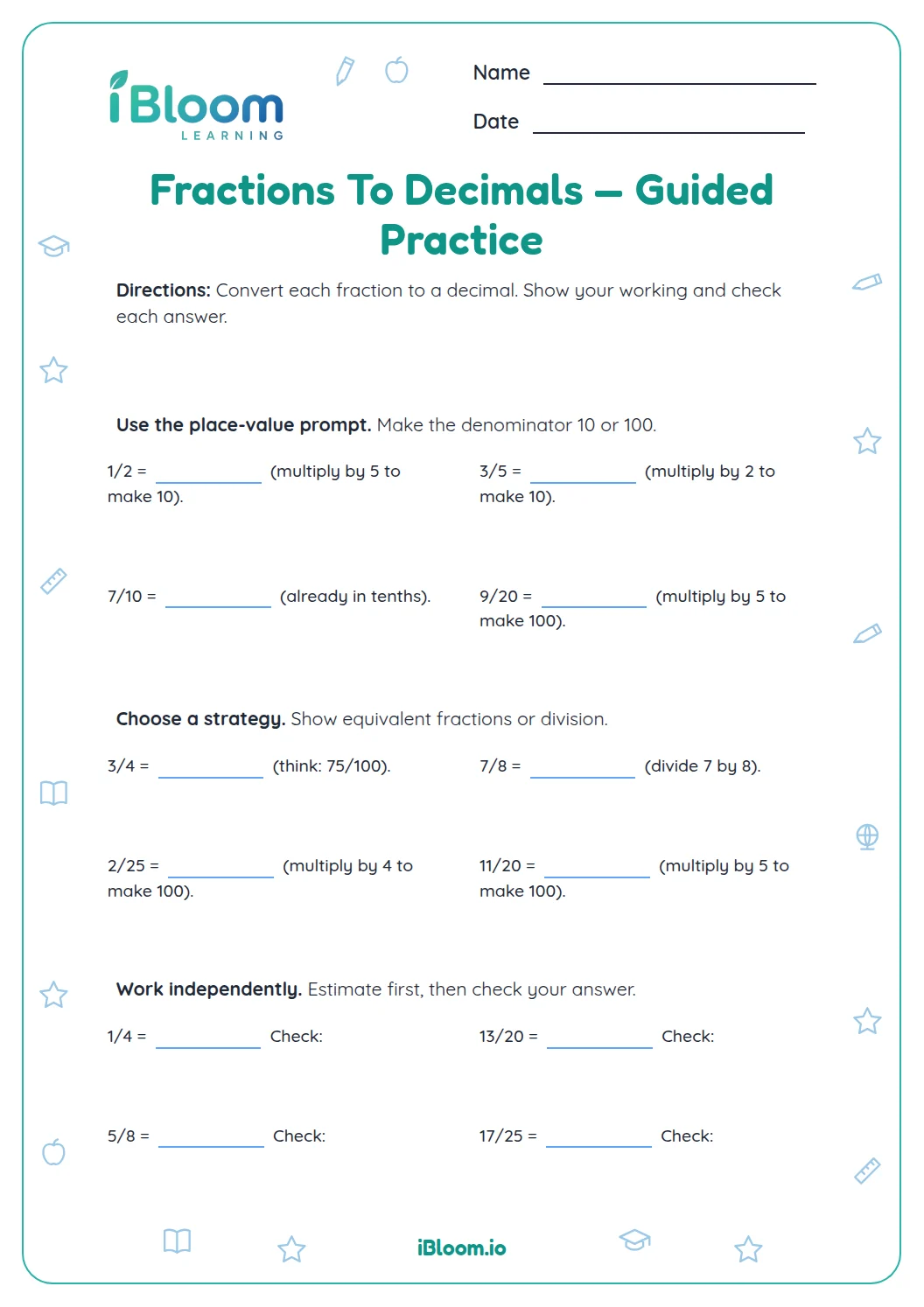
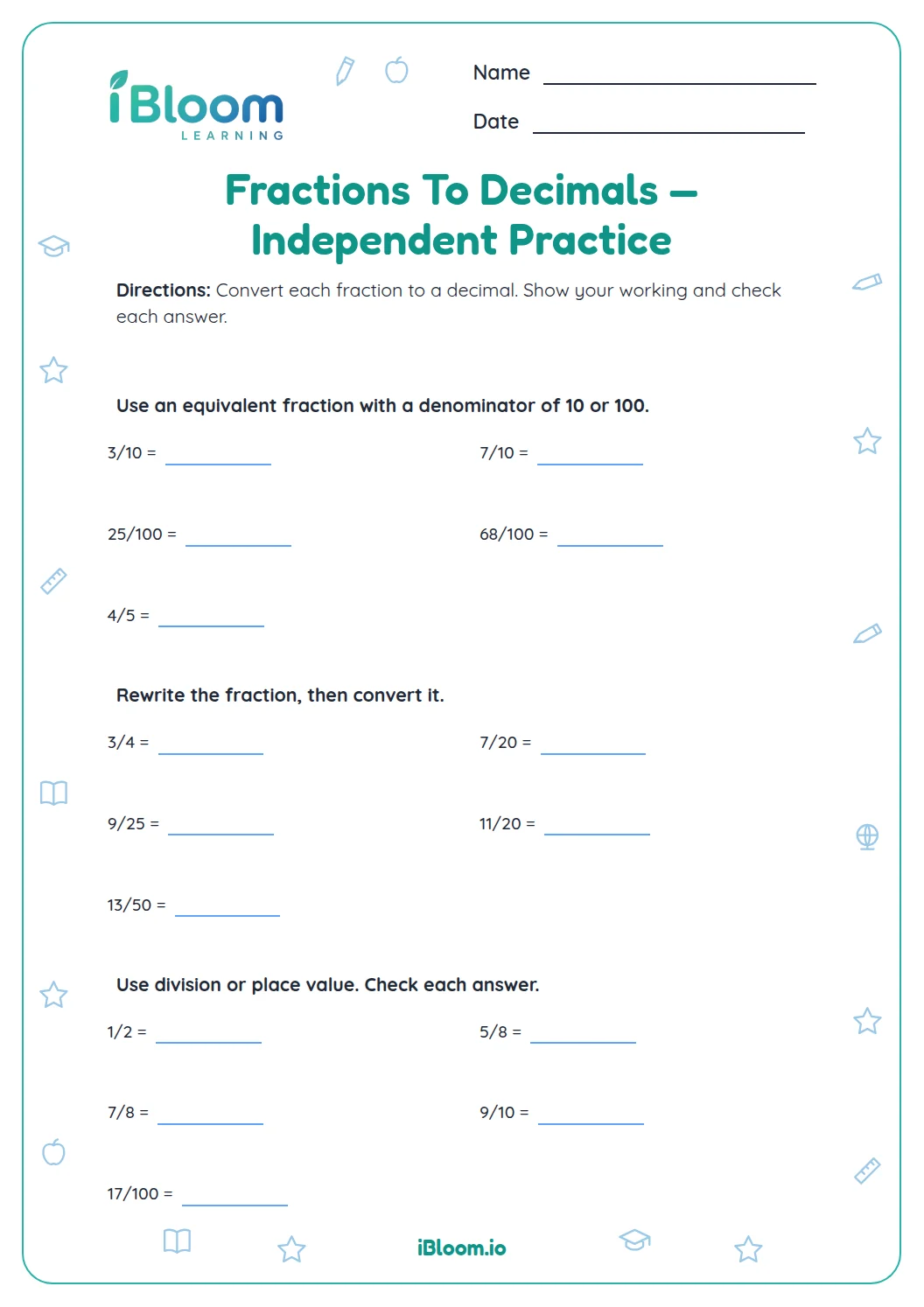
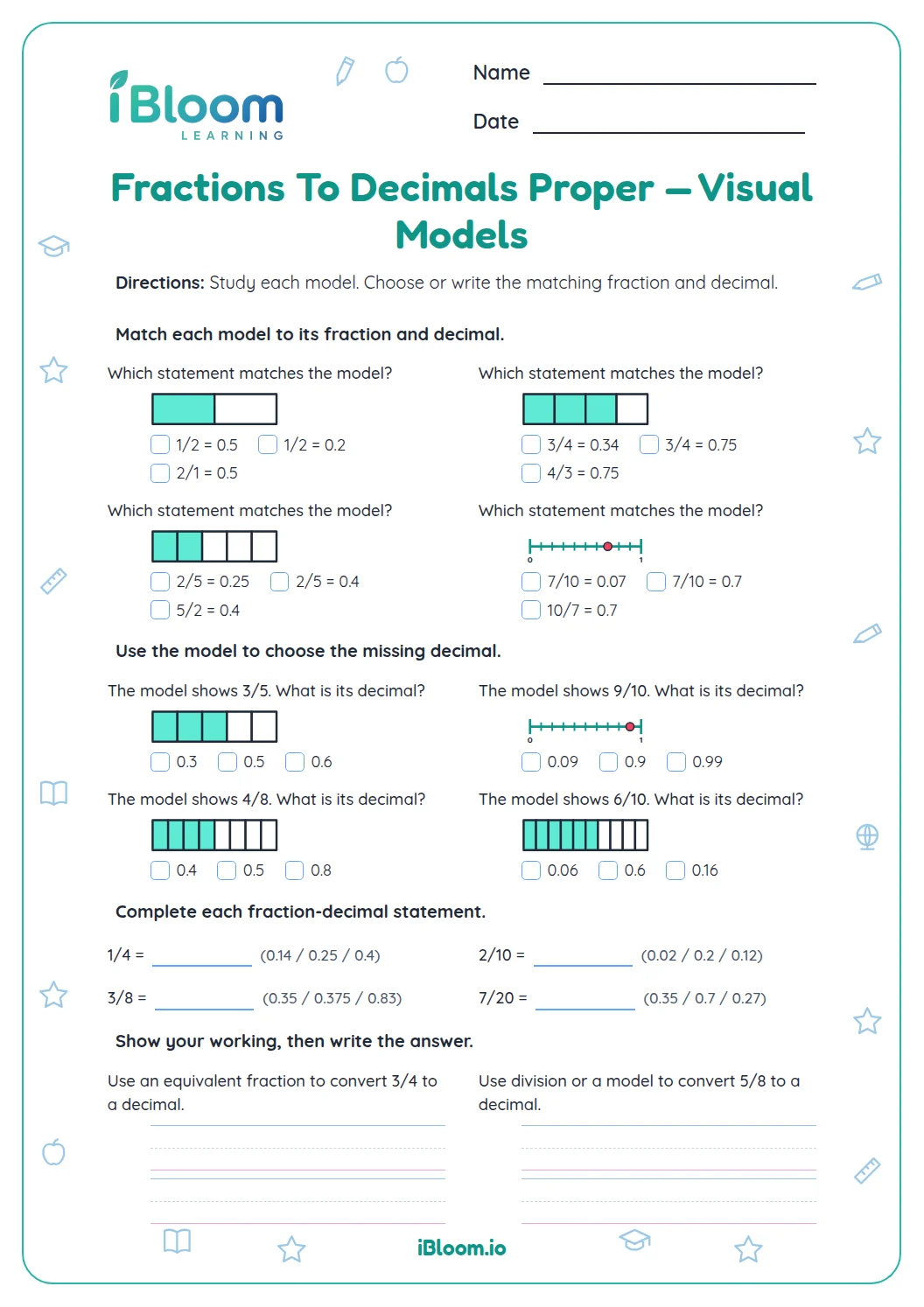
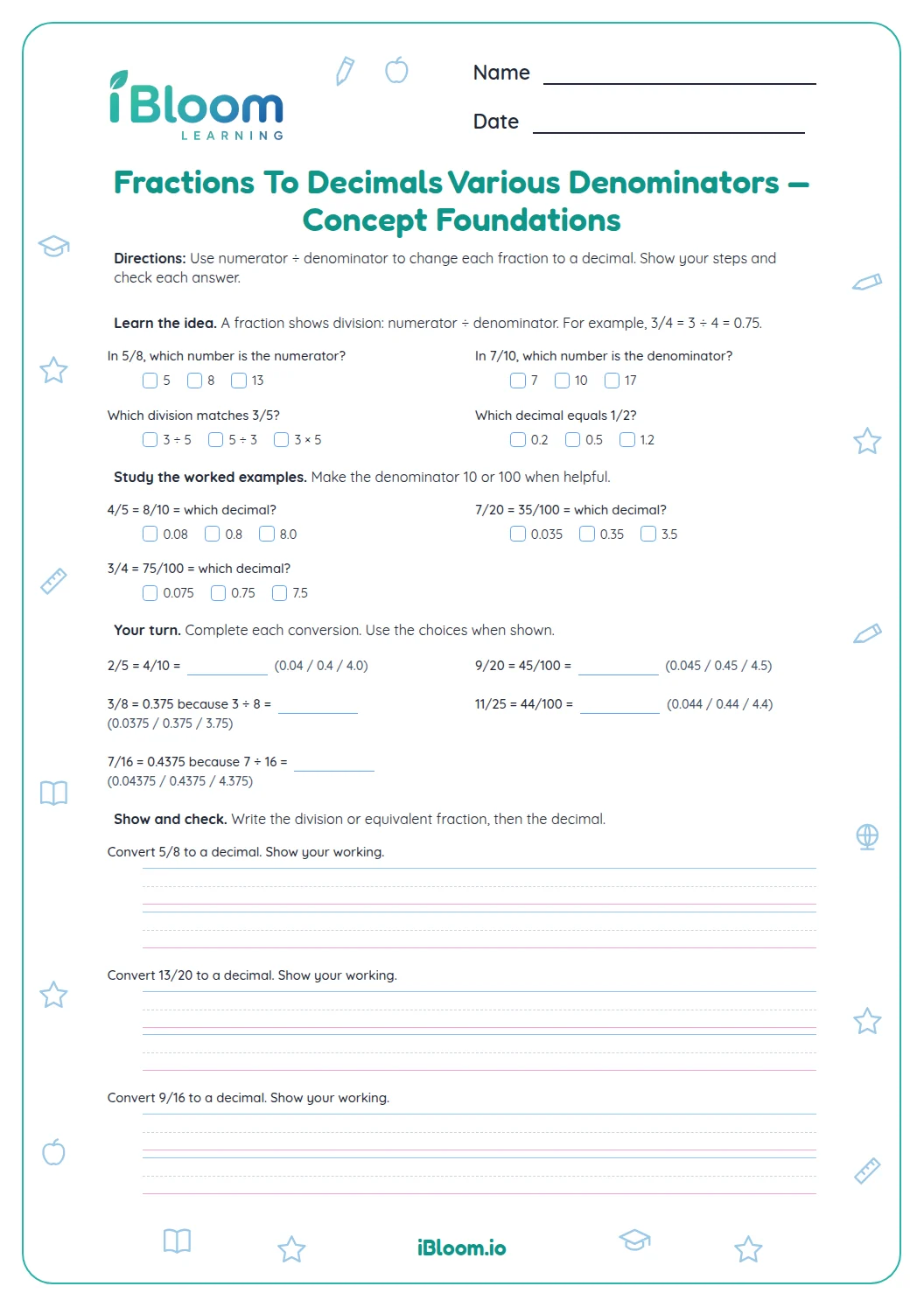
This Grade 5 worksheet connects shaded fraction models to repeating decimals. 13 questions ask students to read shaded parts, identify repeating patterns, and write decimal forms with a repeat bar. A separate answer key supports checking.
How can you solve one example?
The bar model has 9 equal parts and 7 shaded, so it represents 7/9. Dividing 7 by 9 gives 0.777…, where 7 repeats. A bar over the repeating digit records this pattern as 0.7̅.
- 17/9 = 0.777… = 0.7̅
What will the practice ask you to do?
Shade models make the fraction visible before students connect it to a decimal and mark the repeating digit or block.
How can you check an answer?
Check that the result fits the size of the factors and that each answer matches the requested unit, fraction form or repeating cycle. Use the separate key after completing the page.
How can I use this worksheet?
- 1Read the direction at the start of each part.
- 2Write one answer for each prompt and keep its units or notation clear.
- 3Use a model, estimate or inverse operation to check the result.
- 4Compare completed work with the separate answer key.
What mistakes should students watch for?
The mistake
Using the shaded count as the denominator.
The fix
Count all equal parts for the denominator and shaded parts for the numerator.
The mistake
Writing a terminating decimal for a repeating fraction.
The fix
Continue division until the remainder repeats, then mark its cycle.
The mistake
Putting the repeat bar over only part of a repeating block.
The fix
Mark every digit that repeats in the cycle.
What to practice next
Make more practice
Further reading
Questions parents and teachers ask
How many visual-model questions are included?
Count equal sections for the denominator and shaded sections for the numerator. Then divide to find the decimal. Bars, circles and squares display the same fraction idea in different ways, and each drawing supplies the numbers the student needs to interpret.
What does a model with 7 of 9 parts shaded represent?
It represents 7/9. Dividing 7 by 9 gives 0.777…, so the decimal can be written 0.7̅ with a bar over the repeating 7. The worksheet uses this same conversion in a model question. Dividing 7 by 9 gives 0.777…, so the repeating 7 is written 0.7̅. The shaded model makes the fraction’s numerator and denominator visible.
How does the repeat bar appear in the answer key?
The answer key places a bar above exactly the repeating digit or block. For 0.4̅5̅, both digits repeat together as 45. This notation avoids an endless string of digits and lets students see whether one digit or a pair repeats.
Why are circles, bars and squares used?
Each shape has equal parts, and shading shows the numerator. Students count total parts for the denominator, then connect the fraction to a decimal by division. The mix of model outlines reinforces the same reasoning across visual forms.