



About this worksheet
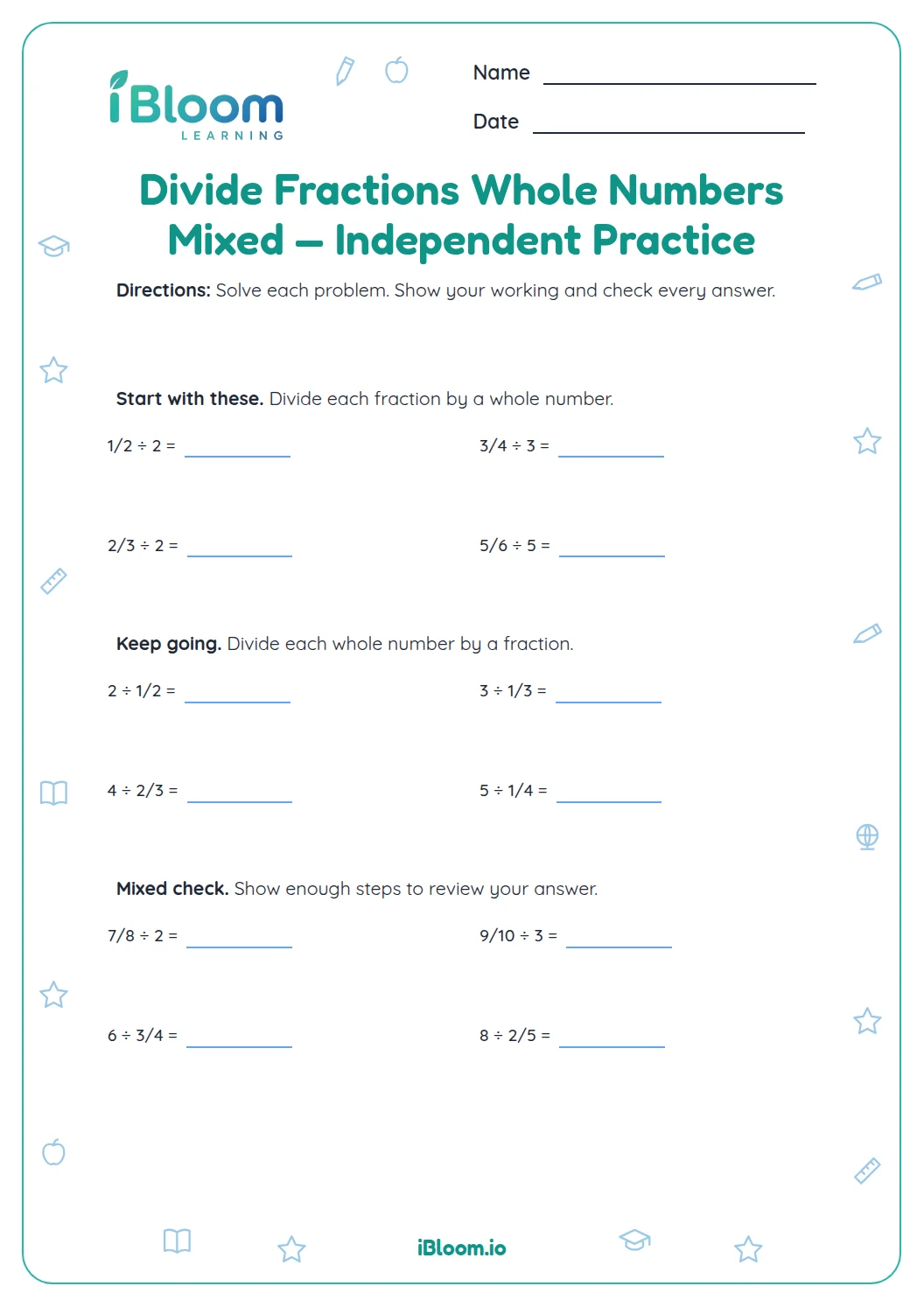
This Grade 5 worksheet practices dividing a fraction by a whole number. Students solve direct quotients, check selected answers by multiplying, and use division in equal-sharing situations. For example, 3/4 ÷ 3 = 1/4 because three shares of 1/4 make 3/4.
Aligned to 5.NF.B.7
How do you divide a fraction by a whole number?
To divide a fraction by a whole number, split the fraction into that many equal shares. For 3/4 ÷ 3, each share is 1/4.
Use the reverse operation to check: 1/4 × 3 = 3/4.
- 13/4 ÷ 3 = 1/4
- 2Check: 1/4 × 3 = 3/4
How does multiplication check a quotient?
Multiply the quotient by the divisor. The product should equal the starting fraction. Part B provides one space for the quotient and a separate check space.
What will students practice?
The 16 problems progress from six exact quotients to five multiplication checks and five situations about equal sharing. The word problems use fractions of a liter, pan, meter, pound and yard.
- Part A: six direct quotients
- Part B: five quotients with a separate multiplication check
- Part C: five equal-sharing word problems
What should a student notice about the answer?
Dividing a positive fraction by a whole number greater than 1 makes a smaller amount. Estimation can catch a quotient that is too large before the multiplication check confirms the exact value.
How to use this worksheet at home or in class
- 1Review that division means equal shares before beginning Part A.
- 2Model 3/4 ÷ 3 by splitting three fourths into three equal parts.
- 3Have the student estimate whether a quotient should be smaller than the starting fraction.
- 4In Part B, keep the quotient and multiplication check in their separate spaces.
- 5For Part C, write a division equation before solving.
Common mistakes and quick fixes
The mistake
Dividing only the numerator when it does not divide evenly.
The fix
Keep the numerator and multiply the denominator by the divisor.
The mistake
Making the quotient larger than the starting fraction.
The fix
Use the equal-share meaning: splitting into more than one group makes each share smaller.
The mistake
Checking with division again instead of the inverse operation.
The fix
Multiply quotient × divisor and compare it with the starting fraction.
Common Core alignment
This worksheet practices the following Common Core mathematics standard.
Apply and extend previous understandings of division to divide unit fractions and whole numbers.
On this sheet: The questions divide fractions by whole numbers and interpret quotients as equal shares.
Show the official wordingHide the official wording
Apply and extend previous understandings of division to divide unit fractions by whole numbers and whole numbers by unit fractions.
What to practice next
Make more practice
Further reading
Questions parents and teachers ask
How do students divide a fraction by a whole number?
Split the fraction into equal shares. For example, 3/4 ÷ 3 = 1/4 because three shares of 1/4 make 3/4. The first part starts with direct quotient problems before students apply the same equal-share idea in word problems. This guide also reminds learners to estimate whether an answer is sensible.
How can a student check a quotient?
Multiply the quotient by the whole-number divisor. The product should equal the starting fraction: 1/4 × 3 = 3/4. Part B gives the quotient and check separate spaces so students can record both steps clearly and compare the product with the original amount.
Why is a quotient smaller than the fraction being divided?
When a positive amount is split into more than one equal share, each share is smaller than the whole amount. For example, each of three shares of 3/4 is 1/4. Students can use this estimate before checking with multiplication. This guide also reminds learners to estimate whether an answer is sensible.
What does Part B ask students to do?
Part B includes five fraction-division problems. Students write each quotient, then check it by multiplying the quotient by the divisor and comparing the result with the original fraction. This reinforces the inverse relationship between division and multiplication. This reverse-operation check confirms that the quotient multiplied by its divisor returns the original fraction.
How many questions are included?
There are 16 questions in three parts: six direct quotients, five quotient checks, and five equal-sharing word problems. The last part uses contexts involving fractional amounts of liters, pans, ribbon, trail mix, and yards. The quantities include fractional portions of common measures, so students state each quotient in the matching context and unit.