




About this worksheet
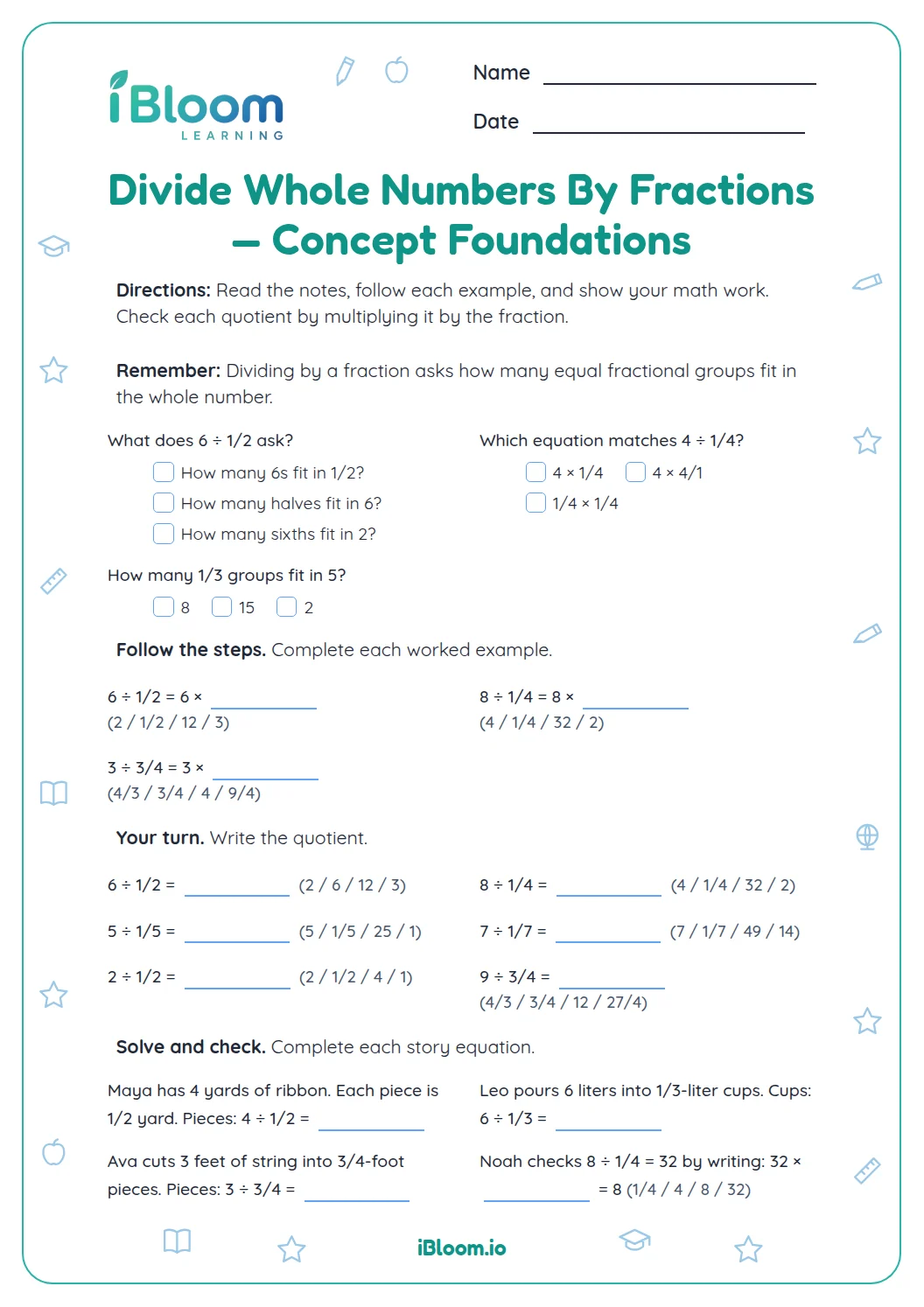
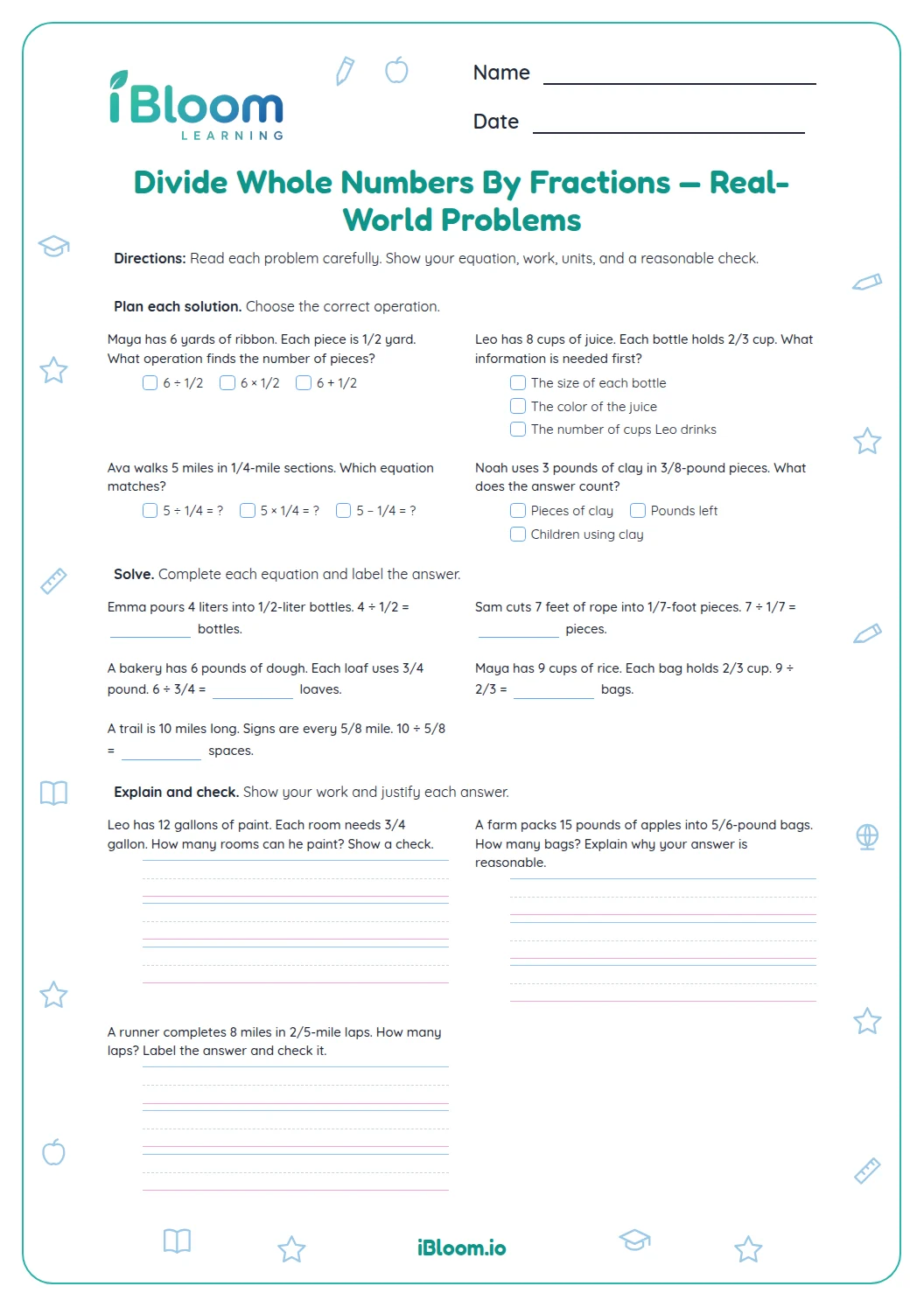
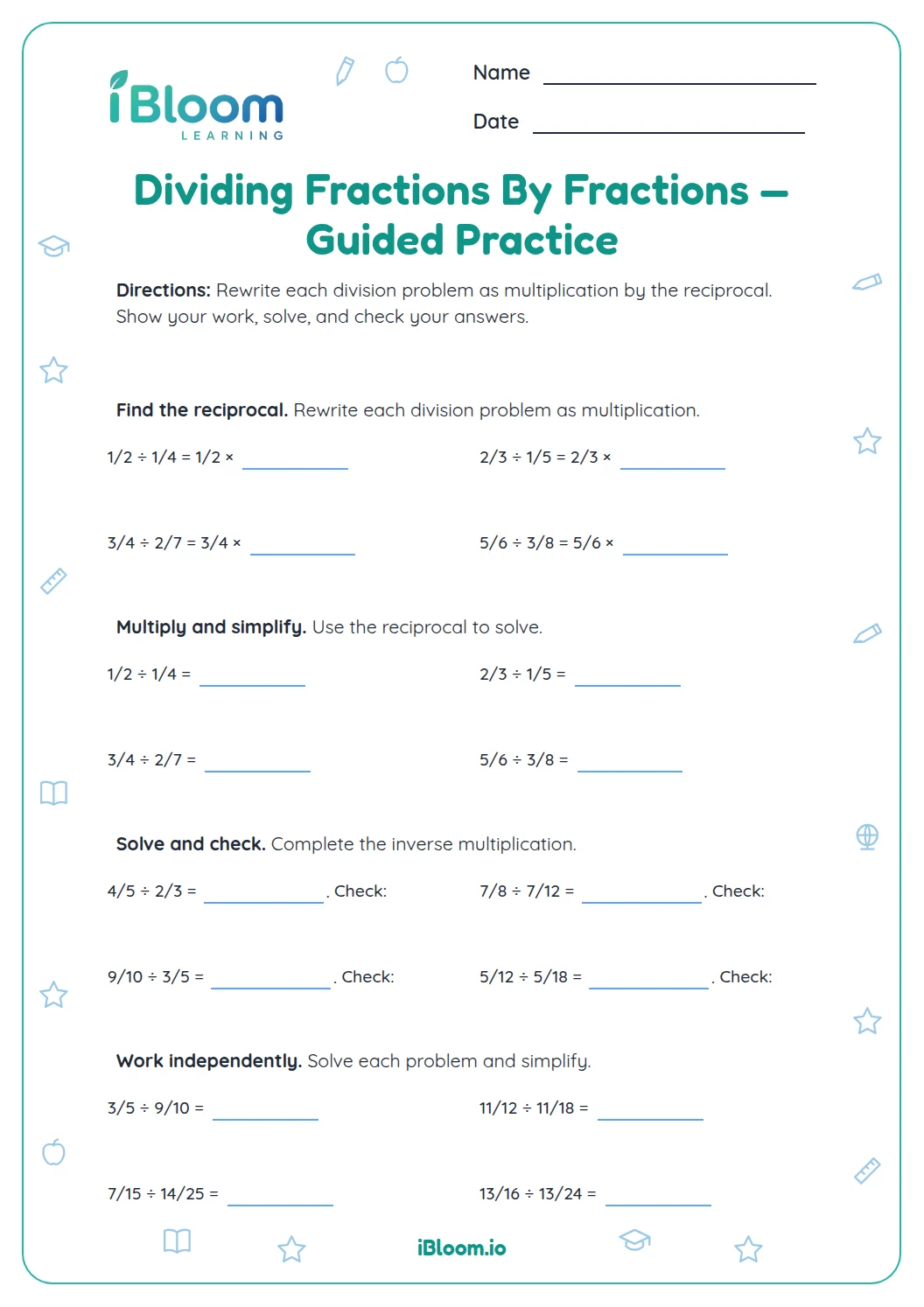
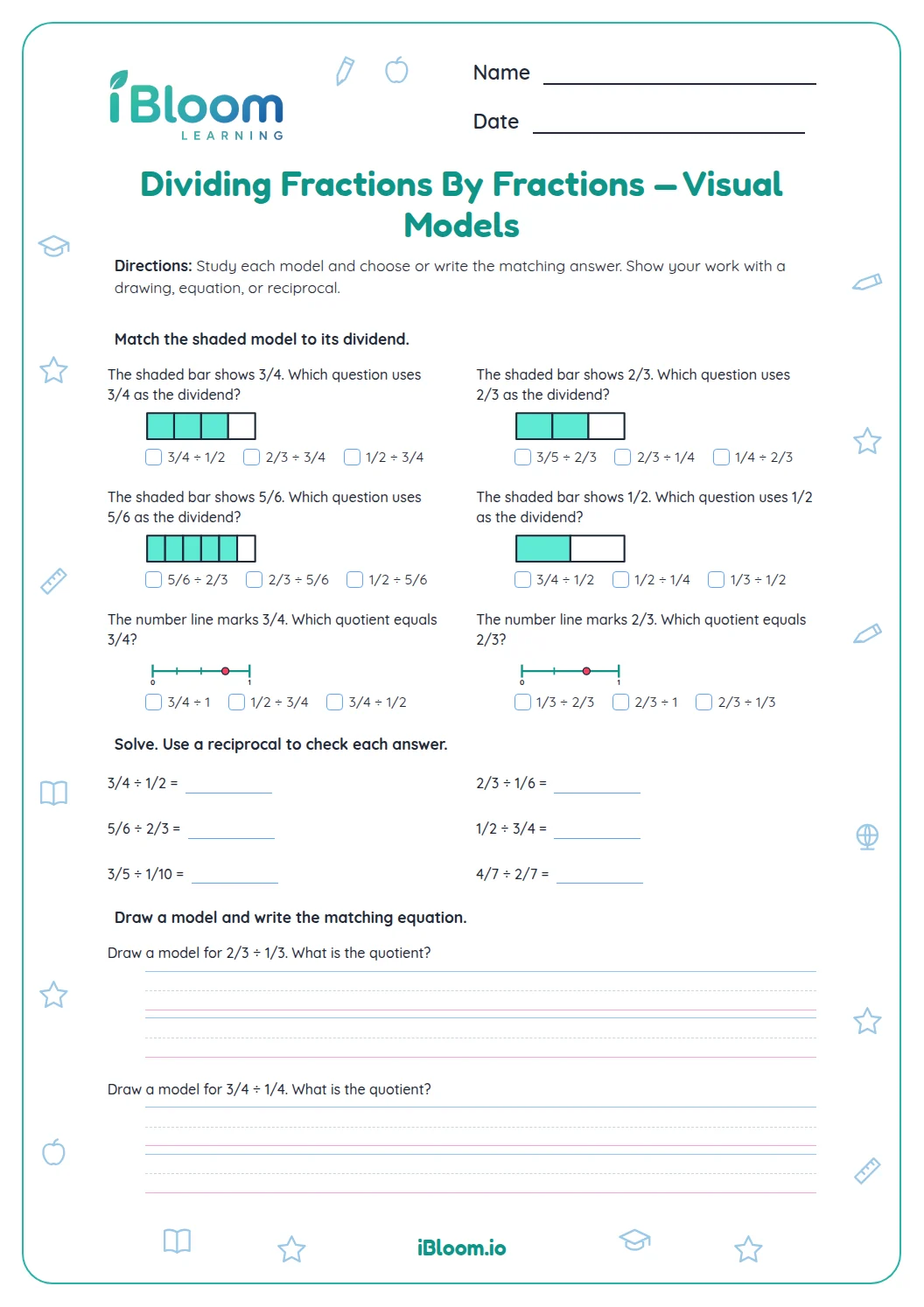
This free printable Grade 5 worksheet practices dividing whole numbers by unit fractions through 18 questions in 5 parts. It includes direct practice, reasoning or checking, and application items, followed by a separate answer key.
Aligned to 5.NF.B.7
What does a whole number divided by a unit fraction ask?
It asks how many pieces of size 1/n fit in the whole number. Each whole contains n pieces of size 1/n, so multiply the whole number by n.
For 4 ÷ 1/2, four wholes contain eight halves. The quotient is 8.
- 14 ÷ 1/2
- 24 × 2 = 8
- 3There are 8 halves in 4 wholes.
How can multiplication check the quotient?
Multiply the quotient by the unit fraction. The product should equal the starting whole number: 8 × 1/2 = 4.
What practice is on the worksheet?
18 questions include direct quotients, multiplication checks, a bottle-filling story, and an explanation of a common divisor-versus-unit-fraction error. Each equation has a complete prompt and key answer.
How can you use this worksheet?
- 1Read 1/n as one piece of size 1/n.
- 2Find how many of those pieces fit in one whole.
- 3Multiply that count by the number of wholes.
- 4Fill both blanks in each multiplication check: quotient × unit fraction = dividend.
- 5Use the story context to label the quotient.
What mistakes should students check?
The mistake
Dividing by the denominator instead of counting unit-fraction pieces.
The fix
Ask how many halves, thirds, or fourths fit into each whole; multiply by that count.
The mistake
Assuming division always makes a number smaller.
The fix
A unit fraction is less than one, so many small pieces fit into the whole number.
The mistake
Leaving a guided multiplication check unfinished.
The fix
Use the quotient and unit-fraction size to verify that their product is the original whole number.
Common Core alignment
Interpret and solve whole-number division by unit fractions.
On this sheet: Use division to determine how many fraction-sized groups fit in a quantity.
Show the official wordingHide the official wording
Apply and extend previous understandings of division to divide unit fractions by whole numbers and whole numbers by unit fractions.
What to practice next
Make more practice
Further reading
Questions parents and teachers ask
What does 6 ÷ 1/3 mean?
It asks how many one-third pieces fit in 6 wholes. Each whole contains 3 thirds, so 6 wholes contain 6 × 3 = 18 thirds. Therefore, 6 ÷ 1/3 = 18. The quotient counts pieces, so it can be larger than the dividend.
Why is 4 ÷ 1/2 greater than 4?
Dividing by one-half counts half-size pieces in four wholes. Each whole contains two halves, so four wholes contain eight halves. Thus, 4 ÷ 1/2 = 8; the quotient counts pieces rather than the number of wholes. This is the same relationship used to check the guided multiplication equations on the page.
How do you check a quotient?
Multiply the quotient by the unit fraction. For example, 8 × 1/2 = 4 checks 4 ÷ 1/2 = 8. The product should return the original whole number, confirming the number of equal-size pieces. That count is the quotient because every half is one equal-size piece.
What mistake does question 18 address?
It addresses dividing by the denominator as if the expression were 8 ÷ 4. Instead, 8 ÷ 1/4 asks how many fourths are in 8. There are 8 × 4 = 32 fourths, so the quotient is 32.
What is in the answer key?
The key gives all 18 quotients, completes four multiplication checks, labels the bottle story with its unit, and explains why counting fourths in eight wholes gives 32. The repeated blanks in each check take the same quotient value.